fluid Ram 1500 2018 User Guide
[x] Cancel search | Manufacturer: RAM, Model Year: 2018, Model line: 1500, Model: Ram 1500 2018Pages: 700, PDF Size: 8.86 MB
Page 313 of 700
During cold temperatures, transmission operation may be
modified depending on engine and transmission tempera-
ture as well as vehicle speed. This feature improves warm
up time of the engine and transmission to achieve maxi-
mum efficiency. Engagement of both the torque converter
clutch and the top overdrive gear are inhibited until the
transmission fluid is warm (refer to the “Note” under
“Torque Converter Clutch” in this section). During ex-
tremely cold temperatures (-16°F [-27°C] or below), opera-
tion may briefly be limited to first and direct gears only.
Normal operation will resume once the transmission tem-
perature has risen to a suitable level.
Transmission Limp Home Mode
Transmission function is monitored electronically for ab-
normal conditions. If a condition is detected that could
result in transmission damage, Transmission Limp Home
Mode is activated. In this mode, the transmission remains
in direct gear regardless of which forward gear is selected.
PARK, REVERSE, and NEUTRAL will continue to operate.
The Malfunction Indicator Light (MIL) may be illuminated.
Limp Home Mode allows the vehicle to be driven to an
authorized dealer for service without damaging the trans-
mission.In the event of a momentary problem, the transmission can
be reset to regain all forward gears by performing the
following steps:
1. Stop the vehicle.
2. Shift the transmission into PARK.
3. Turn the ignition OFF.
4. Wait approximately 10 seconds.
5. Restart the engine.
6. Shift into the desired gear range. If the problem is no
longer detected, the transmission will return to normal
operation.
NOTE: Even if the transmission can be reset, we recom-
mend that you visit your authorized dealer at your earliest
possible convenience. Your authorized dealer has diagnos-
tic equipment to assess the condition of your transmission.
If the transmission cannot be reset, authorized dealer
service is required.
6
STARTING AND OPERATING 311
Page 315 of 700
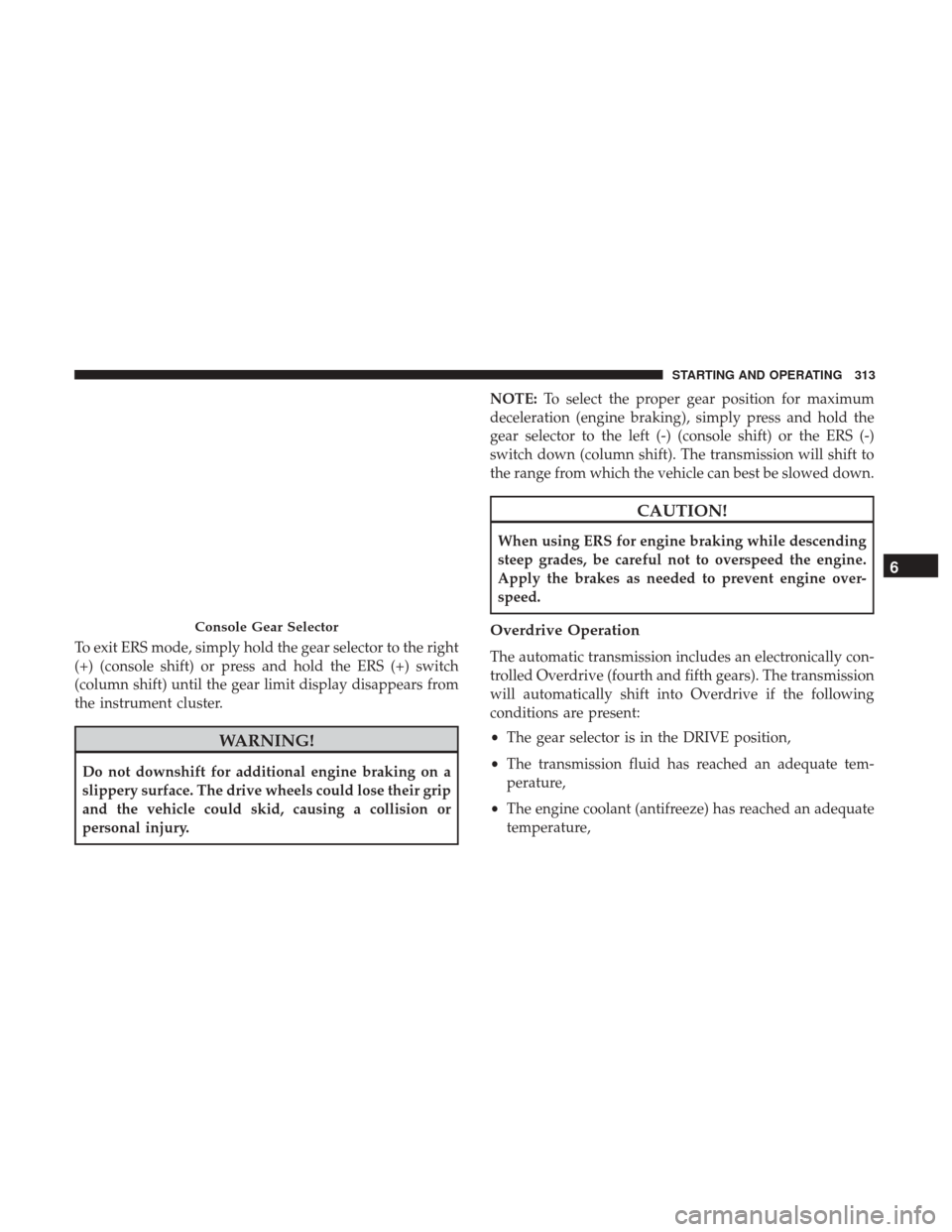
To exit ERS mode, simply hold the gear selector to the right
(+) (console shift) or press and hold the ERS (+) switch
(column shift) until the gear limit display disappears from
the instrument cluster.
WARNING!
Do not downshift for additional engine braking on a
slippery surface. The drive wheels could lose their grip
and the vehicle could skid, causing a collision or
personal injury.NOTE:
To select the proper gear position for maximum
deceleration (engine braking), simply press and hold the
gear selector to the left (-) (console shift) or the ERS (-)
switch down (column shift). The transmission will shift to
the range from which the vehicle can best be slowed down.
CAUTION!
When using ERS for engine braking while descending
steep grades, be careful not to overspeed the engine.
Apply the brakes as needed to prevent engine over-
speed.
Overdrive Operation
The automatic transmission includes an electronically con-
trolled Overdrive (fourth and fifth gears). The transmission
will automatically shift into Overdrive if the following
conditions are present:
• The gear selector is in the DRIVE position,
• The transmission fluid has reached an adequate tem-
perature,
• The engine coolant (antifreeze) has reached an adequate
temperature,
Console Gear Selector
6
STARTING AND OPERATING 313
Page 317 of 700
WARNING!
Do not use the “TOW/HAUL” feature when driving in
icy or slippery conditions. The increased engine brak-
ing can cause the rear wheels to slide, and the vehicle
to swing around with the possible loss of vehicle
control, which may cause an accident possibly result-
ing in personal injury or death.
Torque Converter Clutch
A feature designed to improve fuel economy has been
included in the automatic transmission on your vehicle. A
clutch within the torque converter engages automatically
at calibrated speeds. This may result in a slightly different
feeling or response during normal operation in the upper
gears. When the vehicle speed drops or during some
accelerations, the clutch automatically disengages.
NOTE:
•The torque converter clutch will not engage, and the
transmission will not shift into the top overdrive gear,
until the transmission fluid and engine coolant are warm
[usually after 1 to 3 miles (2 to 5 km) of driving]. Because
top gear is disabled, and the engine speed is higher
when the torque converter clutch is not engaged, it may seem as if the transmission is not shifting properly when
cold. This is normal. Using the Electronic Range Select
(ERS) shift control, when the transmission is sufficiently
warm, will demonstrate that the transmission is able to
shift into and out of Overdrive.
• If the vehicle has not been driven for several days, the
first few seconds of operation after shifting the transmis-
sion into gear may seem sluggish. This is due to the fluid
partially draining from the torque converter into the
transmission. This condition is normal and will not
cause damage to the transmission. The torque converter
will refill within five seconds after starting the engine.
Six-Speed Automatic Transmission — 2500/3500
Models Only
The transmission gear position display (located in the
instrument cluster) indicates the transmission gear range.
The gear selector is mounted on the right side of the
steering column. You must press the brake pedal to move
the gear selector out of PARK (refer to “Brake/
Transmission Shift Interlock System” in this section for
further information). To drive, move the gear selector from
PARK or NEUTRAL to the DRIVE position. Pull the gear
selector toward you when shifting into REVERSE or PARK,
or when shifting out of PARK.
6
STARTING AND OPERATING 315
Page 322 of 700
climbing a grade), or shifting to NEUTRAL (when stopped
in heavy traffic) can help to reduce this excess heat
generation.
During cold temperatures, transmission operation may be
modified depending on engine and transmission tempera-
ture as well as vehicle speed. This feature improves warm
up time of the engine and transmission to achieve maxi-
mum efficiency. Engagement of both the torque converter
clutch and the top overdrive gear are inhibited until the
transmission fluid is warm (refer to the “Note” under
“Torque Converter Clutch” in this section). During ex-
tremely cold temperatures (-16°F [-27°C] or below), opera-
tion may briefly be limited to first and direct gears only.
Normal operation will resume once the transmission tem-
perature has risen to a suitable level.
Transmission Limp Home Mode
Transmission function is monitored electronically for ab-
normal conditions. If a condition is detected that could
result in transmission damage, Transmission Limp Home
Mode is activated. In this mode, the transmission remains
in fourth gear regardless of which forward gear is selected.
PARK, REVERSE, and NEUTRAL will continue to operate.
The Malfunction Indicator Light (MIL) may be illuminated.Limp Home Mode allows the vehicle to be driven to an
authorized dealer for service without damaging the trans-
mission.
In the event of a momentary problem, the transmission can
be reset to regain all forward gears by performing the
following steps:
1. Stop the vehicle.
2. Shift the transmission into PARK.
3. Turn the ignition OFF.
4. Wait approximately 10 seconds.
5. Restart the engine.
6. Shift into the desired gear range. If the problem is no
longer detected, the transmission will return to normal
operation.
NOTE: Even if the transmission can be reset, we recom-
mend that you visit your authorized dealer at your earliest
possible convenience. Your authorized dealer has diagnos-
tic equipment to assess the condition of your transmission.
If the transmission cannot be reset, authorized dealer
service is required.
320 STARTING AND OPERATING
Page 324 of 700
NOTE:To select the proper gear position for maximum
deceleration (engine braking), simply push and hold the
ERS (-) switch. The transmission will shift to the range
from which the vehicle can best be slowed down.
CAUTION!
When using ERS for engine braking while descending
steep grades, be careful not to overspeed the engine.
Apply the brakes as needed to prevent engine over-
speed.
Overdrive Operation
The automatic transmission includes an electronically con-
trolled Overdrive (fifth and sixth gears). The transmission
will automatically shift into Overdrive if the following
conditions are present:
• The gear selector is in the DRIVE position.
• The transmission fluid has reached an adequate tem-
perature.
• The engine coolant has reached an adequate tempera-
ture. •
Vehicle speed is sufficiently high.
• The TOW/HAUL switch has not been activated.
• The driver is not heavily pressing the accelerator.
When To Use TOW/HAUL Mode
When driving in hilly areas, towing a trailer, carrying a
heavy load, etc., and frequent transmission shifting occurs,
push the TOW/HAUL switch to activate TOW/HAUL
mode. This will improve performance and reduce the
potential for transmission overheating or failure due to
excessive shifting. When operating in TOW/HAUL mode,
transmission upshifts are delayed, and the transmission
will automatically downshift (for engine braking) when the
throttle is closed and/or during steady braking maneu-
vers.
322 STARTING AND OPERATING
Page 325 of 700
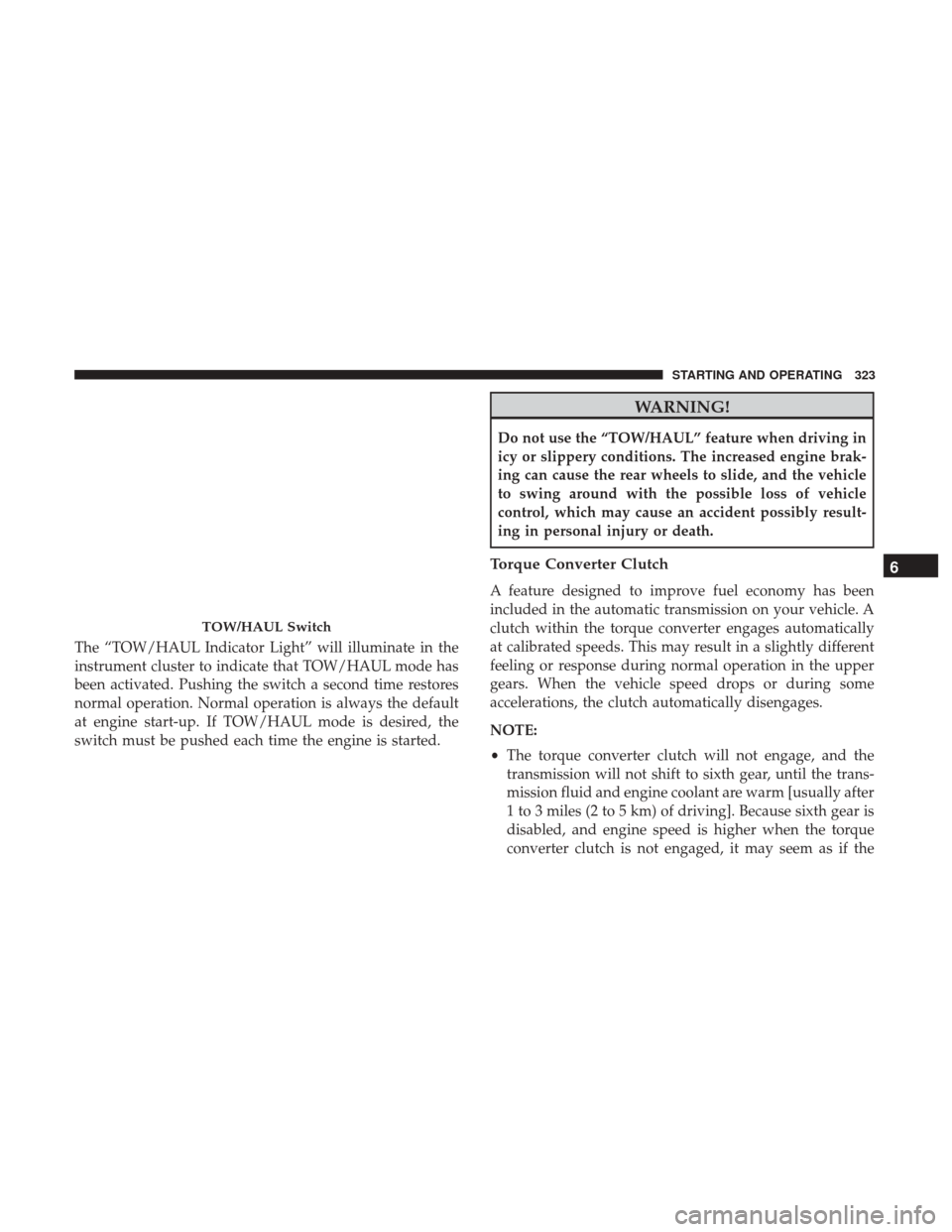
The “TOW/HAUL Indicator Light” will illuminate in the
instrument cluster to indicate that TOW/HAUL mode has
been activated. Pushing the switch a second time restores
normal operation. Normal operation is always the default
at engine start-up. If TOW/HAUL mode is desired, the
switch must be pushed each time the engine is started.
WARNING!
Do not use the “TOW/HAUL” feature when driving in
icy or slippery conditions. The increased engine brak-
ing can cause the rear wheels to slide, and the vehicle
to swing around with the possible loss of vehicle
control, which may cause an accident possibly result-
ing in personal injury or death.
Torque Converter Clutch
A feature designed to improve fuel economy has been
included in the automatic transmission on your vehicle. A
clutch within the torque converter engages automatically
at calibrated speeds. This may result in a slightly different
feeling or response during normal operation in the upper
gears. When the vehicle speed drops or during some
accelerations, the clutch automatically disengages.
NOTE:
•The torque converter clutch will not engage, and the
transmission will not shift to sixth gear, until the trans-
mission fluid and engine coolant are warm [usually after
1 to 3 miles (2 to 5 km) of driving]. Because sixth gear is
disabled, and engine speed is higher when the torque
converter clutch is not engaged, it may seem as if the
TOW/HAUL Switch
6
STARTING AND OPERATING 323
Page 326 of 700
transmission is not shifting properly when cold. This is
normal. Using the Electronic Range Select (ERS) shift
control, when the transmission is sufficiently warm, will
demonstrate that the transmission is able to shift into
and out of Overdrive.
• If the vehicle has not been driven for several days, the
first few seconds of operation after shifting the transmis-
sion into gear may seem sluggish. This is due to the fluid
partially draining from the torque converter into the
transmission. This condition is normal and will not
cause damage to the transmission. The torque converter
will refill within five seconds after starting the engine.
FOUR-WHEEL DRIVE OPERATION — IF EQUIPPED
Four-wheel drive trucks are equipped with either a manu-
ally shifted transfer case or an electronically shifted trans-
fer case. Refer to the operating instructions for your
transfer case, located in this section for further information.
Manually Shifted Transfer Case — If Equipped
The transfer case provides four mode positions:
•Two-Wheel Drive High Range (2H)
• Four-Wheel Drive Lock High Range (4H)
• Neutral (N)
• Four-Wheel Drive Low Range (4L) For additional information on the appropriate use of each
transfer case mode position, see the information below:
2H
Two-Wheel Drive High Range — This range is for normal
street and highway driving on dry, hard surfaced roads.
4H
Four-Wheel Drive Lock High Range — This range locks the
front and rear driveshafts together forcing the front and
rear wheels to rotate at the same speed. Additional traction
for loose, slippery road surfaces only.
NEUTRAL (N)
Neutral — This range disengages both the front and rear
driveshafts from the powertrain. To be used for flat towing
behind another vehicle. Refer to “Recreational Towing” in
“Starting And Operating” for further information.
4L
Four-Wheel Drive Low Range — This range locks the front
and rear driveshafts together forcing the front and rear
wheels to rotate at the same speed. Additional traction and
maximum pulling power for loose, slippery road surfaces
only. Do not exceed 25 mph (40 km/h).
324 STARTING AND OPERATING
Page 372 of 700
Driving Through Water
Extreme care should be taken crossing any type of water.
Water crossings should be avoided if possible and only be
attempted when necessary, in a safe responsible manner.
You should only drive through areas which are designated
and approved. You should tread lightly and avoid damage
to the environment. You should know your vehicle’s
abilities and be able to recover it if something goes wrong.
You should never stop or shut a vehicle off when crossing
deep water unless you ingested water into the engine air
intake. If the engine stalls do not attempt to restart it.
Determine if it has ingested water first. The key to any
crossing is low and slow. You want to use first gear in 4L
(Low Range) and proceed very slowly with a constant slow
speed (3-5 mph [5–8 km/h] maximum) and light throttle.
Keep the vehicle moving; do not try to accelerate through
the crossing. After crossing any water higher than the
bottom of the axle differentials, you should inspect all of
the vehicle fluids for signs of water ingestion.
CAUTION!
Water ingestion into the axles, transmission, transfer
case, engine or vehicle interior can occur if you drive
(Continued)
CAUTION!(Continued)
too fast or through too deep of water. Water can cause
permanent damage to engine, driveline or other ve-
hicle components and your brakes will be less effec-
tive once wet and/or muddy.
• Before You Cross Any Type Of Water – As you ap-
proach any type of water you need to determine if you
can cross it safely and responsibly. If necessary, get out
and walk through the water or probe it with a stick. You
need to be sure of its depth, approach angle, current and
bottom condition. Be careful of murky or muddy waters,
check for hidden obstacles. Make sure you will not be
intruding on any wildlife and you can recover the
vehicle if necessary. The key to a safe crossing is the
water depth, current and bottom conditions. On soft
bottoms the vehicle will sink in, effectively increasing
the water level on the vehicle. Be sure to consider this
when determining the depth and the ability to safely
cross.
• Crossing Puddles, Pools, Flooded Areas Or Other
Standing Water – Puddles, pools, flooded or other
standing water areas normally contain murky or muddy
waters. These water types normally contain hidden
obstacles and make it difficult to determine an accurate
370 STARTING AND OPERATING
Page 395 of 700
If the Steering icon is flashing, it indicates that the vehicle
needs to be taken to the dealer for service. It is likely the
vehicle has lost power steering assistance.
If the Steering icon is displayed and the “POWER STEER-
ING SYSTEM OVER TEMP” message is displayed on the
instrument cluster screen, they indicate that extreme steer-
ing maneuvers may have occurred which caused an over
temperature condition in the power steering system. Once
driving conditions are safe, pull over and let the vehicle
idle for a few moments until the icon and message turn off.
Refer to “Instrument Cluster Display” in “Getting To Know
Your Instrument Panel” for further information.
If the Steering icon is displayed and the “SERVICE POWER
STEERING – ASSIST OFF” message is displayed the in-
strument cluster screen, they indicate the vehicle needs to
be taken to the dealer for service. Refer to “Instrument
Cluster Display” in “Getting To Know Your Instrument
Panel” for further information.
NOTE:
•Even if the power steering assistance is no longer
operational, it is still possible to steer the vehicle. Under
these conditions there will be a substantial increase in
steering effort, especially at low speeds and during
parking maneuvers. •
If the condition persists, see your authorized dealer for
service.
Hydraulic Power Steering — 2500/3500 Models
The standard power steering system will give you good
vehicle response and increased ease of maneuverability in
tight spaces. The system will provide mechanical steering
capability if power assist is lost.
If for some reason the power assist is interrupted, it will
still be possible to steer your vehicle. Under these condi-
tions, you will observe a substantial increase in steering
effort, especially at very low vehicle speeds and during
parking maneuvers.
NOTE:
•Increased noise levels at the end of the steering wheel
travel are considered normal and do not indicate that
there is a problem with the power steering system.
• Upon initial start-up in cold weather, the power steering
pump may make noise for a short amount of time. This
is due to the cold, thick fluid in the steering system. This
noise should be considered normal, and it does not in
any way damage the steering system.
6
STARTING AND OPERATING 393
Page 396 of 700
CAUTION!
Prolonged operation of the steering system at the end
of the steering wheel travel will increase the steering
fluid temperature and it should be avoided when
possible. Damage to the power steering pump may
occur.
Power Steering Fluid Check — 2500/3500 Models
Checking the power steering fluid level at a defined service
interval is not required. The fluid should only be checked
if a leak is suspected, abnormal noises are apparent,
and/or the system is not functioning as anticipated. Check
fluid level when the engine is cold and off. Coordinate
inspection efforts through an authorized dealer.
CAUTION!
Do not use chemical flushes in your power steering
system as the chemicals can damage your power steer-
ing components. Such damage is not covered by the
New Vehicle Limited Warranty.
WARNING!
Fluid level should be checked on a level surface and
with the engine off to prevent injury from moving
parts and to ensure accurate fluid level reading. Do not
overfill. Use only manufacturer’s recommended power
steering fluid.
If necessary, add fluid to restore to the proper indicated
level. With a clean cloth, wipe any spilled fluid from all
surfaces. Refer to “Fluids And Lubricants” in “Technical
Specifications” for further information.
FUEL SAVER TECHNOLOGY 5.7L/6.4L ENGINES
ONLY — IF EQUIPPED
This feature offers improved fuel economy by shutting off
four of the engine’s eight cylinders during light load and
cruise conditions. The system is automatic with no driver
inputs or additional driving skills required.
NOTE: This system may take some time to return to full
functionality after a battery disconnect.
394 STARTING AND OPERATING