air condition Ram 1500 2018 Owner's Guide
[x] Cancel search | Manufacturer: RAM, Model Year: 2018, Model line: 1500, Model: Ram 1500 2018Pages: 700, PDF Size: 8.86 MB
Page 281 of 700
Exhaust Gas
WARNING!
Exhaust gases can injure or kill. They contain carbon
monoxide (CO), which is colorless and odorless.
Breathing it can make you unconscious and can even-
tually poison you. To avoid breathing (CO), follow
these safety tips:
•Do not run the engine in a closed garage or in
confined areas any longer than needed to move your
vehicle in or out of the area.
• If you are required to drive with the trunk/liftgate/
rear doors open, make sure that all windows are
closed and the climate control BLOWER switch is set
at high speed. DO NOT use the recirculation mode.
• If it is necessary to sit in a parked vehicle with the
engine running, adjust your heating or cooling con-
trols to force outside air into the vehicle. Set the
blower at high speed.
The best protection against carbon monoxide entry into the
vehicle body is a properly maintained engine exhaust
system.
Whenever a change is noticed in the sound of the exhaust
system, when exhaust fumes can be detected inside the vehicle, or when the underside or rear of the vehicle is
damaged, have a competent mechanic inspect the complete
exhaust system and adjacent body areas for broken, dam-
aged, deteriorated, or mispositioned parts. Open seams or
loose connections could permit exhaust fumes to seep into
the passenger compartment. In addition, inspect the ex-
haust system each time the vehicle is raised for lubrication
or oil change. Replace as required.
Safety Checks You Should Make Inside The Vehicle
Seat Belts
Inspect the seat belt system periodically, checking for cuts,
frays, and loose parts. Damaged parts must be replaced
immediately. Do not disassemble or modify the system.
Front seat belt assemblies must be replaced after a collision.
Rear seat belt assemblies must be replaced after a collision
if they have been damaged (i.e., bent retractor, torn web-
bing, etc.). If there is any question regarding seat belt or
retractor condition, replace the seat belt.
Air Bag Warning Light
The Air Bag warning lightwill turn on for four to
eight seconds as a bulb check when the ignition switch
is first turned to ON/RUN. If the light is either not on
during starting, stays on, or turns on while driving, 5
SAFETY 279
Page 350 of 700
Protection Strategy
In order to “protect” the air suspension system, the vehicle
will disable load leveling as required (suspension over-
loaded, battery charge low, etc.). Load leveling will auto-
matically resume as soon as system operation requirements
are met. See your authorized dealer if system does not
resume.
NOTE:If towing with air suspension refer to “Trailer
Towing” in “Starting And Operating” for further informa-
tion.
Instrument Cluster Display Messages
When the appropriate conditions exist, a message will
appear in the instrument cluster display. Refer to “Instru-
ment Cluster Display” in “Getting To Know Your Instru-
ment Panel” for further information.
An audible chime will be heard whenever a system error
has been detected.
See your authorized dealer for system service if normal
operation does not resume.
Operation
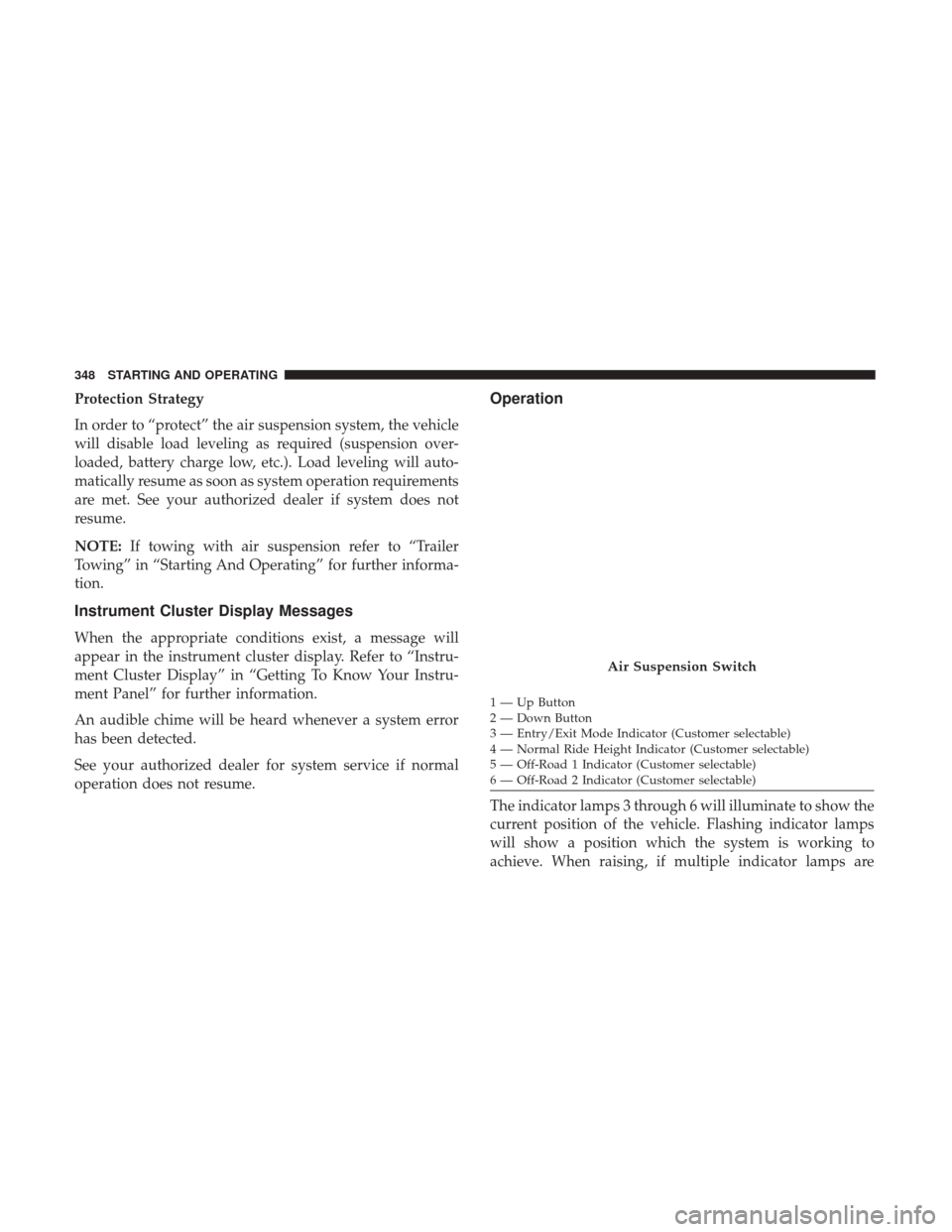
1 — Up Button
2 — Down Button
3 — Entry/Exit Mode Indicator (Customer selectable)
4 — Normal Ride Height Indicator (Customer selectable)
5 — Off-Road 1 Indicator (Customer selectable)
6 — Off-Road 2 Indicator (Customer selectable)
The indicator lamps 3 through 6 will illuminate to show the
current position of the vehicle. Flashing indicator lamps
will show a position which the system is working to
achieve. When raising, if multiple indicator lamps are
Air Suspension Switch
348 STARTING AND OPERATING
Page 356 of 700
Protection Strategy
In order to “protect” the air suspension system, the vehicle
will disable load leveling as required (suspension over-
loaded, battery charge low, etc.). Load leveling will auto-
matically resume as soon as system operation requirements
are met. See your authorized dealer if system does not
resume.
NOTE:If towing with air suspension refer to “Trailer
Towing” in “Starting And Operating” for further informa-
tion.
Instrument Cluster Display Messages
When the appropriate conditions exist, a message will
appear in the instrument cluster display. Refer to “Instru-
ment Cluster Display” in “Getting To Know Your Instru-
ment Panel” for further information.
An audible chime will be heard whenever a system error
has been detected.
See your authorized dealer for system service if normal
operation does not resume.
Operation
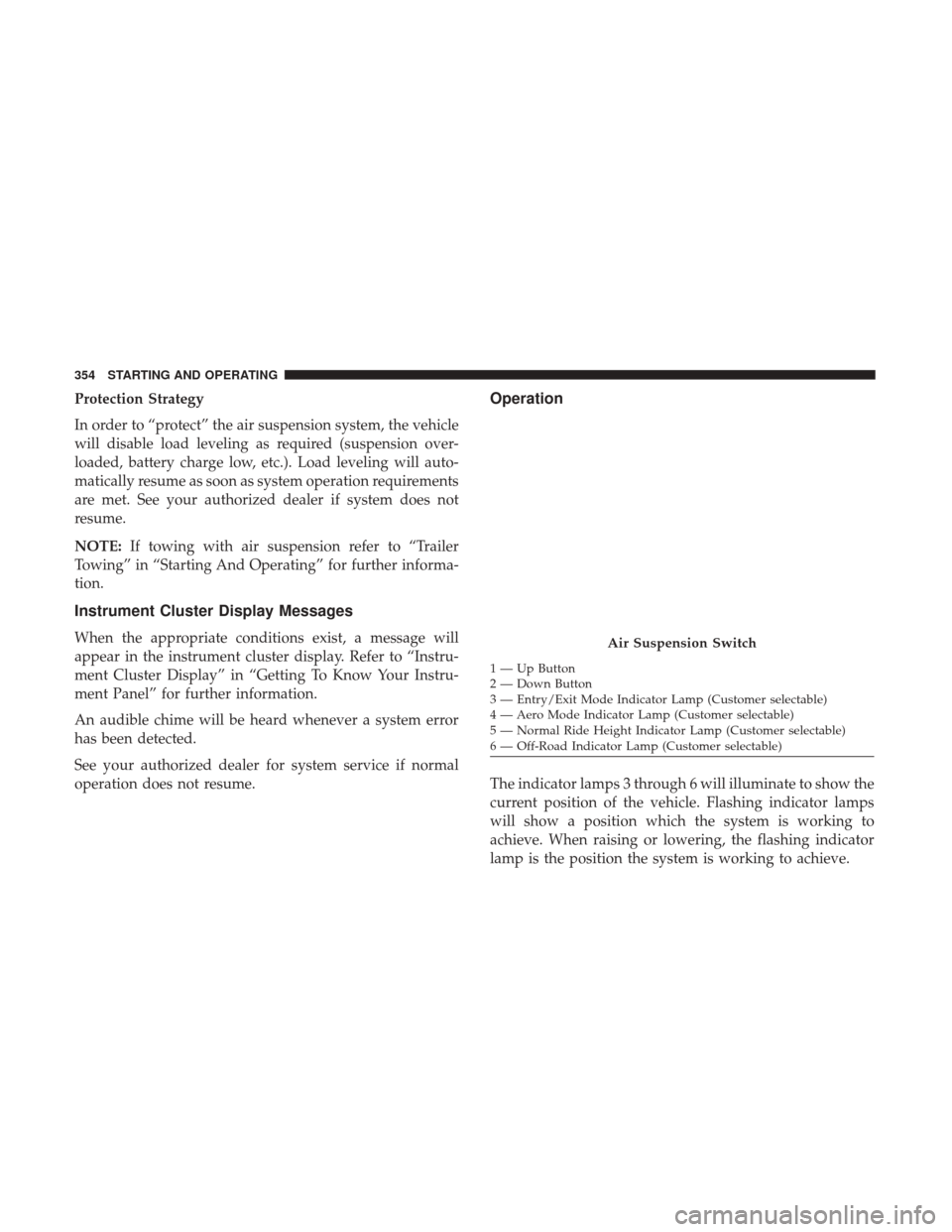
The indicator lamps 3 through 6 will illuminate to show the
current position of the vehicle. Flashing indicator lamps
will show a position which the system is working to
achieve. When raising or lowering, the flashing indicator
lamp is the position the system is working to achieve.
Air Suspension Switch
1 — Up Button
2 — Down Button
3 — Entry/Exit Mode Indicator Lamp (Customer selectable)
4 — Aero Mode Indicator Lamp (Customer selectable)
5 — Normal Ride Height Indicator Lamp (Customer selectable)
6 — Off-Road Indicator Lamp (Customer selectable)
354 STARTING AND OPERATING
Page 358 of 700
AIR SUSPENSION SYSTEM (2500/3500 MODELS) —
IF EQUIPPED
Description
This air suspension system is a rear leveling ride height
system. The main purpose of this system is to maintain the
truck’s rear ride height level. There are two selectable
heights that can be chosen based on your operating condi-
tions.
The system requires that the ignition be in ON/RUN
position or the engine running with zero vehicle speed for
all user requested changes and load leveling.Normal Ride Height (NRH)
– This is the standard position
of the suspension and is meant for normal driving. It will
automatically adjust to maintain the rear ride height as
conditions change.
Alternate Trailer Height (ATH) – Lowers the vehicle
approximately 1 in (25 mm) for a level truck, to be used as
required while trailer towing. It will automatically adjust
to maintain the rear ride height as conditions change.
Trailer Decoupling/Unloading - The air suspension sys-
tem will load level (lower/exhaust only) for up to 10
minutes after the vehicle is turned off. This allows for easy
removal of a trailer and/or load from the back of the truck
by maintaining the ride height. After 10 minutes you will
need to turn the ignition to the run position for the air
suspension to maintain ride height. If the air suspension
system is disabled using the settings menu (Tire Jack Mode,
Transport Mode or Alignment Mode) the system will
remain disabled when the vehicle is turned off. Reactivat-
ing the air suspension can be accomplished via the settings
menu or driving the vehicle above 5 mph (8 km/h) for Tire
Jack Mode or Alignment Mode and 16 mph (26 km/h) for
Transport Mode.
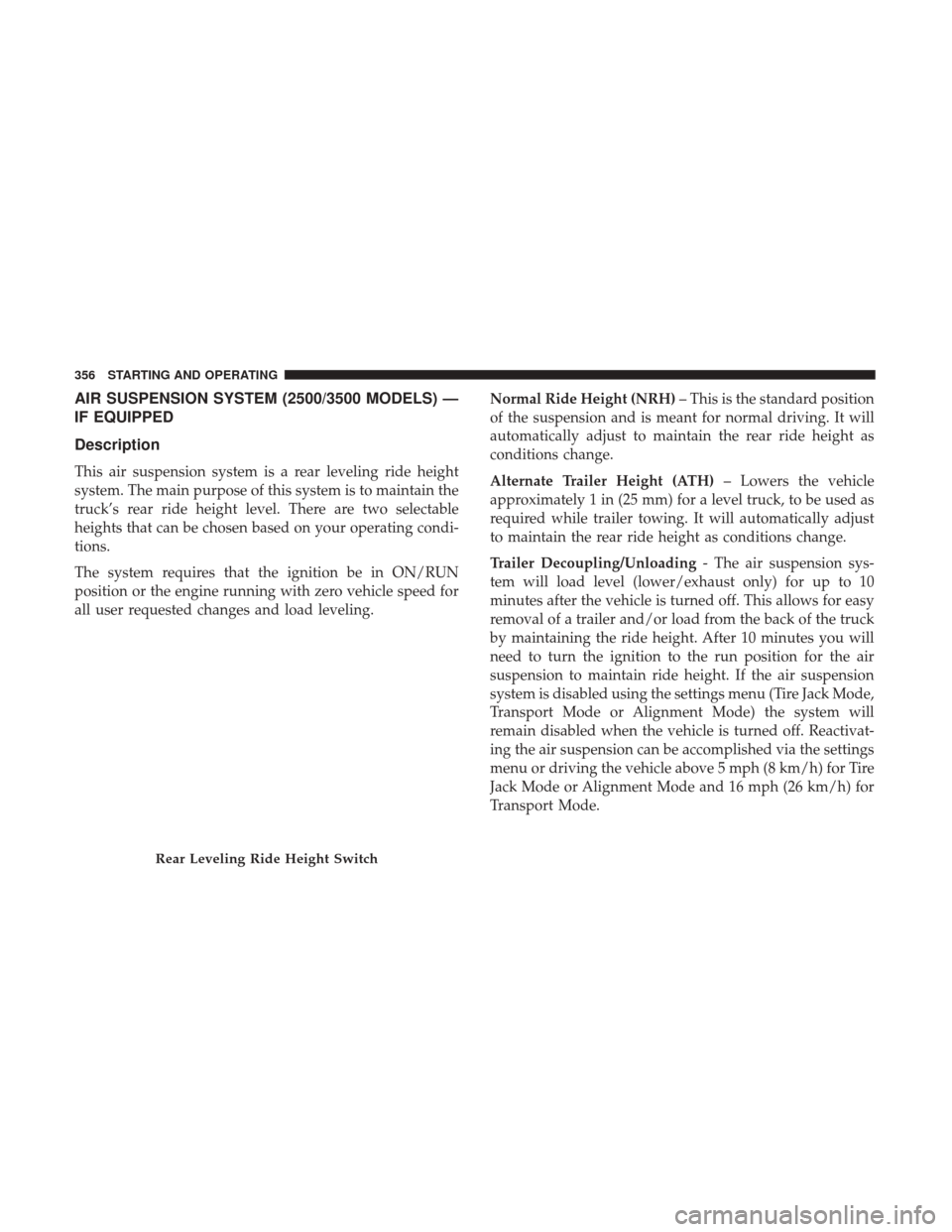
Rear Leveling Ride Height Switch
356 STARTING AND OPERATING
Page 360 of 700
To Know Your Instrument Panel” or “Uconnect Settings” in
“Multimedia” if equipped with a touch screen radio for
further information.
NOTE:This mode is intended to be enabled with engine
running.
Protection Strategy
In order to “protect” the air suspension system, the vehicle
will disable load leveling as required (suspension over-
loaded, battery charge low, etc.). Load leveling will auto-
matically resume as soon as system operation requirements
are met. See your authorized dealer if system does not
resume.
Instrument Cluster Display Messages
When the appropriate conditions exist, a message will
appear in the instrument cluster display. Refer to “Instru-
ment Cluster Display” in “Getting To Know Your Instru-
ment Panel” for further information.
An audible chime will be heard whenever a system error
has been detected.
See your authorized dealer for system service if normal
operation does not resume.
Operation
Pushing the Alternate Trailer Height (ATH) button once
while at Normal Ride Height (NRH), will lower the vehicle
to Alternate Trailer Height (ATH) and will illuminate the
LED.
NOTE: The LED will continuously blink until vehicle
Alternate Trailer Height (ATH) has been achieved and the
LED will turn off.
Pushing the Alternate Trailer Height (ATH) again will raise
the vehicle to Normal Ride Height (NRH).
NOTE: The LED will continuously blink until Normal Ride
Height (NRH) has been achieved.
• Transport Mode – No indicator lamps will be illumi-
nated. Transport Mode is disabled by driving the ve-
hicle.
• Tire/Jack Mode – No indicator lamps will be illumi-
nated. Tire/Jack Mode is disabled by driving the vehicle.
• Wheel Alignment Mode – No indicator lamps will be
illuminated. Wheel Alignment Mode is disabled by
driving the vehicle.
358 STARTING AND OPERATING
Page 365 of 700
The National Forest Service, Bureau of Land Management,
or local Department of Natural Resources are a wealth of
information and usually have maps with marked trails.
Skid Plates And Underbody Protection
Steel skid plates protect the major driveline components of
the truck including the fuel tank, transfer case and steering
damper. In addition, this vehicle is equipped with boxed
cross members and fore/aft rails. This additional protec-
tion allows the vehicle to be utilized in severe off-road
situations that would be considered impassable by a nor-
mal truck.
Ramp Travel Index (RTI)
The ramp travel index is the distance, in inches, that you
can drive your vehicle with one wheel on a 20-degree ramp
without lifting any other wheel off the ground. This
distance up the ramp divided by the wheelbase of the
vehicle and multiplied by 1,000 is the RTI. This vehicle has
an RTI of 510, which means you can articulate one front
wheel 26 inches (66 cm) in the air while the other three
wheels remain in contact with the ground.
Water Fording Characteristics
Water fording characteristic is the vehicle’s ability to cross
a body of still water, where the powertrain and drivetrainare safe from water ingestion. This vehicle has high water
fording characteristics with the ability to cross a pool of
water, without stopping, 24 inches (60 cm) deep at a
maximum speed of 10 mph (16 km/h) and a pool of water
30 inches (76 cm) deep at a maximum speed of 5 mph
(8 km/h), both with an entrance ramp angle of 1.3 degrees.
CAUTION!
The door sill height is 25 inches (63.5 cm). Water may
intrude into the interior of the vehicle at greater
depths.
Simultaneous Brake And Throttle Operation
Many off-road driving conditions require the simultaneous
use of the brake and throttle (two footed driving). When
climbing rocks, logs, or other stepped objects, using light
brake pressure with light throttle will keep the vehicle from
jerking or lurching. This technique is also used when you
need to stop and restart a vehicle on a steep incline.
The Basics Of Off-Road Driving
You will encounter many types of terrain driving off-road.
You should be familiar with the terrain and area before
proceeding. There are many types of surface conditions:
hard packed dirt, gravel, rocks, grass, sand, mud, snow
6
STARTING AND OPERATING 363
Page 372 of 700
Driving Through Water
Extreme care should be taken crossing any type of water.
Water crossings should be avoided if possible and only be
attempted when necessary, in a safe responsible manner.
You should only drive through areas which are designated
and approved. You should tread lightly and avoid damage
to the environment. You should know your vehicle’s
abilities and be able to recover it if something goes wrong.
You should never stop or shut a vehicle off when crossing
deep water unless you ingested water into the engine air
intake. If the engine stalls do not attempt to restart it.
Determine if it has ingested water first. The key to any
crossing is low and slow. You want to use first gear in 4L
(Low Range) and proceed very slowly with a constant slow
speed (3-5 mph [5–8 km/h] maximum) and light throttle.
Keep the vehicle moving; do not try to accelerate through
the crossing. After crossing any water higher than the
bottom of the axle differentials, you should inspect all of
the vehicle fluids for signs of water ingestion.
CAUTION!
Water ingestion into the axles, transmission, transfer
case, engine or vehicle interior can occur if you drive
(Continued)
CAUTION!(Continued)
too fast or through too deep of water. Water can cause
permanent damage to engine, driveline or other ve-
hicle components and your brakes will be less effec-
tive once wet and/or muddy.
• Before You Cross Any Type Of Water – As you ap-
proach any type of water you need to determine if you
can cross it safely and responsibly. If necessary, get out
and walk through the water or probe it with a stick. You
need to be sure of its depth, approach angle, current and
bottom condition. Be careful of murky or muddy waters,
check for hidden obstacles. Make sure you will not be
intruding on any wildlife and you can recover the
vehicle if necessary. The key to a safe crossing is the
water depth, current and bottom conditions. On soft
bottoms the vehicle will sink in, effectively increasing
the water level on the vehicle. Be sure to consider this
when determining the depth and the ability to safely
cross.
• Crossing Puddles, Pools, Flooded Areas Or Other
Standing Water – Puddles, pools, flooded or other
standing water areas normally contain murky or muddy
waters. These water types normally contain hidden
obstacles and make it difficult to determine an accurate
370 STARTING AND OPERATING
Page 373 of 700
water depth, approach angle, and bottom condition.
Murky or muddy water holes are where you want to
hook up tow straps prior to entering. This makes for a
faster, cleaner and easier vehicle recovery. If you are able
to determine you can safely cross, than proceed using
the low and slow method.
CAUTION!
Muddy waters can reduce the cooling system effective-
ness by depositing debris onto the radiator.
• Crossing Ditches, Streams, Shallow Rivers Or Other
Flowing Water – Flowing water can be extremely dan-
gerous. Never attempt to cross a fast running stream or
river even in shallow water. Fast moving water can
easily push your vehicle downstream sweeping it out of
control. Even in very shallow water, a high current can
still wash the dirt out from around your tires putting
you and your vehicle in jeopardy. There is still a high
risk of personal injury and vehicle damage with slower
water currents in depths greater than the vehicle’s
running ground clearance. You should never attempt to
cross flowing water which is deeper than the vehicle’s
running ground clearance. Even the slowest current can
push the heaviest vehicle downstream out of control if the water is deep enough to push on the large surface
area of the vehicle’s body. Before you proceed determine
the speed of the current, the water’s depth, approach
angle, bottom condition and if there are any obstacles,
then cross at an angle heading slightly upstream using
the low and slow technique.
WARNING!
Never drive through fast moving deep water. It can
push your vehicle downstream, sweeping it out of
control. This could put you and your passengers at risk
of injury or drowning.
Airing Down For Off-Road Driving
Running lower tire pressure off-road can improve your
ride comfort and vehicle traction. Reducing the tire air
pressure allows the tire to bulge slightly, improving its
surface area for better flotation and ability to mold or form
to the ground contour. Different terrain, tires, and vehicles
require different tire pressure. Hard surfaces like rock and
heavier vehicles require higher pressures than softer sur-
faces such as sand and lighter vehicles. You will need to
experiment to determine what is right for your situation. It
is easier and faster to let air out than it is to replace it so,
6
STARTING AND OPERATING 371
Page 374 of 700
start high and lower it as required. Remember you must
return the tires to normal air pressure before driving on
road or at highway conditions. Be sure you have a way to
return the tires to their normal on road air pressure.
CAUTION!
Reduced tire pressure increases the risk of tire damage
and may cause tire unseating with total loss of air
pressure. To reduce the risk of tire unseating, while at
a reduced tire pressure, drive at slower speeds and
avoid sharp turns or abrupt maneuvers.
Vehicle Recovery
If you drive off-road, you may encounter a situation where
you will need to recover your vehicle. Vehicle recovery
should always be given consideration before attempting a
questionable obstacle. You should never go off-road driv-
ing without the ability to recover your vehicle from a
situation. Having another vehicle with you usually works
best for most situations. The first thing to do is assess the
situation. Why are you stuck? Are you hung up on
something? Would it be easier to go forward or to go
backward? Can you still move the vehicle? Is there an
anchor point to winch to? Are you alone or do you have
another vehicle to help? Is there high risk of vehicledamage during the recovery process? Answering these
questions will help you determine the best method of
recovery. If you can still move the vehicle slightly and the
only issue is slick ground, then rock cycling your vehicle
would be the first choice. If you have ample room, an
additional vehicle and there is low risk of vehicle impinge-
ment on the surroundings, then using a tow strap to the
vehicle tow hooks would be fast and easy. If the vehicle is
severely hung up or in a situation where great care needs
to be taken during the recovery, then nothing can do the job
better than a winch. If you are severely hung up on
something you should jack the vehicle up and stack
something under the wheels to allow the vehicle to roll off
the object without causing further damage. This should be
tried before attempting any recovery method.
CAUTION!
Pulling the vehicle off an obstacle, without first clear-
ing the object, may result in additional underbody
damage.
• Rock Cycling Your Vehicle – Rock cycling your vehicle
is one of the easiest, fastest and most commonly used
methods. This simply involves shifting your vehicle
from DRIVE to REVERSE, while applying throttle after
372 STARTING AND OPERATING
Page 423 of 700
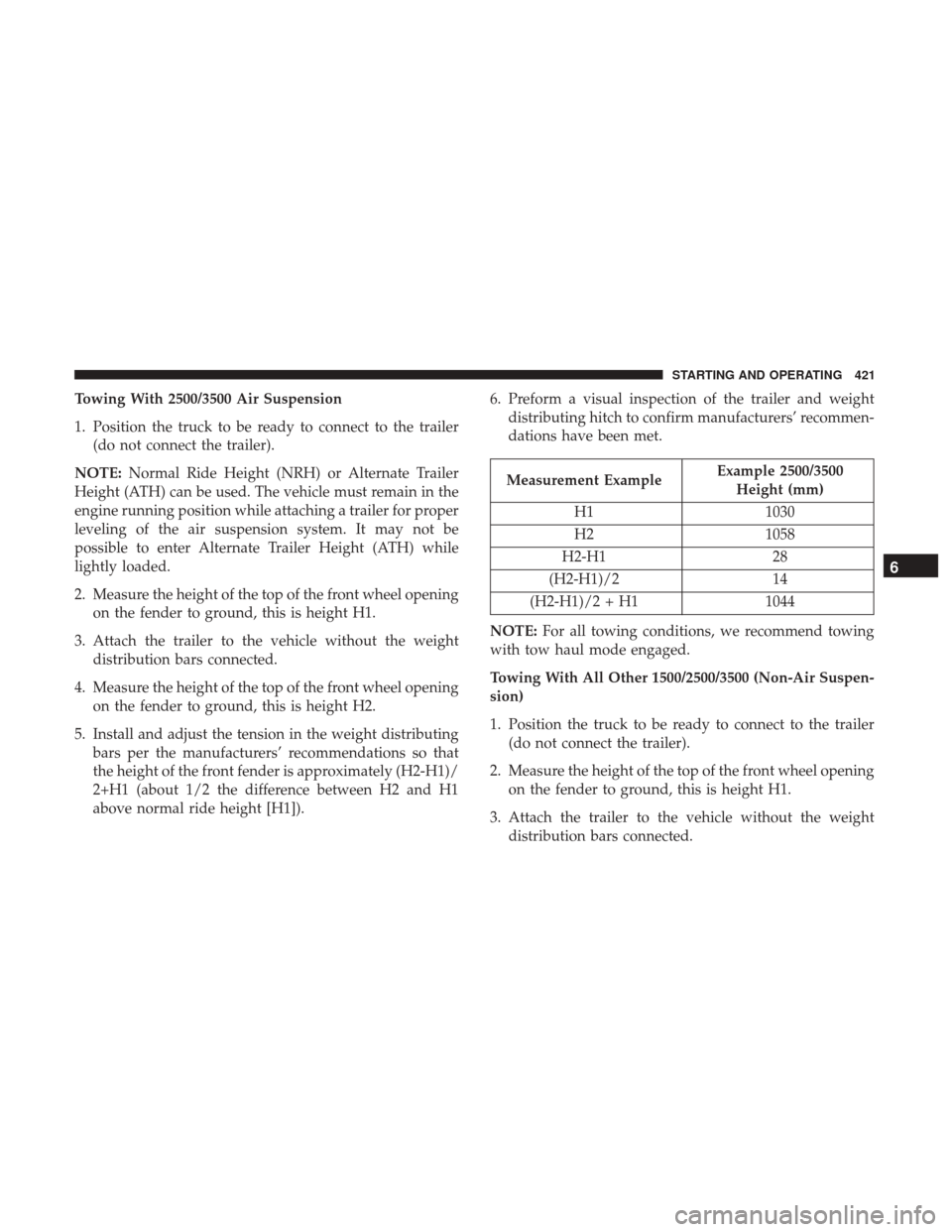
Towing With 2500/3500 Air Suspension
1. Position the truck to be ready to connect to the trailer(do not connect the trailer).
NOTE: Normal Ride Height (NRH) or Alternate Trailer
Height (ATH) can be used. The vehicle must remain in the
engine running position while attaching a trailer for proper
leveling of the air suspension system. It may not be
possible to enter Alternate Trailer Height (ATH) while
lightly loaded.
2. Measure the height of the top of the front wheel opening on the fender to ground, this is height H1.
3. Attach the trailer to the vehicle without the weight distribution bars connected.
4. Measure the height of the top of the front wheel opening on the fender to ground, this is height H2.
5. Install and adjust the tension in the weight distributing bars per the manufacturers’ recommendations so that
the height of the front fender is approximately (H2-H1)/
2+H1 (about 1/2 the difference between H2 and H1
above normal ride height [H1]). 6. Preform a visual inspection of the trailer and weight
distributing hitch to confirm manufacturers’ recommen-
dations have been met.
Measurement Example Example 2500/3500
Height (mm)
H1 1030
H2 1058
H2-H1 28
(H2-H1)/2 14
(H2-H1)/2 + H1 1044
NOTE: For all towing conditions, we recommend towing
with tow haul mode engaged.
Towing With All Other 1500/2500/3500 (Non-Air Suspen-
sion)
1. Position the truck to be ready to connect to the trailer (do not connect the trailer).
2. Measure the height of the top of the front wheel opening on the fender to ground, this is height H1.
3. Attach the trailer to the vehicle without the weight distribution bars connected.
6
STARTING AND OPERATING 421