hood open Ram 1500 2019 User Guide
[x] Cancel search | Manufacturer: RAM, Model Year: 2019, Model line: 1500, Model: Ram 1500 2019Pages: 698, PDF Size: 9.04 MB
Page 446 of 698
6. Rotate the bulb counterclockwise 1/4 turn to unlock thebulb from the lamp.
7. Pull the bulb straight out from the housing.
8. Reverse the procedure for installation of new bulb and covers.
High Beam
1. Open the hood.
2. Disconnect and isolate the negative battery cable.
3. Look under the hood and behind the headlamp to find the high beam bulb access cover.
4. Reach behind the headlamp and disengage the access cover by rotating counterclockwise.
5. Disconnect the internal lamp wiring harness connector from the high beam bulb.
CAUTION!
•Do not contaminate the bulb glass by touching it
with your fingers or by allowing it to contact other
oily surfaces. Shortened bulb life will result.
(Continued)
CAUTION! (Continued)
•Always use the correct bulb size and type for replace-
ment. An incorrect bulb size or type may overheat
and cause damage to the lamp, the bulb socket, or the
lamp wiring.
6. Rotate the bulb counterclockwise 1/4 turn to unlock the bulb from the lamp.
7. Pull the bulb straight out from the housing.
8. Reverse the procedure for installation of new bulb and covers.
Front Park And Turn
1. Open the hood.
2. Disconnect and isolate the negative battery cable.
444 IN CASE OF EMERGENCY
Page 447 of 698
3. Look under the hood and behind the headlamp to findthe park and turn socket.
4. Reach behind the headlamp and unlock the park and turn socket from the lamp by rotating counterclockwise
¼ turn.
5. Pull the bulb straight out from the housing.
6. Separate the bulb from the socket without twisting.
7. Reverse the procedure for installation of new bulb and covers. Side Marker Lamp
1. Open the hood.
2. Disconnect and isolate the negative battery cable.
3. Reach into the front wheel house ahead of the front
wheel, remove the fastener, and lift the cover over the
access hole in the front of the wheel house splash shield.
Access to the rear of the lamp can be gained through this
access hole.
Park And Turn Socket
Splash Shield Access Cover
1 — Access Cover
2 — Fastener
7
IN CASE OF EMERGENCY 445
Page 477 of 698
Preparations For Jump Start
The battery in your vehicle is located in the front of the
engine compartment, behind the left headlight assembly.
NOTE:The positive battery post may be covered with a
protective cap if equipped. Lift up on the cap to gain access
to the positive battery post. Do not jump off fuses. Only
jump directly off positive post which has a positive (+)
symbol on or around the post.
WARNING!
• Take care to avoid the radiator cooling fan whenever
the hood is raised. It can start anytime the ignition
switch is ON. You can be injured by moving fan
blades.
• Remove any metal jewelry such as rings, watch
bands and bracelets that could make an inadvertent
electrical contact. You could be seriously injured.
• Batteries contain sulfuric acid that can burn your
skin or eyes and generate hydrogen gas which is
flammable and explosive. Keep open flames or
sparks away from the battery.
1. Apply the parking brake, shift the automatic transmis- sion into PARK and turn the ignition OFF.
2. Turn off the heater, radio, and all unnecessary electrical accessories.
3. If using another vehicle to jump start the battery, park the vehicle within the jumper cables’ reach, apply the
parking brake and make sure the ignition is OFF.
Positive Battery Post
7
IN CASE OF EMERGENCY 475
Page 480 of 698
•You can also turn the temperature control to maximum
heat, the mode control to floor and the blower control to
high. This allows the heater core to act as a supplement
to the radiator and aids in removing heat from the
engine cooling system.
WARNING!
You or others can be badly burned by hot engine
coolant (antifreeze) or steam from your radiator. If you
see or hear steam coming from under the hood, do not
open the hood until the radiator has had time to cool.
Never try to open a cooling system pressure cap when
the radiator or coolant bottle is hot.
CAUTION!
Driving with a hot cooling system could damage your
vehicle. If the temperature gauge reads HOT (H), pull
over and stop the vehicle. Idle the vehicle with the air
conditioner turned off until the pointer drops back
into the normal range. If the pointer remains on HOT
(H), and you hear continuous chimes, turn the engine
off immediately and call for service.
MANUAL PARK RELEASE
WARNING!
Always secure your vehicle by fully applying the
parking brake before activating the Manual Park Re-
lease. In addition, you should be seated in the driver ’s
seat with your foot firmly on the brake pedal when
activating the Manual Park Release. Activating the
Manual Park Release will allow your vehicle to roll
away if it is not secured by the parking brake, or by
proper connection to a tow vehicle. Activating the
Manual Park Release on an unsecured vehicle could
lead to serious injury or death for those in or around
the vehicle.
In order to push or tow the vehicle in cases where the
transmission will not shift out of PARK (such as a dead
battery), a Manual Park Release is available.
Follow these steps to activate the Manual Park Release:
1. Apply the parking brake.
478 IN CASE OF EMERGENCY
Page 515 of 698
To minimize the possibility of catalytic converter damage:
•Do not interrupt the ignition when the transmission is in
gear and the vehicle is in motion.
• Do not try to start the vehicle by pushing or towing the
vehicle.
• Do not idle the engine with any ignition components
disconnected or removed, such as when diagnostic
testing, or for prolonged periods during very rough idle
or malfunctioning operating conditions.
Cooling System
WARNING!
• You or others can be badly burned by hot engine
coolant (antifreeze) or steam from your radiator. If
you see or hear steam coming from under the hood,
do not open the hood until the radiator has had time
to cool. Never open a cooling system pressure cap
when the radiator or coolant bottle is hot.
• Keep hands, tools, clothing, and jewelry away from
the radiator cooling fan when the hood is raised. The
fan starts automatically and may start at any time,
whether the engine is running or not.
(Continued)
WARNING! (Continued)
•When working near the radiator cooling fan, discon-
nect the fan motor lead or turn the ignition to the
OFF mode. The fan is temperature controlled and can
start at any time the ignition is in the ON mode.
Engine Coolant Checks
Check the engine coolant (antifreeze) protection every 12
months (before the onset of freezing weather, where appli-
cable). If the engine coolant (antifreeze) is dirty or rusty in
appearance, the system should be drained, flushed and
refilled with fresh coolant. Check the front of the A/C
condenser (if equipped) or radiator for any accumulation
of bugs, leaves, etc. If dirty, clean by gently spraying water
from a garden hose vertically down the face of the A/C
condenser (if equipped) or the back of the radiator core.
Check the engine cooling system hoses for brittle rubber,
cracking, tears, cuts and tightness of the connection at the
coolant recovery bottle and radiator. Inspect the entire
system for leaks.
DO NOT REMOVE THE COOLANT PRESSURE CAP
WHEN THE COOLING SYSTEM IS HOT.
8
SERVICING AND MAINTENANCE 513
Page 521 of 698
Brake System
In order to assure brake system performance, all brake
system components should be inspected periodically. Refer
to the “Maintenance Plan” in this section for the proper
maintenance intervals.
WARNING!
Riding the brakes can lead to brake failure and possi-
bly a collision. Driving with your foot resting or riding
on the brake pedal can result in abnormally high brake
temperatures, excessive lining wear, and possible
brake damage. You would not have your full braking
capacity in an emergency.
Fluid Level Check — Brake Master Cylinder
The fluid level of the master cylinder should be checked
when performing under the hood service or immediately if
the brake system warning lamp indicates system failure.
The brake master cylinder has a translucent plastic reser-
voir. On the outboard side of the reservoir, there is a
“MAX” mark and a “MIN” mark. The fluid level must be
kept within these two marks. Do not add fluid above the
MAX mark because leakage may occur at the cap.With disc brakes the fluid level can be expected to fall as
the brake linings wear. However, an unexpected drop in
fluid level may be caused by a leak and a system check
should be conducted.
Refer to “Fluids And Lubricants” in “Technical Specifica-
tions” for further information.
WARNING!
•
Use only manufacturer’s recommended brake fluid.
Refer to “Fluids And Lubricants” in “Technical
Specifications” for further information. Using the
wrong type of brake fluid can severely damage your
brake system and/or impair its performance. The
proper type of brake fluid for your vehicle is also
identified on the original factory installed hydraulic
master cylinder reservoir.
• To avoid contamination from foreign matter or mois-
ture, use only new brake fluid or fluid that has been
in a tightly closed container. Keep the master cylin-
der reservoir cap secured at all times. Brake fluid in
a open container absorbs moisture from the air
resulting in a lower boiling point. This may cause it
(Continued)
8
SERVICING AND MAINTENANCE 519
Page 687 of 698
Glass Cleaning........................... .553
Grocery Bag Retainer .........................55
Gross Axle Weight Rating .....................408
Gross Vehicle Weight Rating ...................408
Guide Body Builders ............................5
GVWR ................................. .406
Hazard Driving Through Flowing, Rising, Or Shallow
Standing Water ......................... .430
Hazard Warning Flashers .....................435
Headlights .............................. .442
Cleaning .............................. .547
High Beam ..............................69
High Beam/Low Beam Select Switch ...........69
Passing ................................71
Switch .................................68
Head Restraints ............................55
Head Rests ................................55
Heated Mirrors .............................66
Heater, Engine Block ....................... .299
High Beam/Low Beam Select (Dimmer) Switch ......69
Hill Descent Control ....................... .208
Hill Descent Control Indicator .................208Hill Start Assist
........................... .200
Hitches Trailer Towing .......................... .413
Hoisting ................................ .522
HomeLink (Garage Door Opener) ...............109
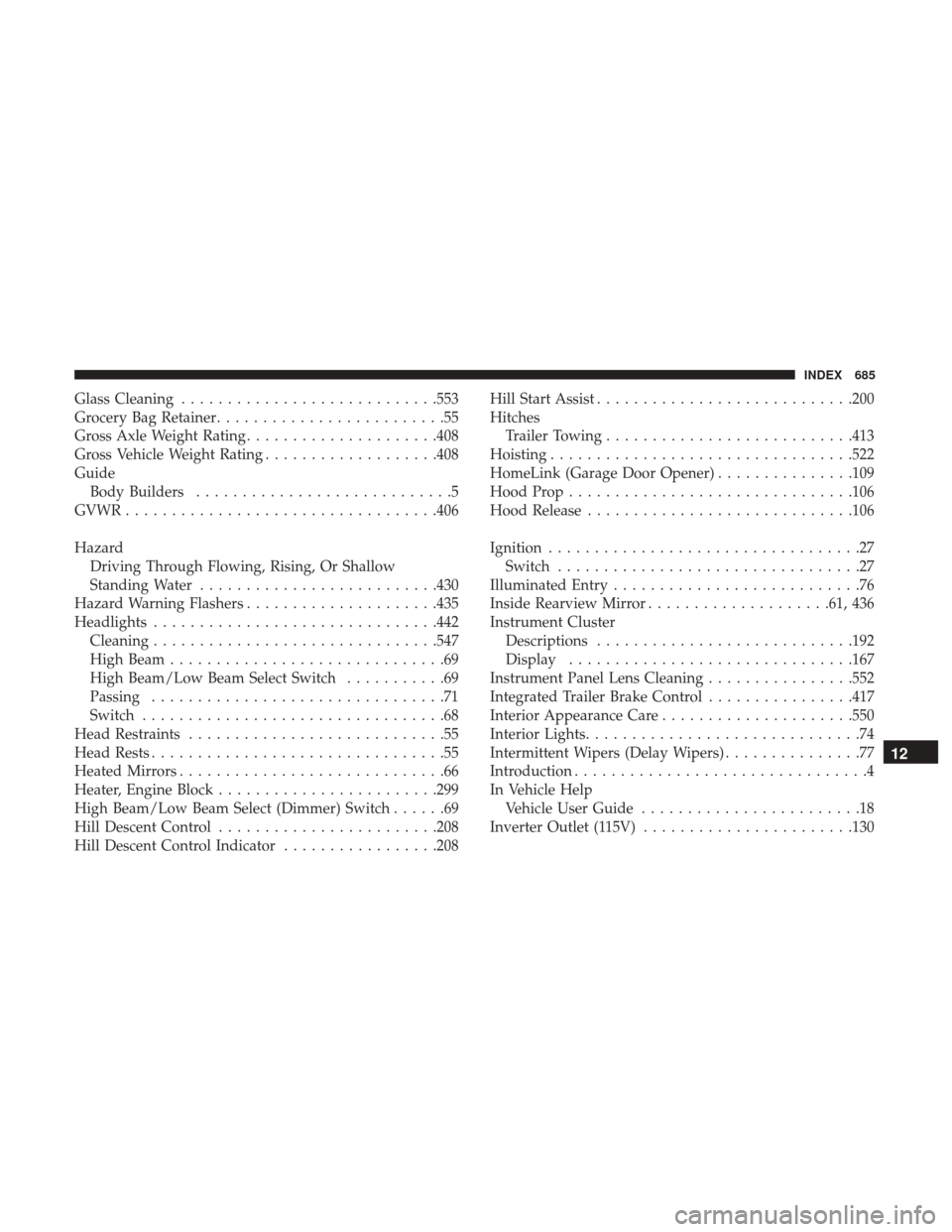
Hood Prop .............................. .106
Hood Release ............................ .106
Ignition ..................................27
Switch .................................27
Illuminated Entry ...........................76
Inside Rearview Mirror ....................61, 436
Instrument Cluster Descriptions ........................... .192
Display .............................. .167
Instrument Panel Lens Cleaning ................552
Integrated Trailer Brake Control ................417
Interior Appearance Care .....................550
Interior Lights ..............................74
Intermittent Wipers (Delay Wipers) ...............
77
Introduction ................................4
In Vehicle Help Vehicle User Guide ........................18
Inverter Outlet (115V) ...................... .13012
INDEX 685
Page 694 of 698
TiltDown .................................47
Up....................................47
Tilt Steering Column .........................58
Tip Start ................................ .294
Tire And Loading Information Placard ............528
Tire Markings ............................ .523
Tires......................... .287, 532, 539, 545
Aging (Life Of Tires) ..................... .536
Air Pressure ........................... .532
Chains ............................... .543
Compact Spare ......................... .540
Dual ................................ .557
General Information ...................532, 539
High Speed ............................ .534
Inflation Pressure ....................... .533
Life Of Tires ........................... .536
Load Capacity ...................... .528, 529
Pressure Monitoring System (TPMS) ........186, 225
Quality Grading ........................ .545
Radial ............................... .534
Replacement ........................... .537
Rotation .............................. .544
Safety ............................ .522, 532
Sizes ................................ .524Snow Tires
............................ .539
Spare Tires ......................... .539, 541
Spinning .............................. .535
Trailer Towing .......................... .416
Tread Wear Indicators .....................536
Wheel Nut Torque ....................... .556
Tire Safety Information ...................... .522
Tongue Weight/Trailer Weight .................414
Tonneau Cover ........................ .150, 547
Tonneau Cover Cleaning .....................547
To Open Hood ........................... .106
Towing ............................. .407,
481
Disabled Vehicle ........................ .481
Guide ................................ .414
Recreational ........................... .424
Weight ............................... .414
Towing Behind A Motorhome ..................424
Traction ................................ .429
Traction Control .......................... .202
Trailer Sway Control (TSC) ....................207
Trailer Towing ............................ .407
Cooling System Tips ..................... .422
Hitches ............................... .413
Minimum Requirements ....................414
Mirrors ................................66
692 INDEX