instrument panel Ram 1500 2019 Manual PDF
[x] Cancel search | Manufacturer: RAM, Model Year: 2019, Model line: 1500, Model: Ram 1500 2019Pages: 698, PDF Size: 9.04 MB
Page 302 of 698
NOTE:A new engine may consume some oil during its
first few thousand miles (kilometers) of operation. This
should be considered a normal part of the break-in and not
interpreted as a problem. Please check your oil level with
the engine oil indicator often during the break in period.
Add oil as required.
PARKING BRAKE
Electric Park Brake (EPB)
Your vehicle is equipped with an Electric Park Brake
System (EPB) that offers simple operation, and some
additional features that make the parking brake more
convenient and useful.
The parking brake is primarily intended to prevent the
vehicle from rolling while parked. Before leaving the
vehicle, make sure that the park brake is applied. Also, be
certain to leave the transmission in PARK.
You can engage the park brake in two ways:
• Manually, by applying the park brake switch.
• Automatically, by enabling the Auto Park Brake feature
in the customer programmable features section of the
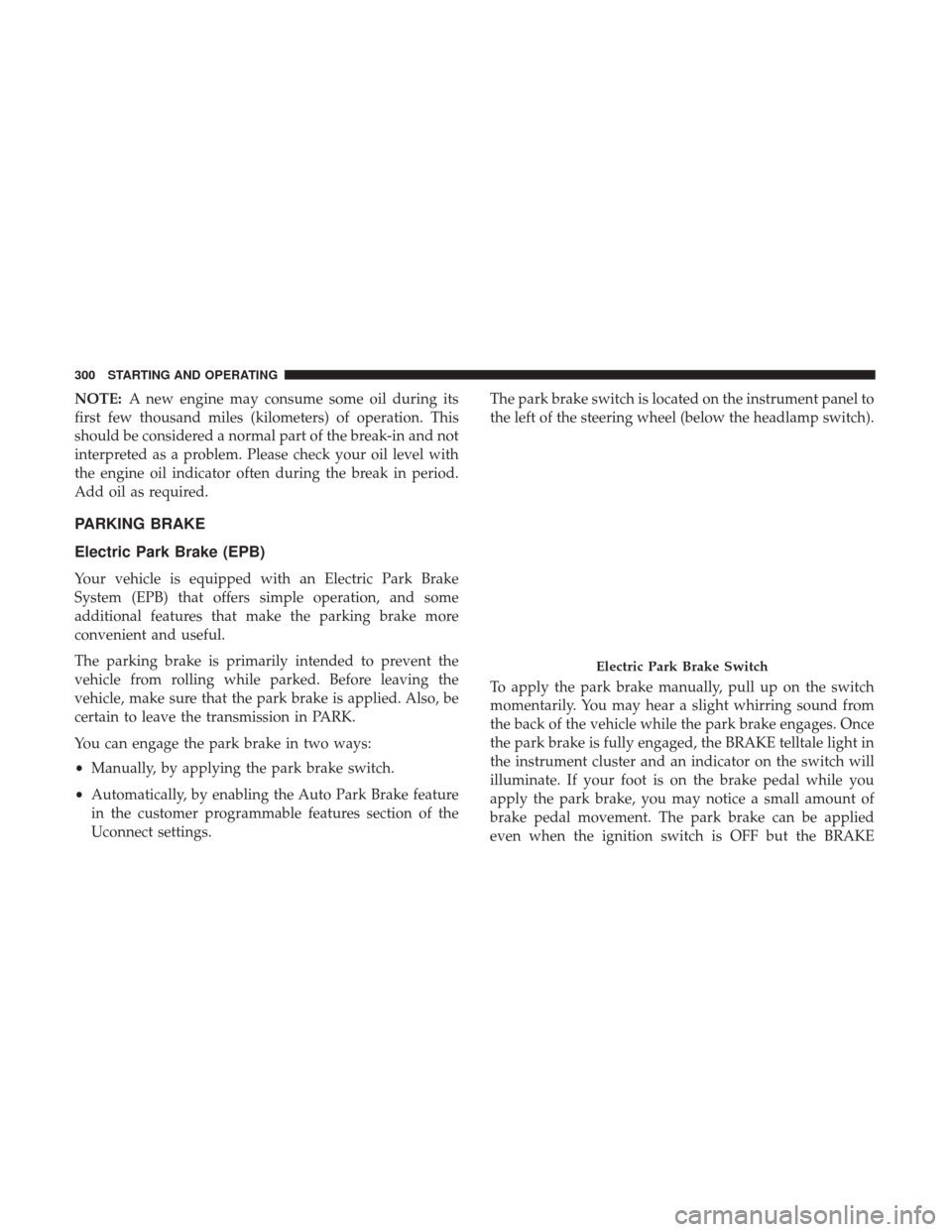
Uconnect settings. The park brake switch is located on the instrument panel to
the left of the steering wheel (below the headlamp switch).
To apply the park brake manually, pull up on the switch
momentarily. You may hear a slight whirring sound from
the back of the vehicle while the park brake engages. Once
the park brake is fully engaged, the BRAKE telltale light in
the instrument cluster and an indicator on the switch will
illuminate. If your foot is on the brake pedal while you
apply the park brake, you may notice a small amount of
brake pedal movement. The park brake can be applied
even when the ignition switch is OFF but the BRAKE
Electric Park Brake Switch
300 STARTING AND OPERATING
Page 308 of 698
Ignition Park Interlock
This vehicle is equipped with an Ignition Park Interlock
which requires the transmission to be in PARK before the
ignition can be turned to the OFF mode. This helps the
driver avoid inadvertently leaving the vehicle without
placing the transmission in PARK. This system also locks
the transmission in PARK whenever the ignition is in the
OFF mode.
NOTE:The transmission is NOT locked in PARK when
the ignition is in the ACC mode (even though the engine
will be off). Ensure that the transmission is in PARK, and
the ignition is OFF (not in ACC mode) before exiting the
vehicle.
Brake/Transmission Shift Interlock System
This vehicle is equipped with a Brake Transmission Shift
Interlock System (BTSI) that holds the transmission gear
selector in PARK unless the brakes are applied. To shift the
transmission out of PARK, the engine must be running and
the brake pedal must be pressed.
The brake pedal must also be pressed to shift from NEU-
TRAL into DRIVE or REVERSE when the vehicle is
stopped or moving at low speeds.
Eight-Speed Automatic Transmission
The transmission is controlled using a rotary electronic
gear selector located on the instrument panel. The trans-
mission gear range (PRND) is displayed both above the
gear selector and in the instrument cluster. To select a gear
range, simply rotate the gear selector. You must press the
brake pedal to shift the transmission out of PARK (or
NEUTRAL, when the vehicle is stopped or moving at low
speeds). To shift past multiple gear ranges at once (such as
PARK to DRIVE), simply rotate the gear selector to the
appropriate detent. Select the DRIVE range for normal
driving.
NOTE: In the event of a mismatch between the gear
selector position and the actual transmission gear (for
example, driver selects PARK while driving), the position
indicator will blink continuously until the selector is re-
turned to the proper position, or the requested shift can be
completed.
The electronically-controlled transmission adapts its shift
schedule based on driver inputs, along with environmental
and road conditions. The transmission electronics are self-
calibrating; therefore, the first few shifts on a new vehicle
306 STARTING AND OPERATING
Page 316 of 698
Four-Position Electronically Shifted Transfer Case
(Eight Speed Transmission Only) — If Equipped
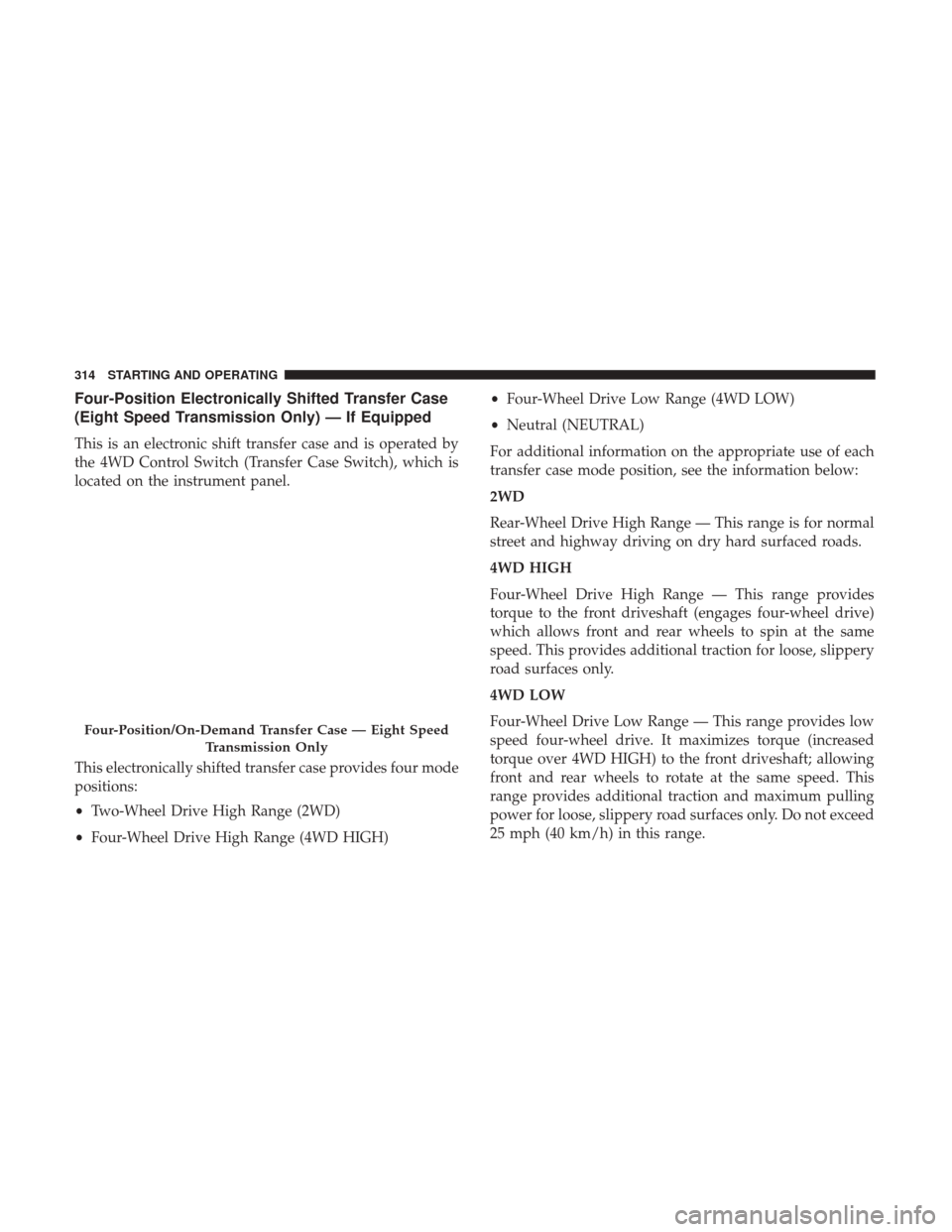
This is an electronic shift transfer case and is operated by
the 4WD Control Switch (Transfer Case Switch), which is
located on the instrument panel.
This electronically shifted transfer case provides four mode
positions:
•Two-Wheel Drive High Range (2WD)
• Four-Wheel Drive High Range (4WD HIGH) •
Four-Wheel Drive Low Range (4WD LOW)
• Neutral (NEUTRAL)
For additional information on the appropriate use of each
transfer case mode position, see the information below:
2WD
Rear-Wheel Drive High Range — This range is for normal
street and highway driving on dry hard surfaced roads.
4WD HIGH
Four-Wheel Drive High Range — This range provides
torque to the front driveshaft (engages four-wheel drive)
which allows front and rear wheels to spin at the same
speed. This provides additional traction for loose, slippery
road surfaces only.
4WD LOW
Four-Wheel Drive Low Range — This range provides low
speed four-wheel drive. It maximizes torque (increased
torque over 4WD HIGH) to the front driveshaft; allowing
front and rear wheels to rotate at the same speed. This
range provides additional traction and maximum pulling
power for loose, slippery road surfaces only. Do not exceed
25 mph (40 km/h) in this range.
Four-Position/On-Demand Transfer Case — Eight Speed Transmission Only
314 STARTING AND OPERATING
Page 320 of 698
Five-Position Electronically Shifted Transfer Case
(Eight Speed Transmission Only) — If Equipped
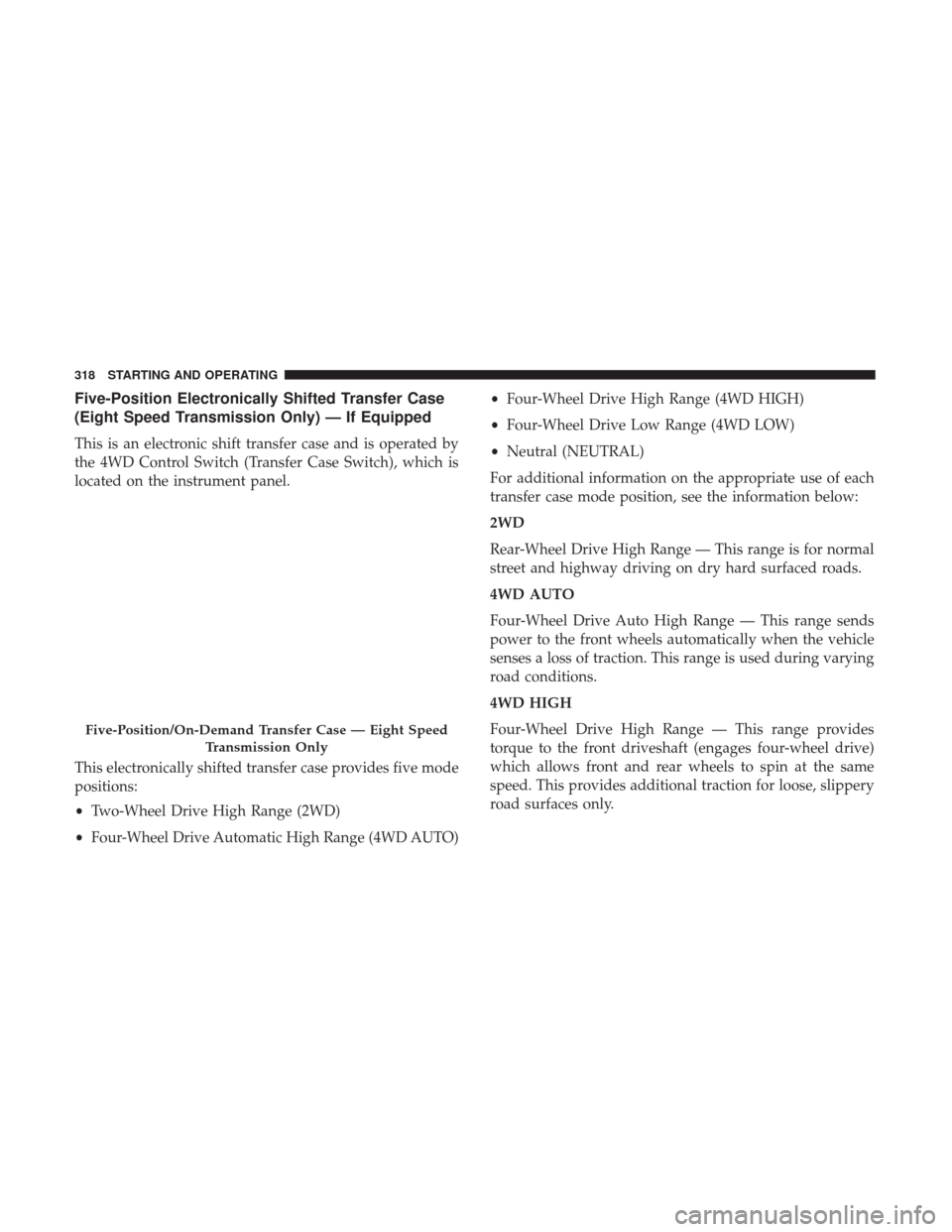
This is an electronic shift transfer case and is operated by
the 4WD Control Switch (Transfer Case Switch), which is
located on the instrument panel.
This electronically shifted transfer case provides five mode
positions:
•Two-Wheel Drive High Range (2WD)
• Four-Wheel Drive Automatic High Range (4WD AUTO) •
Four-Wheel Drive High Range (4WD HIGH)
• Four-Wheel Drive Low Range (4WD LOW)
• Neutral (NEUTRAL)
For additional information on the appropriate use of each
transfer case mode position, see the information below:
2WD
Rear-Wheel Drive High Range — This range is for normal
street and highway driving on dry hard surfaced roads.
4WD AUTO
Four-Wheel Drive Auto High Range — This range sends
power to the front wheels automatically when the vehicle
senses a loss of traction. This range is used during varying
road conditions.
4WD HIGH
Four-Wheel Drive High Range — This range provides
torque to the front driveshaft (engages four-wheel drive)
which allows front and rear wheels to spin at the same
speed. This provides additional traction for loose, slippery
road surfaces only.
Five-Position/On-Demand Transfer Case — Eight Speed Transmission Only
318 STARTING AND OPERATING
Page 324 of 698
ACTIVE-LEVEL FOUR CORNER AIR SUSPENSION
SYSTEM — IF EQUIPPED
Description
The air suspension system provides full time load leveling
capability along with the benefit of being able to adjust
vehicle height by the push of a switch.NOTE:
The vehicle will automatically enter Aero Mode
when the vehicle speed remains between 62 mph
(100 km/h) and 66 mph (106 km/h) for greater than 20
seconds or if the vehicle speed exceeds 66 mph (106 km/h).
• Normal Ride Height (NRH) – This is the standard
position of the suspension and is meant for normal
driving.
• Off-Road 1 (OR1) (Raises the vehicle approximately
1 in (26 mm)) – This position should be the primary
position for all off-road driving until Off Road 2 (OR2) is
needed. A smoother and more comfortable ride will
result. To enter OR1, push the height selector switch up
once from the NRH position while the vehicle speed is
below 35 mph (56 km/h). When in the OR1 position, if
the vehicle speed remains between 40 mph (64 km/h)
and 50 mph (80 km/h) for greater than 20 seconds or if
the vehicle speed exceeds 50 mph (80 km/h), the vehicle
will be automatically lowered to NRH. Off-Road 1 may
not be available due to vehicle payload, an instrument
cluster message will be displayed when this occurs.
Refer to “Instrument Cluster Display” in “Getting To
Know Your Instrument Panel” for further information.
Air Suspension Switch
1 — Off-Road 2 Indicator (Customer Selectable)
2 — Off-Road 1 Indicator (Customer Selectable)
3 — Normal Ride Height Indicator (Customer Selectable)
4 — Aero Mode Indicator (Customer Selectable)
5 — Entry/Exit Mode Indicator (Customer Selectable)
6 — Height Selector 322 STARTING AND OPERATING
Page 325 of 698
•Off-Road 2 (OR2) (Raises the vehicle approximately
2 in (51 mm)) – This position is intended for off-roading
use only where maximum ground clearance is required.
To enter OR2, push the height selector switch up twice
from the NRH position or once from the OR1 position
while vehicle speed is below 20 mph (32 km/h). While
in OR2, if the vehicle speed exceeds 25 mph (40 km/h)
the vehicle height will be automatically lowered to OR1.
Off-Road 2 may not be available due to vehicle payload,
an instrument cluster message will be displayed when
this occurs. Refer to “Instrument Cluster Display” in
“Getting To Know Your Instrument Panel” for further
information.
CAUTION!
If the vehicle is in OFFROAD1 or OFFROAD2 setting,
be aware of your surroundings, you may not have the
clearance required for certain areas and vehicle dam-
age may occur.
• Aero Mode (Lowers the vehicle approximately .6 in
[15 mm]) – This position provides improved aerody-
namics by lowering the vehicle. The vehicle will auto-
matically enter Aero Mode when the vehicle speed
remains between 62 mph (100 km/h) and 66 mph (106 km/h) for greater than 20 seconds or if the vehicle
speed exceeds 66 mph (106 km/h). The vehicle will
return to NRH from Aero Mode if the vehicle speed
remains between 30 mph (48 km/h) and 35 mph
(56 km/h) for greater than 20 seconds or if the vehicle
speed falls below 30 mph (48 km/h).
NOTE: Speed thresholds for raising the vehicle only apply
if Automatic Aero Mode is enabled.
• To enter Aero Mode manually push the height selector
switch down once from NRH at any vehicle speed. To
return to NRH push the height selector switch up once
while vehicle speed is less than 56 mph (90 km/h).
NOTE: Automatic Aero Mode may be disabled through
vehicle settings in the instrument cluster display or
through your Uconnect Radio if equipped. Refer to “In-
strument Cluster Display” in “Getting To Know Your
Instrument Panel” or “Uconnect Settings” in “Multimedia”
for further information.
• Entry/Exit Mode (Lowers the vehicle approximately
2 in (51 mm)) – This position lowers the vehicle for
easier passenger entry and exit as well as lowering the
rear of the vehicle for easier loading and unloading of
cargo. To enter Entry/Exit Mode, push the height selec-
tor switch down once from the NRH while the vehicle
6
STARTING AND OPERATING 323
Page 326 of 698
speed is below 33 mph (53 km/h). Once the vehicle
speed goes below 15 mph (24 km/h) the vehicle height
will begin to lower. If the vehicle speed remains between
15 mph (24 km/h) and 25 mph (40 km/h) for greater
than 60 seconds, or the vehicle speed exceeds 25 mph
(40 km/h) the Entry/Exit change will be cancelled. To
return to Normal Height Mode, push the height selector
switch up once while in Entry/Exit or drive the vehicle
over 15 mph (24 km/h). Entry/Exit mode may not be
available due to vehicle payload, an instrument cluster
message will be displayed when this occurs. Refer to
“Instrument Cluster Display” in “Getting To Know Your
Instrument Panel” for further information.
NOTE: Entry/Exit mode may be achieved using your key
fob for easier entry/loading. Refer to “Keys” in “Getting To
Know Your Vehicle” for further information.
CAUTION!
When in ENTRY/EXIT setting, be aware of your sur-
roundings, you may not have the clearance required for
certain areas and vehicle damage may occur. The system requires that the ignition be in ON/RUN
position or the engine running for all user requested
changes. When lowering the vehicle all of the doors, must
be closed. If a door is opened at any time while the vehicle
is lowering the change will not be completed until the open
door(s) is closed.
This system uses a lifting and lowering pattern which
keeps the headlights from incorrectly shining into oncom-
ing traffic. When raising the vehicle, the rear of the vehicle
will move up first and then the front. When lowering the
vehicle, the front will move down first and then the rear.
After the engine is turned off, it may be noticed that the air
suspension system operates briefly, this is normal. The
system is correcting the position of the vehicle to ensure a
proper appearance.
To assist with changing a spare tire, the air suspension system
has a feature which allows the automatic leveling to be
disabled. Refer to “Instrument Cluster Display” in “Getting To
Know Your Instrument Panel” for further information.
NOTE:
If equipped with a touch screen radio all enabling/
disabling of air suspension features must be done through
the radio. Refer to “Uconnect Settings” in “Multimedia” for
further information.
324 STARTING AND OPERATING
Page 327 of 698
WARNING!
The air suspension system uses a high pressure vol-
ume of air to operate the system. To avoid personal
injury or damage to the system, see your authorized
dealer for service.
Air Suspension Modes
The Air Suspension system has multiple modes to protect
the system in unique situations:
Automatic AERO Mode
To improve aerodynamics, the air suspension system has a
feature which will put the vehicle into AERO height
automatically. Refer to “Instrument Cluster Display” in
“Getting To Know Your Instrument Panel” for further
information.
Automatic Aero Mode may be disabled through vehicle
settings in the instrument cluster display or through your
Uconnect Radio if equipped. Refer to “Instrument Cluster
Display” in “Getting To Know Your Instrument Panel” or
“Uconnect Settings” in “Multimedia” for further informa-
tion.NOTE:
This mode is intended to be enabled with engine
running.
Tire Jack Mode
To assist with changing a tire, the air suspension system
has a feature which allows the automatic leveling to be
disabled. Refer to “Instrument Cluster Display” in “Get-
ting To Know Your Instrument Panel” or “Uconnect Set-
tings” in “Multimedia” if equipped with a touch screen
radio for further information.
NOTE: This mode is intended to be enabled with engine
running.
Transport Mode
For towing your vehicle with four wheels off the road, the
air suspension system has a feature which will put the
vehicle into Entry/Exit height and disable the automatic
load leveling system. Refer to “Instrument Cluster Dis-
play” in “Getting To Know Your Instrument Panel” or
“Uconnect Settings” in “Multimedia” if equipped with a
touch screen radio for further information.
NOTE: This mode is intended to be enabled with engine
running.6
STARTING AND OPERATING 325
Page 328 of 698
Wheel Alignment Mode
Before performing a wheel alignment, this mode must be
enabled. Refer to “Instrument Cluster Display” in “Getting
To Know Your Instrument Panel” or “Uconnect Settings” in
“Multimedia” if equipped with a touch screen radio for
further information.
NOTE:This mode is intended to be enabled with engine
running.
Protection Strategy
In order to “protect” the air suspension system, the vehicle
will disable load leveling as required (suspension over-
loaded, battery charge low, etc.). Load leveling will automati-
cally resume as soon as system operation requirements are
met. See your authorized dealer if system does not resume.
NOTE:If towing with air suspension refer to “Trailer Towing”
in “Starting And Operating” for further information.
Instrument Cluster Display Messages
When the appropriate conditions exist, a message will
appear in the instrument cluster display. Refer to “Instru-
ment Cluster Display” in “Getting To Know Your Instru-
ment Panel” for further information.
An audible chime will be heard whenever a system error
has been detected. See your authorized dealer for system service if normal
operation does not resume.
Operation
Air Suspension Switch
1 — Off-Road 2 Indicator (Customer selectable)
2 — Off-Road 1 Indicator (Customer selectable)
3 — Normal Ride Height Indicator (Customer selectable)
4 — Aero Mode Indicator (Customer Selectable)
5 — Entry/Exit Mode Indicator (Customer selectable)
6 — Height Selector
326 STARTING AND OPERATING
Page 331 of 698
•Normal Ride Height (NRH) – This is the standard
position of the suspension and is meant for normal
driving.
• Off-Road (OR) (Raises the vehicle approximately 1 in
(26 mm)) – This position is intended for off-roading use
only where maximum ground clearance is required. To
enter OR, push the height selector switch up once from
the NRH position while vehicle speed is below 20 mph
(32 km/h). While in OR, if the vehicle speed exceeds
25 mph (40 km/h) the vehicle height will be automati-
cally lowered to NRH. Off-Road may not be available
due to vehicle payload, an instrument cluster display
message will be shown when this occurs.
• Refer to “Instrument Cluster Display” in “Getting To
Know Your Instrument Panel” for further information.
CAUTION!
If the vehicle is in Off-Road setting, be aware of your
surroundings, you may not have the clearance required
for certain areas and vehicle damage may occur.
• Aero Mode (Lowers the vehicle approximately .6 in
(15 mm)) – This position provides improved aerody-
namics by lowering the vehicle. The vehicle will auto-
matically enter Aero Mode when the vehicle speed remains between 62 mph (100 km/h) and 66 mph
(106 km/h) for greater than 20 seconds or if the vehicle
speed exceeds 66 mph (106 km/h). The vehicle will
return to NRH from Aero Mode if the vehicle speed
remains between 30 mph (48 km/h) and 35 mph
(56 km/h) for greater than 20 seconds or if the vehicle
speed falls below 30 mph (48 km/h).
NOTE: Speed thresholds for raising the vehicle only apply
if Automatic Aero Mode is enabled.
• To enter Aero Mode manually push the height selector
switch down once from NRH at any vehicle speed. To
return to NRH push the height selector switch up once
while vehicle speed is less than 56 mph (90 km/h).
NOTE: Automatic Aero Mode may be disabled through
vehicle settings on your Uconnect Radio.
• Entry/Exit Mode (Lowers the vehicle approximately
3 in (73 mm)) – This position lowers the vehicle for
easier passenger entry and exit as well as lowering the
rear of the vehicle for easier loading and unloading of
cargo. To enter Entry/Exit Mode, push the height selec-
tor switch down twice from the NRH while the vehicle
speed is below 33 mph (53 km/h). Once the vehicle
speed goes below 15 mph (24 km/h) the vehicle height
will begin to lower. If the vehicle speed remains between
6
STARTING AND OPERATING 329