ac repair Ram 1500 2020 User Guide
[x] Cancel search | Manufacturer: RAM, Model Year: 2020, Model line: 1500, Model: Ram 1500 2020Pages: 674, PDF Size: 32.69 MB
Page 470 of 674
468 IN CASE OF EMERGENCY
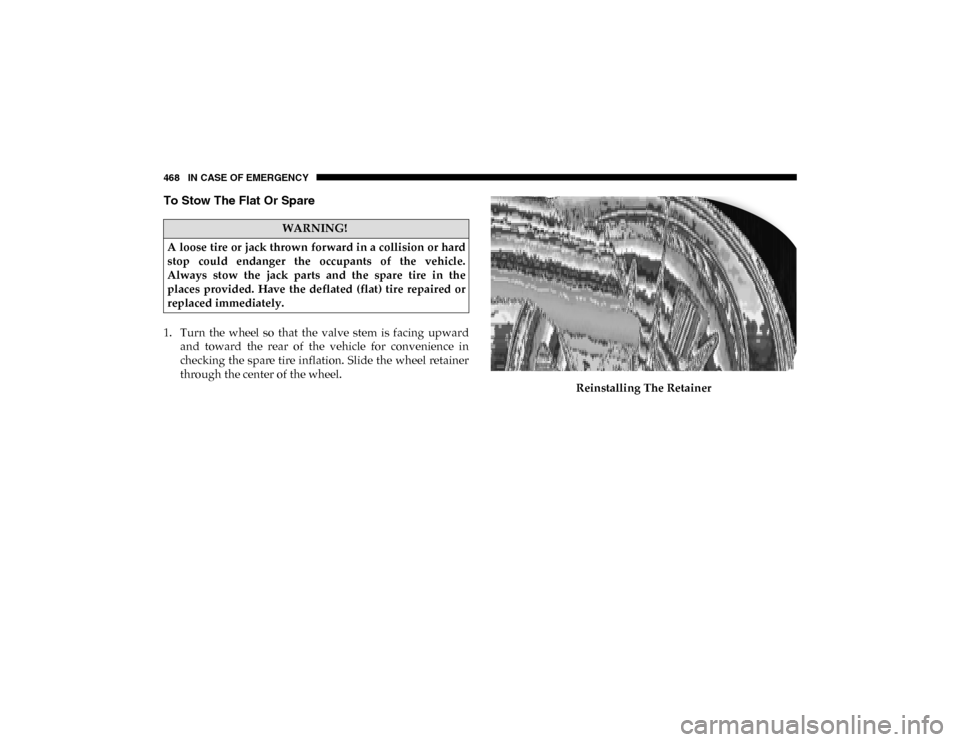
To Stow The Flat Or Spare
1. Turn the wheel so that the valve stem is facing upwardand toward the rear of the vehicle for convenience in
checking the spare tire inflation. Slide the wheel retainer
through the center of the wheel. Reinstalling The Retainer
WARNING!
A loose tire or jack thrown forward in a collision or hard
stop could endanger the occupants of the vehicle.
Always stow the jack parts and the spare tire in the
places provided. Have the deflated (flat) tire repaired or
replaced immediately.
2020_DT_1500_OM_US.book Page 468
Page 496 of 674

494 SERVICING AND MAINTENANCE
Synthetic engine oils which do not have both the engine oil
certification mark and the correct SAE viscosity grade
number should not be used.
Materials Added To Engine Oil
The manufacturer strongly recommends against the addi-
tion of any additives (other than leak detection dyes) to the
engine oil. Engine oil is an engineered product and its perfor -
mance may be impaired by supplemental additives.
Disposing Of Used Engine Oil And Oil Filters
Care should be taken in disposing of used engine oil and oil
filters from your vehicle. Used oil and oil filters, indiscrimi -
nately discarded, can present a problem to the environment.
Contact an authorized dealer, service station or govern -
mental agency for advice on how and where used oil and oil
filters can be safely discarded in your area.
Engine Oil Filter
The engine oil filter should be replaced with a new filter at
every engine oil change.
Engine Oil Filter Selection
This manufacturer's engines have a full-flow type disposable
oil filter. Use a filter of this type for replacement. The quality of replacement filters varies considerably. Only high quality
filters should be used to assure most efficient service. Mopar
engine oil filters are high quality oil filters and are recom
-
mended.
Engine Air Cleaner Filter
Refer to the “Maintenance Plan” in this section for the proper
maintenance intervals.
Engine Air Cleaner Filter Selection
The quality of replacement engine air cleaner filters varies
considerably. Only high quality filters should be used to
assure most efficient service. Mopar engine air cleaner filters
are a high quality filter and are recommended.
WARNING!
The air induction system (air cleaner, hoses, etc.) can
provide a measure of protection in the case of engine
backfire. Do not remove the air induction system (air
cleaner, hoses, etc.) unless such removal is necessary for
repair or maintenance. Make sure that no one is near the
engine compartment before starting the vehicle with the
air induction system (air cleaner, hoses, etc.) removed.
Failure to do so can result in serious personal injury.
2020_DT_1500_OM_US.book Page 494
Page 499 of 674

SERVICING AND MAINTENANCE 497
Refrigerant Recovery And Recycling — R–1234yf
R–1234yf Air Conditioning Refrigerant is a hydrofluo-
roolefin (HFO) that is endorsed by the Environmental
Protection Agency and is an ozone-friendly substance with a
low global-warming potential. The manufacturer recom -
mends that air conditioning service be performed by an
authorized dealer using recovery and recycling equipment.
NOTE:
Use only manufacturer approved A/C system PAG
compressor oil, and refrigerants.
Cabin Filter Replacement (A/C Air Filter)
Refer to the “Maintenance Plan” for the proper maintenance
intervals.WARNING!
• Use only refrigerants and compressor lubricants approved by the manufacturer for your air condi -
tioning system. Some unapproved refrigerants are
flammable and can explode, injuring you. Other unap -
proved refrigerants or lubricants can cause the system
to fail, requiring costly repairs. Refer to Warranty Infor -
mation Book, for further warranty information.
• The air conditioning system contains refrigerant under high pressure. To avoid risk of personal injury or
damage to the system, adding refrigerant or any repair
requiring lines to be disconnected should be done by
an experienced technician.
CAUTION!
Do not use chemical flushes in your air conditioning
system as the chemicals can damage your air
conditioning components. Such damage is not covered
by the New Vehicle Limited Warranty.
WARNING!
Do not remove the cabin air filter while the vehicle is
running, or while the ignition is in the ACC or ON/RUN
mode. With the cabin air filter removed and the blower
operating, the blower can contact hands and may propel
dirt and debris into your eyes, resulting in personal
injury.
7
2020_DT_1500_OM_US.book Page 497
Page 505 of 674

SERVICING AND MAINTENANCE 503
Windshield Wiper Blades
Clean the rubber edges of the wiper blades and the wind-
shield periodically with a sponge or soft cloth and a mild
nonabrasive cleaner. This will remove accumulations of salt
or road film.
Operation of the wipers on dry glass for long periods may
cause deterioration of the wiper blades. Always use washer
fluid when using the wipers to remove salt or dirt from a dry
windshield.
Avoid using the wiper blades to remove frost or ice from the
windshield. Keep the blade rubber out of contact with petro -
leum products such as engine oil, gasoline, etc.
NOTE:
Life expectancy of wiper blades varies depending on
geographical area and frequency of use. Poor performance of
blades may be present with chattering, marks, water lines or
wet spots. If any of these conditions are present, clean the
wiper blades or replace as necessary. The wiper blades and wiper arms should be inspected peri
-
odically, not just when wiper performance problems are
experienced. This inspection should include the following
points:
• Wear or uneven edges
• Foreign material
• Hardening or cracking
• Deformation or fatigue
If a wiper blade or wiper arm is damaged, replace the
affected wiper arm or blade with a new unit. Do not attempt
to repair a wiper arm or blade that is damaged.
7
2020_DT_1500_OM_US.book Page 503
Page 529 of 674

SERVICING AND MAINTENANCE 527
Example: If garage temperature = 68°F (20°C) and the outside
temperature = 32°F (0°C) then the cold tire inflation pressure
should be increased by 3 psi (21 kPa), which equals 1 psi (7 kPa)
for every 12°F (7°C) for this outside temperature condition.
Tire pressure may increase from 2 to 6 psi (13 to 40 kPa)
during operation. DO NOT reduce this normal pressure
build up or your tire pressure will be too low.
Tire Pressures For High Speed Operation
The manufacturer advocates driving at safe speeds and
within posted speed limits. Where speed limits or conditions
are such that the vehicle can be driven at high speeds, main-
taining correct tire inflation pressure is very important.
Increased tire pressure and reduced vehicle loading may be
required for high-speed vehicle operation. Refer to an autho -
rized tire dealer or original equipment vehicle dealer for
recommended safe operating speeds, loading and cold tire
inflation pressures. Radial Ply Tires
Tire Repair
If your tire becomes damaged, it may be repaired if it meets
the following criteria:
• The tire has not been driven on when flat
• The damage is only on the tread section of your tire (side
-
wall damage is not repairable)
• The puncture is no greater than a ¼ of an inch (6 mm)
Consult an authorized tire dealer for tire repairs and addi -
tional information.
Damaged Run Flat tires, or Run Flat tires that have experi -
enced a loss of pressure should be replaced immediately
with another Run Flat tire of identical size and service
description (Load Index and Speed Symbol). Replace the tire
pressure sensor as well as it is not designed to be reused.
WARNING!
High speed driving with your vehicle under maximum
load is dangerous. The added strain on your tires could
cause them to fail. You could have a serious collision. Do
not drive a vehicle loaded to the maximum capacity at
continuous speeds above 75 mph (120 km/h).
WARNING!
Combining radial ply tires with other types of tires on
your vehicle will cause your vehicle to handle poorly.
The instability could cause a collision. Always use radial
ply tires in sets of four. Never combine them with other
types of tires.
7
2020_DT_1500_OM_US.book Page 527
Page 530 of 674

528 SERVICING AND MAINTENANCE
Run Flat Tires — If Equipped
Run Flat tires allow you the capability to drive 50 miles
(80 km) at 50 mph (80 km/h) after a rapid loss of inflation
pressure. This rapid loss of inflation is referred to as the Run
Flat mode. A Run Flat mode occurs when the tire inflation
pressure is of/or below 14 psi (96 kPa). Once a Run Flat tire
reaches the run flat mode it has limited driving capabilities
and needs to be replaced immediately. A Run Flat tire is not
repairable. When a run flat tire is changed after driving with
underinflated tire condition, please replace the TPM sensor
as it is not designed to be reused when driven under run flat
mode 14 psi (96 kPa) condition.
NOTE:
TPM Sensor must be replaced after driving the vehicle on a
flat tire condition.
It is not recommended driving a vehicle loaded at full
capacity or to tow a trailer while a tire is in the run flat mode.
See the tire pressure monitoring section for more informa-
tion. Tire Spinning
When stuck in mud, sand, snow, or ice conditions, do not
spin your vehicle's wheels above 30 mph (48 km/h) or for
longer than 30 seconds continuously without stopping.
Refer to “Freeing A Stuck Vehicle” in “In Case Of Emer
-
gency” for further information.
WARNING!
Fast spinning tires can be dangerous. Forces generated
by excessive wheel speeds may cause tire damage or
failure. A tire could explode and injure someone. Do not
spin your vehicle's wheels faster than 30 mph (48 km/h)
for more than 30 seconds continuously when you are
stuck, and do not let anyone near a spinning wheel, no
matter what the speed.
2020_DT_1500_OM_US.book Page 528
Page 535 of 674

SERVICING AND MAINTENANCE 533
Spare Tire Matching Original Equipped Tire And Wheel
— If Equipped
Your vehicle may be equipped with a spare tire and wheel
equivalent in look and function to the original equipment
tire and wheel found on the front or rear axle of your vehicle.
This spare tire may be used in the tire rotation for your
vehicle. If your vehicle has this option, refer to an authorized
tire dealer for the recommended tire rotation pattern.
Compact Spare Tire — If Equipped
The compact spare is for temporary emergency use only.
You can identify if your vehicle is equipped with a compact
spare by looking at the spare tire description on the Tire and
Loading Information Placard located on the driver’s side
door opening or on the sidewall of the tire. Compact spare
tire descriptions begin with the letter “T” or “S” preceding
the size designation. Example: T145/80D18 103M.
T, S = Temporary Spare Tire
Since this tire has limited tread life, the original equipment
tire should be repaired (or replaced) and reinstalled on your
vehicle at the first opportunity.
Do not install a wheel cover or attempt to mount a conven-
tional tire on the compact spare wheel, since the wheel is designed specifically for the compact spare tire. Do not
install more than one compact spare tire and wheel on the
vehicle at any given time.
Collapsible Spare Tire — If Equipped
The collapsible spare is for temporary emergency use only.
You can identify if your vehicle is equipped with a collaps
-
ible spare by looking at the spare tire description on the Tire
and Loading Information Placard located on the driver’s side
door opening or on the sidewall of the tire.
Collapsible spare tire description example: 165/80-17 101P.
Since this tire has limited tread life, the original equipment
tire should be repaired (or replaced) and reinstalled on your
vehicle at the first opportunity.
WARNING!
Compact and collapsible spares are for temporary
emergency use only. With these spares, do not drive
more than 50 mph (80 km/h). Temporary use spares have
limited tread life. When the tread is worn to the tread
wear indicators, the temporary use spare tire needs to be
replaced. Be sure to follow the warnings, which apply to
your spare. Failure to do so could result in spare tire
failure and loss of vehicle control.
7
2020_DT_1500_OM_US.book Page 533
Page 536 of 674

534 SERVICING AND MAINTENANCE
Inflate collapsible tire only after the wheel is properly
installed to the vehicle. Inflate the collapsible tire using the
electric air pump before lowering the vehicle.
Do not install a wheel cover or attempt to mount a conven-
tional tire on the collapsible spare wheel, since the wheel is
designed specifically for the collapsible spare tire.
Full Size Spare — If Equipped
The full size spare is for temporary emergency use only. This
tire may look like the originally equipped tire on the front or
rear axle of your vehicle, but it is not. This spare tire may
have limited tread life. When the tread is worn to the tread
wear indicators, the temporary use full size spare tire needs
to be replaced. Since it is not the same as your original equip -ment tire, replace (or repair) the original equipment tire and
reinstall on the vehicle at the first opportunity.
Limited Use Spare — If Equipped
The limited use spare tire is for temporary emergency use
only. This tire is identified by a label located on the limited
use spare wheel. This label contains the driving limitations
for this spare. This tire may look like the original equipped
tire on the front or rear axle of your vehicle, but it is not.
Installation of this limited use spare tire affects vehicle
handling. Since it is not the same as your original equipment
tire, replace (or repair) the original equipment tire and rein
-
stall on the vehicle at the first opportunity.
WARNING!
Compact and Collapsible spares are for temporary
emergency use only. With these spares, do not drive
more than 50 mph (80 km/h). Temporary use spares have
limited tread life. When the tread is worn to the tread
wear indicators, the temporary use spare tire needs to be
replaced. Be sure to follow the warnings, which apply to
your spare. Failure to do so could result in spare tire
failure and loss of vehicle control.
WARNING!
Limited use spares are for emergency use only.
Installation of this limited use spare tire affects vehicle
handling. With this tire, do not drive more than the
speed listed on the limited use spare wheel. Keep
inflated to the cold tire inflation pressures listed on your
Tire and Loading Information Placard located on the
driver’s side B-Pillar or the rear edge of the driver’s side
door. Replace (or repair) the original equipment tire at
the first opportunity and reinstall it on your vehicle.
Failure to do so could result in loss of vehicle control.
2020_DT_1500_OM_US.book Page 534
Page 544 of 674

542 SERVICING AND MAINTENANCE
Special Care
• If you drive on salted or dusty roads or if you drive nearthe ocean, hose off the undercarriage at least once a month.
• It is important that the drain holes in the lower edges of the doors, rocker panels, and trunk be kept clear and open.
• If you detect any stone chips or scratches in the paint, touch them up immediately. The cost of such repairs is
considered the responsibility of the owner.
• If your vehicle is damaged due to a collision or similar cause that destroys the paint and protective coating, have
your vehicle repaired as soon as possible. The cost of such
repairs is considered the responsibility of the owner.
• If you carry special cargo such as chemicals, fertilizers, de-icer salt, etc., be sure that such materials are well pack -
aged and sealed.
• If a lot of driving is done on gravel roads, consider mud or stone shields behind each wheel.
• Use Mopar Touch Up Paint on scratches as soon as possible. An authorized dealer has touch up paint to
match the color of your vehicle. Spray-On Bedliner – If Equipped
During ownership, the shine and luster of the Spray-On
Bedliner can fade from oxidation, road dirt, heavy-duty
hauling and hard water stains. Weathering and UV exposure
will lead to fading, dulling, and loss of gloss over time.
To help maintain the appearance of your Spray-On Bedliner,
the manufacturer recommends you periodically rinse all
loose dirt from your truck bed and clean your truck at least
twice per year using the Mopar Spray-On Bedliner Condi
-
tioner available at your local authorized dealer.
To Help Maintain The Appearance Of Your Spray-On
Bedliner, Follow The Steps Below:
1. Rinse your truck bed out with water to remove any loose dirt and debris.
2. Mix a mild soap or detergent with water with a soft cloth or brush.
3. Rinse bedliner with water.
4. Once dry, apply a small amount of Mopar Spray-On Bedliner Conditioner to a moist towel or sponge and wipe
over the entire surface of the truck bedliner.
2020_DT_1500_OM_US.book Page 542
Page 545 of 674

SERVICING AND MAINTENANCE 543
Spray-On Bedliners are chemically-resistant to many
different types of chemicals (including gasoline, oil,
hydraulic fluids) for short periods of time. If a spill occurs on
your Spray-On Bedliner, rinse the truck out as soon as
possible to avoid permanent damage.
Repairing The Spray-On Bedliner
While extremely tough, it is possible to damage a Spray-On
Bedliner. One common condition is when loading a heavy
pallet and dragging that pallet across the floor of the bed. If
a nail or sharp point is exposed under the weight of the pallet
a scratch or tear is possible. While not covered by your new
vehicle warranty, a cosmetic fix to cover the metal exposed
by the scratch is required. To repair a tear or gouge, follow
the directions provided in the Mopar Quick Repair Kit.
INTERIORS
Seats And Fabric Parts
Use Mopar Total Clean to clean fabric upholstery and
carpeting.
Stain Repel Fabric Cleaning Procedure — If Equipped
Stain Repel seats may be cleaned in the following manner:
• Remove as much of the stain as possible by blotting with aclean, dry towel.
• Blot any remaining stain with a clean, damp towel.
• For tough stains, apply Mopar Total Clean, or a mild soap solution to a clean, damp cloth and remove stain. Use a
fresh, damp towel to remove soap residue.
WARNING!
Do not use silicon-based protection products to clean
your bedliner. Silicon-based products can become
slippery and may result in personal injury.
WARNING!
Do not use volatile solvents for cleaning purposes. Many
are potentially flammable, and if used in closed areas
they may cause respiratory harm.
7
2020_DT_1500_OM_US.book Page 543