coolant Ram 1500 2020 User Guide
[x] Cancel search | Manufacturer: RAM, Model Year: 2020, Model line: 1500, Model: Ram 1500 2020Pages: 674, PDF Size: 32.69 MB
Page 455 of 674
IN CASE OF EMERGENCY 453
(Continued)
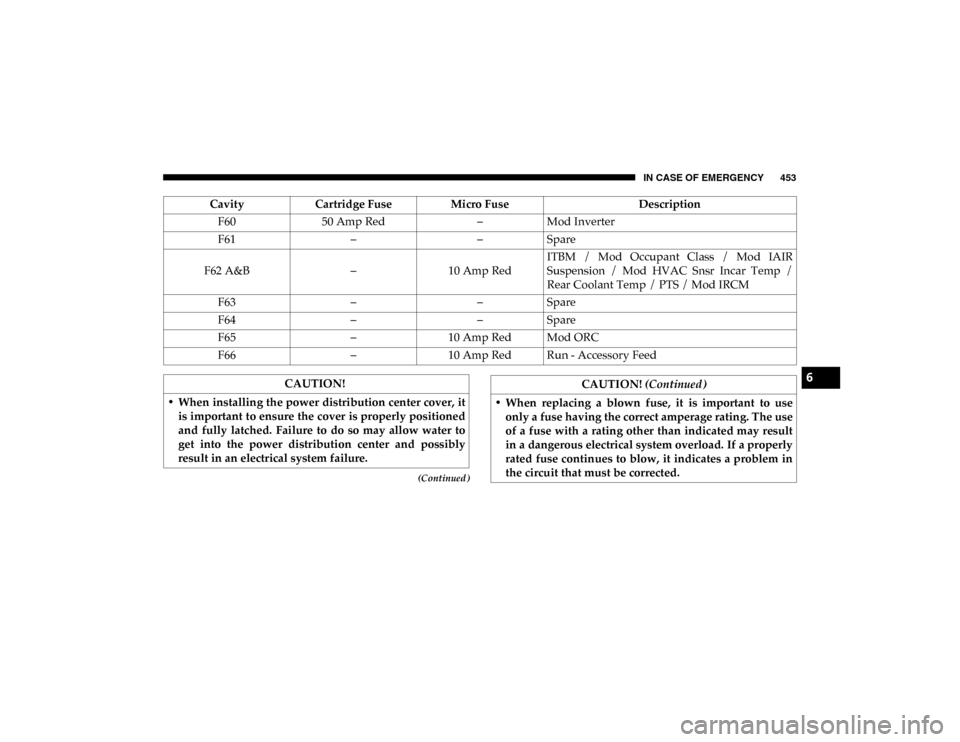
F6050 Amp Red –Mod Inverter
F61 ––Spare
F62 A&B –10 Amp Red ITBM / Mod Occupant Class / Mod IAIR
Suspension / Mod HVAC Snsr Incar Temp /
Rear Coolant Temp / PTS / Mod IRCM
F63 ––Spare
F64 ––Spare
F65 –10 Amp Red Mod ORC
F66 –10 Amp Red Run - Accessory Feed
Cavity
Cartridge Fuse Micro Fuse Description
CAUTION!
• When installing the power distribution center cover, it is important to ensure the cover is properly positioned
and fully latched. Failure to do so may allow water to
get into the power distribution center and possibly
result in an electrical system failure.
• When replacing a blown fuse, it is important to useonly a fuse having the correct amperage rating. The use
of a fuse with a rating other than indicated may result
in a dangerous electrical system overload. If a properly
rated fuse continues to blow, it indicates a problem in
the circuit that must be corrected. CAUTION!
(Continued)
6
2020_DT_1500_OM_US.book Page 453
Page 477 of 674
IN CASE OF EMERGENCY 475
If frequent jump starting is required to start your vehicle you
should have the battery and charging system inspected at an
authorized dealer.
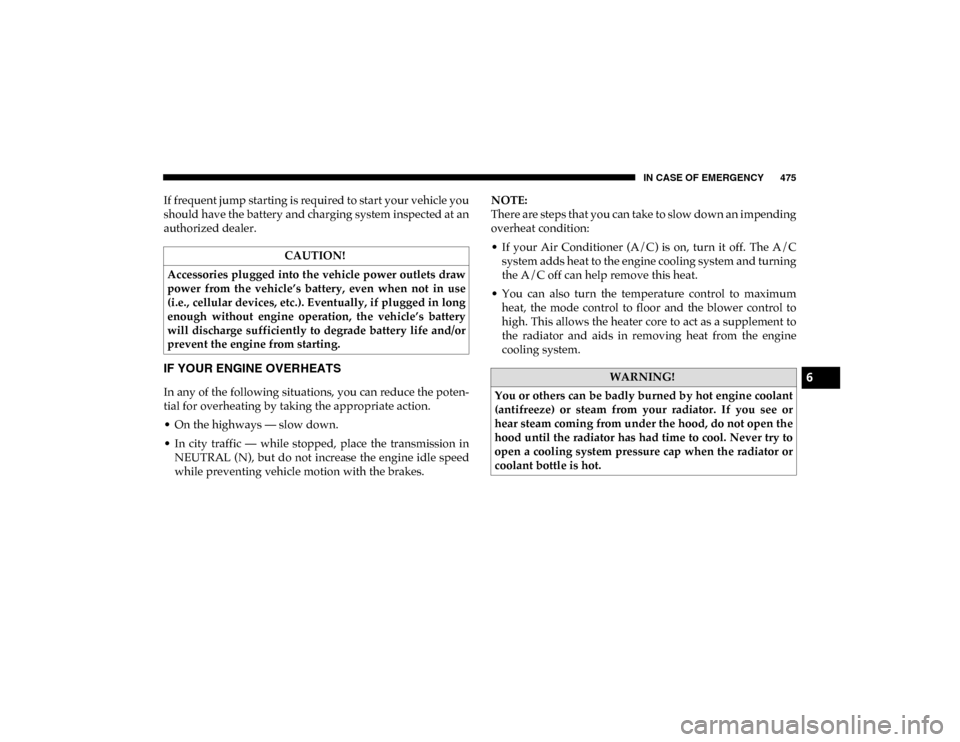
IF YOUR ENGINE OVERHEATS
In any of the following situations, you can reduce the poten-
tial for overheating by taking the appropriate action.
• On the highways — slow down.
• In city traffic — while stopped, place the transmission in NEUTRAL (N), but do not increase the engine idle speed
while preventing vehicle motion with the brakes. NOTE:
There are steps that you can take to slow down an impending
overheat condition:
• If your Air Conditioner (A/C) is on, turn it off. The A/C
system adds heat to the engine cooling system and turning
the A/C off can help remove this heat.
• You can also turn the temperature control to maximum heat, the mode control to floor and the blower control to
high. This allows the heater core to act as a supplement to
the radiator and aids in removing heat from the engine
cooling system.
CAUTION!
Accessories plugged into the vehicle power outlets draw
power from the vehicle’s battery, even when not in use
(i.e., cellular devices, etc.). Eventually, if plugged in long
enough without engine operation, the vehicle’s battery
will discharge sufficiently to degrade battery life and/or
prevent the engine from starting.
WARNING!
You or others can be badly burned by hot engine coolant
(antifreeze) or steam from your radiator. If you see or
hear steam coming from under the hood, do not open the
hood until the radiator has had time to cool. Never try to
open a cooling system pressure cap when the radiator or
coolant bottle is hot.6
2020_DT_1500_OM_US.book Page 475
Page 485 of 674
SERVICING AND MAINTENANCE 483
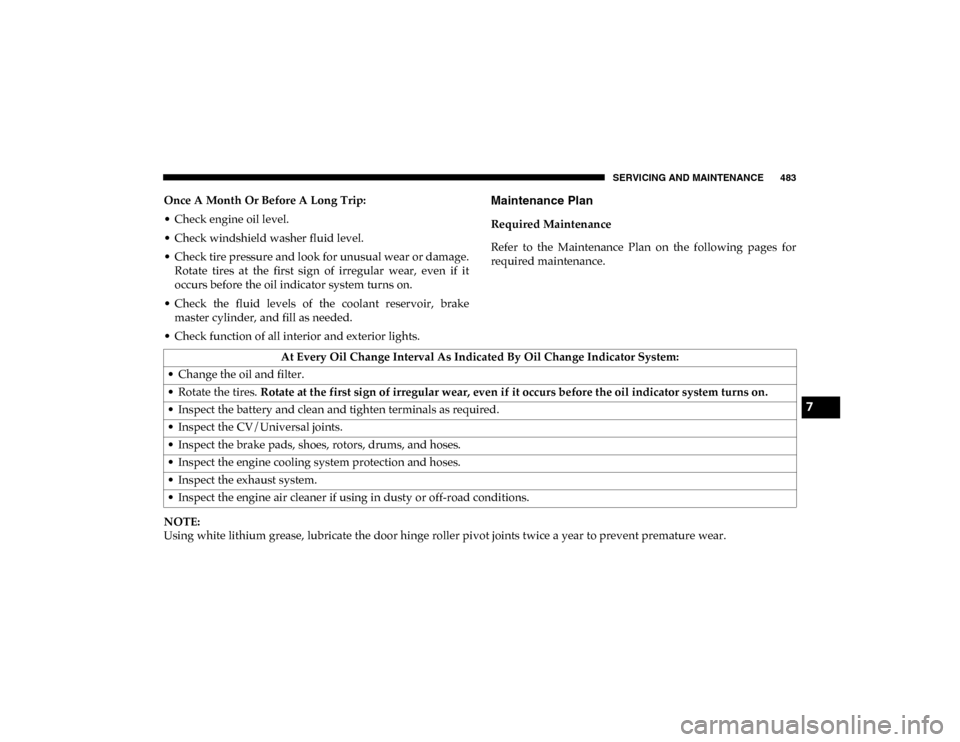
Once A Month Or Before A Long Trip:
• Check engine oil level.
• Check windshield washer fluid level.
• Check tire pressure and look for unusual wear or damage.Rotate tires at the first sign of irregular wear, even if it
occurs before the oil indicator system turns on.
• Check the fluid levels of the coolant reservoir, brake master cylinder, and fill as needed.
• Check function of all interior and exterior lights.Maintenance Plan
Required Maintenance
Refer to the Maintenance Plan on the following pages for
required maintenance.
NOTE:
Using white lithium grease, lubricate the door hinge roller pivot joints twice a year to prevent premature wear. At Every Oil Change Interval As Indicated By Oil Change Indicator System:
• Change the oil and filter.
• Rotate the tires. Rotate at the first sign of irregular wear, even if it occurs before the oil indicator system turns on.
• Inspect the battery and clean and tighten terminals as required.
• Inspect the CV/Universal joints.
• Inspect the brake pads, shoes, rotors, drums, and hoses.
• Inspect the engine cooling system protection and hoses.
• Inspect the exhaust system.
• Inspect the engine air cleaner if using in dusty or off-road conditions.
7
2020_DT_1500_OM_US.book Page 483
Page 487 of 674
SERVICING AND MAINTENANCE 485
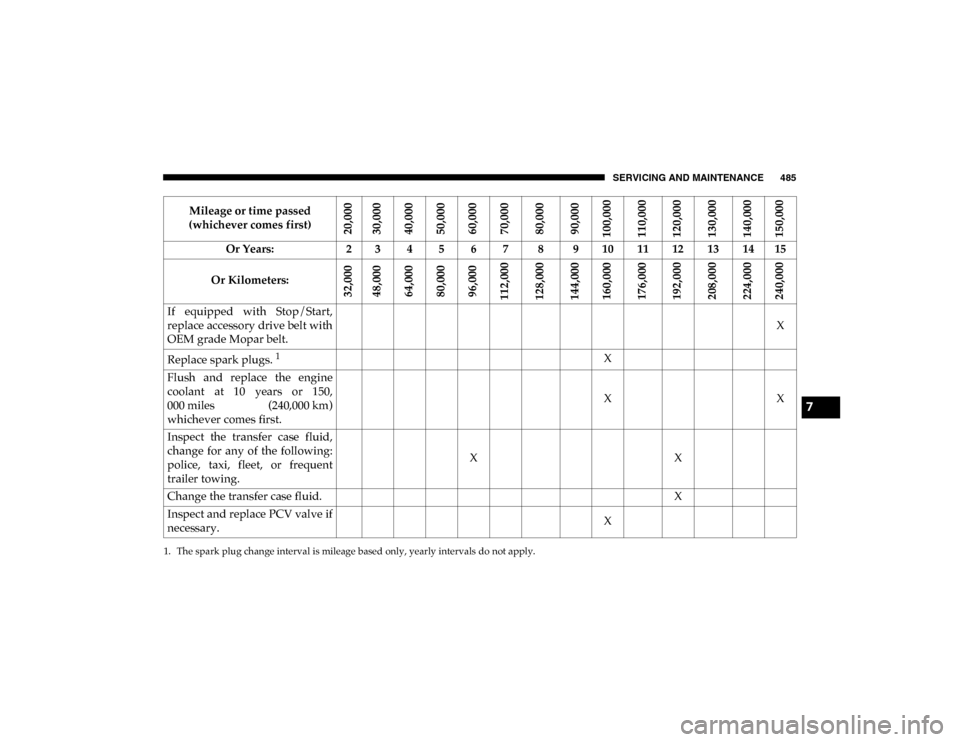
If equipped with Stop/Start,
replace accessory drive belt with
OEM grade Mopar belt.X
Replace spark plugs.
1X
Flush and replace the engine
coolant at 10 years or 150,
000 miles (240,000 km)
whichever comes first. X
X
Inspect the transfer case fluid,
change for any of the following:
police, taxi, fleet, or frequent
trailer towing. X
X
Change the transfer case fluid. X
Inspect and replace PCV valve if
necessary. X
1. The spark plug change interval is mileage based only, yearly intervals do not apply.
Mileage or time passed
(whichever comes first)
20,000
30,000
40,00050,00060,00070,000
80,00090,000
100,000
110,000120,000130,000140,000150,000
Or Years: 2 3 4 5 6 7 8 9 10 11 12 13 14 15
Or Kilometers:
32,000 48,000
64,00080,00096,000
112,000
128,000144,000160,000
176,000192,000208,000224,000240,000
7
2020_DT_1500_OM_US.book Page 485
Page 489 of 674
SERVICING AND MAINTENANCE 487
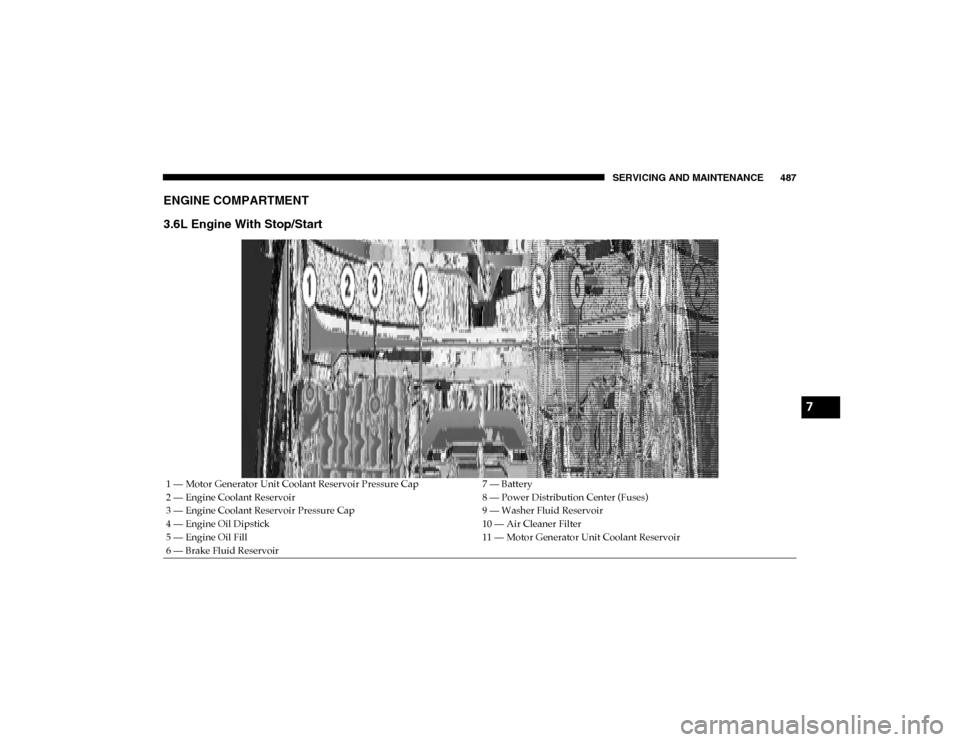
ENGINE COMPARTMENT
3.6L Engine With Stop/Start
1 — Motor Generator Unit Coolant Reservoir Pressure Cap7 — Battery
2 — Engine Coolant Reservoir 8 — Power Distribution Center (Fuses)
3 — Engine Coolant Reservoir Pressure Cap 9 — Washer Fluid Reservoir
4 — Engine Oil Dipstick 10 — Air Cleaner Filter
5 — Engine Oil Fill 11 — Motor Generator Unit Coolant Reservoir
6 — Brake Fluid Reservoir
7
2020_DT_1500_OM_US.book Page 487
Page 490 of 674
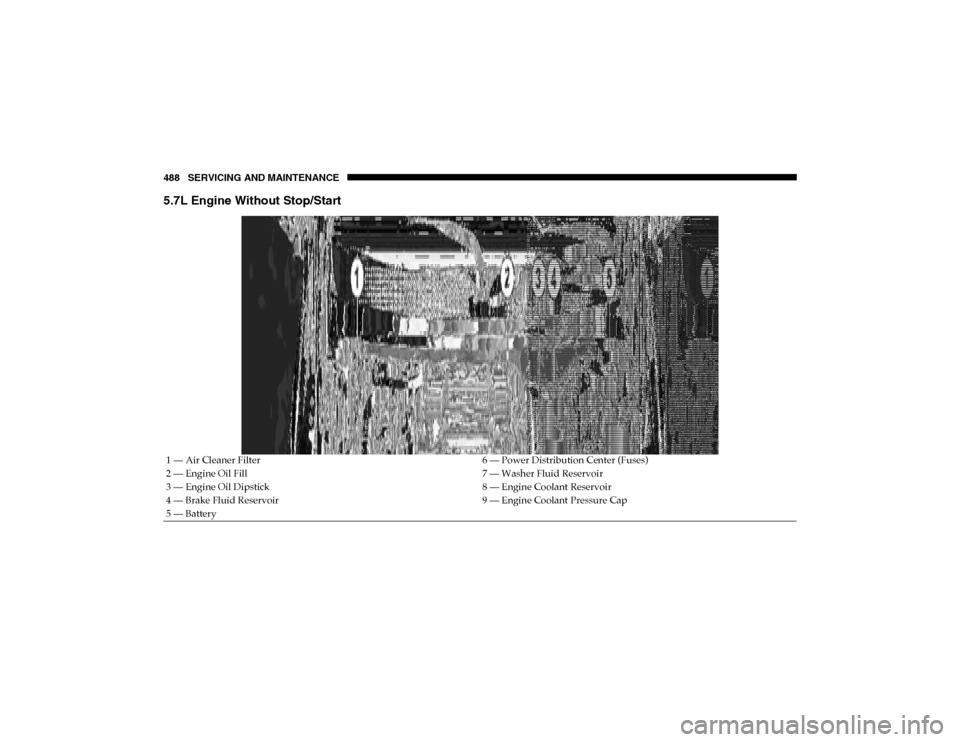
488 SERVICING AND MAINTENANCE
5.7L Engine Without Stop/Start
1 — Air Cleaner Filter6 — Power Distribution Center (Fuses)
2 — Engine Oil Fill 7 — Washer Fluid Reservoir
3 — Engine Oil Dipstick 8 — Engine Coolant Reservoir
4 — Brake Fluid Reservoir 9 — Engine Coolant Pressure Cap
5 — Battery
2020_DT_1500_OM_US.book Page 488
Page 491 of 674
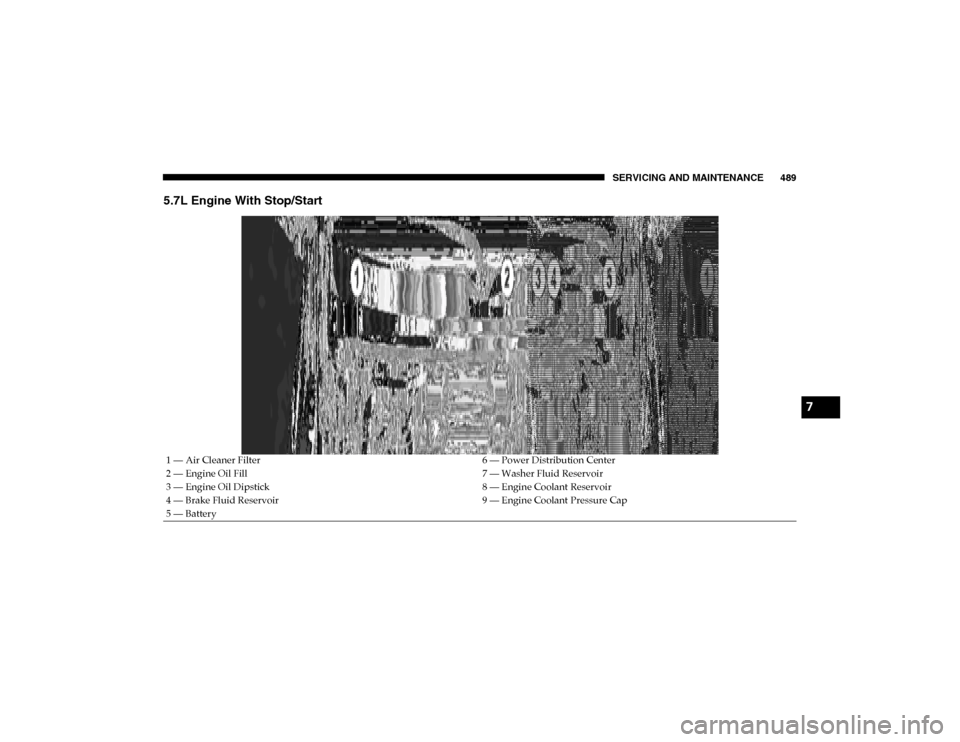
SERVICING AND MAINTENANCE 489
5.7L Engine With Stop/Start
1 — Air Cleaner Filter6 — Power Distribution Center
2 — Engine Oil Fill 7 — Washer Fluid Reservoir
3 — Engine Oil Dipstick 8 — Engine Coolant Reservoir
4 — Brake Fluid Reservoir 9 — Engine Coolant Pressure Cap
5 — Battery
7
2020_DT_1500_OM_US.book Page 489
Page 508 of 674
506 SERVICING AND MAINTENANCE
(Continued)
Under normal operating conditions, the catalytic converter
will not require maintenance. However, it is important to
keep the engine properly tuned to assure proper catalyst
operation and prevent possible catalyst damage.
NOTE:
Intentional tampering with emissions control systems can
result in civil penalties being assessed against you.
In unusual situations involving grossly malfunctioning
engine operation, a scorching odor may suggest severe and
abnormal catalyst overheating. If this occurs, stop the
vehicle, turn off the engine and allow it to cool. Service,
including a tune-up to manufacturer's specifications, should
be obtained immediately.To minimize the possibility of catalytic converter damage:
• Do not interrupt the ignition when the transmission is in
gear and the vehicle is in motion.
• Do not try to start the vehicle by pushing or towing the vehicle.
• Do not idle the engine with any ignition components disconnected or removed, such as when diagnostic testing,
or for prolonged periods during very rough idle or
malfunctioning operating conditions.Cooling System
• Damage to the catalytic converter can result if yourvehicle is not kept in proper operating condition. In the
event of engine malfunction, particularly involving
engine misfire or other apparent loss of performance,
have your vehicle serviced promptly. Continued opera -
tion of your vehicle with a severe malfunction could
cause the converter to overheat, resulting in possible
damage to the converter and vehicle. CAUTION!
(Continued)
WARNING!
• You or others can be badly burned by hot engine coolant (antifreeze) or steam from your radiator. If you
see or hear steam coming from under the hood, do not
open the hood until the radiator has had time to cool.
Never open a cooling system pressure cap when the
radiator or coolant bottle is hot.
• Keep hands, tools, clothing, and jewelry away from the radiator cooling fan when the hood is raised. The fan
starts automatically and may start at any time, whether
the engine is running or not.
2020_DT_1500_OM_US.book Page 506
Page 509 of 674
SERVICING AND MAINTENANCE 507
Engine Coolant Checks
Check the engine coolant (antifreeze) protection every
12 months (before the onset of freezing weather, where
applicable). If the engine coolant (antifreeze) is dirty or rusty
in appearance, the system should be drained, flushed and
refilled with fresh coolant. Check the front of the A/C
condenser (if equipped) or radiator for any accumulation of
bugs, leaves, etc. If dirty, clean by gently spraying water
from a garden hose vertically down the face of the A/C
condenser (if equipped) or the back of the radiator core.
Check the engine cooling system hoses for brittle rubber,
cracking, tears, cuts and tightness of the connection at the
coolant recovery bottle and radiator. Inspect the entire
system for leaks.
DO NOT REMOVE THE COOLANT PRESSURE CAP
WHEN THE COOLING SYSTEM IS HOT. Cooling System — Drain, Flush And Refill
NOTE:
Some vehicles require special tools to add coolant properly.
Failure to fill these systems properly could lead to severe
internal engine damage. If any coolant is needed to be added
to the system please contact an authorized dealer.
If the engine coolant (antifreeze) is dirty or contains visible
sediment, have an authorized dealer clean and flush with
OAT coolant (antifreeze) (conforming to MS.90032).
Refer to the “Maintenance Plan” in this section for the proper
maintenance intervals.
Selection Of Coolant
Refer to “Fluids And Lubricants” in “Technical Specifica
-
tions” for further information.
NOTE:
• Mixing of engine coolant (antifreeze) other than specified Organic Additive Technology (OAT) engine coolant (anti -
freeze), may result in engine damage and may decrease
corrosion protection. Organic Additive Technology (OAT)
engine coolant is different and should not be mixed with
Hybrid Organic Additive Technology (HOAT) engine
coolant (antifreeze) or any “globally compatible” coolant
• When working near the radiator cooling fan, discon
-
nect the fan motor lead or turn the ignition to the OFF
mode. The fan is temperature controlled and can start at
any time the ignition is in the ON mode.
WARNING! (Continued)
7
2020_DT_1500_OM_US.book Page 507
Page 510 of 674

508 SERVICING AND MAINTENANCE
(antifreeze). If a non-OAT engine coolant (antifreeze) is
introduced into the cooling system in an emergency, the
cooling system will need to be drained, flushed, and
refilled with fresh OAT coolant (conforming to MS.90032),
by an authorized dealer as soon as possible.
• Do not use water alone or alcohol-based engine coolant (antifreeze) products. Do not use additional rust inhibitors
or antirust products, as they may not be compatible with
the radiator engine coolant and may plug the radiator.
• This vehicle has not been designed for use with propylene glycol-based engine coolant (antifreeze). Use of propylene
glycol-based engine coolant (antifreeze) is not recom -
mended.
• Some vehicles require special tools to add coolant prop -
erly. Failure to fill these systems properly could lead to
severe internal engine damage. If any coolant is needed to
be added to the system please contact an authorized
dealer.
Adding Coolant
Your vehicle has been built with an improved engine coolant
(OAT coolant conforming to MS.90032) that allows extended
maintenance intervals. This engine coolant (antifreeze) can
be used up to 10 years or 150,000 miles (240,000 km) before
replacement. To prevent reducing this extended mainte -nance period, it is important that you use the same engine
coolant (OAT coolant conforming to MS.90032) throughout
the life of your vehicle.
Please review these recommendations for using Organic
Additive Technology (OAT) engine coolant (antifreeze) that
meets the requirements of FCA Material Standard MS.90032.
When adding engine coolant (antifreeze):
• We recommend using Mopar® Antifreeze/Coolant 10 Year/
150,000 Mile (240,000 km) Formula OAT (Organic Additive
Technology) that meets the requirements of FCA Material
Standard MS.90032.
• Mix a minimum solution of 50% OAT engine coolant that meets the requirements of FCA Material Standard
MS.90032 and distilled water. Use higher concentrations
(not to exceed 70%) if temperatures below −34°F (−37°C)
are anticipated. Please contact an authorized dealer for
assistance.
• Use only high purity water such as distilled or deionized water when mixing the water/engine coolant (antifreeze)
solution. The use of lower quality water will reduce the
amount of corrosion protection in the engine cooling
system.
2020_DT_1500_OM_US.book Page 508