spare tire Ram 1500 2020 User Guide
[x] Cancel search | Manufacturer: RAM, Model Year: 2020, Model line: 1500, Model: Ram 1500 2020Pages: 674, PDF Size: 32.69 MB
Page 459 of 674

IN CASE OF EMERGENCY 457
NOTE:
If the tailgate is lowered, the jack extension with hook can be
added to this assembly to enable lowering of the spare tire
without having to raise the tailgateAssembled For Jack Operation
Assembled For Jack Operation
CAUTION!
• The lug wrench can only be attached to extension 2.
• When attaching the tool to the winch mechanism be sure the large flared end opening on extension 4 is posi -
tioned correctly over the winch mechanism adjusting
nut.
• Damage to the lug wrench, extensions and winch mech -
anism may occur from improper tool assembly.
1 — Lug Wrench
2 — Long Extension 2
3 — Long Extension 3
4 — Long Extension 4
5 — Short Extension 5
6 — Extension With Hook
6
2020_DT_1500_OM_US.book Page 457
Page 460 of 674
458 IN CASE OF EMERGENCY
Removing The Spare Tire
1. Remove the spare tire before attempting to jack up thetruck. Attach the lug wrench to the extension tubes with
the curved angle facing away from the vehicle.
2. Remove the protective cover over the access hole for the winch mechanism by sliding the cover upward. Access Hole Cover Location
WARNING!
After using the jack and tools, always reinstall them in
the original carrier and location. While driving you may
experience abrupt stopping, rapid acceleration or sharp
turns. A loose jack, tools, bracket or other objects in the
vehicle may move around with force, resulting in serious
injury.
2020_DT_1500_OM_US.book Page 458
Page 462 of 674
460 IN CASE OF EMERGENCY
4. Rotate the lug wrench handle counterclockwise until thespare tire is on the ground with enough cable slack to
allow you to pull it out from under the vehicle.
Rotating The Lug Wrench Handle 5. Pull the spare tire out from under the vehicle to gain
access to the spare tire retainer.
Pulling The Spare Tire Out
2020_DT_1500_OM_US.book Page 460
Page 463 of 674
IN CASE OF EMERGENCY 461
6. Lift the spare tire with one hand to give clearance to tiltthe retainer at the end of the cable.
Gaining Access To The Retainer 7. Pull the retainer through the center of the wheel.
Pulling The Retainer Through The Center Of The Wheel
NOTE:
The winch mechanism is designed for use with the extension
tubes only. Use of an air wrench or other power tools is not
recommended and can damage the winch.
6
2020_DT_1500_OM_US.book Page 461
Page 465 of 674
IN CASE OF EMERGENCY 463
Jacking Instructions
Jack Warning Label
1. Remove the spare tire, jack, and tools from the stored location.
2. Using the lug wrench, loosen the wheel nuts (but do not remove), by turning them counterclockwise one turn
while the wheel is still on the ground.
WARNING!
Carefully follow these tire changing warnings to help
prevent personal injury or damage to your vehicle:
• Always park on a firm, level surface as far from the edge of the roadway as possible before raising the vehicle.
• Turn on the Hazard Warning flasher.
• Block the wheel diagonally opposite the wheel to be raised.
• Apply the parking brake firmly and set the transmission in PARK.
• Never start or run the engine with the vehicle on a jack.
• Do not let anyone sit in the vehicle when it is on a jack.
• Do not get under the vehicle when it is on a jack. If you need to get under a raised vehicle, take it to a service center
where it can be raised on a lift.
• Only use the jack in the positions indicated and for lifting this vehicle during a tire change.
• If working on or near a roadway, be extremely careful of motor traffic.
• To assure that spare tires, flat or inflated, are securely stowed, spares must be stowed with the valve stem facing
the ground.
CAUTION!
Do not attempt to raise the vehicle by jacking on
locations other than those indicated in the Jacking
Instructions for this vehicle.
6
2020_DT_1500_OM_US.book Page 463
Page 469 of 674

IN CASE OF EMERGENCY 467
6. Remove the lug nuts and pull the wheel off. Install thespare wheel and lug nuts with the cone shaped end of the
lug nuts toward the wheel. Hand tighten the lug nuts
with vehicle lifted. To avoid the risk of forcing the vehicle
off the jack, do not fully tighten the lug nuts until the
vehicle has been lowered.
7. Lower vehicle to ground, finish tightening the lug nuts. Push down on the wrench while at the end of the handle
for increased leverage. Tighten the lug nuts in a star
pattern until each nut has been tightened twice.
NOTE:
For the correct lug nut torque refer to “Technical Specifica -
tions” in “Torque Specifications.” If in doubt about the
correct tightness, have them checked with a torque wrench
by an authorized dealer or service station. 8. If your vehicle is equipped with a wheel center cap, install
the cap and remove the wheel blocks. Do not install
chrome or aluminum wheel center caps on the spare
wheel. This may result in cap damage.
9. Lower the jack to its fully closed position. Stow the replaced tire, and secure the jack and tools in the proper
location.
10. Adjust the tire pressure when possible.
WARNING!
Raising the vehicle higher than necessary can make the
vehicle less stable. It could slip off the jack and hurt
someone near it. Raise the vehicle only enough to
remove the tire.WARNING!
A loose tire or jack thrown forward in a collision or hard
stop, could endanger the occupants of the vehicle.
Always stow the jack parts and the spare tire in the
places provided.
6
2020_DT_1500_OM_US.book Page 467
Page 470 of 674
468 IN CASE OF EMERGENCY
To Stow The Flat Or Spare
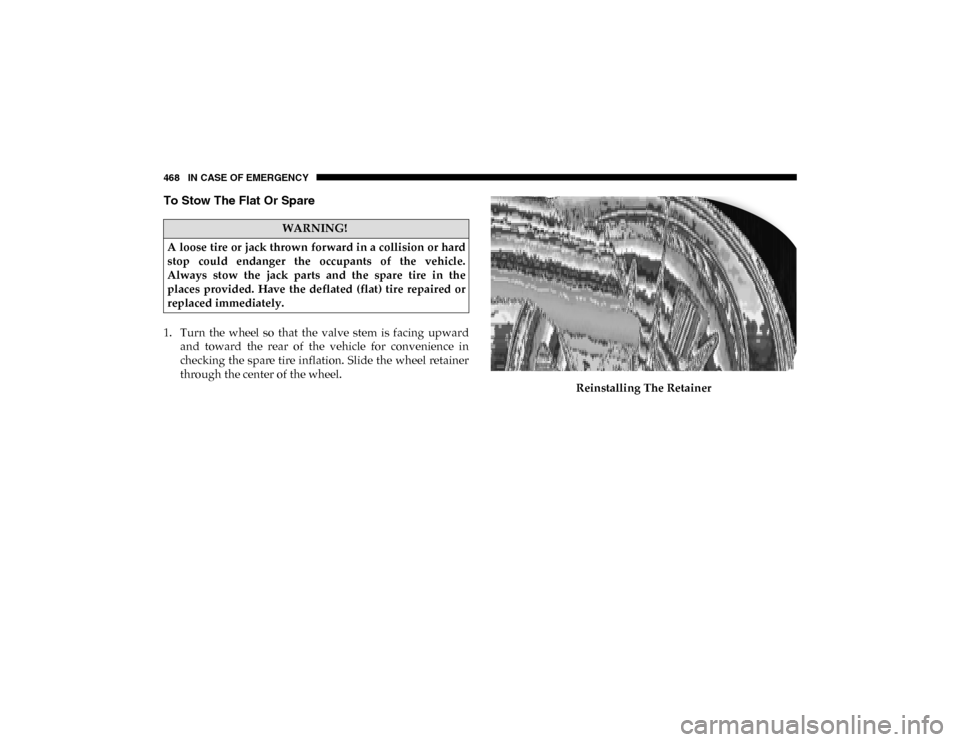
1. Turn the wheel so that the valve stem is facing upwardand toward the rear of the vehicle for convenience in
checking the spare tire inflation. Slide the wheel retainer
through the center of the wheel. Reinstalling The Retainer
WARNING!
A loose tire or jack thrown forward in a collision or hard
stop could endanger the occupants of the vehicle.
Always stow the jack parts and the spare tire in the
places provided. Have the deflated (flat) tire repaired or
replaced immediately.
2020_DT_1500_OM_US.book Page 468
Page 471 of 674

IN CASE OF EMERGENCY 469
2. Lift the spare tire with one hand to give clearance to tiltthe retainer at the end of the cable and position it properly
across the wheel opening.
Pushing The Retainer Through The Center Of The Wheel And Positioning It 3. Remove the extension with the hook and reattach the
short extension 5. Attach the lug wrench to the extension
tubes with the curved angle facing away from the vehicle.
Insert the extension tubes through the access hole
between the lower tailgate and the top of the bumper and
into the winch mechanism tube.
Lug Wrench And Extension Tubes Assembled And In Position
6
2020_DT_1500_OM_US.book Page 469
Page 519 of 674

SERVICING AND MAINTENANCE 517
NOTE:
• P (Passenger) — Metric tire sizing is based on US designstandards. P-Metric tires have the letter “P” molded into
the sidewall preceding the size designation. Example:
P215/65R15 95H.
• European — Metric tire sizing is based on European design standards. Tires designed to this standard have the
tire size molded into the sidewall beginning with the
section width. The letter "P" is absent from this tire size
designation. Example: 215/65R15 96H.
• LT (Light Truck) — Metric tire sizing is based on US design standards. The size designation for LT-Metric tires is the same as for P-Metric tires except for the letters “LT” that
are molded into the sidewall preceding the size designa
-
tion. Example: LT235/85R16.
• Temporary spare tires are designed for temporary emer -
gency use only. Temporary high pressure compact spare
tires have the letter “T” or “S” molded into the sidewall
preceding the size designation. Example: T145/80D18
103M.
• High flotation tire sizing is based on US design standards and it begins with the tire diameter molded into the side -
wall. Example: 31x10.5 R15 LT.
Tire Sizing Chart EXAMPLE:
Example Size Designation: P215/65R15XL 95H, 215/65R15 96H, LT235/85R16C, T145/80D18 103M, 31x10.5 R15 LT
P = Passenger car tire size based on US design standards, or
"....blank...." = Passenger car tire based on European design standards, or
LT = Light truck tire based on US design standards, or
T or S = Temporary spare tire or
31 = Overall diameter in inches (in)
215, 235, 145 = Section width in millimeters (mm)
7
2020_DT_1500_OM_US.book Page 517
Page 523 of 674
SERVICING AND MAINTENANCE 521
Tire Loading And Tire Pressure
NOTE:
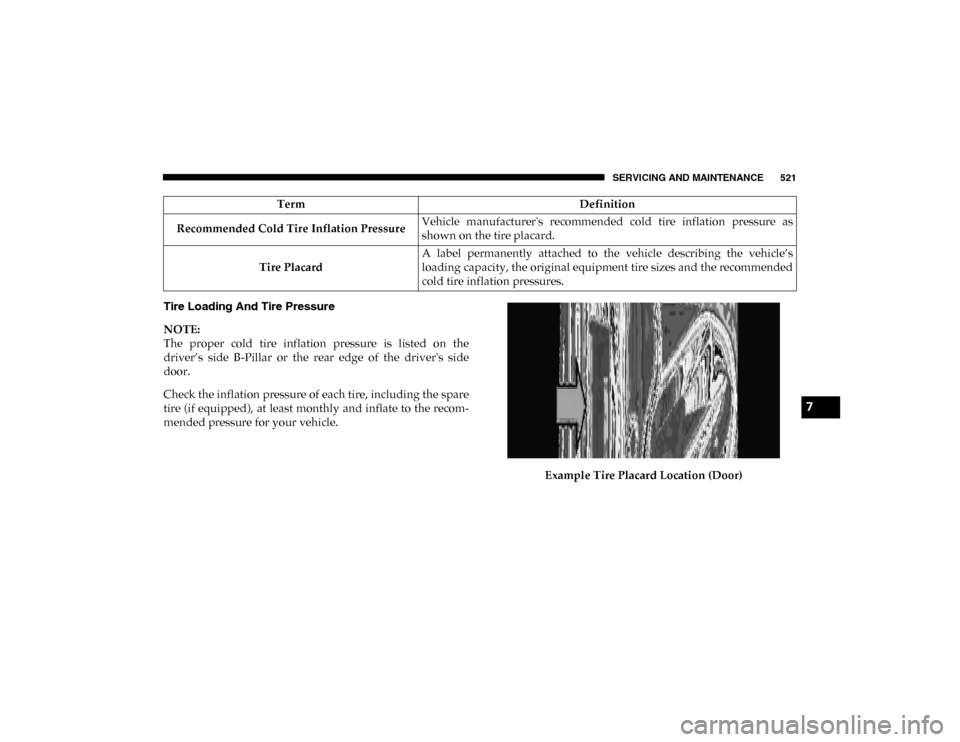
The proper cold tire inflation pressure is listed on the
driver’s side B-Pillar or the rear edge of the driver's side
door.
Check the inflation pressure of each tire, including the spare
tire (if equipped), at least monthly and inflate to the recom-
mended pressure for your vehicle.
Example Tire Placard Location (Door)
Recommended Cold Tire Inflation Pressure
Vehicle manufacturer's recommended cold tire inflation pressure as
shown on the tire placard.
Tire Placard A label permanently attached to the vehicle describing the vehicle’s
loading capacity, the original equipment tire sizes and the recommended
cold tire inflation pressures.
Term
Definition
7
2020_DT_1500_OM_US.book Page 521