tire size Ram 1500 2020 User Guide
[x] Cancel search | Manufacturer: RAM, Model Year: 2020, Model line: 1500, Model: Ram 1500 2020Pages: 674, PDF Size: 32.69 MB
Page 345 of 674

STARTING AND OPERATING 343
NOTE:
Any chassis/suspension or tire size modifications to the
vehicle will effect the performance of the Adaptive Cruise
Control and Forward Collision Warning System.
Activating Adaptive Cruise Control (ACC)
You can only engage ACC if the vehicle speed is above
0 mph (0 km/h).
The minimum set speed for the ACC system is 20 mph
(32 km/h).
When the system is turned on and in the ready state, the
instrument cluster display will read “ACC Ready.”
When the system is off, the instrument cluster display will
read “Adaptive Cruise Control (ACC) Off.”NOTE:
You cannot engage ACC under the following conditions:
• When in Four-Wheel Drive Low
• When you apply the brakes
• When the parking brake is applied
• When the automatic transmission is in PARK, REVERSE or
NEUTRAL
• When the vehicle speed is outside of the speed range
• When the brakes are overheated
• When the driver door is open at low speed
• When the driver seat belt is unbuckled at low speed
• ESC Full-Off Mode is active
5
2020_DT_1500_OM_US.book Page 343
Page 408 of 674

406 STARTING AND OPERATING
Gross Axle Weight Rating (GAWR)
The GAWR is the maximum permissible load on the front
and rear axles. The load must be distributed in the cargo area
so that the GAWR of each axle is not exceeded.
Each axle GAWR is determined by the components in the
system with the lowest load carrying capacity (axle, springs,
tires or wheels). Heavier axles or suspension components
sometimes specified by purchasers for increased durability
does not necessarily increase the vehicle's GVWR.
Tire Size
The tire size on the Vehicle Certification Label represents the
actual tire size on your vehicle. Replacement tires must be
equal to the load capacity of this tire size.
Rim Size
This is the rim size that is appropriate for the tire size listed.
Inflation Pressure
This is the cold tire inflation pressure for your vehicle for all
loading conditions up to full Gross Axle Weight Rating
(GAWR).
Curb Weight
The curb weight of a vehicle is defined as the total weight of
the vehicle with all fluids, including vehicle fuel, at full
capacity conditions, and with no occupants or cargo loaded
into the vehicle. The front and rear curb weight values are
determined by weighing your vehicle on a commercial scale
before any occupants or cargo are added.
Loading
The actual total weight and the weight of the front and rear
of your vehicle at the ground can best be determined by
weighing it when it is loaded and ready for operation.
The entire vehicle should first be weighed on a commercial
scale to insure that the Gross Vehicle Weight Rating (GVWR)
has not been exceeded. The weight on the front and rear of
the vehicle should then be determined separately to be sure
that the load is properly distributed over the front and rear
axle. Weighing the vehicle may show that the Gross Axle
Weight Rating (GAWR) of either the front or rear axles has
been exceeded but the total load is within the specified
GVWR. If so, weight must be shifted from front to rear or
rear to front as appropriate until the specified weight limita-
tions are met. Store the heavier items down low and be sure
2020_DT_1500_OM_US.book Page 406
Page 417 of 674

STARTING AND OPERATING 415
Towing Requirements — Tires
• Do not attempt to tow a trailer while using a compact sparetire.
• Do not drive more than 50 mph (80 km/h) when towing while using a full size spare tire.
• Proper tire inflation pressures are essential to the safe and satisfactory operation of your vehicle. Refer to “Tires” in
“Servicing And Maintenance” for proper tire inflation
procedures.
• Check the trailer tires for proper tire inflation pressures before trailer usage.
• Check for signs of tire wear or visible tire damage before towing a trailer. Refer to “Tires” in “Servicing And Main -
tenance” for the proper inspection procedure.
• When replacing tires, refer to “Tires” in “Servicing And Maintenance” for the proper tire replacement procedures.
Replacing tires with a higher load carrying capacity will
not increase the vehicle's GVWR and GAWR limits.
Towing Requirements — Trailer Brakes
• Do not interconnect the hydraulic brake system or vacuum
system of your vehicle with that of the trailer. This could
cause inadequate braking and possible personal injury. • An electronically actuated trailer brake controller is
required when towing a trailer with electronically actu -
ated brakes. When towing a trailer equipped with a
hydraulic surge actuated brake system, an electronic brake
controller is not required.
• Trailer brakes are recommended for trailers over 1,000 lbs (453 kg) and required for trailers in excess of 2,000 lbs (907 kg).
WARNING!
• Do not connect trailer brakes to your vehicle's hydraulic brake lines. It can overload your brake
system and cause it to fail. You might not have brakes
when you need them and could have an accident.
• Towing any trailer will increase your stopping distance. When towing, you should allow for addi -
tional space between your vehicle and the vehicle in
front of you. Failure to do so could result in an accident.
CAUTION!
If the trailer weighs more than 1,000 lbs (453 kg) loaded,
it should have its own brakes and they should be of
adequate capacity. Failure to do this could lead to
accelerated brake lining wear, higher brake pedal effort,
and longer stopping distances.
5
2020_DT_1500_OM_US.book Page 415
Page 518 of 674
516 SERVICING AND MAINTENANCE
Fluid Level Check
This fluid level can be checked by removing the filler plug. The
fluid level should be to the bottom edge of the filler plug hole (or
within 1/8 inch of the bottom) with the vehicle in a level position.
Drain And Refill
Refer to the “Maintenance Plan” in this section for the proper
maintenance intervals.
HOISTING
A conventional floor jack may be used at the jacking loca-
tions. Refer to the graphics that show jacking locations.
However, a floor jack or frame hoist must never be used on
any other parts of the underbody.
TIRES
Tire Safety Information
Tire safety information will cover aspects of the following infor -
mation: Tire Markings, Tire Identification Numbers, Tire Termi -
nology and Definitions, Tire Pressures, and Tire Loading.
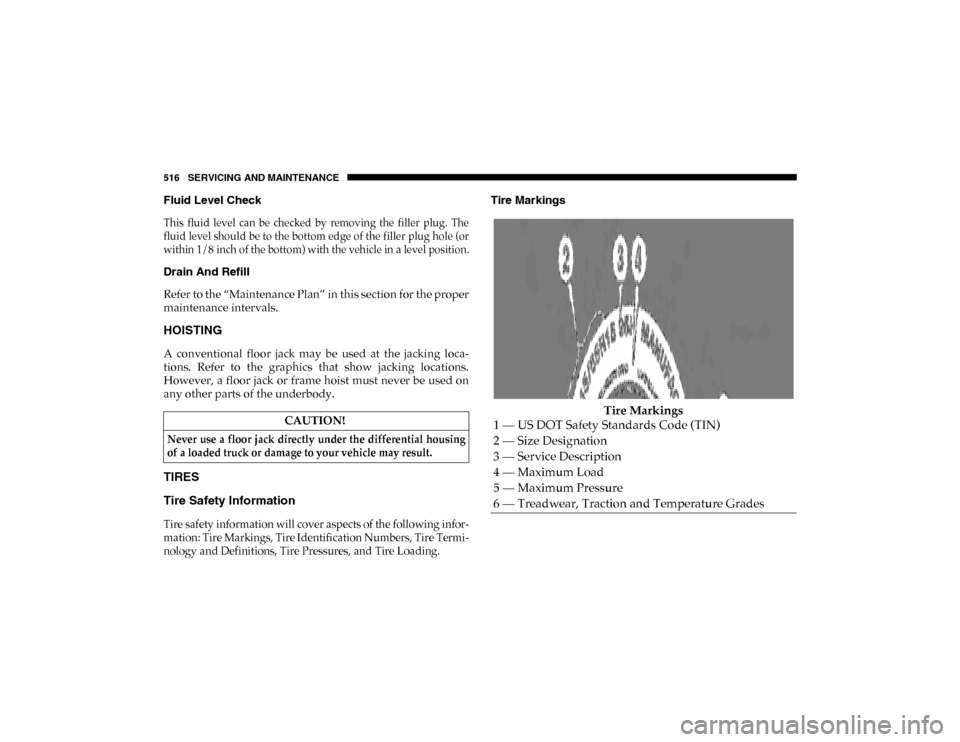
Tire Markings
Tire MarkingsCAUTION!
Never use a floor jack directly under the differential housing
of a loaded truck or damage to your vehicle may result.
1 — US DOT Safety Standards Code (TIN)
2 — Size Designation
3 — Service Description
4 — Maximum Load
5 — Maximum Pressure
6 — Treadwear, Traction and Temperature Grades
2020_DT_1500_OM_US.book Page 516
Page 519 of 674

SERVICING AND MAINTENANCE 517
NOTE:
• P (Passenger) — Metric tire sizing is based on US designstandards. P-Metric tires have the letter “P” molded into
the sidewall preceding the size designation. Example:
P215/65R15 95H.
• European — Metric tire sizing is based on European design standards. Tires designed to this standard have the
tire size molded into the sidewall beginning with the
section width. The letter "P" is absent from this tire size
designation. Example: 215/65R15 96H.
• LT (Light Truck) — Metric tire sizing is based on US design standards. The size designation for LT-Metric tires is the same as for P-Metric tires except for the letters “LT” that
are molded into the sidewall preceding the size designa
-
tion. Example: LT235/85R16.
• Temporary spare tires are designed for temporary emer -
gency use only. Temporary high pressure compact spare
tires have the letter “T” or “S” molded into the sidewall
preceding the size designation. Example: T145/80D18
103M.
• High flotation tire sizing is based on US design standards and it begins with the tire diameter molded into the side -
wall. Example: 31x10.5 R15 LT.
Tire Sizing Chart EXAMPLE:
Example Size Designation: P215/65R15XL 95H, 215/65R15 96H, LT235/85R16C, T145/80D18 103M, 31x10.5 R15 LT
P = Passenger car tire size based on US design standards, or
"....blank...." = Passenger car tire based on European design standards, or
LT = Light truck tire based on US design standards, or
T or S = Temporary spare tire or
31 = Overall diameter in inches (in)
215, 235, 145 = Section width in millimeters (mm)
7
2020_DT_1500_OM_US.book Page 517
Page 521 of 674

SERVICING AND MAINTENANCE 519
Tire Identification Number (TIN)
The Tire Identification Number (TIN) may be found on one or both sides of the tire; however, the date code may only be on
one side. Tires with white sidewalls will have the full TIN, including the date code, located on the white sidewall side of the
tire. Look for the TIN on the outboard side of black sidewall tires as mounted on the vehicle. If the TIN is not found on the
outboard side, then you will find it on the inboard side of the tire.Load Identification:
Absence of the following load identification symbols on the sidewall of the tire indicates a Standard Load (SL) tire:
•
XL = Extra load (or reinforced) tire, or
• LL = Light load tire or
• C, D, E, F, G = Load range associated with the maximum load a tire can carry at a specified pressure
Maximum Load – Maximum load indicates the maximum load this tire is designed to carry
Maximum Pressure – Maximum pressure indicates the maximum permissible cold tire inflation pressure for this tire EXAMPLE:
EXAMPLE:
DOT MA L9 ABCD 0301
DOT = Department of Transportation
• This symbol certifies that the tire is in compliance with the US Department of Transportation tire safety standards and is approved for highway use
MA = Code representing the tire manufacturing location (two digits)
L9 = Code representing the tire size (two digits)
7
2020_DT_1500_OM_US.book Page 519
Page 523 of 674
SERVICING AND MAINTENANCE 521
Tire Loading And Tire Pressure
NOTE:
The proper cold tire inflation pressure is listed on the
driver’s side B-Pillar or the rear edge of the driver's side
door.
Check the inflation pressure of each tire, including the spare
tire (if equipped), at least monthly and inflate to the recom-
mended pressure for your vehicle.
Example Tire Placard Location (Door)
Recommended Cold Tire Inflation Pressure
Vehicle manufacturer's recommended cold tire inflation pressure as
shown on the tire placard.
Tire Placard A label permanently attached to the vehicle describing the vehicle’s
loading capacity, the original equipment tire sizes and the recommended
cold tire inflation pressures.
Term
Definition
7
2020_DT_1500_OM_US.book Page 521
Page 524 of 674
522 SERVICING AND MAINTENANCE
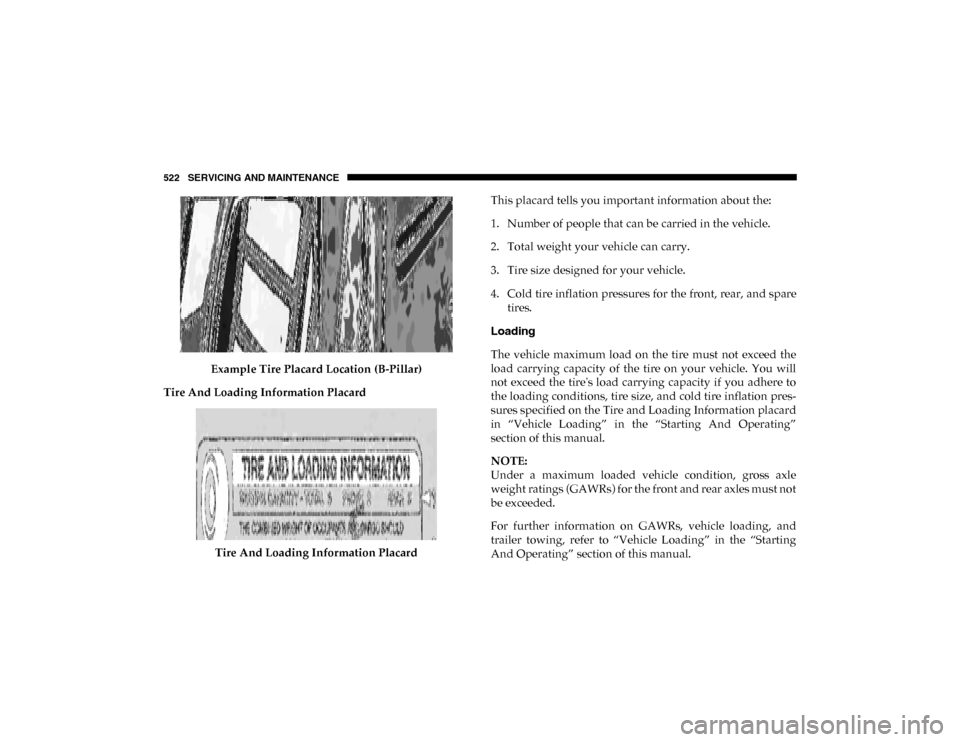
Example Tire Placard Location (B-Pillar)
Tire And Loading Information Placard
Tire And Loading Information Placard This placard tells you important information about the:
1. Number of people that can be carried in the vehicle.
2. Total weight your vehicle can carry.
3. Tire size designed for your vehicle.
4. Cold tire inflation pressures for the front, rear, and spare
tires.
Loading
The vehicle maximum load on the tire must not exceed the
load carrying capacity of the tire on your vehicle. You will
not exceed the tire's load carrying capacity if you adhere to
the loading conditions, tire size, and cold tire inflation pres -
sures specified on the Tire and Loading Information placard
in “Vehicle Loading” in the “Starting And Operating”
section of this manual.
NOTE:
Under a maximum loaded vehicle condition, gross axle
weight ratings (GAWRs) for the front and rear axles must not
be exceeded.
For further information on GAWRs, vehicle loading, and
trailer towing, refer to “Vehicle Loading” in the “Starting
And Operating” section of this manual.
2020_DT_1500_OM_US.book Page 522
Page 525 of 674

SERVICING AND MAINTENANCE 523
To determine the maximum loading conditions of your
vehicle, locate the statement “The combined weight of occu-
pants and cargo should never exceed XXX kg or XXX lbs” on
the Tire and Loading Information placard. The combined
weight of occupants, cargo/luggage and trailer tongue
weight (if applicable) should never exceed the weight refer-
enced here.
Steps For Determining Correct Load Limit—
(1) Locate the statement “The combined weight of occupants
and cargo should never exceed XXX kg or XXX lbs.” on your
vehicle's placard.
(2) Determine the combined weight of the driver and passen -
gers that will be riding in your vehicle.
(3) Subtract the combined weight of the driver and passen -
gers from XXX kg or XXX lbs.
(4) The resulting figure equals the available amount of cargo
and luggage load capacity. For example, if “XXX” amount
equals 1400 lbs. and there will be five 150 lb passengers in
your vehicle, the amount of available cargo and luggage load
capacity is 650 lbs. (1400-750 (5x150) = 650 lbs.)
(5) Determine the combined weight of luggage and cargo
being loaded on the vehicle. That weight may not safely exceed the available cargo and luggage load capacity calcu-
lated in Step 4.
(6) If your vehicle will be towing a trailer, load from your
trailer will be transferred to your vehicle. Consult this
manual to determine how this reduces the available cargo
and luggage load capacity of your vehicle.
Metric Example For Load Limit
For example, if “XXX” amount equals 635 kg and there will
be five 68 kg passengers in your vehicle, the amount of avail
-
able cargo and luggage load capacity is 295 kg (635-340
(5x68) = 295 kg) as shown in step 4.
NOTE:
• If your vehicle will be towing a trailer, load from your trailer will be transferred to your vehicle. The following
table shows examples on how to calculate total load,
cargo/luggage, and towing capacities of your vehicle with
varying seating configurations and number and size of
occupants. This table is for illustration purposes only and
may not be accurate for the seating and load carry capacity
of your vehicle.
• For the following example, the combined weight of occu -
pants and cargo should never exceed 865 lbs (392 kg).
7
2020_DT_1500_OM_US.book Page 523
Page 529 of 674

SERVICING AND MAINTENANCE 527
Example: If garage temperature = 68°F (20°C) and the outside
temperature = 32°F (0°C) then the cold tire inflation pressure
should be increased by 3 psi (21 kPa), which equals 1 psi (7 kPa)
for every 12°F (7°C) for this outside temperature condition.
Tire pressure may increase from 2 to 6 psi (13 to 40 kPa)
during operation. DO NOT reduce this normal pressure
build up or your tire pressure will be too low.
Tire Pressures For High Speed Operation
The manufacturer advocates driving at safe speeds and
within posted speed limits. Where speed limits or conditions
are such that the vehicle can be driven at high speeds, main-
taining correct tire inflation pressure is very important.
Increased tire pressure and reduced vehicle loading may be
required for high-speed vehicle operation. Refer to an autho -
rized tire dealer or original equipment vehicle dealer for
recommended safe operating speeds, loading and cold tire
inflation pressures. Radial Ply Tires
Tire Repair
If your tire becomes damaged, it may be repaired if it meets
the following criteria:
• The tire has not been driven on when flat
• The damage is only on the tread section of your tire (side
-
wall damage is not repairable)
• The puncture is no greater than a ¼ of an inch (6 mm)
Consult an authorized tire dealer for tire repairs and addi -
tional information.
Damaged Run Flat tires, or Run Flat tires that have experi -
enced a loss of pressure should be replaced immediately
with another Run Flat tire of identical size and service
description (Load Index and Speed Symbol). Replace the tire
pressure sensor as well as it is not designed to be reused.
WARNING!
High speed driving with your vehicle under maximum
load is dangerous. The added strain on your tires could
cause them to fail. You could have a serious collision. Do
not drive a vehicle loaded to the maximum capacity at
continuous speeds above 75 mph (120 km/h).
WARNING!
Combining radial ply tires with other types of tires on
your vehicle will cause your vehicle to handle poorly.
The instability could cause a collision. Always use radial
ply tires in sets of four. Never combine them with other
types of tires.
7
2020_DT_1500_OM_US.book Page 527