Belt Ram 1500 2020 Workshop Manual
[x] Cancel search | Manufacturer: RAM, Model Year: 2020, Model line: 1500, Model: Ram 1500 2020Pages: 674, PDF Size: 32.69 MB
Page 287 of 674

SAFETY 285
Transporting Pets
Air Bags deploying in the front seat could harm your pet. An
unrestrained pet will be thrown about and possibly injured,
or injure a passenger during panic braking or in a collision.
Pets should be restrained in the rear seat (if equipped) in pet
harnesses or pet carriers that are secured by seat belts.
SAFETY TIPS
Transporting Passengers
NEVER TRANSPORT PASSENGERS IN THE CARGO
AREA.
WARNING!
• An incorrectly anchored tether strap could lead to increased head motion and possible injury to the child.
Use only the anchorage position directly behind the
child seat to secure a child restraint top tether strap.
• If your vehicle is equipped with a split rear seat, make sure the tether strap does not slip into the opening
between the seatbacks as you remove slack in the strap.
WARNING!
• Do not leave children or animals inside parked vehicles in hot weather. Interior heat build-up may cause
serious injury or death.
• It is extremely dangerous to ride in a cargo area, inside or outside of a vehicle. In a collision, people riding in
these areas are more likely to be seriously injured or
killed.
• Do not allow people to ride in any area of your vehicle that is not equipped with seats and seat belts.
• Be sure everyone in your vehicle is in a seat and using a seat belt properly.
4
2020_DT_1500_OM_US.book Page 285
Page 288 of 674

286 SAFETY
Exhaust Gas
The best protection against carbon monoxide entry into the
vehicle body is a properly maintained engine exhaust
system.Whenever a change is noticed in the sound of the exhaust
system, when exhaust fumes can be detected inside the
vehicle, or when the underside or rear of the vehicle is
damaged, have a competent mechanic inspect the complete
exhaust system and adjacent body areas for broken,
damaged, deteriorated, or mispositioned parts. Open seams
or loose connections could permit exhaust fumes to seep into
the passenger compartment. In addition, inspect the exhaust
system each time the vehicle is raised for lubrication or oil
change. Replace as required.
Safety Checks You Should Make Inside The Vehicle
Seat Belts
Inspect the seat belt system periodically, checking for cuts,
frays, and loose parts. Damaged parts must be replaced
immediately. Do not disassemble or modify the system.
Front seat belt assemblies must be replaced after a collision.
Rear seat belt assemblies must be replaced after a collision if
they have been damaged (i.e., bent retractor, torn webbing,
etc.). If there is any question regarding seat belt or retractor
condition, replace the seat belt.
WARNING!
Exhaust gases can injure or kill. They contain carbon
monoxide (CO), which is colorless and odorless.
Breathing it can make you unconscious and can
eventually poison you. To avoid breathing (CO), follow
these safety tips:
• Do not run the engine in a closed garage or in confined areas any longer than needed to move your vehicle in or
out of the area.
• If you are required to drive with the trunk/liftgate/rear doors open, make sure that all windows are closed and
the climate control BLOWER switch is set at high
speed. DO NOT use the recirculation mode.
• If it is necessary to sit in a parked vehicle with the engine running, adjust your heating or cooling controls
to force outside air into the vehicle. Set the blower at
high speed.
2020_DT_1500_OM_US.book Page 286
Page 292 of 674

290
(Continued)
STARTING AND OPERATING
STARTING THE ENGINE
Before starting your vehicle, adjust your seat, adjust both
inside and outside mirrors, and fasten your seat belt.
The starter should not be operated for more than 10-second
intervals. Waiting a few seconds between such intervals will
protect the starter from overheating.
WARNING!
• When leaving the vehicle, always make sure the keyless ignition node is in the "OFF" mode, remove the
key fob from the vehicle and lock the vehicle.
• Never leave children alone in a vehicle, or with access to an unlocked vehicle. Allowing children to be in a
vehicle unattended is dangerous for a number of
reasons. A child or others could be seriously or fatally
injured. Children should be warned not to touch the
parking brake, brake pedal or the gear selector.
• Do not leave the key fob in or near the vehicle, or in alocation accessible to children, and do not leave the
ignition of a vehicle equipped with Keyless
Enter-N-Go in the ACC or ON/RUN mode. A child
could operate power windows, other controls, or move
the vehicle.
• Do not leave children or animals inside parked vehicles in hot weather. Interior heat build-up may cause
serious injury or death.
WARNING! (Continued)
2020_DT_1500_OM_US.book Page 290
Page 296 of 674

294 STARTING AND OPERATING
If the vehicle is not in PARK and the driver turns off the
engine, the vehicle may AutoPark.
AutoPark will engage when all of these conditions are met:
• Vehicle is equipped with a rotary shifter and an 8-speedtransmission
• Vehicle is not in PARK
• Vehicle Speed is 1.2 mph (1.9 km/h) or less
• Ignition switched from RUN to ACC
NOTE:
For Keyless Enter-N-Go equipped vehicles, The engine will
turn off and the ignition switch will change to ACC mode.
After 30 minutes the ignition switches to OFF automatically,
unless the driver turns the ignition switch OFF.
If the vehicle is not in PARK and the driver exits the
vehicle with the engine running, the vehicle may Auto -
Park.
AutoPark will engage when all of these conditions are met:
• Vehicle is equipped with a rotary shifter and an 8-speed transmission
• Vehicle is not in PARK
• Vehicle speed is 1.2 mph (1.9 km/h) or less
• Driver’s seat belt is unbuckled • Driver’s door is ajar
• Brake Pedal is not depressed
The MESSAGE “
AutoPark Engaged Shift to P then Shift to
Gear ” will display in the instrument cluster.
NOTE:
In some cases the ParkSense graphic will be displayed in the
instrument cluster, causing the “ AutoPark Engaged Shift to
P then Shift to Gear ” to not be seen. In these cases, the shifter
must be returned to “P” to select desired gear.
If the driver shifts into PARK while moving, the vehicle
may AutoPark.
AutoPark will engage ONLYwhen vehicle speed is 1.2 MPH
(1.9 km/h) or less.
The MESSAGE “ Vehicle Speed is Too High to Shift to
P ”will be displayed in the instrument cluster if vehicle speed
is above 1.2 mph (1.9 km/h).
WARNING!
If vehicle speed is above 1.2 mph (1.9 km/h), the transmission will default to NEUTRAL until the vehicle
speed drops below 1.2 mph (1.9 km). A vehicle left in the
NEUTRAL position can roll. As an added precaution,
always apply the parking brake when exiting the vehicle.
2020_DT_1500_OM_US.book Page 294
Page 300 of 674
298 STARTING AND OPERATING
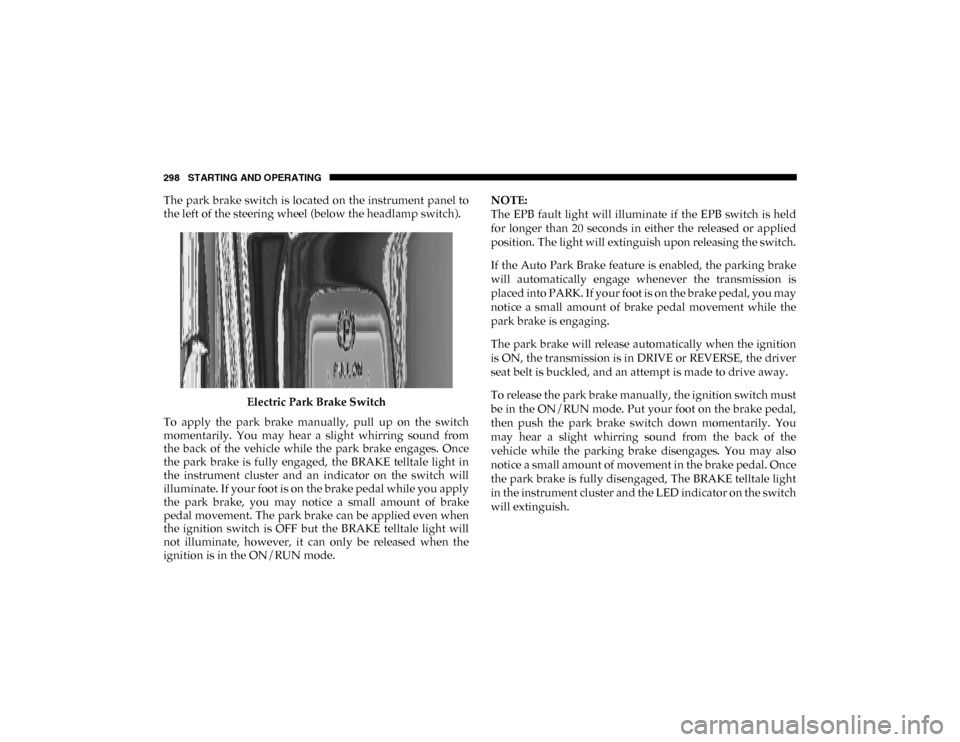
The park brake switch is located on the instrument panel to
the left of the steering wheel (below the headlamp switch).Electric Park Brake Switch
To apply the park brake manually, pull up on the switch
momentarily. You may hear a slight whirring sound from
the back of the vehicle while the park brake engages. Once
the park brake is fully engaged, the BRAKE telltale light in
the instrument cluster and an indicator on the switch will
illuminate. If your foot is on the brake pedal while you apply
the park brake, you may notice a small amount of brake
pedal movement. The park brake can be applied even when
the ignition switch is OFF but the BRAKE telltale light will
not illuminate, however, it can only be released when the
ignition is in the ON/RUN mode. NOTE:
The EPB fault light will illuminate if the EPB switch is held
for longer than 20 seconds in either the released or applied
position. The light will extinguish upon releasing the switch.
If the Auto Park Brake feature is enabled, the parking brake
will automatically engage whenever the transmission is
placed into PARK. If your foot is on the brake pedal, you may
notice a small amount of brake pedal movement while the
park brake is engaging.
The park brake will release automatically when the ignition
is ON, the transmission is in DRIVE or REVERSE, the driver
seat belt is buckled, and an attempt is made to drive away.
To release the park brake manually, the ignition switch must
be in the ON/RUN mode. Put your foot on the brake pedal,
then push the park brake switch down momentarily. You
may hear a slight whirring sound from the back of the
vehicle while the parking brake disengages. You may also
notice a small amount of movement in the brake pedal. Once
the park brake is fully disengaged, The BRAKE telltale light
in the instrument cluster and the LED indicator on the switch
will extinguish.
2020_DT_1500_OM_US.book Page 298
Page 303 of 674

STARTING AND OPERATING 301
In the unlikely event of a malfunction of the Electric Park
Brake system, a yellow EPB fault light will illuminate. This
may be accompanied by the BRAKE telltale light flashing. In
this event, urgent service of the electric park brake system is
required. Do not rely on the parking brake to hold the vehicle
stationary.
Auto Park Brake
The electric park brake can be programmed to be applied
automatically whenever the vehicle is at a standstill and the
automatic transmission is placed in PARK. Auto Park Brake
is enabled and disabled by customer selection through the
customer programmable features section of the Uconnect
Settings.
Any single auto park brake application can be bypassed by
pushing the EPB switch to the release position while the
transmission is placed in PARK.
SafeHold
SafeHold is a safety feature of the Electric Park Brake System
that will engage the park brake automatically if the vehicle is
left unsecured while the ignition is in ON/RUN.For automatic transmissions, the park brake will automati
-
cally engage if all of the following conditions are met:
• The vehicle is at a standstill.
• There is no attempt to depress the brake pedal or acceler -
ator pedal.
• The seat belt is unbuckled.
• The driver door is open.
SafeHold can be temporarily bypassed by pushing the Elec -
tric Park Brake Switch while the driver door is open. Once
manually bypassed, SafeHold will be enabled again once the
vehicle reaches 12 mph (20 km/h) or the ignition is turned to the OFF position and back to ON again.
Brake Service Mode
We recommend having your brakes serviced by your autho -
rized dealer. You should only make repairs for which you
have the knowledge and the right equipment. You should
only enter Brake Service Mode during brake service.
When servicing your rear brakes, it may be necessary for you
or your technician to push the rear piston into the rear caliper
bore. With the electric park brake system, this can only be
done after retracting the Electric Park Brake actuator. Fortu-
nately, actuator retraction can be done easily by entering the
5
2020_DT_1500_OM_US.book Page 301
Page 336 of 674

334 STARTING AND OPERATING
STOP/START SYSTEM — IF EQUIPPED
The Stop/Start function is developed to save fuel and reduce
emissions. The system will stop the engine automatically
during a vehicle stop if the required conditions are met.
Releasing the brake pedal or shifting out of DRIVE will auto-
matically restart the engine.
Vehicles equipped with eTorque contain a heavy duty motor
generator and an additional hybrid electric battery to store
energy from vehicle deceleration for use on engine startup
after a stop as well as providing launch torque assist.
Automatic Mode
The Stop/Start feature is enabled after every normal
customer engine start. It will remain in STOP/START NOT
READY until you drive forward with a vehicle speed greater
than 2 mph (3 km/h). At that time, the system will go into
STOP/START READY and if all other conditions are met,
can go into an STOP/START AUTO STOP ACTIVE
“Autostop” mode.
To Activate The Autostop Mode, The Following Must
Occur:
1. The system must be in STOP/START READY state. A STOP/START READY message will be displayed in the instrument cluster within the Stop/Start section. Refer to
“Instrument Cluster Display” in “Getting To know Your
Instrument Panel” for further information.
2. The vehicle must be completely stopped.
3. The transmission Gear Selector must be in DRIVE and the brake pedal depressed.
The engine will shut down, the tachometer will move to the
zero position and the stop/start telltale will illuminate indi -
cating you are in an Autostop. While in an Autostop, the
Climate Controls system may automatically adjust airflow to
maintain cabin comfort. Customer settings will be main -
tained upon return to an engine running condition.
Possible Reasons The Engine Does Not Autostop
Prior to engine shut down, the system will check many safety
and comfort conditions to see if they are fulfilled. In
following situations, the engine will not Autostop:
• Driver’s seat belt is not buckled
• Driver’s door is not closed
• The vehicle is on a steep grade
• Cabin heating or cooling is in process and an acceptable cabin temperature has not been achieved
2020_DT_1500_OM_US.book Page 334
Page 338 of 674
336 STARTING AND OPERATING
Conditions That Force An Automatic Shift To Park While
In Autostop Mode
The engine will not start automatically and the transmission
will be placed in PARK if:
• The driver door is open and brake pedal released.
• The driver door is open and the driver seat belt isunbuckled.
• The engine hood has been opened.
• A STOP/START system error present.
The engine may then be restarted by moving the transmis -
sion shift selector out of PARK (e.g. to DRIVE) or, in some
cases, only by a KEY START. The instrument cluster will
display a SHIFT OUT OF PARK message, or a STOP/START
KEY START REQUIRED message, to indicate which action is
required.
Refer to “Instrument Cluster Display” in “Getting To Know
Your Instrument Panel” for further information.To Manually Turn Off The Stop Start System
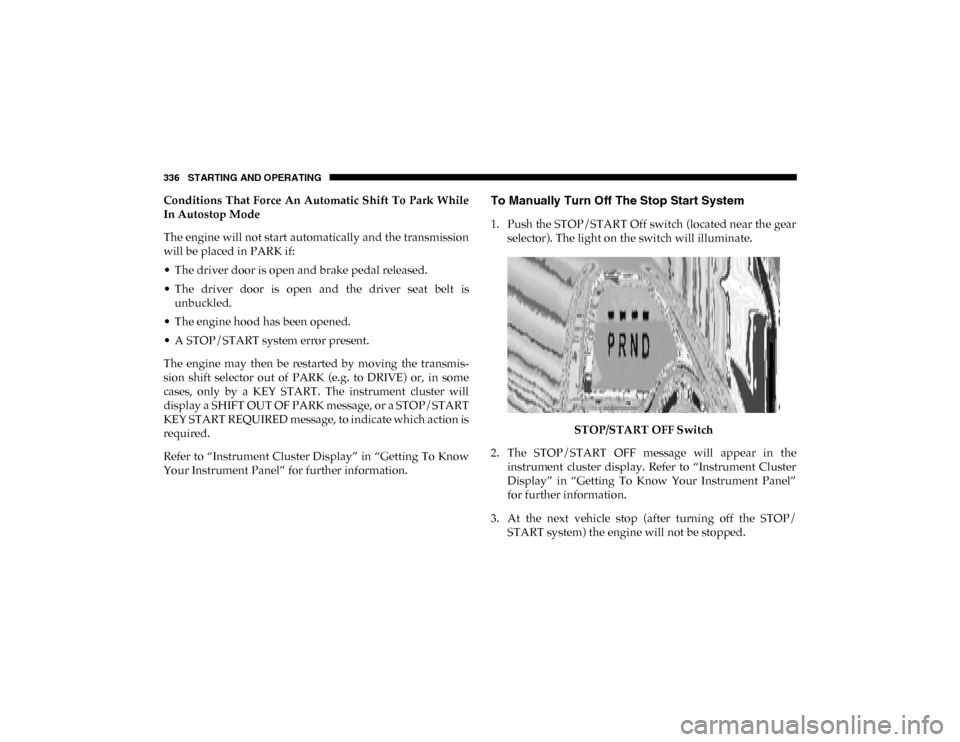
1. Push the STOP/START Off switch (located near the gear selector). The light on the switch will illuminate.
STOP/START OFF Switch
2. The STOP/START OFF message will appear in the instrument cluster display. Refer to “Instrument Cluster
Display” in “Getting To Know Your Instrument Panel”
for further information.
3. At the next vehicle stop (after turning off the STOP/ START system) the engine will not be stopped.
2020_DT_1500_OM_US.book Page 336
Page 345 of 674

STARTING AND OPERATING 343
NOTE:
Any chassis/suspension or tire size modifications to the
vehicle will effect the performance of the Adaptive Cruise
Control and Forward Collision Warning System.
Activating Adaptive Cruise Control (ACC)
You can only engage ACC if the vehicle speed is above
0 mph (0 km/h).
The minimum set speed for the ACC system is 20 mph
(32 km/h).
When the system is turned on and in the ready state, the
instrument cluster display will read “ACC Ready.”
When the system is off, the instrument cluster display will
read “Adaptive Cruise Control (ACC) Off.”NOTE:
You cannot engage ACC under the following conditions:
• When in Four-Wheel Drive Low
• When you apply the brakes
• When the parking brake is applied
• When the automatic transmission is in PARK, REVERSE or
NEUTRAL
• When the vehicle speed is outside of the speed range
• When the brakes are overheated
• When the driver door is open at low speed
• When the driver seat belt is unbuckled at low speed
• ESC Full-Off Mode is active
5
2020_DT_1500_OM_US.book Page 343
Page 347 of 674

STARTING AND OPERATING 345
To Set A Desired ACC Speed
When the vehicle reaches the speed desired, push the SET (+)
button or the SET (-) button and release. The instrument
cluster display will show the set speed.
If the system is set when the vehicle speed is below 20 mph
(32 km/h), the set speed shall be defaulted to 20 mph
(32 km/h). If the system is set when the vehicle speed is
above 20 mph (32 km/h), the set speed shall be the current
speed of the vehicle.
NOTE:
ACC cannot be set if there is a stationary vehicle in front of
your vehicle in close proximity.
Remove your foot from the accelerator pedal, after the ACC
has been set. If you do not, the vehicle may continue to accel -
erate beyond the set speed. If this occurs:
• The message “ACC DRIVER OVERRIDE” will display in the instrument cluster display.
• The system will not be controlling the distance between your vehicle and the vehicle ahead. The vehicle speed will
only be determined by the position of the accelerator
pedal.
To Cancel
The following conditions cancel the system:
• The brake pedal is applied.
• The CANC (cancel) button is pushed.
• An Anti-Lock Brake System (ABS) event occurs.
• The trailer brake is applied manually (if equipped).
• The gear selector is removed from the DRIVE position.
• The Electronic Stability Control/Traction Control System(ESC/TCS) activates.
• The vehicle parking brake is applied.
• Driver seatbelt is unbuckled at low speeds.
• Driver door is opened at low speeds.
• A Trailer Sway Control (TSC) event occurs.
• The driver switches ESC to Full Off mode.
• The braking temperature exceeds normal range (over -
heated).
5
2020_DT_1500_OM_US.book Page 345