Tire Ram 1500 2020 Repair Manual
[x] Cancel search | Manufacturer: RAM, Model Year: 2020, Model line: 1500, Model: Ram 1500 2020Pages: 674, PDF Size: 32.69 MB
Page 469 of 674

IN CASE OF EMERGENCY 467
6. Remove the lug nuts and pull the wheel off. Install thespare wheel and lug nuts with the cone shaped end of the
lug nuts toward the wheel. Hand tighten the lug nuts
with vehicle lifted. To avoid the risk of forcing the vehicle
off the jack, do not fully tighten the lug nuts until the
vehicle has been lowered.
7. Lower vehicle to ground, finish tightening the lug nuts. Push down on the wrench while at the end of the handle
for increased leverage. Tighten the lug nuts in a star
pattern until each nut has been tightened twice.
NOTE:
For the correct lug nut torque refer to “Technical Specifica -
tions” in “Torque Specifications.” If in doubt about the
correct tightness, have them checked with a torque wrench
by an authorized dealer or service station. 8. If your vehicle is equipped with a wheel center cap, install
the cap and remove the wheel blocks. Do not install
chrome or aluminum wheel center caps on the spare
wheel. This may result in cap damage.
9. Lower the jack to its fully closed position. Stow the replaced tire, and secure the jack and tools in the proper
location.
10. Adjust the tire pressure when possible.
WARNING!
Raising the vehicle higher than necessary can make the
vehicle less stable. It could slip off the jack and hurt
someone near it. Raise the vehicle only enough to
remove the tire.WARNING!
A loose tire or jack thrown forward in a collision or hard
stop, could endanger the occupants of the vehicle.
Always stow the jack parts and the spare tire in the
places provided.
6
2020_DT_1500_OM_US.book Page 467
Page 470 of 674
468 IN CASE OF EMERGENCY
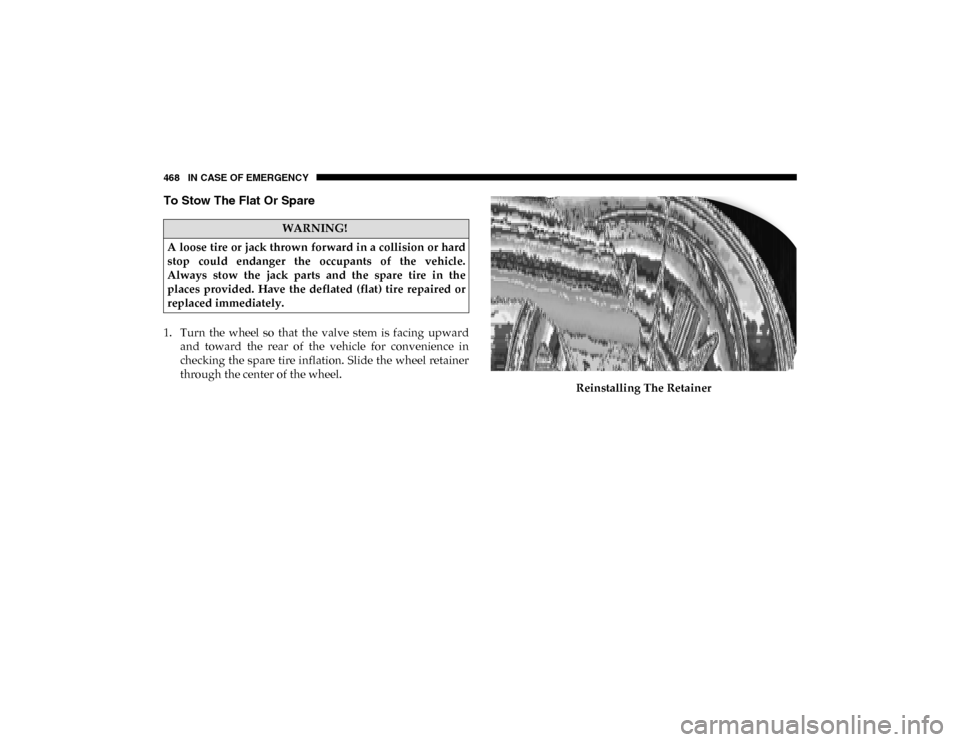
To Stow The Flat Or Spare
1. Turn the wheel so that the valve stem is facing upwardand toward the rear of the vehicle for convenience in
checking the spare tire inflation. Slide the wheel retainer
through the center of the wheel. Reinstalling The Retainer
WARNING!
A loose tire or jack thrown forward in a collision or hard
stop could endanger the occupants of the vehicle.
Always stow the jack parts and the spare tire in the
places provided. Have the deflated (flat) tire repaired or
replaced immediately.
2020_DT_1500_OM_US.book Page 468
Page 471 of 674

IN CASE OF EMERGENCY 469
2. Lift the spare tire with one hand to give clearance to tiltthe retainer at the end of the cable and position it properly
across the wheel opening.
Pushing The Retainer Through The Center Of The Wheel And Positioning It 3. Remove the extension with the hook and reattach the
short extension 5. Attach the lug wrench to the extension
tubes with the curved angle facing away from the vehicle.
Insert the extension tubes through the access hole
between the lower tailgate and the top of the bumper and
into the winch mechanism tube.
Lug Wrench And Extension Tubes Assembled And In Position
6
2020_DT_1500_OM_US.book Page 469
Page 472 of 674
470 IN CASE OF EMERGENCY
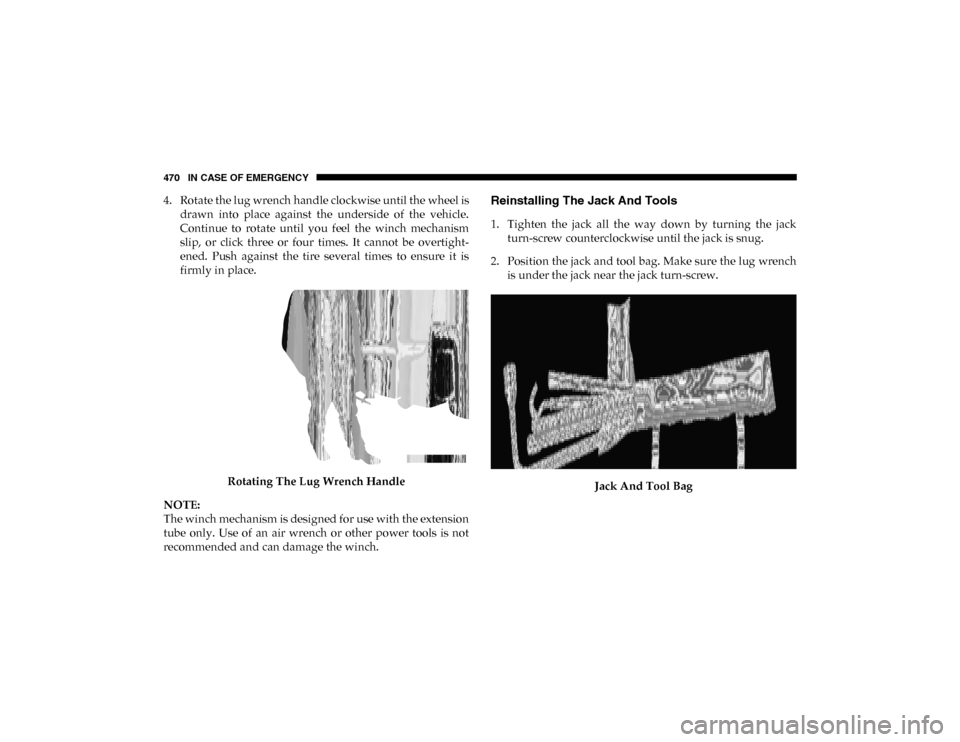
4. Rotate the lug wrench handle clockwise until the wheel isdrawn into place against the underside of the vehicle.
Continue to rotate until you feel the winch mechanism
slip, or click three or four times. It cannot be overtight -
ened. Push against the tire several times to ensure it is
firmly in place.
Rotating The Lug Wrench Handle
NOTE:
The winch mechanism is designed for use with the extension
tube only. Use of an air wrench or other power tools is not
recommended and can damage the winch.Reinstalling The Jack And Tools
1. Tighten the jack all the way down by turning the jack turn-screw counterclockwise until the jack is snug.
2. Position the jack and tool bag. Make sure the lug wrench is under the jack near the jack turn-screw.
Jack And Tool Bag
2020_DT_1500_OM_US.book Page 470
Page 480 of 674

478 IN CASE OF EMERGENCY
TOWING A DISABLED VEHICLE
This section describes procedures for towing a disabled
vehicle using a commercial towing service.
If the transmission and drivetrain are operable, disabled
vehicles may also be towed as described under “Recreational
Towing (Behind Motorhome, Etc.)” in the “Starting And
Operating” section.
NOTE:
Vehicles equipped with the Active-Level Four Corner Air
Suspension System must be placed in Transport mode,
before tying them down (from the body) on a trailer or
flatbed truck. If the vehicle cannot be placed in Transport
mode (for example, engine will not run), tie-downs must be
fastened to the axles (not to the body). Failure to follow these
instructions may cause fault codes to be set and/or cause loss
of proper tie-down tension.
Refer to "Active-Level Four Corner Air Suspension System
— If Equipped" in "Starting And Operating" for more infor-
mation.
WARNING!
Fast spinning tires can be dangerous. Forces generated by
excessive wheel speeds may cause damage, or even failure, of
the axle and tires. A tire could explode and injure someone.
Do not spin your vehicle's wheels faster than 30 mph (48 km/ h) or for longer than 30 seconds continuously without
stopping when you are stuck and do not let anyone near a
spinning wheel, no matter what the speed.
CAUTION!
• Racing the engine or spinning the wheels may lead to transmission overheating and failure. Allow the engine to
idle with the transmission in NEUTRAL for at least one
minute after every five rocking-motion cycles. This will
minimize overheating and reduce the risk of transmission
failure during prolonged efforts to free a stuck vehicle.
• When “rocking” a stuck vehicle by shifting between DRIVE and REVERSE, do not spin the wheels faster than
15 mph (24 km/h), or drivetrain damage may result.
• Revving the engine or spinning the wheels too fast may lead to transmission overheating and failure. It can also
damage the tires. Do not spin the wheels above 30 mph
(48 km/h) while in gear (no transmission shifting occur-
ring).
2020_DT_1500_OM_US.book Page 478
Page 485 of 674

SERVICING AND MAINTENANCE 483
Once A Month Or Before A Long Trip:
• Check engine oil level.
• Check windshield washer fluid level.
• Check tire pressure and look for unusual wear or damage.Rotate tires at the first sign of irregular wear, even if it
occurs before the oil indicator system turns on.
• Check the fluid levels of the coolant reservoir, brake master cylinder, and fill as needed.
• Check function of all interior and exterior lights.Maintenance Plan
Required Maintenance
Refer to the Maintenance Plan on the following pages for
required maintenance.
NOTE:
Using white lithium grease, lubricate the door hinge roller pivot joints twice a year to prevent premature wear. At Every Oil Change Interval As Indicated By Oil Change Indicator System:
• Change the oil and filter.
• Rotate the tires. Rotate at the first sign of irregular wear, even if it occurs before the oil indicator system turns on.
• Inspect the battery and clean and tighten terminals as required.
• Inspect the CV/Universal joints.
• Inspect the brake pads, shoes, rotors, drums, and hoses.
• Inspect the engine cooling system protection and hoses.
• Inspect the exhaust system.
• Inspect the engine air cleaner if using in dusty or off-road conditions.
7
2020_DT_1500_OM_US.book Page 483
Page 509 of 674

SERVICING AND MAINTENANCE 507
Engine Coolant Checks
Check the engine coolant (antifreeze) protection every
12 months (before the onset of freezing weather, where
applicable). If the engine coolant (antifreeze) is dirty or rusty
in appearance, the system should be drained, flushed and
refilled with fresh coolant. Check the front of the A/C
condenser (if equipped) or radiator for any accumulation of
bugs, leaves, etc. If dirty, clean by gently spraying water
from a garden hose vertically down the face of the A/C
condenser (if equipped) or the back of the radiator core.
Check the engine cooling system hoses for brittle rubber,
cracking, tears, cuts and tightness of the connection at the
coolant recovery bottle and radiator. Inspect the entire
system for leaks.
DO NOT REMOVE THE COOLANT PRESSURE CAP
WHEN THE COOLING SYSTEM IS HOT. Cooling System — Drain, Flush And Refill
NOTE:
Some vehicles require special tools to add coolant properly.
Failure to fill these systems properly could lead to severe
internal engine damage. If any coolant is needed to be added
to the system please contact an authorized dealer.
If the engine coolant (antifreeze) is dirty or contains visible
sediment, have an authorized dealer clean and flush with
OAT coolant (antifreeze) (conforming to MS.90032).
Refer to the “Maintenance Plan” in this section for the proper
maintenance intervals.
Selection Of Coolant
Refer to “Fluids And Lubricants” in “Technical Specifica
-
tions” for further information.
NOTE:
• Mixing of engine coolant (antifreeze) other than specified Organic Additive Technology (OAT) engine coolant (anti -
freeze), may result in engine damage and may decrease
corrosion protection. Organic Additive Technology (OAT)
engine coolant is different and should not be mixed with
Hybrid Organic Additive Technology (HOAT) engine
coolant (antifreeze) or any “globally compatible” coolant
• When working near the radiator cooling fan, discon
-
nect the fan motor lead or turn the ignition to the OFF
mode. The fan is temperature controlled and can start at
any time the ignition is in the ON mode.
WARNING! (Continued)
7
2020_DT_1500_OM_US.book Page 507
Page 518 of 674
516 SERVICING AND MAINTENANCE
Fluid Level Check
This fluid level can be checked by removing the filler plug. The
fluid level should be to the bottom edge of the filler plug hole (or
within 1/8 inch of the bottom) with the vehicle in a level position.
Drain And Refill
Refer to the “Maintenance Plan” in this section for the proper
maintenance intervals.
HOISTING
A conventional floor jack may be used at the jacking loca-
tions. Refer to the graphics that show jacking locations.
However, a floor jack or frame hoist must never be used on
any other parts of the underbody.
TIRES
Tire Safety Information
Tire safety information will cover aspects of the following infor -
mation: Tire Markings, Tire Identification Numbers, Tire Termi -
nology and Definitions, Tire Pressures, and Tire Loading.
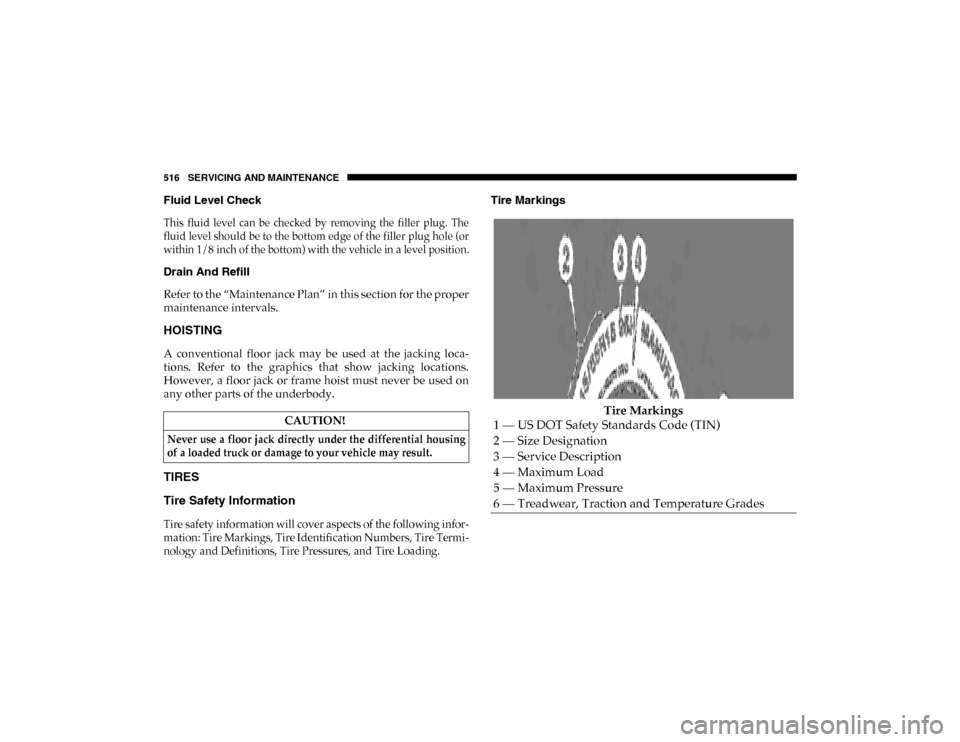
Tire Markings
Tire MarkingsCAUTION!
Never use a floor jack directly under the differential housing
of a loaded truck or damage to your vehicle may result.
1 — US DOT Safety Standards Code (TIN)
2 — Size Designation
3 — Service Description
4 — Maximum Load
5 — Maximum Pressure
6 — Treadwear, Traction and Temperature Grades
2020_DT_1500_OM_US.book Page 516
Page 519 of 674

SERVICING AND MAINTENANCE 517
NOTE:
• P (Passenger) — Metric tire sizing is based on US designstandards. P-Metric tires have the letter “P” molded into
the sidewall preceding the size designation. Example:
P215/65R15 95H.
• European — Metric tire sizing is based on European design standards. Tires designed to this standard have the
tire size molded into the sidewall beginning with the
section width. The letter "P" is absent from this tire size
designation. Example: 215/65R15 96H.
• LT (Light Truck) — Metric tire sizing is based on US design standards. The size designation for LT-Metric tires is the same as for P-Metric tires except for the letters “LT” that
are molded into the sidewall preceding the size designa
-
tion. Example: LT235/85R16.
• Temporary spare tires are designed for temporary emer -
gency use only. Temporary high pressure compact spare
tires have the letter “T” or “S” molded into the sidewall
preceding the size designation. Example: T145/80D18
103M.
• High flotation tire sizing is based on US design standards and it begins with the tire diameter molded into the side -
wall. Example: 31x10.5 R15 LT.
Tire Sizing Chart EXAMPLE:
Example Size Designation: P215/65R15XL 95H, 215/65R15 96H, LT235/85R16C, T145/80D18 103M, 31x10.5 R15 LT
P = Passenger car tire size based on US design standards, or
"....blank...." = Passenger car tire based on European design standards, or
LT = Light truck tire based on US design standards, or
T or S = Temporary spare tire or
31 = Overall diameter in inches (in)
215, 235, 145 = Section width in millimeters (mm)
7
2020_DT_1500_OM_US.book Page 517
Page 520 of 674

518 SERVICING AND MAINTENANCE
65, 85, 80 = Aspect ratio in percent (%)
• Ratio of section height to section width of tire, or
10.5 = Section width in inches (in)
R = Construction code
• "R" means radial construction, or
• "D" means diagonal or bias construction
15, 16, 18 = Rim diameter in inches (in)
Service Description:
95 = Load Index
• A numerical code associated with the maximum load a tire can carry
H = Speed Symbol
• A symbol indicating the range of speeds at which a tire can carry a load corresponding to its load index under certain oper -
ating conditions
• The maximum speed corresponding to the speed symbol should only be achieved under specified operating conditions (i.e., tire pressure, vehicle loading, road conditions, and posted speed limits) EXAMPLE:
2020_DT_1500_OM_US.book Page 518