tow RAM 1500 2021 Owners Manual
[x] Cancel search | Manufacturer: RAM, Model Year: 2021, Model line: 1500, Model: RAM 1500 2021Pages: 496, PDF Size: 20.89 MB
Page 401 of 496
SERVICING AND MAINTENANCE399
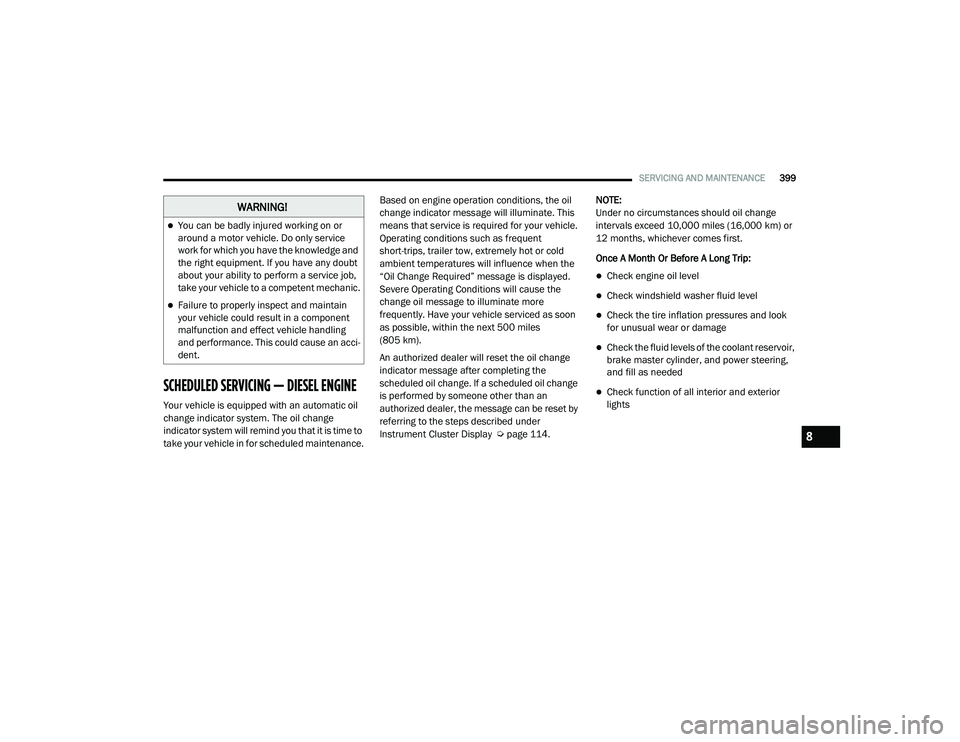
SCHEDULED SERVICING — DIESEL ENGINE
Your vehicle is equipped with an automatic oil
change indicator system. The oil change
indicator system will remind you that it is time to
take your vehicle in for scheduled maintenance. Based on engine operation conditions, the oil
change indicator message will illuminate. This
means that service is required for your vehicle.
Operating conditions such as frequent
short-trips, trailer tow, extremely hot or cold
ambient temperatures will influence when the
“Oil Change Required” message is displayed.
Severe Operating Conditions will cause the
change oil message to illuminate more
frequently. Have your vehicle serviced as soon
as possible, within the next 500 miles
(805 km).
An authorized dealer will reset the oil change
indicator message after completing the
scheduled oil change. If a scheduled oil change
is performed by someone other than an
authorized dealer, the message can be reset by
referring to the steps described under
Instrument Cluster Display Ú
page 114.NOTE:
Under no circumstances should oil change
intervals exceed 10,000 miles (16,000 km) or
12 months, whichever comes first.
Once A Month Or Before A Long Trip:
Check engine oil level
Check windshield washer fluid level
Check the tire inflation pressures and look
for unusual wear or damage
Check the fluid levels of the coolant reservoir,
brake master cylinder, and power steering,
and fill as needed
Check function of all interior and exterior
lights
WARNING!
You can be badly injured working on or
around a motor vehicle. Do only service
work for which you have the knowledge and
the right equipment. If you have any doubt
about your ability to perform a service job,
take your vehicle to a competent mechanic.
Failure to properly inspect and maintain
your vehicle could result in a component
malfunction and effect vehicle handling
and performance. This could cause an acci
-
dent.
8
21_DT_OM_EN_USC_t.book Page 399
Page 403 of 496
SERVICING AND MAINTENANCE401
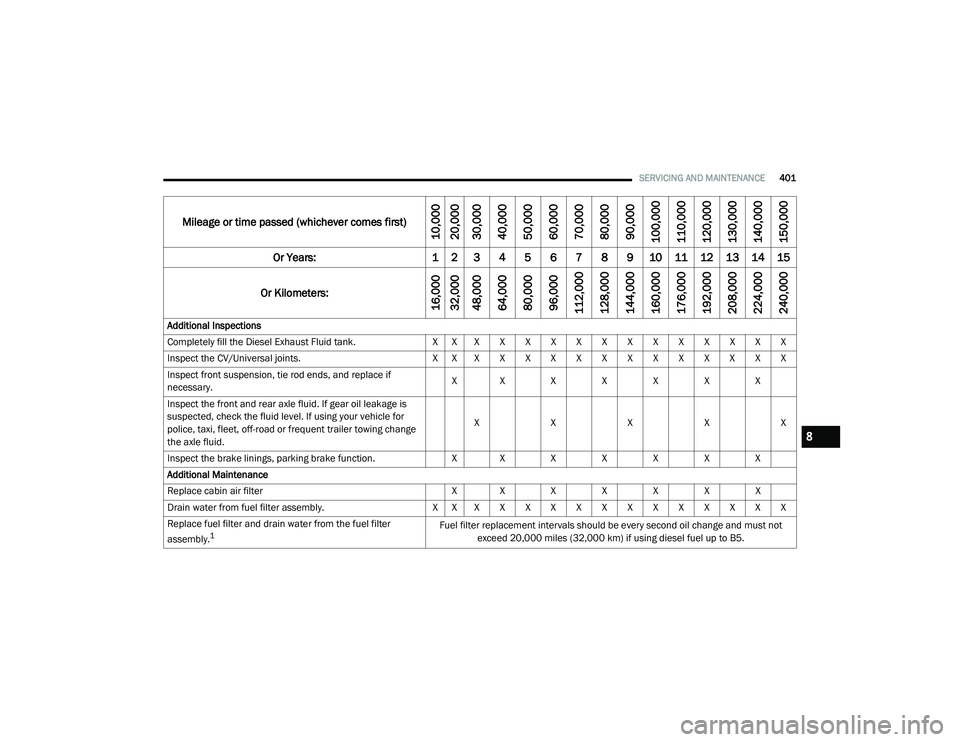
Mileage or time passed (whichever comes first)
10,000
20,000
30,000
40,000
50,000
60,000
70,000
80,000
90,000
100,000
110,000
120,000
130,000
140,000
150,000
Or Years: 1 2 3 4 5 6 7 8 9 10 11 12 13 14 15
Or Kilometers:
16,000
32,000
48,000
64,000
80,000
96,000
112,000
128,000
144,000
160,000
176,000
192,000
208,000
224,000
240,000
Additional Inspections
Completely fill the Diesel Exhaust Fluid tank. X X X X X X X X X X X X X X X
Inspect the CV/Universal joints. X X X X X X X X X X X X X X X
Inspect front suspension, tie rod ends, and replace if
necessary. X X X X X X X
Inspect the front and rear axle fluid. If gear oil leakage is
suspected, check the fluid level. If using your vehicle for
police, taxi, fleet, off-road or frequent trailer towing change
the axle fluid. X
XXXX
Inspect the brake linings, parking brake function. X X X X X X X
Additional Maintenance
Replace cabin air filter X X X X X X X
Drain water from fuel filter assembly. X X X X X X X X X X X X X X X
Replace fuel filter and drain water from the fuel filter
assembly.
1Fuel filter replacement intervals should be every second oil change and must not exceed 20,000 miles (32,000 km) if using diesel fuel up to B5.
8
21_DT_OM_EN_USC_t.book Page 401
Page 404 of 496
402SERVICING AND MAINTENANCE
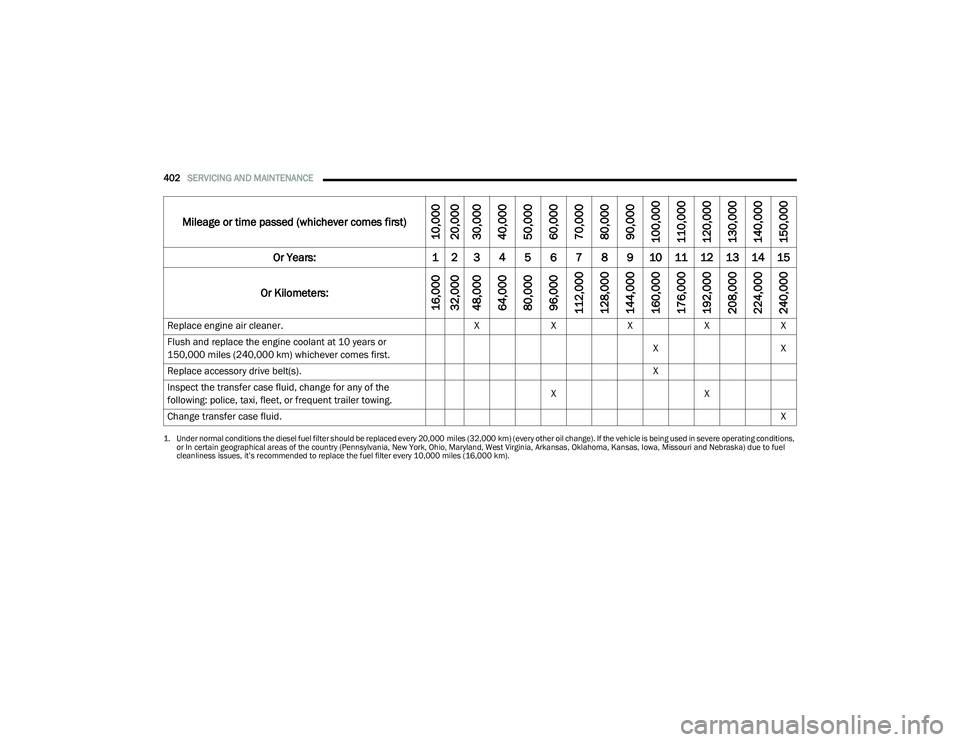
Replace engine air cleaner. XXXXX
Flush and replace the engine coolant at 10 years or
150,000 miles (240,000 km) whichever comes first. X
X
Replace accessory drive belt(s). X
Inspect the transfer case fluid, change for any of the
following: police, taxi, fleet, or frequent trailer towing. X
X
Change transfer case fluid. X
1. Under normal conditions the diesel fuel filter should be replaced every 20,000 miles (32,000 km) (every other oil change). If the vehicle is being used in severe operating conditions,
or In certain geographical areas of the country (Pennsylvania, New York, Ohio, Maryland, West Virginia, Arkansas, Oklahoma, Kansas, Iowa, Missouri and Nebraska) due to fuel
cleanliness issues, it’s recommended to replace the fuel filter every 10,000 miles (16,000 km).
Mileage or time passed (whichever comes first)
10,000
20,000
30,000
40,000
50,000
60,000
70,000
80,000
90,000
100,000
110,000
120,000
130,000
140,000
150,000
Or Years: 1 2 3 4 5 6 7 8 9 10 11 12 13 14 15
Or Kilometers:
16,000
32,000
48,000
64,000
80,000
96,000
112,000
128,000
144,000
160,000
176,000
192,000
208,000
224,000
240,000
21_DT_OM_EN_USC_t.book Page 402
Page 410 of 496
408SERVICING AND MAINTENANCE
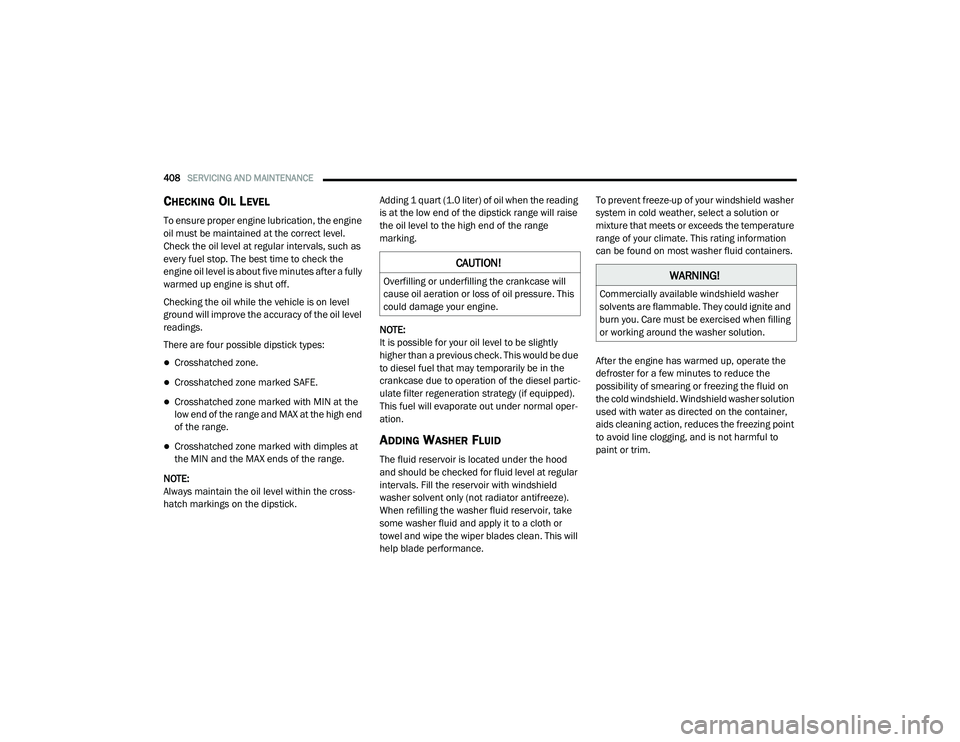
CHECKING OIL LEVEL
To ensure proper engine lubrication, the engine
oil must be maintained at the correct level.
Check the oil level at regular intervals, such as
every fuel stop. The best time to check the
engine oil level is about five minutes after a fully
warmed up engine is shut off.
Checking the oil while the vehicle is on level
ground will improve the accuracy of the oil level
readings.
There are four possible dipstick types:
Crosshatched zone.
Crosshatched zone marked SAFE.
Crosshatched zone marked with MIN at the
low end of the range and MAX at the high end
of the range.
Crosshatched zone marked with dimples at
the MIN and the MAX ends of the range.
NOTE:
Always maintain the oil level within the cross -
hatch markings on the dipstick. Adding 1 quart (1.0 liter) of oil when the reading
is at the low end of the dipstick range will raise
the oil level to the high end of the range
marking.
NOTE:
It is possible for your oil level to be slightly
higher than a previous check. This would be due
to diesel fuel that may temporarily be in the
crankcase due to operation of the diesel partic
-
ulate filter regeneration strategy (if equipped).
This fuel will evaporate out under normal oper -
ation.ADDING WASHER FLUID
The fluid reservoir is located under the hood
and should be checked for fluid level at regular
intervals. Fill the reservoir with windshield
washer solvent only (not radiator antifreeze).
When refilling the washer fluid reservoir, take
some washer fluid and apply it to a cloth or
towel and wipe the wiper blades clean. This will
help blade performance. To prevent freeze-up of your windshield washer
system in cold weather, select a solution or
mixture that meets or exceeds the temperature
range of your climate. This rating information
can be found on most washer fluid containers.
After the engine has warmed up, operate the
defroster for a few minutes to reduce the
possibility of smearing or freezing the fluid on
the cold windshield. Windshield washer solution
used with water as directed on the container,
aids cleaning action, reduces the freezing point
to avoid line clogging, and is not harmful to
paint or trim.
CAUTION!
Overfilling or underfilling the crankcase will
cause oil aeration or loss of oil pressure. This
could damage your engine.WARNING!
Commercially available windshield washer
solvents are flammable. They could ignite and
burn you. Care must be exercised when filling
or working around the washer solution.
21_DT_OM_EN_USC_t.book Page 408
Page 418 of 496
416SERVICING AND MAINTENANCE
The cabin air filter is located in the fresh air inlet
behind the glove compartment. Perform the
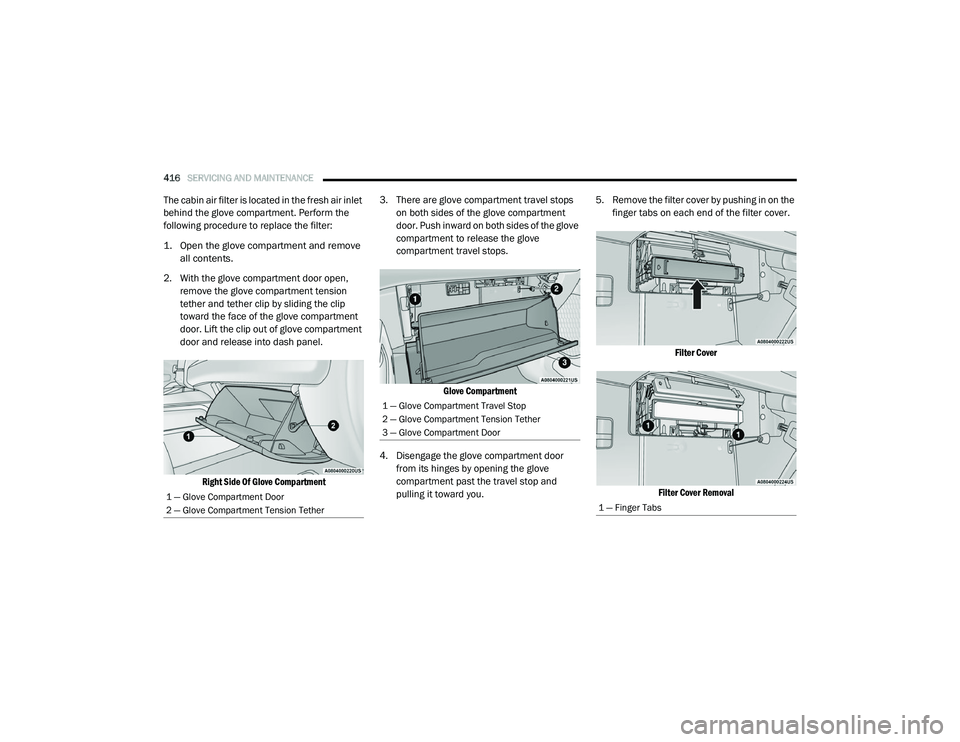
following procedure to replace the filter:
1. Open the glove compartment and remove
all contents.
2. With the glove compartment door open, remove the glove compartment tension
tether and tether clip by sliding the clip
toward the face of the glove compartment
door. Lift the clip out of glove compartment
door and release into dash panel.
Right Side Of Glove Compartment
3. There are glove compartment travel stops
on both sides of the glove compartment
door. Push inward on both sides of the glove
compartment to release the glove
compartment travel stops.
Glove Compartment
4. Disengage the glove compartment door from its hinges by opening the glove
compartment past the travel stop and
pulling it toward you. 5. Remove the filter cover by pushing in on the
finger tabs on each end of the filter cover.
Filter Cover
Filter Cover Removal
1 — Glove Compartment Door
2 — Glove Compartment Tension Tether
1 — Glove Compartment Travel Stop
2 — Glove Compartment Tension Tether
3 — Glove Compartment Door
1 — Finger Tabs
21_DT_OM_EN_USC_t.book Page 416
Page 419 of 496

SERVICING AND MAINTENANCE417
6. Remove the cabin air filter by pulling it
straight out of the housing.
Cabin Air Filter
7. Install the cabin air filter with the arrow on the filter pointing toward the floor. When
installing the filter cover, press on each end
until you hear an audible click.
8. Reinstall the glove compartment on the hinges. 9. Pull the tension tether outward and reinstall
the glove compartment past the travel stops
by pushing in on the glove compartment
sides.
Glove Compartment
NOTE:
Ensure the glove compartment door hinges and
glove compartment travel stops are fully
engaged.
10. Reattach the glove compartment tension tether by inserting the tether clip in the
glove compartment and sliding the clip
away from the face of the glove
compartment door.ACCESSORY DRIVE BELT INSPECTION
When inspecting accessory drive belts, small
cracks that run across the ribbed surface of the
belt from rib to rib, are considered normal. This
is not a reason to replace the belt. However,
cracks running along a rib (not across) are not
normal. Any belt with cracks running along a rib
must be replaced. Also have the belt replaced if
it has excessive wear, frayed cords or severe
glazing.CAUTION!
The cabin air filter is identified with an arrow
to indicate airflow direction through the filter.
Failure to properly install the filter will result
in the need to replace it more often.
1 — Glove Compartment Travel Stop
2 — Glove Compartment Tension Tether
3 — Glove Compartment Door
WARNING!
Do not attempt to inspect an accessory
drive belt with vehicle running.
When working near the radiator cooling fan,
disconnect the fan motor lead. The fan is
temperature controlled and can start at any
time regardless of ignition mode. You could
be injured by the moving fan blades.
You can be badly injured working on or
around a motor vehicle. Only do service
work for which you have the knowledge and
the proper equipment. If you have any
doubt about your ability to perform a
service job, take your vehicle to a compe -
tent mechanic.
8
21_DT_OM_EN_USC_t.book Page 417
Page 421 of 496
SERVICING AND MAINTENANCE419
NOTE:
Life expectancy of wiper blades varies
depending on geographical area and frequency
of use. If chattering, marks, water lines or wet
spots are present, clean the wiper blades or
replace as necessary.
The wiper blades and wiper arms should be
inspected periodically, not just when wiper
performance problems are experienced. This
inspection should include the following points:
Wear or uneven edges
Foreign material
Hardening or cracking
Deformation or fatigue
If a wiper blade or wiper arm is damaged,
replace the affected wiper arm or blade with a
new unit. Do not attempt to repair a wiper arm
or blade that is damaged.
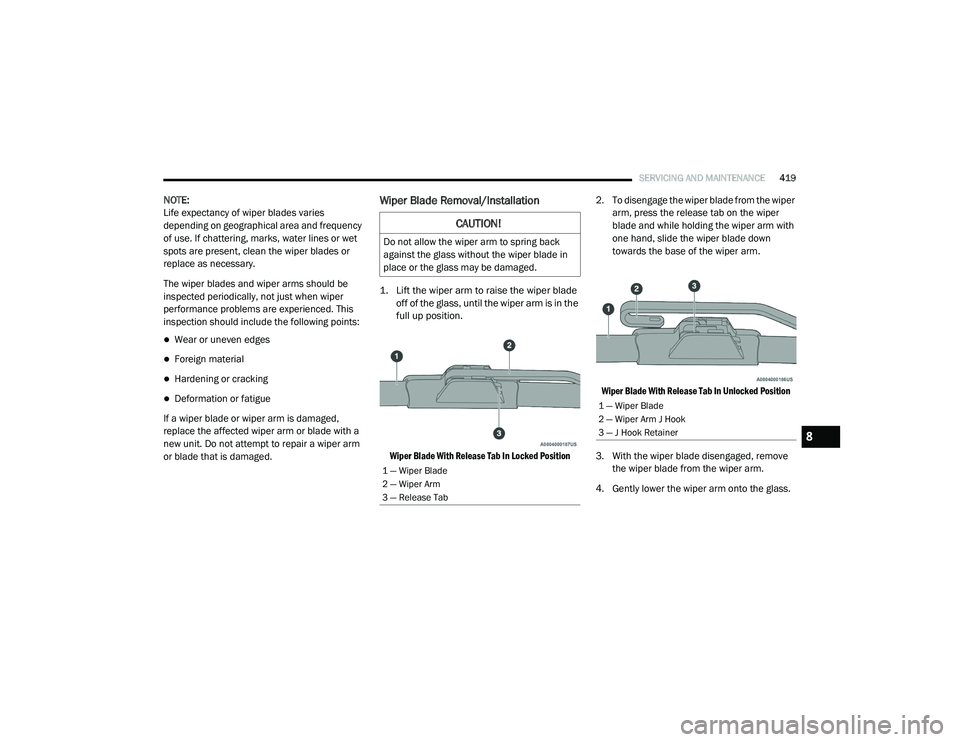
Wiper Blade Removal/Installation
1. Lift the wiper arm to raise the wiper blade off of the glass, until the wiper arm is in the
full up position.
Wiper Blade With Release Tab In Locked Position
2. To disengage the wiper blade from the wiper
arm, press the release tab on the wiper
blade and while holding the wiper arm with
one hand, slide the wiper blade down
towards the base of the wiper arm.
Wiper Blade With Release Tab In Unlocked Position
3. With the wiper blade disengaged, remove the wiper blade from the wiper arm.
4. Gently lower the wiper arm onto the glass.
CAUTION!
Do not allow the wiper arm to spring back
against the glass without the wiper blade in
place or the glass may be damaged.
1 — Wiper Blade
2 — Wiper Arm
3 — Release Tab
1 — Wiper Blade
2 — Wiper Arm J Hook
3 — J Hook Retainer
8
21_DT_OM_EN_USC_t.book Page 419
Page 423 of 496

SERVICING AND MAINTENANCE421
overheating. If this occurs, stop the vehicle, turn
off the engine and allow it to cool. Service,
including a tune-up to manufacturer's
specifications, should be obtained immediately.
To minimize the possibility of catalytic converter
damage:
Do not interrupt the ignition when the trans -
mission is in gear and the vehicle is in
motion.
Do not try to start the vehicle by pushing or
towing the vehicle.
Do not idle the engine with any ignition
components disconnected or removed, such
as when diagnostic testing, or for prolonged
periods during very rough idle or malfunc -
tioning operating conditions.
COOLING SYSTEM Engine Coolant Checks
Check the engine coolant (antifreeze)
protection every 12 months (before the onset of
freezing weather, where applicable). If the
engine coolant is dirty or rusty in appearance,
the system should be drained, flushed and
refilled with fresh coolant. Check the front of the
A/C condenser (if equipped) or radiator for any
accumulation of bugs, leaves, etc. If dirty, clean
by gently spraying water from a garden hose
vertically down the face of the A/C condenser (if
equipped) or the back of the radiator core.
Check the engine cooling system hoses for
brittle rubber, cracking, tears, cuts and
tightness of the connection at the coolant
recovery bottle and radiator. Inspect the entire
system for leaks.
DO NOT REMOVE THE COOLANT PRESSURE CAP
WHEN THE COOLING SYSTEM IS HOT. WARNING!
You or others can be badly burned by hot
engine coolant (antifreeze) or steam from
your radiator. If you see or hear steam
coming from under the hood, do not open
the hood until the radiator has had time to
cool. Never open a cooling system pressure
cap when the radiator or coolant bottle is
hot.
Keep hands, tools, clothing, and jewelry
away from the radiator cooling fan when
the hood is raised. The fan starts automati -
cally and may start at any time, whether the
engine is running or not.
When working near the radiator cooling fan,
disconnect the fan motor lead or turn the
ignition to the OFF mode. The fan is
temperature controlled and can start at any
time the ignition is in the ON mode.
8
21_DT_OM_EN_USC_t.book Page 421
Page 431 of 496
SERVICING AND MAINTENANCE429
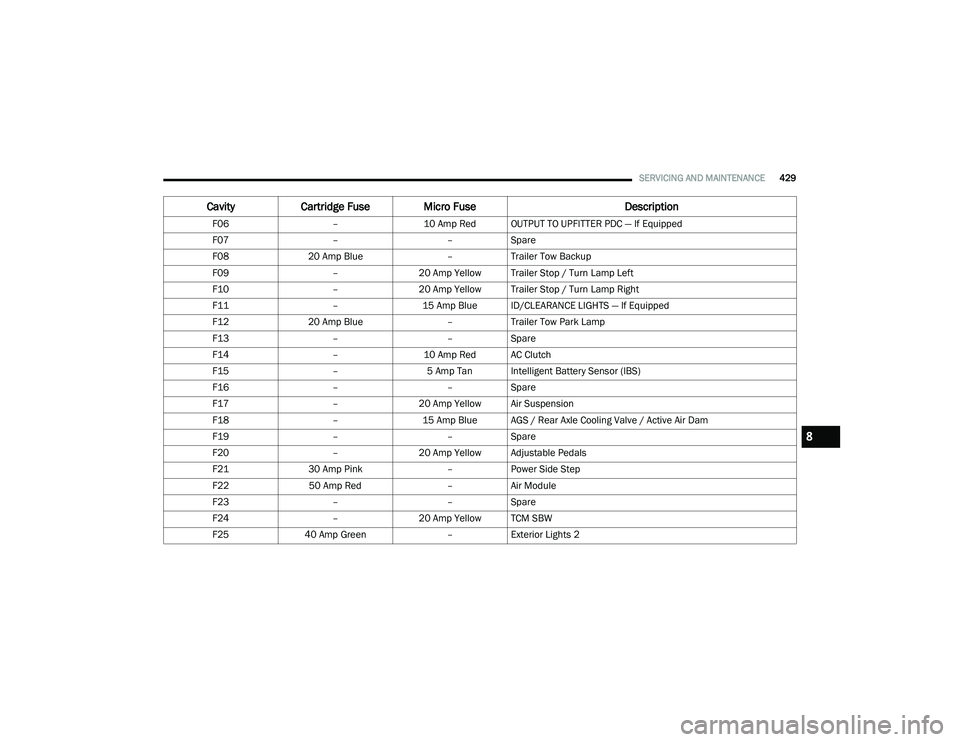
F06–10 Amp Red OUTPUT TO UPFITTER PDC — If Equipped
F07 ––Spare
F08 20 Amp Blue –Trailer Tow Backup
F09 –20 Amp Yellow Trailer Stop / Turn Lamp Left
F10 –20 Amp Yellow Trailer Stop / Turn Lamp Right
F11 –15 Amp Blue ID/CLEARANCE LIGHTS — If Equipped
F12 20 Amp Blue –Trailer Tow Park Lamp
F13 ––Spare
F14 –10 Amp Red AC Clutch
F15 –5 Amp Tan Intelligent Battery Sensor (IBS)
F16 ––Spare
F17 –20 Amp Yellow Air Suspension
F18 –15 Amp Blue AGS / Rear Axle Cooling Valve / Active Air Dam
F19 ––Spare
F20 –20 Amp Yellow Adjustable Pedals
F21 30 Amp Pink –Power Side Step
F22 50 Amp Red –Air Module
F23 ––Spare
F24 –20 Amp Yellow TCM SBW
F25 40 Amp Green –Exterior Lights 2
Cavity Cartridge Fuse Micro Fuse Description
8
21_DT_OM_EN_USC_t.book Page 429
Page 434 of 496

432SERVICING AND MAINTENANCE
Internal Power Distribution Center
The Power Distribution Center is located under
the drivers side instrument panel. This center
contains cartridge fuses, micro fuses, relays,
and circuit breakers. A description of each fuse
and component may be stamped on the inside
cover, otherwise the cavity number of each fuse
is stamped on the inside cover that corresponds
to the following chart.CAUTION!
When installing the power distribution
center cover, it is important to ensure the
cover is properly positioned and fully
latched. Failure to do so may allow water to
get into the power distribution center and
possibly result in an electrical system
failure.
When replacing a blown fuse, it is important
to use only a fuse having the correct
amperage rating. The use of a fuse with a
rating other than indicated may result in a
dangerous electrical system overload. If a
properly rated fuse continues to blow, it
indicates a problem in the circuit that must
be corrected.
CavityCartridge Fuse Micro Fuse Description
F0130 Amp Pink –Trailer Tow Receptacle
F03 –20 Amp Yellow Module Seat Heater Front (Pass)
F04 ––Spare
F05 –20 Amp Yellow Module PPU Cooling Fan
F06 ––Spare
F07 40 Amp Green –Mod CBC 3 PWR Locks
F08 ––Spare
21_DT_OM_EN_USC_t.book Page 432