heater RAM 1500 2021 User Guide
[x] Cancel search | Manufacturer: RAM, Model Year: 2021, Model line: 1500, Model: RAM 1500 2021Pages: 496, PDF Size: 20.89 MB
Page 213 of 496
STARTING AND OPERATING211
DIESEL EXHAUST FLUID
Your vehicle is equipped with a Selective
Catalytic Reduction (SCR) system to meet diesel
emissions standards required by the
Environmental Protection Agency.
The purpose of the SCR system is to reduce
levels of oxides of nitrogen (NO
x) emitted from
engines that are harmful to our health and the
environment to a near-zero level. A small
quantity of Diesel Exhaust Fluid (DEF) is
injected into the exhaust upstream of a catalyst
where, when vaporized, converts smog-forming
NO
x into harmless nitrogen (N2) and water
vapor (H
2O), two natural components of the air
we breathe.
DIESEL EXHAUST FLUID STORAGE
Diesel Exhaust Fluid (DEF) is considered a very
stable product with a long shelf life. If DEF is
kept in temperatures between 10° and 90°F
(-12° and 32°C), it will last a minimum of one
year.
DEF may freeze at temperatures at or below
12°F (-11°C). The system has been designed to
operate in this environment. NOTE:
When working with DEF, it is important to know
that:
Any containers or parts that come into
contact with DEF must be DEF compatible
(plastic or stainless steel). Copper, brass,
aluminum, iron or non-stainless steel should
be avoided as they are subject to corrosion
by DEF.
If DEF is spilled, it should be wiped up
completely.
ADDING DIESEL EXHAUST FLUID
The Diesel Exhaust Fluid (DEF) gauge (located
on the instrument cluster) will display the level
of DEF remaining in the tank Ú
page 109.
NOTE:
Driving conditions (altitude, vehicle speed,
load, etc.) will effect the amount of DEF that
is used in your vehicle.
Outside temperature can affect DEF
consumption. In cold conditions, 12°F
(-11°C) and below, the DEF gauge may take
longer to operate as intended. This is a
normal function of the system.
There is an electric heater inside the DEF
tank that automatically works when neces -
sary. And if the DEF supply does freeze, the
truck will operate normally until it thaws.
Diesel Exhaust Fluid (DEF) Fill Procedure
NOTE:
For the correct fluid type Ú page 475.
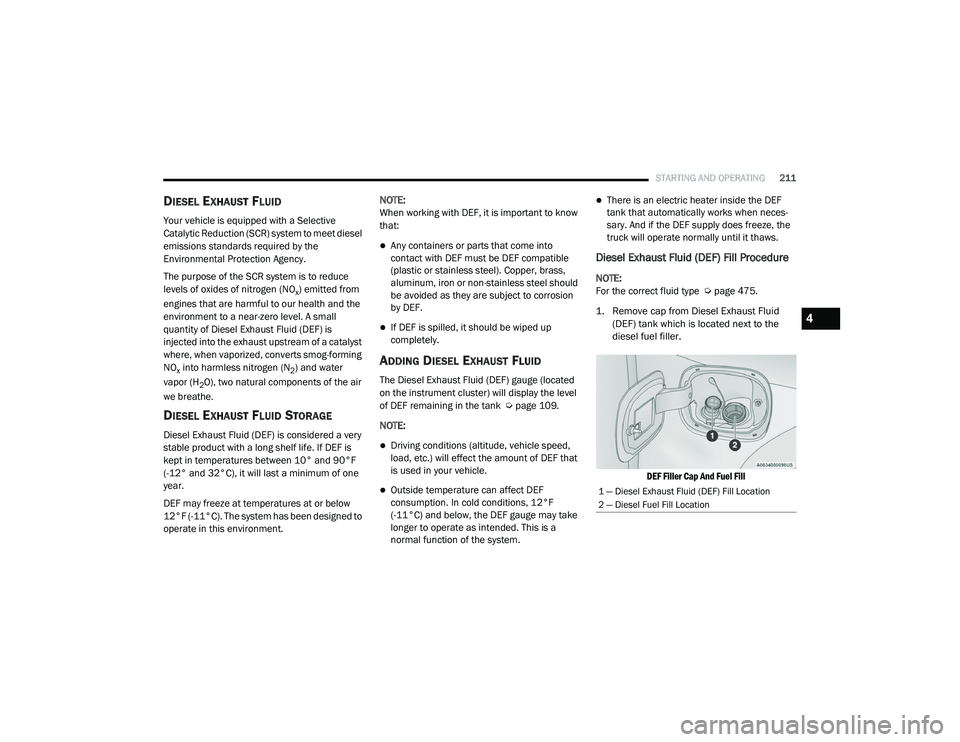
1. Remove cap from Diesel Exhaust Fluid (DEF) tank which is located next to the
diesel fuel filler.
DEF Filler Cap And Fuel Fill
1 — Diesel Exhaust Fluid (DEF) Fill Location
2 — Diesel Fuel Fill Location
4
21_DT_OM_EN_USC_t.book Page 211
Page 214 of 496

212STARTING AND OPERATING
(Continued)
(Continued)
2. Insert DEF fill adapter/nozzle into DEF tank filler neck.
NOTE:
The DEF gauge may take up to five seconds
to update after adding a gallon or more of
(DEF) to the DEF tank. If you have a fault
related to the DEF system, the gauge may not
update to the new level. See an authorized
dealer for service.
The DEF gauge may also not immediately
update after a refill if the temperature of the
DEF fluid is below 12°F (-11°C). The DEF line
heater will possibly warm up the DEF fluid
and allow the gauge to update after a period
of run time. Under very cold conditions, it is
possible that the gauge may not reflect the
new fill level for several drives.
Refilling With Nozzles
You can fill up at any DEF distributor.
Proceed as follows:
Insert the DEF nozzle in the filler, start
refilling and stop refilling at the first
shut-off (the shut-off indicates that the
DEF tank is full). Do not proceed with the
refilling, to prevent spillage of DEF.
Extract the nozzle. Refilling With Containers
Proceed as follows:
Check the expiration date.
Read the advice for use on the label
before pouring the content of the bottle
into the DEF tank.
If systems which cannot be screwed in
(e.g. tanks) are used for refilling, after the
indication appears on the instrument
panel display Ú
page 114 fill the DEF
tank with no more than 2 Gallons (8
liters).
If containers which can be screwed to the
filler are used, the reservoir is full when
the DEF level in the container stops
pouring out. Do not proceed further.
CAUTION!
To avoid DEF spillage, and possible
damage to the DEF tank from overfilling, do
not “top off” the DEF tank after filling.
DO NOT OVERFILL. DEF will freeze below
12ºF (-11ºC). The DEF system is designed
to work in temperatures below the DEF
freezing point, however, if the tank is over -
filled and freezes, the system could be
damaged.
When DEF is spilled, clean the area imme -
diately with water and use an absorbent
material to soak up the spills on the ground.
Do not attempt to start your engine if DEF is
accidentally added to the diesel fuel tank
as it can result in severe damage to your
engine, including but not limited to failure
of the fuel pump and injectors.
CAUTION! (Continued)
21_DT_OM_EN_USC_t.book Page 212
Page 355 of 496

SAFETY353
eye irritation, rinse the area with cool water.
For nose or throat irritation, move to fresh air.
If the irritation continues, see your doctor. If
these particles settle on your clothing, follow
the garment manufacturer’s instructions for
cleaning.
Do not drive your vehicle after the air bags have
deployed. If you are involved in another
collision, the air bags will not be in place to
protect you.
NOTE:
Air bag covers may not be obvious in the inte -
rior trim, but they will open during air bag
deployment.
After any collision, the vehicle should be
taken to an authorized dealer immediately.
Enhanced Accident Response System
In the event of an impact, if the communication
network remains intact, and the power remains
intact, depending on the nature of the event,
the Occupant Restraint Controller (ORC) will
determine whether to have the Enhanced
Accident Response System perform the
following functions:
Cut off fuel to the engine (if equipped)
Cut off battery power to the electric motor (if
equipped)
Flash hazard lights as long as the battery has
power
Turn on the interior lights, which remain on
as long as the battery has power or for
15 minutes from the intervention of the
Enhanced Accident Response System
Unlock the power door locks
Your vehicle may also be designed to perform
any of these other functions in response to the
Enhanced Accident Response System:
Turn off the Fuel Filter Heater, Turn off the
HVAC Blower Motor, Close the HVAC Circula -
tion Door
Cut off battery power to the:
Engine
Electric Motor (if equipped)
Electric power steering
Brake booster
Electric park brake
Automatic transmission gear selector
Horn
Front wiper
Headlamp washer pump
NOTE:
After an accident, remember to cycle the igni -
tion to the STOP (OFF/LOCK) position and
remove the key from the ignition switch to avoid
draining the battery. Carefully check the vehicle
for fuel leaks in the engine compartment and on
the ground near the engine compartment and
fuel tank before resetting the system and
starting the engine. If there are no fuel leaks or
damage to the vehicle electrical devices (e.g.
headlights) after an accident, reset the system
by following the procedure described below. If
you have any doubt, contact an authorized
dealer.
WARNING!
Deployed air bags and seat belt
pretensioners cannot protect you in another
collision. Have the air bags, seat belt
pretensioners, and the seat belt retractor
assemblies replaced by an authorized dealer
immediately. Also, have the Occupant
Restraint Controller System serviced as well.
6
21_DT_OM_EN_USC_t.book Page 353
Page 389 of 496
IN CASE OF EMERGENCY387
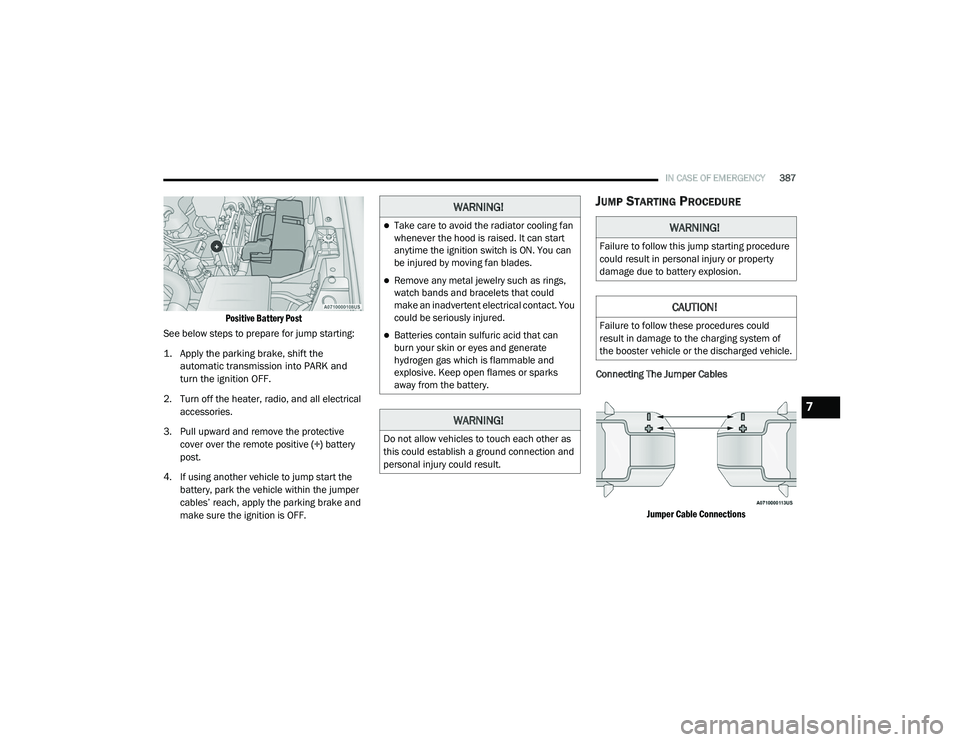
Positive Battery Post
See below steps to prepare for jump starting:
1. Apply the parking brake, shift the automatic transmission into PARK and
turn the ignition OFF.
2. Turn off the heater, radio, and all electrical accessories.
3. Pull upward and remove the protective cover over the remote positive (+) battery
post.
4. If using another vehicle to jump start the battery, park the vehicle within the jumper
cables’ reach, apply the parking brake and
make sure the ignition is OFF.
JUMP STARTING PROCEDURE
Connecting The Jumper Cables
Jumper Cable Connections
WARNING!
Take care to avoid the radiator cooling fan
whenever the hood is raised. It can start
anytime the ignition switch is ON. You can
be injured by moving fan blades.
Remove any metal jewelry such as rings,
watch bands and bracelets that could
make an inadvertent electrical contact. You
could be seriously injured.
Batteries contain sulfuric acid that can
burn your skin or eyes and generate
hydrogen gas which is flammable and
explosive. Keep open flames or sparks
away from the battery.
WARNING!
Do not allow vehicles to touch each other as
this could establish a ground connection and
personal injury could result.
WARNING!
Failure to follow this jump starting procedure
could result in personal injury or property
damage due to battery explosion.
CAUTION!
Failure to follow these procedures could
result in damage to the charging system of
the booster vehicle or the discharged vehicle.
7
21_DT_OM_EN_USC_t.book Page 387
Page 391 of 496
IN CASE OF EMERGENCY389
REFUELING IN EMERGENCY – IF EQUIPPED
The fuel filling procedure in case of an
emergency is described on Ú page 208.
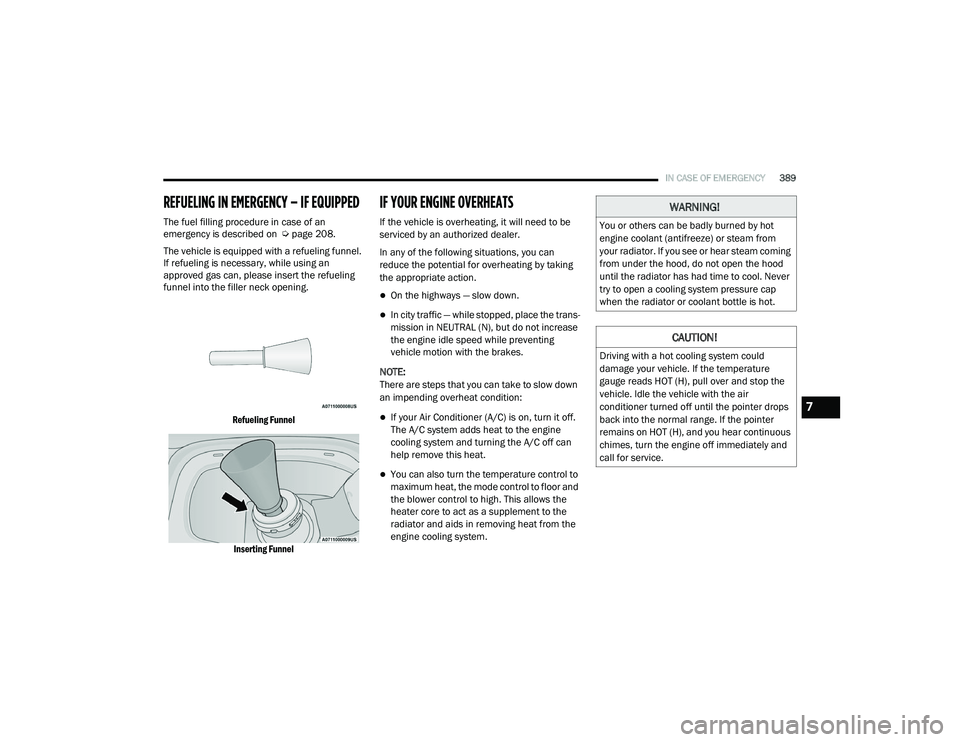
The vehicle is equipped with a refueling funnel.
If refueling is necessary, while using an
approved gas can, please insert the refueling
funnel into the filler neck opening.
Refueling FunnelInserting Funnel
IF YOUR ENGINE OVERHEATS
If the vehicle is overheating, it will need to be
serviced by an authorized dealer.
In any of the following situations, you can
reduce the potential for overheating by taking
the appropriate action.
On the highways — slow down.
In city traffic — while stopped, place the trans -
mission in NEUTRAL (N), but do not increase
the engine idle speed while preventing
vehicle motion with the brakes.
NOTE:
There are steps that you can take to slow down
an impending overheat condition:
If your Air Conditioner (A/C) is on, turn it off.
The A/C system adds heat to the engine
cooling system and turning the A/C off can
help remove this heat.
You can also turn the temperature control to
maximum heat, the mode control to floor and
the blower control to high. This allows the
heater core to act as a supplement to the
radiator and aids in removing heat from the
engine cooling system.
WARNING!
You or others can be badly burned by hot
engine coolant (antifreeze) or steam from
your radiator. If you see or hear steam coming
from under the hood, do not open the hood
until the radiator has had time to cool. Never
try to open a cooling system pressure cap
when the radiator or coolant bottle is hot.
CAUTION!
Driving with a hot cooling system could
damage your vehicle. If the temperature
gauge reads HOT (H), pull over and stop the
vehicle. Idle the vehicle with the air
conditioner turned off until the pointer drops
back into the normal range. If the pointer
remains on HOT (H), and you hear continuous
chimes, turn the engine off immediately and
call for service.
7
21_DT_OM_EN_USC_t.book Page 389
Page 432 of 496
430SERVICING AND MAINTENANCE
F2650 Amp Red –ESP Module
F27 30 Amp Pink –Front Wiper
F28 –10 Amp Red PCM / ECM
F29 40 Amp Green –ESP Module
F30 ––Spare
F31 ––Spare
F32 20 Amp Blue –ECM / PCM
F33 30 Amp Pink –Brake Vacuum Pump
F34 ––Spare
F35 –10 Amp RedPCM / ECM / Power Pack Unit (PPU) Motor Generator Unit (MGU)
Wake Up / EPS / Active Tuned Mass Module (ATMM) / ESP
F36 ––Spare
F37 –5 Amp Tan R / S Output to iPDC
F38 –10 Amp Red DTCM / Active CL TEMP VLV
F39 –15 Amp Red MOD ATMM
F40 40 Amp Green –Starter
F41 –10 Amp Red IRCAM Heaters
F42 20 Amp Blue –AUX SWITCH #5 — If Equipped
F43 –20 Amp Yellow MGU Coolant Pump
F44 –10 Amp Red Trailer Camera
F45 –10 Amp Red ADCM — If Equipped
CavityCartridge Fuse Micro Fuse Description
21_DT_OM_EN_USC_t.book Page 430
Page 433 of 496

SERVICING AND MAINTENANCE431
F4630 Amp Pink –Fuel Heater
F47 30 Amp Pink –Rear Defroster
F48 ––Spare
F49 30 Amp Pink –Htr Ctrl (Diesel Only)
F50 20 Amp Blue –AUX SWITCH #6 — If Equipped
F51 25 Amp White –FUEL PUMP MOTOR #1 — If Equipped
F52 ––Spare
F53 –10 Amp Red Supply / Purging Pump – If Equipped
F54 –15 Amp Blue PCM
F55 –15 Amp Blue Right HID Headlamp
F56 ––Spare
F57 –20 Amp Yellow Horn
F58 25 Amp White –FUEL PUMP MOTOR #2 — If Equipped
F59 –25 Amp Clear Injectors / IGN Coil / Glow Plug Module
F60 –20 Amp Yellow ECM / PCM / ACT Short Running Valve
F61 –15 Amp Blue Left HID Headlamp / Spare
F62 60 Amp Blue
40 Amp Green –
Glow Plug (DSL) / LTR Coolant Pump (TRX)
F63 20 Amp Blue –NOx Sensor
F64 –10 Amp Red PM Sensor – If Equipped
CavityCartridge Fuse Micro Fuse Description
8
21_DT_OM_EN_USC_t.book Page 431
Page 434 of 496

432SERVICING AND MAINTENANCE
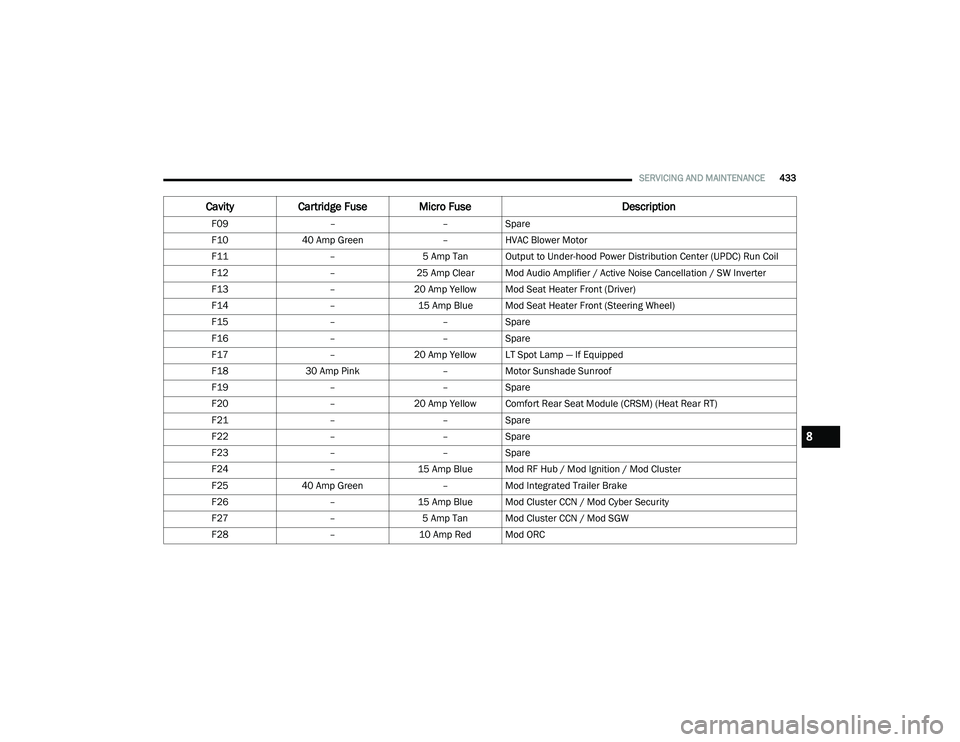
Internal Power Distribution Center
The Power Distribution Center is located under
the drivers side instrument panel. This center
contains cartridge fuses, micro fuses, relays,
and circuit breakers. A description of each fuse
and component may be stamped on the inside
cover, otherwise the cavity number of each fuse
is stamped on the inside cover that corresponds
to the following chart.CAUTION!
When installing the power distribution
center cover, it is important to ensure the
cover is properly positioned and fully
latched. Failure to do so may allow water to
get into the power distribution center and
possibly result in an electrical system
failure.
When replacing a blown fuse, it is important
to use only a fuse having the correct
amperage rating. The use of a fuse with a
rating other than indicated may result in a
dangerous electrical system overload. If a
properly rated fuse continues to blow, it
indicates a problem in the circuit that must
be corrected.
CavityCartridge Fuse Micro Fuse Description
F0130 Amp Pink –Trailer Tow Receptacle
F03 –20 Amp Yellow Module Seat Heater Front (Pass)
F04 ––Spare
F05 –20 Amp Yellow Module PPU Cooling Fan
F06 ––Spare
F07 40 Amp Green –Mod CBC 3 PWR Locks
F08 ––Spare
21_DT_OM_EN_USC_t.book Page 432
Page 435 of 496
SERVICING AND MAINTENANCE433
F09––Spare
F10 40 Amp Green –HVAC Blower Motor
F11 –5 Amp Tan Output to Under-hood Power Distribution Center (UPDC) Run Coil
F12 –25 Amp Clear Mod Audio Amplifier / Active Noise Cancellation / SW Inverter
F13 –20 Amp Yellow Mod Seat Heater Front (Driver)
F14 –15 Amp Blue Mod Seat Heater Front (Steering Wheel)
F15 ––Spare
F16 ––Spare
F17 –20 Amp Yellow LT Spot Lamp — If Equipped
F18 30 Amp Pink –Motor Sunshade Sunroof
F19 ––Spare
F20 –20 Amp Yellow Comfort Rear Seat Module (CRSM) (Heat Rear RT)
F21 ––Spare
F22 ––Spare
F23 ––Spare
F24 –15 Amp Blue Mod RF Hub / Mod Ignition / Mod Cluster
F25 40 Amp Green –Mod Integrated Trailer Brake
F26 –15 Amp Blue Mod Cluster CCN / Mod Cyber Security
F27 –5 Amp Tan Mod Cluster CCN / Mod SGW
F28 –10 Amp Red Mod ORC
CavityCartridge Fuse Micro Fuse Description
8
21_DT_OM_EN_USC_t.book Page 433
Page 487 of 496
485
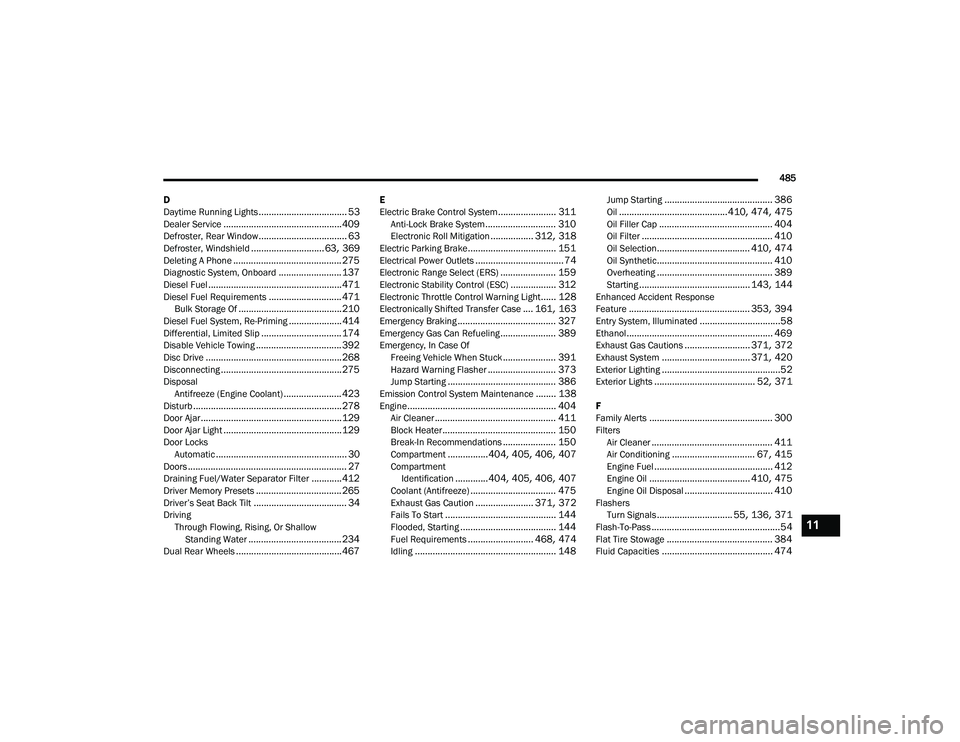
D
Daytime Running Lights
................................... 53Dealer Service............................................... 409Defroster, Rear Window................................... 63Defroster, Windshield............................. 63, 369Deleting A Phone........................................... 275Diagnostic System, Onboard......................... 137Diesel Fuel..................................................... 471Diesel Fuel Requirements............................. 471Bulk Storage Of......................................... 210Diesel Fuel System, Re-Priming..................... 414Differential, Limited Slip................................ 174Disable Vehicle Towing.................................. 392Disc Drive...................................................... 268Disconnecting................................................ 275Disposal Antifreeze (Engine Coolant)....................... 423Disturb........................................................... 278Door Ajar........................................................ 129Door Ajar Light............................................... 129Door LocksAutomatic.................................................... 30Doors............................................................... 27Draining Fuel/Water Separator Filter............ 412Driver Memory Presets.................................. 265Driver’s Seat Back Tilt..................................... 34DrivingThrough Flowing, Rising, Or Shallow Standing Water
..................................... 234Dual Rear Wheels.......................................... 467
E
Electric Brake Control System....................... 311Anti-Lock Brake System............................ 310Electronic Roll Mitigation................. 312, 318Electric Parking Brake................................... 151Electrical Power Outlets................................... 74Electronic Range Select (ERS)...................... 159Electronic Stability Control (ESC).................. 312Electronic Throttle Control Warning Light...... 128Electronically Shifted Transfer Case.... 161, 163Emergency Braking....................................... 327Emergency Gas Can Refueling...................... 389Emergency, In Case OfFreeing Vehicle When Stuck..................... 391Hazard Warning Flasher........................... 373Jump Starting........................................... 386Emission Control System Maintenance........ 138Engine........................................................... 404Air Cleaner................................................ 411Block Heater............................................. 150Break-In Recommendations..................... 150Compartment................404, 405, 406, 407Compartment Identification.............404, 405, 406, 407Coolant (Antifreeze).................................. 475Exhaust Gas Caution....................... 371, 372Fails To Start............................................ 144Flooded, Starting...................................... 144Fuel Requirements.......................... 468, 474Idling........................................................ 148
Jump Starting........................................... 386Oil...........................................410, 474, 475Oil Filler Cap............................................. 404Oil Filter.................................................... 410Oil Selection..................................... 410, 474Oil Synthetic.............................................. 410Overheating.............................................. 389Starting............................................ 143, 144Enhanced Accident Response
Feature................................................ 353, 394Entry System, Illuminated................................58Ethanol.......................................................... 469Exhaust Gas Cautions.......................... 371, 372Exhaust System................................... 371, 420Exterior Lighting...............................................52Exterior Lights........................................ 52, 371
F
Family Alerts................................................. 300FiltersAir Cleaner................................................ 411Air Conditioning................................. 67, 415Engine Fuel............................................... 412Engine Oil........................................ 410, 475Engine Oil Disposal................................... 410FlashersTurn Signals.............................. 55, 136, 371Flash-To-Pass...................................................54Flat Tire Stowage.......................................... 384Fluid Capacities............................................ 474
11
21_DT_OM_EN_USC_t.book Page 485