flat tire RAM 1500 2021 Owner's Guide
[x] Cancel search | Manufacturer: RAM, Model Year: 2021, Model line: 1500, Model: RAM 1500 2021Pages: 496, PDF Size: 20.89 MB
Page 455 of 496

SERVICING AND MAINTENANCE453
(Continued)
NOTE:
Wheel Valve Stem must be replaced as well
when installing new tires due to wear and tear
in existing tires.
Keep dismounted tires in a cool, dry place with
as little exposure to light as possible. Protect
tires from contact with oil, grease, and gasoline.
Replacement Tires
The tires on your new vehicle provide a balance
of many characteristics. They should be
inspected regularly for wear and correct cold
tire inflation pressures. FCA strongly
recommends that you use tires equivalent to
the originals in size, quality and performance
when replacement is needed Ú page 452. Refer to the Tire and Loading Information
placard or the Vehicle Certification Label for the
size designation of your tire. The Load Index and
Speed Symbol for your tire will be found on the
original equipment tire sidewall.
For more information relating to the Load Index
and Speed Symbol of a tire Ú
page 444.
It is recommended to replace the two front tires
or two rear tires as a pair. Replacing just one tire
can seriously affect your vehicle’s handling. If
you ever replace a wheel, make sure that the
wheel’s specifications match those of the
original wheels.
It is recommended you contact an authorized
tire dealer or original equipment dealer with any
questions you may have on tire specifications or
capability. Failure to use equivalent
replacement tires may adversely affect the
safety, handling, and ride of your vehicle.
WARNING!
Tires and the spare tire should be replaced after
six years, regardless of the remaining tread.
Failure to follow this warning can result in sud -
den tire failure. You could lose control and have
a collision resulting in serious injury or death.
WARNING!
Do not use a tire, wheel size, load rating, or
speed rating other than that specified for
your vehicle. Some combinations of unap -
proved tires and wheels may change
suspension dimensions and performance
characteristics, resulting in changes to
steering, handling, and braking of your
vehicle. This can cause unpredictable
handling and stress to steering and
suspension components. You could lose
control and have a collision resulting in
serious injury or death. Use only the tire and
wheel sizes with load ratings approved for
your vehicle.
Never use a tire with a smaller load index or
capacity, other than what was originally
equipped on your vehicle. Using a tire with
a smaller load index could result in tire
overloading and failure. You could lose
control and have a collision.
8
21_DT_OM_EN_USC_t.book Page 453
Page 456 of 496

454SERVICING AND MAINTENANCE
TIRE TYPES
All Season Tires — If Equipped
All Season tires provide traction for all seasons
(Spring, Summer, Autumn, and Winter). Traction
levels may vary between different all season
tires. All season tires can be identified by the
M+S, M&S, M/S or MS designation on the tire
sidewall. Use all season tires only in sets of four;
failure to do so may adversely affect the safety
and handling of your vehicle.
Summer Or Three Season Tires — If
Equipped
Summer tires provide traction in both wet and
dry conditions, and are not intended to be
driven in snow or on ice. If your vehicle is
equipped with Summer tires, be aware these
tires are not designed for Winter or cold driving
conditions. Install Winter tires on your vehicle
when ambient temperatures are less than 40°F
(5°C) or if roads are covered with ice or snow.
For more information, contact an authorized
dealer.
Summer tires do not contain the all season
designation or mountain/snowflake symbol on
the tire sidewall. Use Summer tires only in sets
of four; failure to do so may adversely affect the
safety and handling of your vehicle.
Snow Tires
Some areas of the country require the use of
snow tires during the Winter. Snow tires can be
identified by a “mountain/snowflake” symbol
on the tire sidewall.
If you need snow tires, select tires
equivalent in size and type to the
original equipment tires. Use snow
tires only in sets of four; failure to do
so may adversely affect the safety and handling
of your vehicle.
Snow tires generally have lower speed ratings
than what was originally equipped with your
vehicle and should not be operated at
sustained speeds over 75 mph (120 km/h). For
speeds above 75 mph (120 km/h) refer to
original equipment or an authorized tire dealer
for recommended safe operating speeds,
loading and cold tire inflation pressures.
While studded tires improve performance on
ice, skid and traction capability on wet or dry
surfaces may be poorer than that of
non-studded tires. Some states prohibit
studded tires; therefore, local laws should be
checked before using these tire types.Failure to equip your vehicle with tires
having adequate speed capability can
result in sudden tire failure and loss of
vehicle control.
CAUTION!
Replacing original tires with tires of a
different size may result in false speedometer
and odometer readings.
WARNING! (Continued)
WARNING!
Do not use Summer tires in snow/ice
conditions. You could lose vehicle control,
resulting in severe injury or death. Driving too
fast for conditions also creates the possibility
of loss of vehicle control.
21_DT_OM_EN_USC_t.book Page 454
Page 458 of 496
456SERVICING AND MAINTENANCE
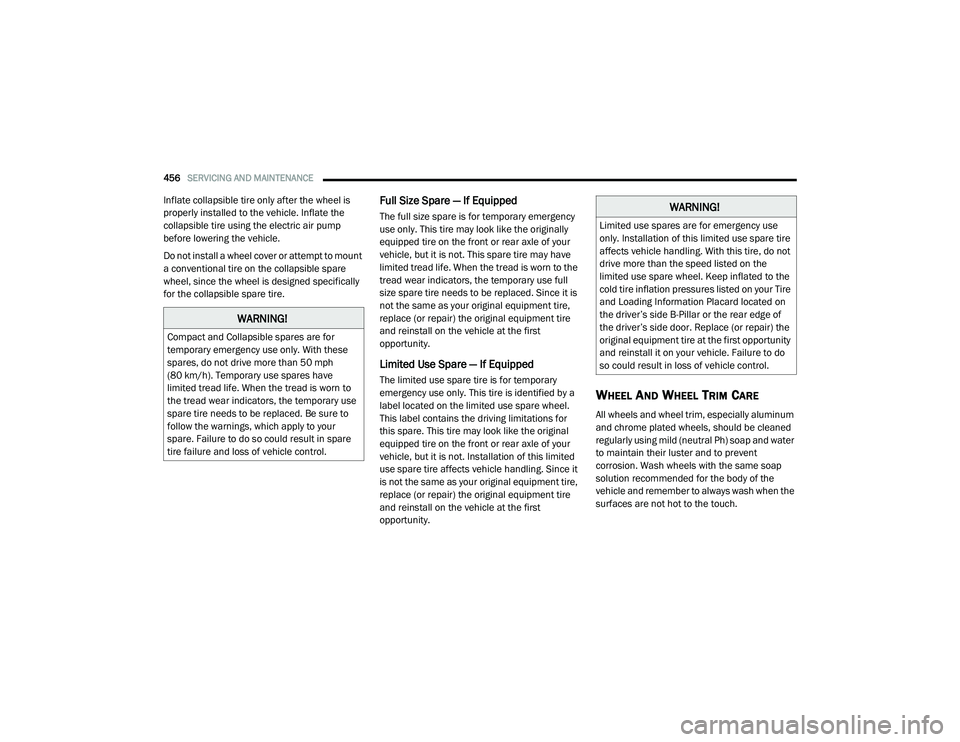
Inflate collapsible tire only after the wheel is
properly installed to the vehicle. Inflate the
collapsible tire using the electric air pump
before lowering the vehicle.
Do not install a wheel cover or attempt to mount
a conventional tire on the collapsible spare
wheel, since the wheel is designed specifically
for the collapsible spare tire.Full Size Spare — If Equipped
The full size spare is for temporary emergency
use only. This tire may look like the originally
equipped tire on the front or rear axle of your
vehicle, but it is not. This spare tire may have
limited tread life. When the tread is worn to the
tread wear indicators, the temporary use full
size spare tire needs to be replaced. Since it is
not the same as your original equipment tire,
replace (or repair) the original equipment tire
and reinstall on the vehicle at the first
opportunity.
Limited Use Spare — If Equipped
The limited use spare tire is for temporary
emergency use only. This tire is identified by a
label located on the limited use spare wheel.
This label contains the driving limitations for
this spare. This tire may look like the original
equipped tire on the front or rear axle of your
vehicle, but it is not. Installation of this limited
use spare tire affects vehicle handling. Since it
is not the same as your original equipment tire,
replace (or repair) the original equipment tire
and reinstall on the vehicle at the first
opportunity.
WHEEL AND WHEEL TRIM CARE
All wheels and wheel trim, especially aluminum
and chrome plated wheels, should be cleaned
regularly using mild (neutral Ph) soap and water
to maintain their luster and to prevent
corrosion. Wash wheels with the same soap
solution recommended for the body of the
vehicle and remember to always wash when the
surfaces are not hot to the touch.
WARNING!
Compact and Collapsible spares are for
temporary emergency use only. With these
spares, do not drive more than 50 mph
(80 km/h). Temporary use spares have
limited tread life. When the tread is worn to
the tread wear indicators, the temporary use
spare tire needs to be replaced. Be sure to
follow the warnings, which apply to your
spare. Failure to do so could result in spare
tire failure and loss of vehicle control.
WARNING!
Limited use spares are for emergency use
only. Installation of this limited use spare tire
affects vehicle handling. With this tire, do not
drive more than the speed listed on the
limited use spare wheel. Keep inflated to the
cold tire inflation pressures listed on your Tire
and Loading Information Placard located on
the driver’s side B-Pillar or the rear edge of
the driver’s side door. Replace (or repair) the
original equipment tire at the first opportunity
and reinstall it on your vehicle. Failure to do
so could result in loss of vehicle control.
21_DT_OM_EN_USC_t.book Page 456
Page 463 of 496

SERVICING AND MAINTENANCE461
TRACTION GRADES
The Traction grades, from highest to
lowest, are AA, A, B, and C. These grades
represent the tire's ability to stop on wet
pavement, as measured under
controlled conditions on specified
government test surfaces of asphalt and
concrete. A tire marked C may have poor
traction performance.
TEMPERATURE GRADES
The Temperature grades are A (the
highest), B, and C, representing the tire's
resistance to the generation of heat and
its ability to dissipate heat, when tested
under controlled conditions on a
specified indoor laboratory test wheel. Sustained high temperature can cause
the material of the tire to degenerate
and reduce tire life, and excessive
temperature can lead to sudden tire
failure. The grade C corresponds to a
level of performance, which all
passenger vehicle tires must meet
under the Federal Motor Vehicle Safety
Standard No. 109. Grades B and A
represent higher levels of performance
on the laboratory test wheel, than the
minimum required by law.
STORING THE VEHICLE
If you are storing your vehicle for more than
three weeks, we recommend that you take the
following steps to minimize the drain on your
vehicle's battery:
Disconnect the negative cable from battery.
Any time you store your vehicle or keep it out
of service (i.e., vacation) for two weeks or
more, run the air conditioning system at idle
for about five minutes in the fresh air and
high blower setting. This will ensure
adequate system lubrication to minimize the
possibility of compressor damage when the
system is started again.
BODYWORK
PROTECTION FROM ATMOSPHERIC
A
GENTS
Vehicle body care requirements vary according
to geographic locations and usage. Chemicals
that make roads passable in snow and ice and
those that are sprayed on trees and road
surfaces during other seasons are highly
corrosive to the metal in your vehicle. Outside
parking, which exposes your vehicle to airborne
WARNING!
The traction grade assigned to this tire is
based on straight-ahead braking traction
tests, and does not include acceleration, cor -
nering, hydroplaning, or peak traction charac -
teristics.
WARNING!
The temperature grade for this tire is
established for a tire that is properly inflated
and not overloaded. Excessive speed,
underinflation, or excessive loading, either
separately or in combination, can cause heat
buildup and possible tire failure.
8
21_DT_OM_EN_USC_t.book Page 461
Page 487 of 496
485
D
Daytime Running Lights
................................... 53Dealer Service............................................... 409Defroster, Rear Window................................... 63Defroster, Windshield............................. 63, 369Deleting A Phone........................................... 275Diagnostic System, Onboard......................... 137Diesel Fuel..................................................... 471Diesel Fuel Requirements............................. 471Bulk Storage Of......................................... 210Diesel Fuel System, Re-Priming..................... 414Differential, Limited Slip................................ 174Disable Vehicle Towing.................................. 392Disc Drive...................................................... 268Disconnecting................................................ 275Disposal Antifreeze (Engine Coolant)....................... 423Disturb........................................................... 278Door Ajar........................................................ 129Door Ajar Light............................................... 129Door LocksAutomatic.................................................... 30Doors............................................................... 27Draining Fuel/Water Separator Filter............ 412Driver Memory Presets.................................. 265Driver’s Seat Back Tilt..................................... 34DrivingThrough Flowing, Rising, Or Shallow Standing Water
..................................... 234Dual Rear Wheels.......................................... 467
E
Electric Brake Control System....................... 311Anti-Lock Brake System............................ 310Electronic Roll Mitigation................. 312, 318Electric Parking Brake................................... 151Electrical Power Outlets................................... 74Electronic Range Select (ERS)...................... 159Electronic Stability Control (ESC).................. 312Electronic Throttle Control Warning Light...... 128Electronically Shifted Transfer Case.... 161, 163Emergency Braking....................................... 327Emergency Gas Can Refueling...................... 389Emergency, In Case OfFreeing Vehicle When Stuck..................... 391Hazard Warning Flasher........................... 373Jump Starting........................................... 386Emission Control System Maintenance........ 138Engine........................................................... 404Air Cleaner................................................ 411Block Heater............................................. 150Break-In Recommendations..................... 150Compartment................404, 405, 406, 407Compartment Identification.............404, 405, 406, 407Coolant (Antifreeze).................................. 475Exhaust Gas Caution....................... 371, 372Fails To Start............................................ 144Flooded, Starting...................................... 144Fuel Requirements.......................... 468, 474Idling........................................................ 148
Jump Starting........................................... 386Oil...........................................410, 474, 475Oil Filler Cap............................................. 404Oil Filter.................................................... 410Oil Selection..................................... 410, 474Oil Synthetic.............................................. 410Overheating.............................................. 389Starting............................................ 143, 144Enhanced Accident Response
Feature................................................ 353, 394Entry System, Illuminated................................58Ethanol.......................................................... 469Exhaust Gas Cautions.......................... 371, 372Exhaust System................................... 371, 420Exterior Lighting...............................................52Exterior Lights........................................ 52, 371
F
Family Alerts................................................. 300FiltersAir Cleaner................................................ 411Air Conditioning................................. 67, 415Engine Fuel............................................... 412Engine Oil........................................ 410, 475Engine Oil Disposal................................... 410FlashersTurn Signals.............................. 55, 136, 371Flash-To-Pass...................................................54Flat Tire Stowage.......................................... 384Fluid Capacities............................................ 474
11
21_DT_OM_EN_USC_t.book Page 485
Page 493 of 496
491
Tires
................................... 371, 449, 455, 460Aging (Life Of Tires)................................... 452Air Pressure............................................... 449Chains....................................................... 458Compact Spare......................................... 455Dual........................................................... 467General Information........................ 449, 455High Speed................................................ 451Inflation Pressure...................................... 450Life Of Tires............................................... 452Load Capacity............................................ 447Pressure Monitoring System (TPMS)........................................ 131, 327Quality Grading.......................................... 460Radial........................................................ 451Replacement............................................. 453Rotation.................................................... 460Safety.............................................. 443, 449Sizes.......................................................... 444Snow Tires................................................. 454Spare Tires...................................... 455, 456Spinning.................................................... 452Trailer Towing............................................ 222Tread Wear Indicators............................... 452Wheel Nut Torque..................................... 467To Open Hood.................................................. 84Tongue Weight/Trailer Weight....................... 219Tonneau Cover....................................... 97, 462Tonneau Cover Cleaning................................ 462
Towing................................................. 214, 392Disabled Vehicle....................................... 392Guide........................................................ 218Recreational............................................. 230Weight...................................................... 218Towing Behind A Motorhome........................ 230Traction......................................................... 234Traction Control............................................ 318Trailer Reverse Steering Control................... 219Trailer Sway Control (TSC)............................. 318Trailer Towing............................................... 214Hitches..................................................... 218Minimum Requirements........................... 221Mirrors......................................................... 48Tips........................................................... 227Trailer And Tongue Weight........................ 219Wiring....................................................... 225Trailer Towing Guide..................................... 218Trailer Weight................................................ 218Transfer Case............................................... 427Electronically Shifted....................... 161, 163Fluid......................................................... 478Transmission................................................ 156Automatic........................................ 156, 426Fluid......................................................... 478Maintenance............................................ 426Shifting..................................................... 154Transporting Pets.......................................... 369Tread Wear Indicators.................................. 452Turn Signals......................... 55, 136, 439, 441
U
UconnectPhone Call Features
................................. 276Things You Should Know About Your Uconnect Phone................................... 279Uconnect App................................................ 284Uconnect Phone................................... 272, 273Answer Or Ignore An Incoming Call — Call Currently In Progress..................... 278Answer Or Ignore An Incoming Call — No Call Currently In Progress................ 277Bluetooth Communication Link................ 281Call Continuation...................................... 279Call Controls............................................. 277Call Termination....................................... 279Cancel Command..................................... 273Connecting To A Particular Mobile Phone Or Audio Device After Pairing................ 275Help Command......................................... 273Join Calls.................................................. 279Making A Phone Or Audio Device AFavorite................................................ 275Making A Second Call While Current Call Is In Progress........................................ 278Managing Your Favorites.......................... 276Natural Speech......................................... 272Operation.................................................. 272Overview................................................... 27111
21_DT_OM_EN_USC_t.book Page 491