engine oil RAM 1500 2021 Service Manual
[x] Cancel search | Manufacturer: RAM, Model Year: 2021, Model line: 1500, Model: RAM 1500 2021Pages: 496, PDF Size: 20.89 MB
Page 428 of 496
426SERVICING AND MAINTENANCE
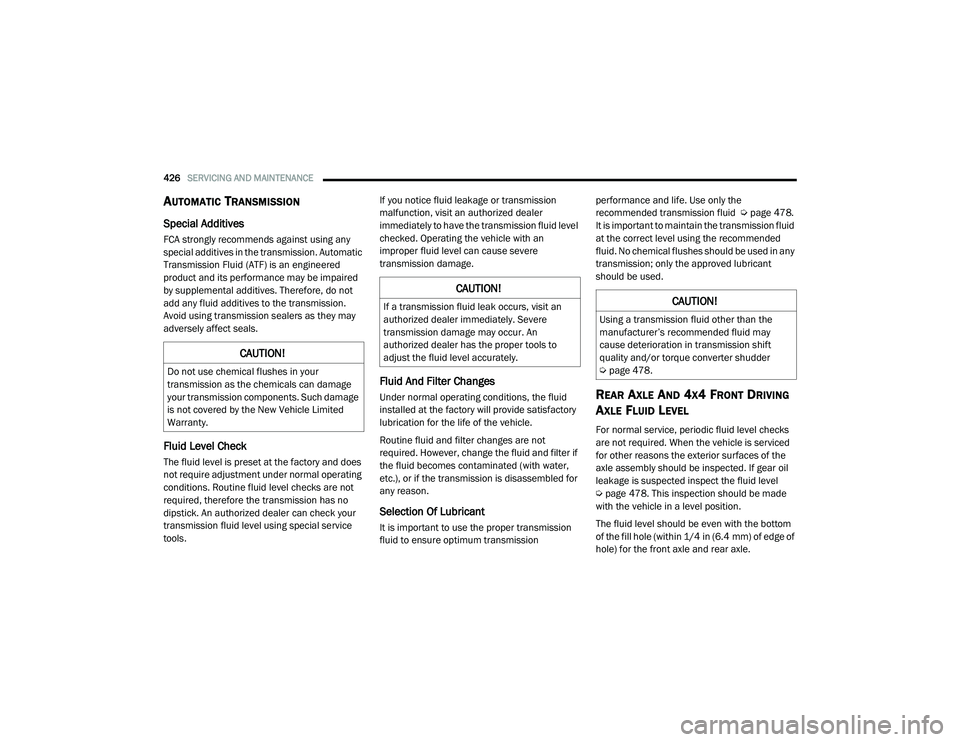
AUTOMATIC TRANSMISSION
Special Additives
FCA strongly recommends against using any
special additives in the transmission. Automatic
Transmission Fluid (ATF) is an engineered
product and its performance may be impaired
by supplemental additives. Therefore, do not
add any fluid additives to the transmission.
Avoid using transmission sealers as they may
adversely affect seals.
Fluid Level Check
The fluid level is preset at the factory and does
not require adjustment under normal operating
conditions. Routine fluid level checks are not
required, therefore the transmission has no
dipstick. An authorized dealer can check your
transmission fluid level using special service
tools. If you notice fluid leakage or transmission
malfunction, visit an authorized dealer
immediately to have the transmission fluid level
checked. Operating the vehicle with an
improper fluid level can cause severe
transmission damage.
Fluid And Filter Changes
Under normal operating conditions, the fluid
installed at the factory will provide satisfactory
lubrication for the life of the vehicle.
Routine fluid and filter changes are not
required. However, change the fluid and filter if
the fluid becomes contaminated (with water,
etc.), or if the transmission is disassembled for
any reason.
Selection Of Lubricant
It is important to use the proper transmission
fluid to ensure optimum transmission performance and life. Use only the
recommended transmission fluid
Úpage 478.
It is important to maintain the transmission fluid
at the correct level using the recommended
fluid. No chemical flushes should be used in any
transmission; only the approved lubricant
should be used.
REAR AXLE AND 4X4 FRONT DRIVING
A
XLE FLUID LEVEL
For normal service, periodic fluid level checks
are not required. When the vehicle is serviced
for other reasons the exterior surfaces of the
axle assembly should be inspected. If gear oil
leakage is suspected inspect the fluid level
Ú page 478. This inspection should be made
with the vehicle in a level position.
The fluid level should be even with the bottom
of the fill hole (within 1/4 in (6.4 mm) of edge of
hole) for the front axle and rear axle.
CAUTION!
Do not use chemical flushes in your
transmission as the chemicals can damage
your transmission components. Such damage
is not covered by the New Vehicle Limited
Warranty.
CAUTION!
If a transmission fluid leak occurs, visit an
authorized dealer immediately. Severe
transmission damage may occur. An
authorized dealer has the proper tools to
adjust the fluid level accurately.CAUTION!
Using a transmission fluid other than the
manufacturer’s recommended fluid may
cause deterioration in transmission shift
quality and/or torque converter shudder
Ú page 478.
21_DT_OM_EN_USC_t.book Page 426
Page 469 of 496

467
TECHNICAL SPECIFICATIONS
VEHICLE IDENTIFICATION NUMBER
The Vehicle Identification Number (VIN) is found
on the left front corner of the instrument panel,
visible through the windshield.
Vehicle Identification Number
NOTE:
It is illegal to remove or alter the VIN.
BRAKE SYSTEM
If power assist is lost for any reason (for
example, repeated brake applications with the
engine off), the brakes will still function.
However, you will experience a substantial
increase in braking effort to stop the vehicle.
If either the front or rear hydraulic system loses
normal braking capability, the remaining
system will still function with some loss of
overall braking effectiveness. This will be
evident by increased pedal travel during
application, greater pedal force required to slow
or stop, and the “Brake Warning Light” and the
“ABS Warning Light” will activate during brake
use.
WHEEL AND TIRE TORQUE SPECIFICATIONS
Proper lug nut/bolt torque is very important to
ensure that the wheel is properly mounted to
the vehicle. Any time a wheel has been removed
and reinstalled on the vehicle, the lug nuts/
bolts should be torqued using a properly
calibrated torque wrench using a six sided (hex)
deep wall socket.
TORQUE SPECIFICATIONS
**Use only authorized dealer recommended lug nuts/
bolts and clean or remove any dirt or oil before tightening.
Lug Nut/ Bolt
Torque Lug Nut/
Bolt Type **Lug
Nut/Bolt Size Lug Nut/
Bolt
Socket Size
130
Ft-Lbs
(176 N·m) Cone
M14 x
1.50 22 mm
9
21_DT_OM_EN_USC_t.book Page 467
Page 470 of 496

468TECHNICAL SPECIFICATIONS
NOTE:
Do not oil wheel studs. For chrome wheels, do
not substitute with chrome plated wheel nuts.
Inspect the wheel mounting surface prior to
mounting the tire and remove any corrosion or
loose particles.
Wheel Mounting Surface
Tighten the lug nuts/bolts in a star pattern until
each nut/bolt has been tightened twice. Ensure
that the socket is fully engaged on the lug nut/
bolt (do not insert it halfway).
After 25 miles (40 km), check the lug nut/bolt torque to be sure that all the lug nuts/bolts are
properly seated against the wheel.
Four, Five, And Six Lug Nuts/Bolts Torque Pattern
FUEL REQUIREMENTS — GASOLINE ENGINE
While operating on gasoline with the required
octane number, hearing a light knocking sound
from the engine is not a cause for concern.
However, if the engine is heard making a heavy
knocking sound, see a dealer immediately. Use
of gasoline with a lower than recommended octane number can cause engine failure and
may void or not be covered by the New Vehicle
Limited Warranty.
Poor quality gasoline can cause problems such
as hard starting, stalling, and hesitations. If you
experience these symptoms, try another brand
of gasoline before considering service for the
vehicle.
3.6L ENGINE
Do not use E-85 flex fuel or ethanol blends
greater than 15% in this engine.
This engine is designed to meet all
emissions regulations and provide
optimum fuel economy and
performance when using high quality
unleaded “Regular” gasoline having a posted
octane number of 87 as specified by the (R+M)/
2 method. The use of higher octane “Premium”
gasoline is not required, as it will not provide
any benefit over “Regular” gasoline in these
engines.WARNING!
To avoid the risk of forcing the vehicle off the
jack, do not tighten the lug nuts/bolts fully
until the vehicle has been lowered. Failure to
follow this warning may result in personal
injury.
21_DT_OM_EN_USC_t.book Page 468
Page 474 of 496

472TECHNICAL SPECIFICATIONS
BIODIESEL FUEL REQUIREMENTS
A maximum blend of 5% biodiesel meeting
ASTM specification D975 is recommended for
use with your diesel engine. If frequent
operation with Biodiesel blends that are
between 6% and 20% (B6–B20) is desired, the
maintenance schedule is subject to shorter
intervals.
The oil and filter change along with fuel filter
replacement is subject to shorter intervals
when operating your engine on biodiesel
greater than 5%. Do not use biodiesel greater
than 20%.
For regular use of biodiesel blends between 6%
and 20% (B6–B20) it is important that you
understand and comply with these
requirements. For further direction
Úpage 403. Biodiesel is a fuel produced from renewable
resources typically derived from animal fat,
rapeseed oil (Rapeseed Methyl Ester (RME)
base), or soybean oil (Soy Methyl Ester (SME or
SOME) base).
Biodiesel fuel has inherent limitations which
require that you understand and adhere to the
following requirements if you use blends of
Biodiesel between 6% and 20% (B6–B20).
There are no unique restrictions for the use of
B5.
Biodiesel Fuel Properties — Low Ambient
Temperatures
Biodiesel fuel may gel or solidify at low ambient
temperatures, which may pose problems for
both storage and operation. Precautions can be
necessary at low ambient temperatures, such
as storing the fuel in a heated building or a
heated storage tank, or using cold temperature
additives.
CAUTION!
Failure to comply with Oil Change
requirements for vehicles operating on
biodiesel blends between 6% and 20%
(B6–B20) will result in premature engine
wear. Such wear is not covered by the New
Vehicle Limited Warranty.
CAUTION!
Use of blends greater than 20% is not
approved. Use of blends greater than 20%
can result in engine damage. Such damage is
not covered by the New Vehicle Limited
Warranty.
CAUTION!
In the event that the vehicle is filled with
biodiesel and not used for more than a
month, the fuel should either be used up by
driving (up to quarter tank) and filled with
standard diesel blends with less than 5% that
is normally available. This will help prevent
the fuel filter clogging and potential damage
to the fuel injection system due to degraded
biodiesel, which is not covered by the New
Vehicle Limited Warranty.
21_DT_OM_EN_USC_t.book Page 472
Page 475 of 496

TECHNICAL SPECIFICATIONS473
Fuel Quality — Must Comply With ASTM
Standards
The quality of Biodiesel fuel may vary widely.
Only fuel produced by a BQ9000 supplier to the
following specifications may be blended to
meet Biodiesel blend B6 – B20 fuel meeting
ASTM specification D-7467:
Petrodiesel fuel meeting ASTM specification
D-975 and Biodiesel fuel (B100) meeting ASTM
specification D-6751
Fuel Oxidation Stability — Must Use Fuel
Within Six Months Of Manufacture
Biodiesel fuel has poor oxidation stability which
can result in long term storage problems. Fuel
produced to approved ASTM standards, if
stored properly, provides for protection against
fuel oxidation for up to six months.
Fuel Water Separation — Must Use Mopar
Approved Fuel Filter Elements
Biodiesel fuel has a natural affinity to water and
water accelerates microbial growth. Your Mopar
filtration system is designed to provide
adequate fuel water separation capabilities.
Fuel In Oil Dilution — Must Adhere To
Required Oil Change Interval
Fuel dilution of lubricating oil has been
observed with the use of Biodiesel fuel. Fuel in
oil must not exceed 5%. To ensure this limit is
met your oil change interval must be
maintained with in the suggested schedule. The
regular use of biodiesel between 6% and 20%
requires intervals shorter than the outlined
10,000 miles (16,100 km) and must not
exceed the suggested schedule. When routinely
operating on biodiesel between 6% and 20%, oil
and filter replacement intervals must not
exceed 8,000 Miles (12,900 km) or six months,
which ever comes first.
Biodiesel Fuel Filter Change Intervals
The use of biodiesel requires more frequent fuel
filter change intervals. When operating on
biodiesel between 6% and 20%, fuel filter
replacement intervals should be every second
oil change, and must not exceed 16,000 miles
(25,750 km).
NOTE:
Under no circumstances should oil change
intervals exceed 8,000 miles (12,875 km) or
six months, if regular operation occurs with 6%
- 20% biodiesel blends. Under no circumstances
should fuel filter replacement intervals exceed
every second oil change and must not exceed
16,000 miles (25,750 km), if regular operation
occurs with 6% - 20% biodiesel blends. Failure
to comply with these oil change and fuel filter
requirements for vehicles operating on
biodiesel blends up to B20 may result in prema -
ture engine wear. Such wear is not covered by
the New Vehicle Limited Warranty. The engine
may suffer severe damage if operated with
concentrations of biodiesel higher than 20%.
9
21_DT_OM_EN_USC_t.book Page 473
Page 476 of 496
474TECHNICAL SPECIFICATIONS
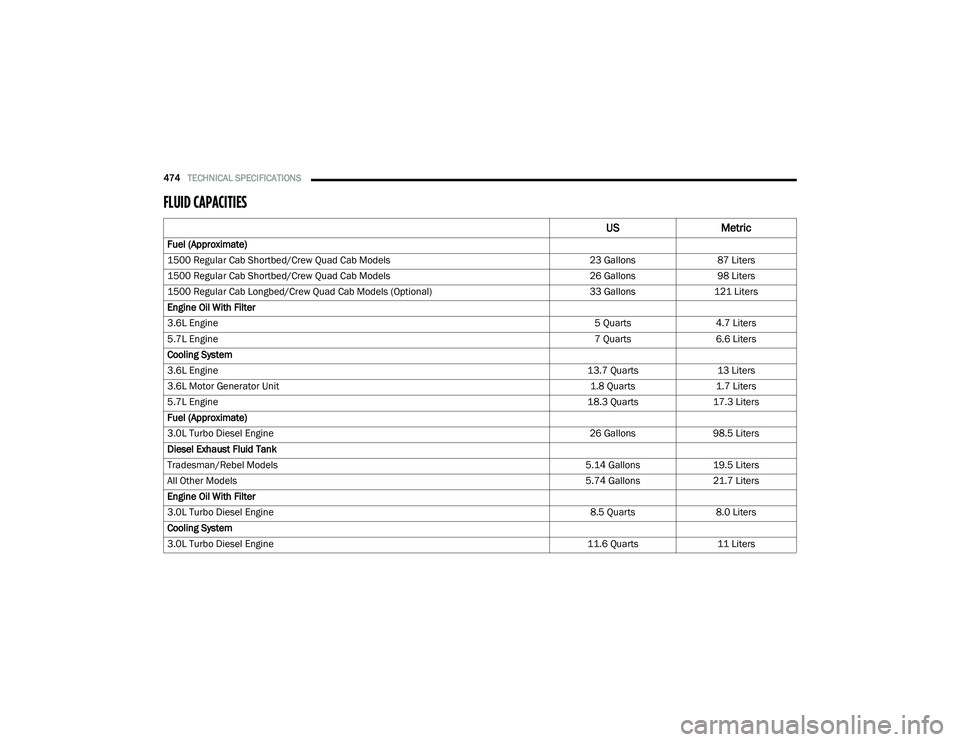
FLUID CAPACITIES
USMetric
Fuel (Approximate)
1500 Regular Cab Shortbed/Crew Quad Cab Models 23 Gallons87 Liters
1500 Regular Cab Shortbed/Crew Quad Cab Models 26 Gallons98 Liters
1500 Regular Cab Longbed/Crew Quad Cab Models (Optional) 33 Gallons121 Liters
Engine Oil With Filter
3.6L Engine 5 Quarts4.7 Liters
5.7L Engine 7 Quarts6.6 Liters
Cooling System
3.6L Engine 13.7 Quarts13 Liters
3.6L Motor Generator Unit 1.8 Quarts1.7 Liters
5.7L Engine 18.3 Quarts17.3 Liters
Fuel (Approximate)
3.0L Turbo Diesel Engine 26 Gallons98.5 Liters
Diesel Exhaust Fluid Tank
Tradesman/Rebel Models 5.14 Gallons19.5 Liters
All Other Models 5.74 Gallons21.7 Liters
Engine Oil With Filter
3.0L Turbo Diesel Engine 8.5 Quarts8.0 Liters
Cooling System
3.0L Turbo Diesel Engine 11.6 Quarts11 Liters
21_DT_OM_EN_USC_t.book Page 474
Page 477 of 496
TECHNICAL SPECIFICATIONS475
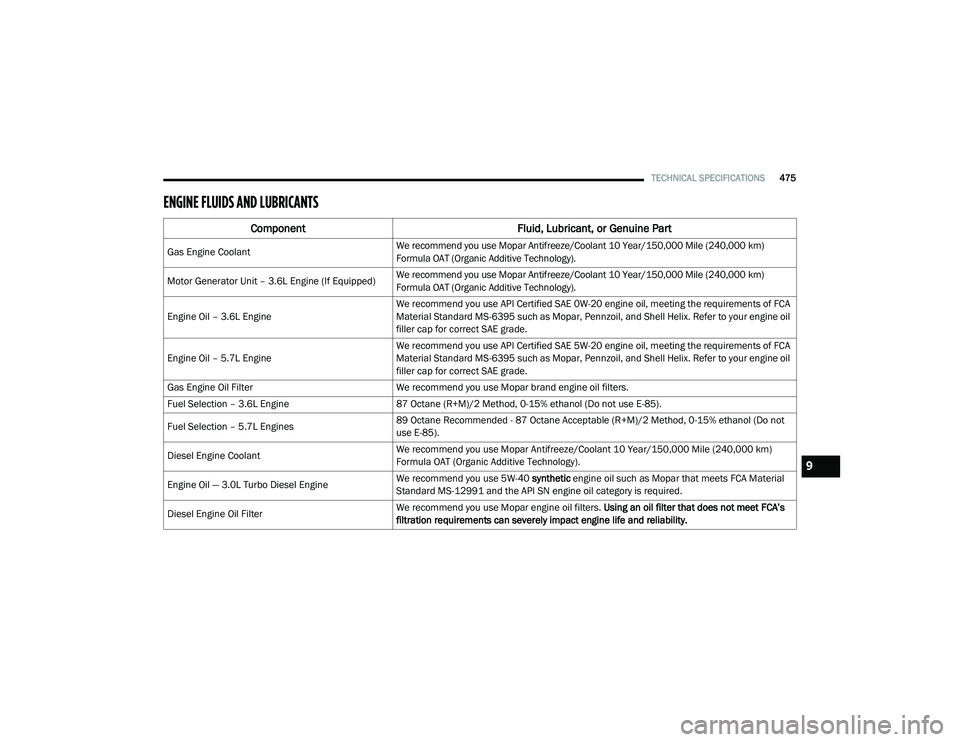
ENGINE FLUIDS AND LUBRICANTS
Component Fluid, Lubricant, or Genuine Part
Gas Engine CoolantWe recommend you use Mopar Antifreeze/Coolant 10 Year/150,000 Mile (240,000 km)
Formula OAT (Organic Additive Technology).
Motor Generator Unit – 3.6L Engine (If Equipped) We recommend you use Mopar Antifreeze/Coolant 10 Year/150,000 Mile (240,000 km)
Formula OAT (Organic Additive Technology).
Engine Oil – 3.6L Engine We recommend you use API Certified SAE 0W-20 engine oil, meeting the requirements of FCA
Material Standard MS-6395 such as Mopar, Pennzoil, and Shell Helix. Refer to your engine oil
filler cap for correct SAE grade.
Engine Oil – 5.7L Engine We recommend you use API Certified SAE 5W-20 engine oil, meeting the requirements of FCA
Material Standard MS-6395 such as Mopar, Pennzoil, and Shell Helix. Refer to your engine oil
filler cap for correct SAE grade.
Gas Engine Oil Filter We recommend you use Mopar brand engine oil filters.
Fuel Selection – 3.6L Engine 87 Octane (R+M)/2 Method, 0-15% ethanol (Do not use E-85).
Fuel Selection – 5.7L Engines 89 Octane Recommended - 87 Octane Acceptable (R+M)/2 Method, 0-15% ethanol (Do not
use E-85).
Diesel Engine Coolant We recommend you use Mopar Antifreeze/Coolant 10 Year/150,000 Mile (240,000 km)
Formula OAT (Organic Additive Technology).
Engine Oil — 3.0L Turbo Diesel Engine We recommend you use 5W-40
synthetic engine oil such as Mopar that meets FCA Material
Standard MS-12991 and the API SN engine oil category is required.
Diesel Engine Oil Filter We recommend you use Mopar engine oil filters.
Using an oil filter that does not meet FCA’s
filtration requirements can severely impact engine life and reliability.
9
21_DT_OM_EN_USC_t.book Page 475
Page 478 of 496
476TECHNICAL SPECIFICATIONS
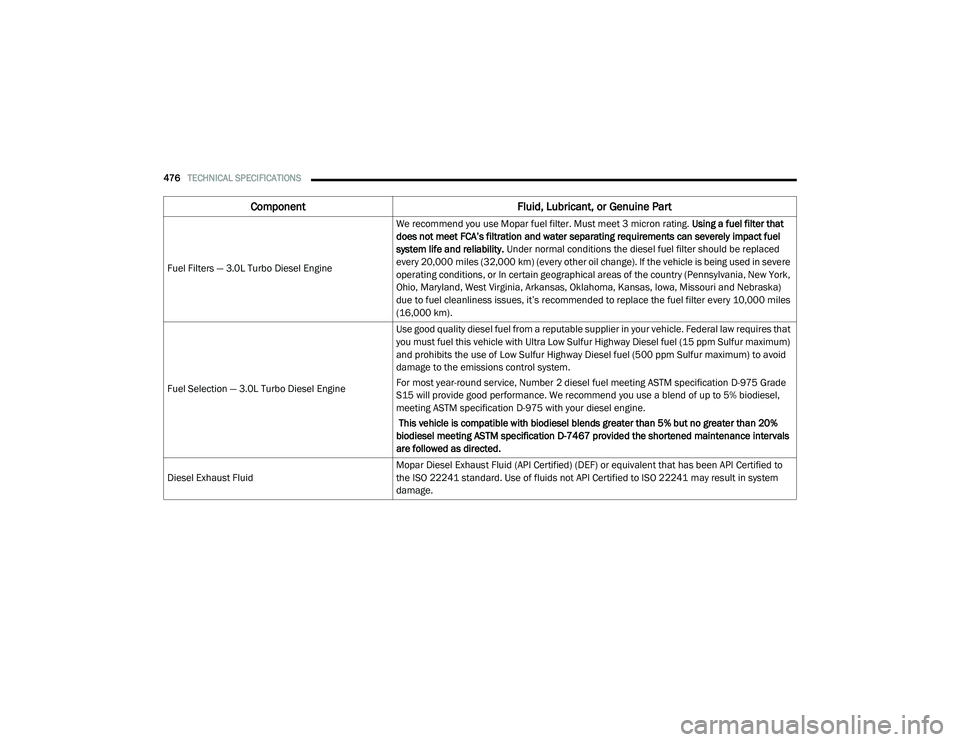
Fuel Filters — 3.0L Turbo Diesel Engine We recommend you use Mopar fuel filter. Must meet 3 micron rating. Using a fuel filter that
does not meet FCA’s filtration and water separating requirements can severely impact fuel
system life and reliability.
Under normal conditions the diesel fuel filter should be replaced
every 20,000 miles (32,000 km) (every other oil change). If the vehicle is being used in severe
operating conditions, or In certain geographical areas of the country (Pennsylvania, New York,
Ohio, Maryland, West Virginia, Arkansas, Oklahoma, Kansas, Iowa, Missouri and Nebraska)
due to fuel cleanliness issues, it’s recommended to replace the fuel filter every 10,000 miles
(16,000 km).
Fuel Selection — 3.0L Turbo Diesel Engine Use good quality diesel fuel from a reputable supplier in your vehicle. Federal law requires that
you must fuel this vehicle with Ultra Low Sulfur Highway Diesel fuel (15 ppm Sulfur maximum)
and prohibits the use of Low Sulfur Highway Diesel fuel (500 ppm Sulfur maximum) to avoid
damage to the emissions control system.
For most year-round service, Number 2 diesel fuel meeting ASTM specification D-975 Grade
S15 will provide good performance. We recommend you use a blend of up to 5% biodiesel,
meeting ASTM specification D-975 with your diesel engine.
This vehicle is compatible with biodiesel blends greater than 5% but no greater than 20%
biodiesel meeting ASTM specification D-7467 provided the shortened maintenance intervals
are followed as directed.
Diesel Exhaust Fluid Mopar Diesel Exhaust Fluid (API Certified) (DEF) or equivalent that has been API Certified to
the ISO 22241 standard. Use of fluids not API Certified to ISO 22241 may result in system
damage.
Component
Fluid, Lubricant, or Genuine Part
21_DT_OM_EN_USC_t.book Page 476
Page 486 of 496
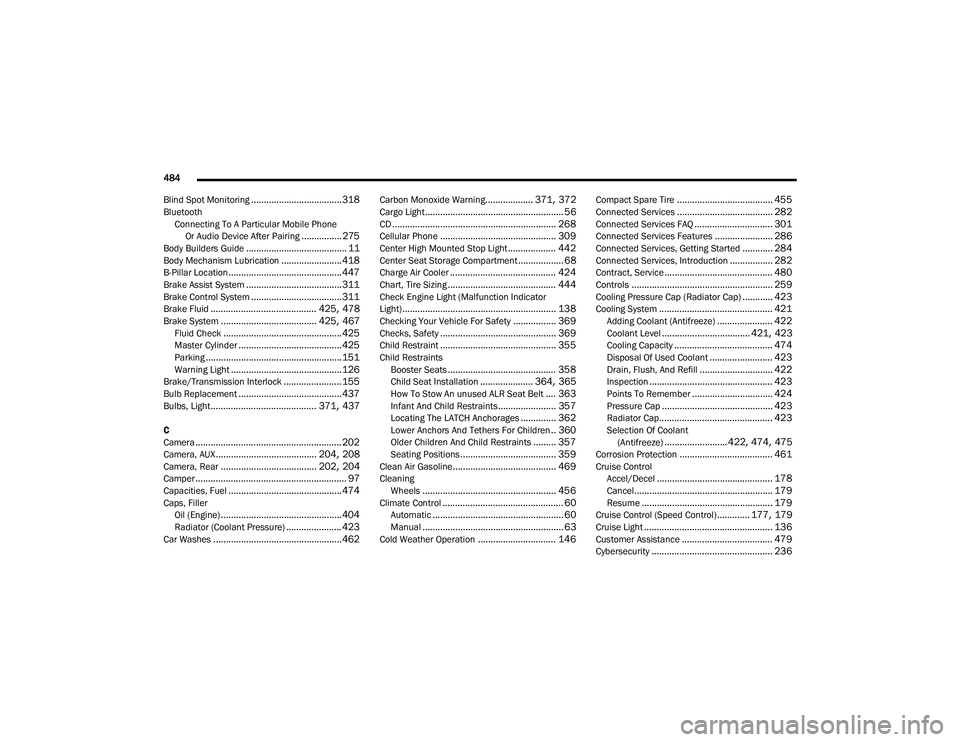
484
Blind Spot Monitoring
.................................... 318Bluetooth Connecting To A Particular Mobile PhoneOr Audio Device After Pairing
................275Body Builders Guide........................................ 11Body Mechanism Lubrication........................ 418B-Pillar Location............................................. 447Brake Assist System...................................... 311Brake Control System.................................... 311Brake Fluid.......................................... 425, 478Brake System...................................... 425, 467Fluid Check............................................... 425Master Cylinder......................................... 425Parking...................................................... 151Warning Light............................................ 126Brake/Transmission Interlock....................... 155Bulb Replacement......................................... 437Bulbs, Light.......................................... 371, 437
C
Camera.......................................................... 202Camera, AUX........................................ 204, 208Camera, Rear...................................... 202, 204Camper............................................................ 97Capacities, Fuel............................................. 474Caps, FillerOil (Engine)................................................ 404Radiator (Coolant Pressure)...................... 423Car Washes................................................... 462
Carbon Monoxide Warning................... 371, 372Cargo Light....................................................... 56CD................................................................. 268Cellular Phone.............................................. 309Center High Mounted Stop Light................... 442Center Seat Storage Compartment.................. 68Charge Air Cooler.......................................... 424Chart, Tire Sizing........................................... 444Check Engine Light (Malfunction Indicator
Light)............................................................. 138Checking Your Vehicle For Safety................. 369Checks, Safety.............................................. 369Child Restraint.............................................. 355Child RestraintsBooster Seats........................................... 358Child Seat Installation..................... 364, 365How To Stow An unused ALR Seat Belt.... 363Infant And Child Restraints....................... 357Locating The LATCH Anchorages.............. 362Lower Anchors And Tethers For Children.. 360Older Children And Child Restraints......... 357Seating Positions...................................... 359Clean Air Gasoline......................................... 469CleaningWheels..................................................... 456Climate Control................................................ 60Automatic.................................................... 60Manual........................................................ 63Cold Weather Operation............................... 146
Compact Spare Tire...................................... 455Connected Services...................................... 282Connected Services FAQ............................... 301Connected Services Features....................... 286Connected Services, Getting Started............ 284Connected Services, Introduction................. 282Contract, Service........................................... 480Controls........................................................ 259Cooling Pressure Cap (Radiator Cap)............ 423Cooling System............................................. 421Adding Coolant (Antifreeze)...................... 422Coolant Level................................... 421, 423Cooling Capacity....................................... 474Disposal Of Used Coolant......................... 423Drain, Flush, And Refill............................. 422Inspection................................................. 423Points To Remember................................ 424Pressure Cap............................................ 423Radiator Cap............................................. 423Selection Of Coolant (Antifreeze)......................... 422, 474, 475Corrosion Protection..................................... 461Cruise ControlAccel/Decel.............................................. 178Cancel....................................................... 179Resume.................................................... 179Cruise Control (Speed Control)............. 177, 179Cruise Light................................................... 136Customer Assistance.................................... 479Cybersecurity................................................ 236
21_DT_OM_EN_USC_t.book Page 484
Page 487 of 496
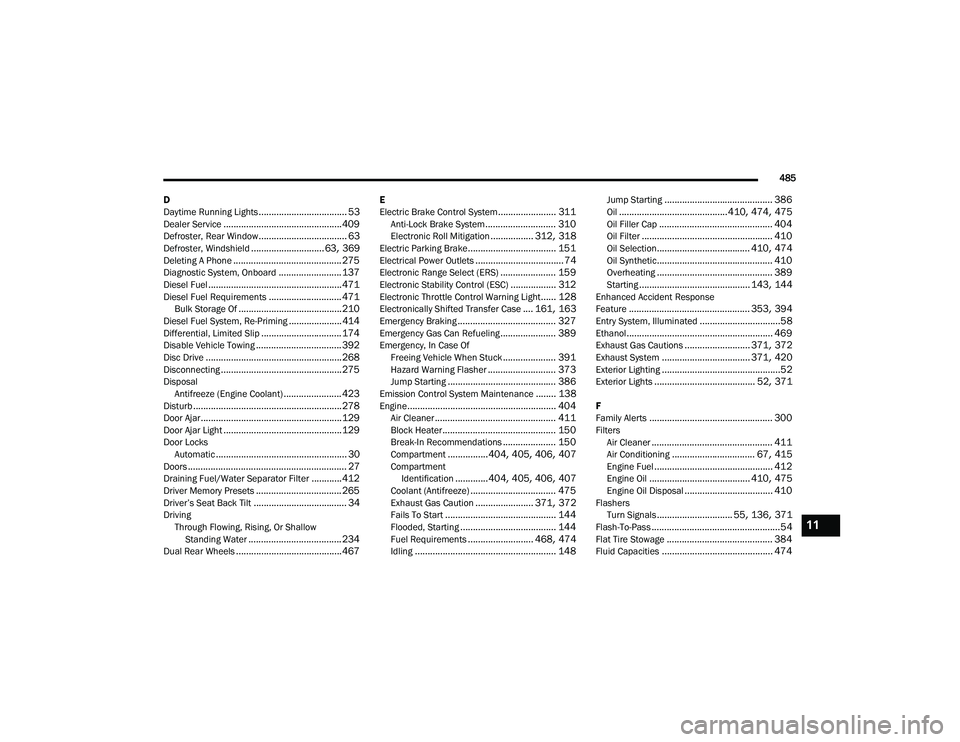
485
D
Daytime Running Lights
................................... 53Dealer Service............................................... 409Defroster, Rear Window................................... 63Defroster, Windshield............................. 63, 369Deleting A Phone........................................... 275Diagnostic System, Onboard......................... 137Diesel Fuel..................................................... 471Diesel Fuel Requirements............................. 471Bulk Storage Of......................................... 210Diesel Fuel System, Re-Priming..................... 414Differential, Limited Slip................................ 174Disable Vehicle Towing.................................. 392Disc Drive...................................................... 268Disconnecting................................................ 275Disposal Antifreeze (Engine Coolant)....................... 423Disturb........................................................... 278Door Ajar........................................................ 129Door Ajar Light............................................... 129Door LocksAutomatic.................................................... 30Doors............................................................... 27Draining Fuel/Water Separator Filter............ 412Driver Memory Presets.................................. 265Driver’s Seat Back Tilt..................................... 34DrivingThrough Flowing, Rising, Or Shallow Standing Water
..................................... 234Dual Rear Wheels.......................................... 467
E
Electric Brake Control System....................... 311Anti-Lock Brake System............................ 310Electronic Roll Mitigation................. 312, 318Electric Parking Brake................................... 151Electrical Power Outlets................................... 74Electronic Range Select (ERS)...................... 159Electronic Stability Control (ESC).................. 312Electronic Throttle Control Warning Light...... 128Electronically Shifted Transfer Case.... 161, 163Emergency Braking....................................... 327Emergency Gas Can Refueling...................... 389Emergency, In Case OfFreeing Vehicle When Stuck..................... 391Hazard Warning Flasher........................... 373Jump Starting........................................... 386Emission Control System Maintenance........ 138Engine........................................................... 404Air Cleaner................................................ 411Block Heater............................................. 150Break-In Recommendations..................... 150Compartment................404, 405, 406, 407Compartment Identification.............404, 405, 406, 407Coolant (Antifreeze).................................. 475Exhaust Gas Caution....................... 371, 372Fails To Start............................................ 144Flooded, Starting...................................... 144Fuel Requirements.......................... 468, 474Idling........................................................ 148
Jump Starting........................................... 386Oil...........................................410, 474, 475Oil Filler Cap............................................. 404Oil Filter.................................................... 410Oil Selection..................................... 410, 474Oil Synthetic.............................................. 410Overheating.............................................. 389Starting............................................ 143, 144Enhanced Accident Response
Feature................................................ 353, 394Entry System, Illuminated................................58Ethanol.......................................................... 469Exhaust Gas Cautions.......................... 371, 372Exhaust System................................... 371, 420Exterior Lighting...............................................52Exterior Lights........................................ 52, 371
F
Family Alerts................................................. 300FiltersAir Cleaner................................................ 411Air Conditioning................................. 67, 415Engine Fuel............................................... 412Engine Oil........................................ 410, 475Engine Oil Disposal................................... 410FlashersTurn Signals.............................. 55, 136, 371Flash-To-Pass...................................................54Flat Tire Stowage.......................................... 384Fluid Capacities............................................ 474
11
21_DT_OM_EN_USC_t.book Page 485