engine oil RAM 1500 2021 Owner's Guide
[x] Cancel search | Manufacturer: RAM, Model Year: 2021, Model line: 1500, Model: RAM 1500 2021Pages: 496, PDF Size: 20.89 MB
Page 407 of 496
SERVICING AND MAINTENANCE405
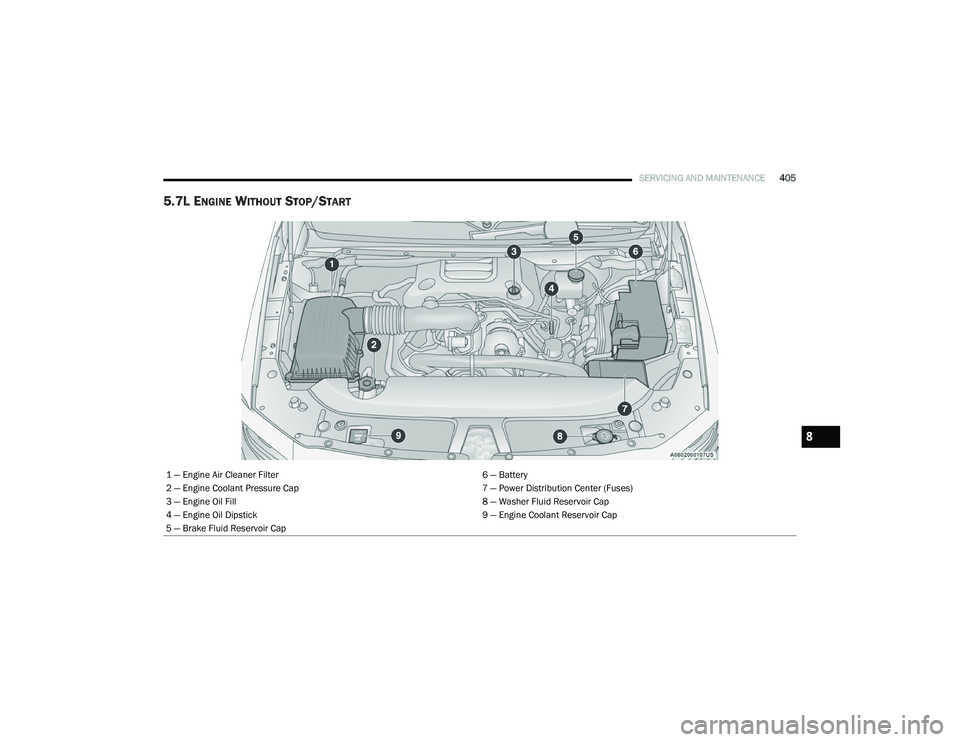
5.7L ENGINE WITHOUT STOP/START
1 — Engine Air Cleaner Filter 6 — Battery
2 — Engine Coolant Pressure Cap 7 — Power Distribution Center (Fuses)
3 — Engine Oil Fill 8 — Washer Fluid Reservoir Cap
4 — Engine Oil Dipstick 9 — Engine Coolant Reservoir Cap
5 — Brake Fluid Reservoir Cap
8
21_DT_OM_EN_USC_t.book Page 405
Page 408 of 496
406SERVICING AND MAINTENANCE
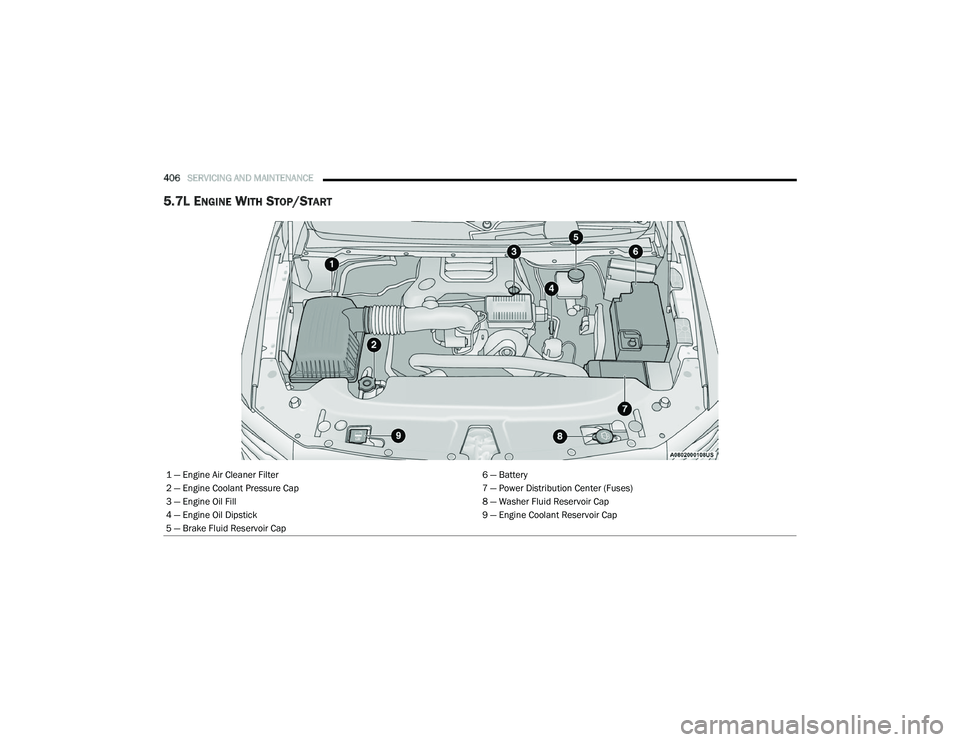
5.7L ENGINE WITH STOP/START
1 — Engine Air Cleaner Filter 6 — Battery
2 — Engine Coolant Pressure Cap 7 — Power Distribution Center (Fuses)
3 — Engine Oil Fill 8 — Washer Fluid Reservoir Cap
4 — Engine Oil Dipstick 9 — Engine Coolant Reservoir Cap
5 — Brake Fluid Reservoir Cap
21_DT_OM_EN_USC_t.book Page 406
Page 409 of 496
SERVICING AND MAINTENANCE407
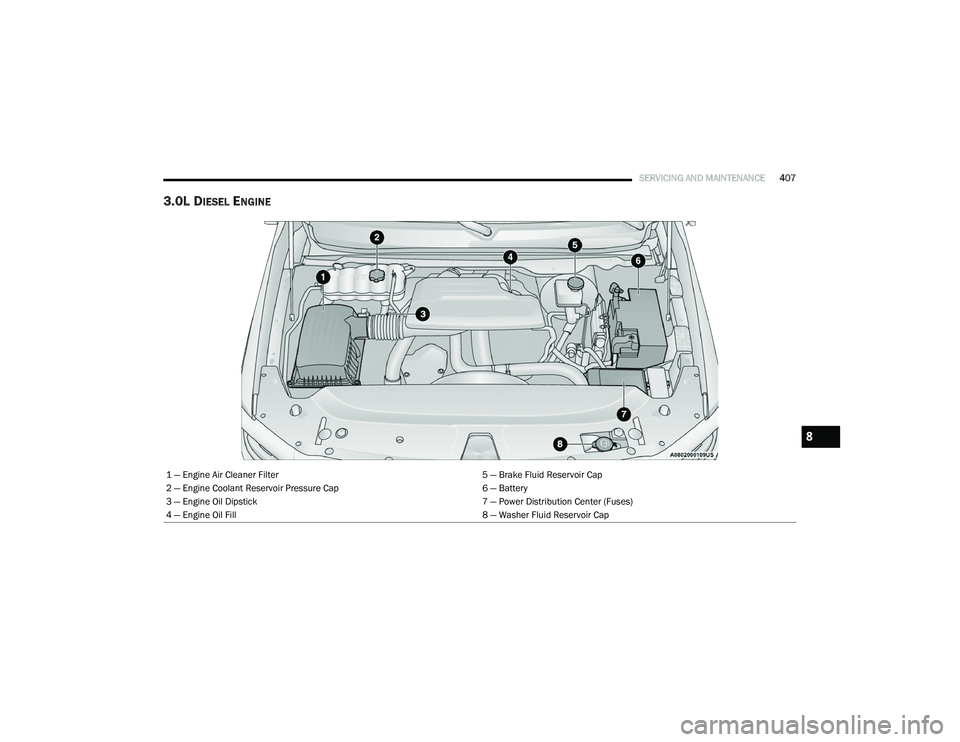
3.0L DIESEL ENGINE
1 — Engine Air Cleaner Filter 5 — Brake Fluid Reservoir Cap
2 — Engine Coolant Reservoir Pressure Cap 6 — Battery
3 — Engine Oil Dipstick 7 — Power Distribution Center (Fuses)
4 — Engine Oil Fill 8 — Washer Fluid Reservoir Cap
8
21_DT_OM_EN_USC_t.book Page 407
Page 410 of 496
408SERVICING AND MAINTENANCE
CHECKING OIL LEVEL
To ensure proper engine lubrication, the engine
oil must be maintained at the correct level.
Check the oil level at regular intervals, such as
every fuel stop. The best time to check the
engine oil level is about five minutes after a fully
warmed up engine is shut off.
Checking the oil while the vehicle is on level
ground will improve the accuracy of the oil level
readings.
There are four possible dipstick types:
Crosshatched zone.
Crosshatched zone marked SAFE.
Crosshatched zone marked with MIN at the
low end of the range and MAX at the high end
of the range.
Crosshatched zone marked with dimples at
the MIN and the MAX ends of the range.
NOTE:
Always maintain the oil level within the cross -
hatch markings on the dipstick. Adding 1 quart (1.0 liter) of oil when the reading
is at the low end of the dipstick range will raise
the oil level to the high end of the range
marking.
NOTE:
It is possible for your oil level to be slightly
higher than a previous check. This would be due
to diesel fuel that may temporarily be in the
crankcase due to operation of the diesel partic
-
ulate filter regeneration strategy (if equipped).
This fuel will evaporate out under normal oper -
ation.ADDING WASHER FLUID
The fluid reservoir is located under the hood
and should be checked for fluid level at regular
intervals. Fill the reservoir with windshield
washer solvent only (not radiator antifreeze).
When refilling the washer fluid reservoir, take
some washer fluid and apply it to a cloth or
towel and wipe the wiper blades clean. This will
help blade performance. To prevent freeze-up of your windshield washer
system in cold weather, select a solution or
mixture that meets or exceeds the temperature
range of your climate. This rating information
can be found on most washer fluid containers.
After the engine has warmed up, operate the
defroster for a few minutes to reduce the
possibility of smearing or freezing the fluid on
the cold windshield. Windshield washer solution
used with water as directed on the container,
aids cleaning action, reduces the freezing point
to avoid line clogging, and is not harmful to
paint or trim.
CAUTION!
Overfilling or underfilling the crankcase will
cause oil aeration or loss of oil pressure. This
could damage your engine.WARNING!
Commercially available windshield washer
solvents are flammable. They could ignite and
burn you. Care must be exercised when filling
or working around the washer solution.
21_DT_OM_EN_USC_t.book Page 408
Page 412 of 496
410SERVICING AND MAINTENANCE
ENGINE OIL — GAS ENGINE
Engine Oil Selection — Gasoline Engine
For best performance and maximum protection
under all types of operating conditions, FCA only
recommends engine oils that are API Certified
and meet the requirements of FCA Material
Standard MS-6395.
NOTE:
Hemi engines (5.7L) at times can tick right after
startup and then quiet down after approxi -
mately 30 seconds. This is normal and will not
harm the engine. This characteristic can be
caused by short drive cycles. For example, if the
vehicle is started then shut off after driving a
short distance. Upon restarting, you may experi -
ence a ticking sound. Other causes could be if
the vehicle is unused for an extended period of
time, incorrect oil, extended oil changes or
extended idling. If the engine continues to tick
or if the Malfunction Indicator Light (MIL) comes
on, see the nearest authorized dealer.
Engine Oil Selection — Diesel Engine
For best performance and maximum protection
under all types of operating conditions, FCA
recommends engine oils that meet the
requirements of FCA Material Standard MS-12991, and that are API SN certified and
meet the requirements of FCA LLC.
American Petroleum Institute (API) Engine
Oil Identification Symbol
This symbol means that the oil has
been certified by the American
Petroleum Institute (API). The
manufacturer only recommends API
Certified engine oils.
This symbol certifies 0W-20, 5W-20, 0W-30,
5W-30 and 10W-30 engine oils.
Synthetic Engine Oils
You may use synthetic engine oils provided the
recommended oil quality requirements are met,
and the recommended maintenance intervals
for oil and filter changes are followed.
Synthetic engine oils which do not have both the
engine oil certification mark and the correct SAE
viscosity grade number should not be used.
Materials Added To Engine Oil
FCA strongly recommends against the addition
of any additives (other than leak detection dyes)
to the engine oil. Engine oil is an engineered
product and its performance may be impaired
by supplemental additives.
Disposing Of Used Engine Oil And Oil
Filters
Care should be taken in disposing of used
engine oil and oil filters from your vehicle. Used
oil and oil filters, indiscriminately discarded, can
present a problem to the environment. Contact
an authorized dealer, service station or
governmental agency for advice on how and
where used oil and oil filters can be safely
discarded in your area.
ENGINE OIL FILTER
The engine oil filter should be replaced with a
new filter at every engine oil change.
Engine Oil Filter Selection
A full-flow type disposable oil filter should be
used for replacement. The quality of
replacement filters varies considerably. Only
high quality Mopar certified filters should be
used.
CAUTION!
Do not use chemical flushes in your engine oil
as the chemicals can damage your engine.
Such damage is not covered by the New
Vehicle Limited Warranty.
21_DT_OM_EN_USC_t.book Page 410
Page 415 of 496
SERVICING AND MAINTENANCE413
Drain the fuel/water separator filter when the
“Water In Fuel Indicator Light” is ON. Within
10 minutes of vehicle shutdown, turn the filter
drain valve (located on the bottom of the filter
housing) counterclockwise to drain fuel/water,
then turn the ignition switch to the ON position,
and allow any accumulated water to drain.
Leave the drain valve open until all water and
contaminants have been removed. When clean
fuel is visible, close the drain valve by turning it
clockwise, and turn the ignition switch to OFF.
If more than two ounces or 60 milliliters of fuel
have been drained Úpage 414.
UNDERBODY MOUNTED FUEL FILTER
R
EPLACEMENT — DIESEL ENGINE
NOTE:
Using a fuel filter that does not meet FCA’s filtra-
tion and water separating requirements can
severely impact fuel system life and reliability.
Under normal conditions the diesel fuel filter
should be replaced every 20,000 miles (every
other oil change). If the vehicle is being used in
severe operating conditions, or In certain
geographical areas of the country (Pennsyl -
vania, New York, Ohio, Maryland, West Virginia,
Arkansas, Oklahoma, Kansas, Iowa, Missouri and Nebraska) due to fuel cleanliness’ issues,
it’s recommended to replace the fuel filter every
10,000 miles.
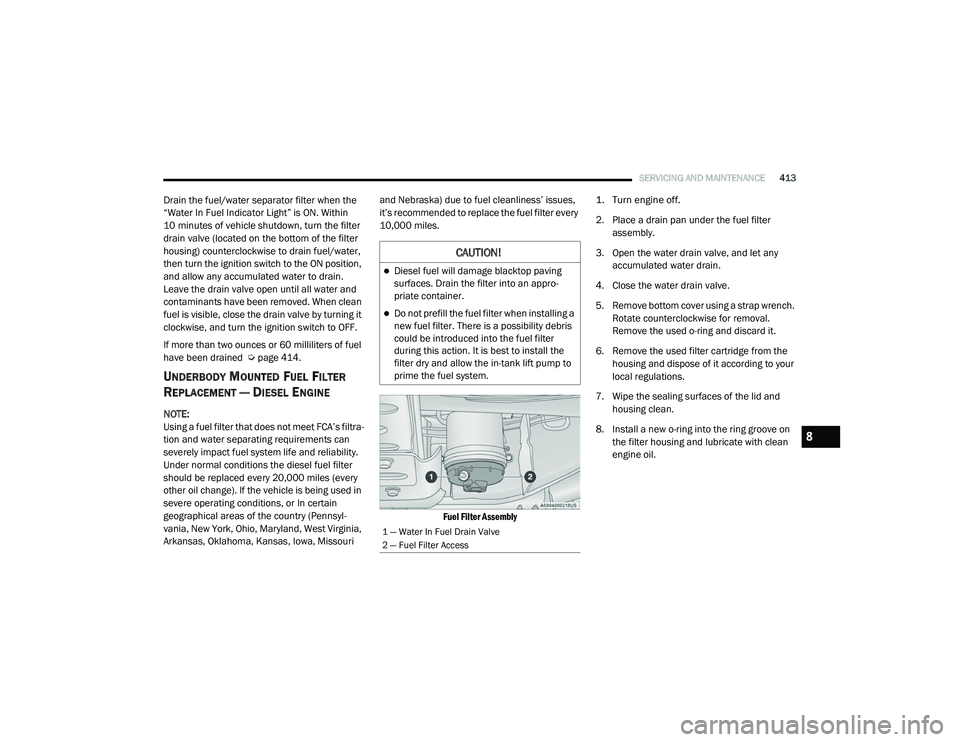
Fuel Filter Assembly
1. Turn engine off.
2. Place a drain pan under the fuel filter
assembly.
3. Open the water drain valve, and let any accumulated water drain.
4. Close the water drain valve.
5. Remove bottom cover using a strap wrench. Rotate counterclockwise for removal.
Remove the used o-ring and discard it.
6. Remove the used filter cartridge from the housing and dispose of it according to your
local regulations.
7. Wipe the sealing surfaces of the lid and housing clean.
8. Install a new o-ring into the ring groove on the filter housing and lubricate with clean
engine oil.
CAUTION!
Diesel fuel will damage blacktop paving
surfaces. Drain the filter into an appro-
priate container.
Do not prefill the fuel filter when installing a
new fuel filter. There is a possibility debris
could be introduced into the fuel filter
during this action. It is best to install the
filter dry and allow the in-tank lift pump to
prime the fuel system.
1 — Water In Fuel Drain Valve
2 — Fuel Filter Access
8
21_DT_OM_EN_USC_t.book Page 413
Page 417 of 496
SERVICING AND MAINTENANCE415
DIESEL EXHAUST FLUID
Diesel Exhaust Fluid (DEF) sometimes known
simply by the name of its active component,
UREA—is a key component of Selective Catalytic
Reduction (SCR) systems, which help diesel
vehicles meet stringent emission regulations.
DEF is a liquid reducing agent that reacts with
engine exhaust in the presence of a catalyst to
convert smog-forming nitrogen oxides (NOx)
into harmless nitrogen and water vapor.
Refer to Engine Fluids And Lubricants
Úpage 475 for further information.
AIR CONDITIONER MAINTENANCE
For best possible performance, your air
conditioner should be checked and serviced by
an authorized dealer at the start of each warm
season. This service should include cleaning of
the condenser fins and a performance test.
Drive belt tension should also be checked at
this time.
Refrigerant Recovery And Recycling —
R–1234yf
R–1234yf Air Conditioning Refrigerant is a
hydrofluoroolefin (HFO) that is endorsed by the
Environmental Protection Agency and is an
ozone-friendly substance with a low
global-warming potential. It is recommended
that air conditioning service be performed by an
authorized dealer using recovery and recycling
equipment.
NOTE:
Use only FCA approved A/C system PAG
compressor oil, and refrigerants.
Cabin Filter Replacement (A/C Air Filter)
For the proper maintenance intervals
Úpage 395.
WARNING!
Use only refrigerants and compressor lubri -
cants approved by FCA for your air condi -
tioning system. Some unapproved
refrigerants are flammable and can
explode, injuring you. Other unapproved
refrigerants or lubricants can cause the
system to fail, requiring costly repairs.
Refer to Warranty Information Book, for
further warranty information.
The air conditioning system contains refrig -
erant under high pressure. To avoid risk of
personal injury or damage to the system,
adding refrigerant or any repair requiring
lines to be disconnected should be done by
an experienced technician.
CAUTION!
Do not use chemical flushes in your air
conditioning system as the chemicals can
damage your air conditioning components.
Such damage is not covered by the New
Vehicle Limited Warranty.
WARNING!
Do not remove the cabin air filter while the
vehicle is running, or while the ignition is in
the ACC or ON/RUN mode. With the cabin air
filter removed and the blower operating, the
blower can contact hands and may propel dirt
and debris into your eyes, resulting in
personal injury.
8
21_DT_OM_EN_USC_t.book Page 415
Page 420 of 496

418SERVICING AND MAINTENANCE
Accessory Belt (Serpentine Belt)
Conditions that would require replacement:
Rib chunking (one or more ribs has sepa -
rated from belt body)
Rib or belt wear
Longitudinal belt cracking (cracks between
two ribs)
Belt slips
“Groove jumping" (belt does not maintain
correct position on pulley)
Belt broken
Noise (objectionable squeal, squeak, or
rumble is heard or felt while drive belt is in
operation) NOTE:
Identify and correct problem before new belt is
installed.
NOTE:
If your vehicle is equipped with a Stop/Start,
belt must be replaced with an OEM grade
Mopar belt.
Some conditions can be caused by a faulty
component such as a belt pulley. Belt pulleys
should be carefully inspected for damage and
proper alignment.
Belt replacement on some models requires the
use of special tools, we recommend having your
vehicle serviced at an authorized dealer.
BODY LUBRICATION
Locks and all body pivot points, including such
items as seat tracks, door hinge pivot points
and rollers, liftgate, tailgate, decklid, sliding
doors and hood hinges, should be lubricated
periodically. Use a lithium-based grease, such
as Mopar Spray White Lube to assure quiet,
easy operation and to protect against rust and
wear. Prior to the application of any lubricant,
the parts concerned should be wiped clean to
remove dust and grit; after lubricating excess oil
and grease should be removed. Particular attention should also be given to hood latching
components to ensure proper function. When
performing other underhood services, the hood
latch release mechanism, and safety catch
should be cleaned and lubricated.
The external lock cylinders should be lubricated
twice a year, preferably in the Autumn and
Spring. Apply a small amount of a high quality
lubricant, such as Mopar Lock Cylinder
Lubricant directly into the lock cylinder.
WINDSHIELD WIPER BLADES
Clean the rubber edges of the wiper blades and
the windshield periodically with a sponge or soft
cloth and a mild nonabrasive cleaner. This will
remove accumulations of salt or road film.
Operation of the wipers on dry glass for long
periods may cause deterioration of the wiper
blades. Always use washer fluid when using the
wipers to remove salt or dirt from a dry
windshield.
Avoid using the wiper blades to remove frost or
ice from the windshield. Keep the blade rubber
out of contact with petroleum products such as
engine oil, gasoline, etc.
21_DT_OM_EN_USC_t.book Page 418
Page 422 of 496
420SERVICING AND MAINTENANCE
(Continued)
Installing The Front Wipers
1. Lift the wiper arm off of the glass, until the wiper arm is in the full up position.
2. Position the wiper blade near the hook on the tip of the wiper arm.
3. Slide the wiper blade up into the hook on the wiper arm, latch engagement will be
accompanied by an audible click.
4. Gently lower the wiper blade onto the glass.
EXHAUST SYSTEM
The best protection against carbon monoxide
entry into the vehicle body is a properly
maintained engine exhaust system.
If you notice a change in the sound of the
exhaust system; or if the exhaust fumes can be
detected inside the vehicle; or when the
underside or rear of the vehicle is damaged;
have an authorized technician inspect the
complete exhaust system and adjacent body
areas for broken, damaged, deteriorated, or
mispositioned parts. Open seams or loose
connections could permit exhaust fumes to
seep into the passenger compartment. In
addition, have the exhaust system inspected each time the vehicle is raised for lubrication or
oil change. Replace as required.
Under normal operating conditions, the
catalytic converter will not require
maintenance. However, it is important to keep
the engine properly tuned to assure proper
catalyst operation and prevent possible catalyst
damage.
NOTE:
Intentional tampering with emissions control
systems can result in civil penalties being
assessed against you.
In unusual situations involving grossly
malfunctioning engine operation, a scorching
odor may suggest severe and abnormal catalyst
WARNING!
Exhaust gases can injure or kill. They
contain carbon monoxide (CO), which is
colorless and odorless. Breathing it can
make you unconscious and can eventually
poison you. To avoid breathing CO see
Úpage 369.
A hot exhaust system can start a fire if you
park over materials that can burn. Such
materials might be grass or leaves coming
into contact with your exhaust system. Do
not park or operate your vehicle in areas
where your exhaust system can contact
anything that can burn.
CAUTION!
The catalytic converter requires the use of
unleaded fuel only. Leaded gasoline will
destroy the effectiveness of the catalyst as
an emissions control device and may seri -
ously reduce engine performance and
cause serious damage to the engine.
Damage to the catalytic converter can
result if your vehicle is not kept in proper
operating condition. In the event of engine
malfunction, particularly involving engine
misfire or other apparent loss of perfor -
mance, have your vehicle serviced
promptly. Continued operation of your
vehicle with a severe malfunction could
cause the converter to overheat, resulting
in possible damage to the converter and
vehicle.
CAUTION! (Continued)
21_DT_OM_EN_USC_t.book Page 420
Page 427 of 496
SERVICING AND MAINTENANCE425
(Continued)
and through another hose to the intake
manifold of the engine. This cooling process
enables more efficient burning of fuel resulting
in fewer emissions.
To guarantee optimum performance of the
system, keep the surfaces of the charge air
cooler, condenser and radiator clean and free
of debris. Periodically check the hoses leading
to and from the charge air cooler for cracks or
loose clamps resulting in loss of pressure and
reduced engine performance.
BRAKE SYSTEM
In order to ensure brake system performance,
all brake system components should be
inspected periodically Ú page 395.
Fluid Level Check — Brake Master Cylinder
The fluid level of the brake master cylinder
should be checked whenever the vehicle is
serviced, or immediately if the brake system
warning light is on. If necessary, add fluid to
bring level within the designated marks on the
side of the reservoir of the brake master
cylinder. Be sure to clean the top of the master
cylinder area before removing cap. With disc
brakes, fluid level can be expected to fall as the
brake pads wear. Brake fluid level should be
checked when pads are replaced. If the brake
fluid is abnormally low, check the system for
leaks Úpage 478.
WARNING!
Riding the brakes can lead to brake failure
and possibly a collision. Driving with your foot
resting or riding on the brake pedal can result
in abnormally high brake temperatures,
excessive lining wear, and possible brake
damage. You would not have your full braking
capacity in an emergency.
WARNING!
Use only manufacturer's recommended
brake fluid Ú page 478. Using the wrong
type of brake fluid can severely damage
your brake system and/or impair its perfor -
mance. The proper type of brake fluid for
your vehicle is also identified on the original
factory installed hydraulic master cylinder
reservoir.
To avoid contamination from foreign matter
or moisture, use only new brake fluid or
fluid that has been in a tightly closed
container. Keep the master cylinder reser -
voir cap secured at all times. Brake fluid in
a open container absorbs moisture from
the air resulting in a lower boiling point. This
may cause it to boil unexpectedly during
hard or prolonged braking, resulting in
sudden brake failure. This could result in a
collision.
Overfilling the brake fluid reservoir can
result in spilling brake fluid on hot engine
parts, causing the brake fluid to catch fire.
Brake fluid can also damage painted and
vinyl surfaces, care should be taken to
avoid its contact with these surfaces.
Do not allow petroleum based fluid to
contaminate the brake fluid. Brake seal
components could be damaged, causing
partial or complete brake failure. This could
result in a collision.
WARNING! (Continued)
8
21_DT_OM_EN_USC_t.book Page 425