hood release RAM 1500 2021 Owners Manual
[x] Cancel search | Manufacturer: RAM, Model Year: 2021, Model line: 1500, Model: RAM 1500 2021Pages: 496, PDF Size: 20.89 MB
Page 25 of 496

GETTING TO KNOW YOUR VEHICLE23
To drive the vehicle, push the unlock button,
insert the key into the ignition, and turn to the
ON/RUN position.
NOTE:
With Remote Start, the engine will only run
for 15 minutes.
Remote Start can only be used twice.
If an engine fault is present or fuel level is
low, the vehicle will start and then shut down
in 10 seconds.
The parking lights will turn on and remain on
during Remote Start mode.
For security, power window and power
sunroof operation (if equipped) are disabled
when the vehicle is in the Remote Start
mode.
The ignition must be placed in the ON/RUN
position before the Remote Start sequence
can be repeated for a third cycle. All of the following conditions must be met
before the engine will remote start:
Gear selector in PARK
Doors closed
Hood closed
Hazard switch off
Brake switch inactive (brake pedal not
pushed)
Battery at an acceptable charge level
PANIC button not pushed
Fuel meets minimum requirement
System not disabled from previous remote
start event
Vehicle Security system not active
Malfunction Indicator Light is not illuminated
TO EXIT REMOTE START MODE
To drive the vehicle after starting the Remote
Start system, either push and release the
unlock button on the key fob to unlock the
doors, or unlock the vehicle using Keyless
Enter-N-Go — Passive Entry via the door
handles, and disarm the vehicle security system
(if equipped). Then, prior to the end of the
15 minute cycle, press the brake pedal and
push and release the START/STOP ignition
button.
WARNING!
Do not start or run an engine in a closed
garage or confined area. Exhaust gas
contains Carbon Monoxide (CO) which is
odorless and colorless. Carbon Monoxide is
poisonous and can cause serious injury or
death when inhaled.
Keep key fobs away from children. Opera
-
tion of the Remote Start System, windows,
door locks or other controls could cause
serious injury or death.
2
21_DT_OM_EN_USC_t.book Page 23
Page 28 of 496
26GETTING TO KNOW YOUR VEHICLE
VEHICLE SECURITY SYSTEM — IF EQUIPPED
The Vehicle Security system monitors the vehicle
doors, hood, tailgate, and the Keyless Enter-N-Go
— Ignition for unauthorized operation. While the
Vehicle Security system is armed, interior
switches for door locks and tailgate release are
disabled. If something triggers the alarm, the
Vehicle Security system will provide the following
audible and visible signals:
The horn will pulse
The turn signals will flash
The vehicle security light in the instrument
cluster will flash
TO ARM THE SYSTEM
Follow these steps to arm the Vehicle Security
system:
1. Make sure the vehicle’s ignition is placed
in the OFF position.
For vehicles equipped with Keyless Entry,
make sure the vehicle’s keyless ignition
system is OFF.
2. Perform one of the following methods to lock the vehicle:
Push the lock button on the interior
power door lock switch with the driver
and/or passenger door open.
Push the lock button on the exterior
Passive Entry door handle with a valid key
fob available in the same exterior zone
Úpage 28.
Push the lock button on the key fob.
3. If any doors are open, close them.
TO DISARM THE SYSTEM
The Vehicle Security system can be disarmed
using any of the following methods:
Push the unlock button on the key fob.
Grab the Passive Entry door handle to unlock
the door Ú page 28.
Cycle the ignition out of the OFF position to
disarm the system.
NOTE:
The driver's door key cylinder cannot arm or
disarm the Vehicle Security system. Use of
the door key cylinder when the system is
armed will sound the alarm when the door is
opened.
The Vehicle Security system remains armed
when the power tailgate (if equipped) is
opened using the tailgate button on the key
fob.
If Passive Entry (if equipped) is used to
unlock the tailgate, the Vehicle Security
system is disarmed and the rest of the
vehicle doors will remain locked unless
“Unlock All Doors 1st Press” is selected in the
Passive Entry settings.
When the Vehicle Security system is armed,
the interior power door lock switches will not
unlock the doors.
WARNING!
Do not start or run an engine in a closed
garage or confined area. Exhaust gas
contains Carbon Monoxide (CO) which is
odorless and colorless. Carbon Monoxide is
poisonous and can cause serious injury or
death when inhaled.
Keep key fobs away from children. Opera -
tion of the Remote Start System, windows,
door locks or other controls could cause
serious injury or death.
21_DT_OM_EN_USC_t.book Page 26
Page 86 of 496
84GETTING TO KNOW YOUR VEHICLE
Venting Sunroof — Express
Push and release the Vent button within one
half second and the sunroof will open to the
vent position. This is called “Express Vent” and
it will occur regardless of sunroof position.
During Express Vent operation, any movement
of the switch will stop the sunroof.
NOTE:
If the sunshade was not already open, it will
automatically open prior to the roof opening to
the vent position.
Ignition Off Operation
The power sunroof switch will remain active for
up to approximately 10 minutes after the
ignition switch is placed in the OFF position.
Opening either front door will cancel this
feature.
NOTE:
Ignition Off time is programmable through the
Uconnect system Úpage 237.
Sunroof Maintenance
Use only a non-abrasive cleaner and a soft cloth
to clean the glass panel. Periodically check for
and clear out any debris that may have
collected in the tracks.
HOOD
TO OPEN THE HOOD
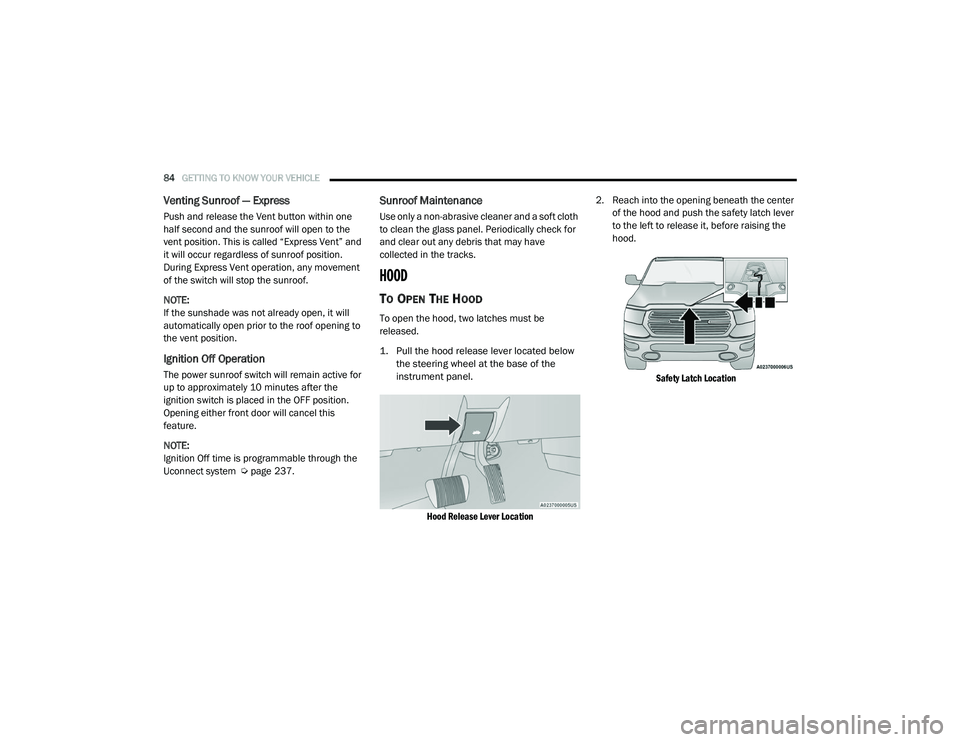
To open the hood, two latches must be
released.
1. Pull the hood release lever located below
the steering wheel at the base of the
instrument panel.
Hood Release Lever Location
2. Reach into the opening beneath the center
of the hood and push the safety latch lever
to the left to release it, before raising the
hood.
Safety Latch Location
21_DT_OM_EN_USC_t.book Page 84
Page 87 of 496
GETTING TO KNOW YOUR VEHICLE85
TO CLOSE THE HOOD
Hoods equipped with gas props are closed from
the point where the props no longer hold the
hood open.
TAILGATE
OPENING
The tailgate may be opened by pushing the
tailgate release pad located on the tailgate
door.
The tailgate damper strut will lower the tailgate
to the open position (if equipped).
Electronic Tailgate Release — If Equipped
The key fob may be equipped with an
electronic release feature for the
tailgate, allowing hands-free tailgate
opening. To activate, push and
release the Tailgate Release button on the key
fob twice within five seconds. The tailgate door
will unlatch, and slowly lower into the open
position.
If equipped, a button on the center overhead
console inside the vehicle can be used to
release the tailgate. An indicator light may also
signal when the tailgate is open.
For the tailgate to lower, the vehicle must be
stationary and in PARK or NEUTRAL. NOTE:
The optional Tri-Fold Tonneau Cover
Úpage 97
may prevent electronic tailgate release. The
Tonneau Cover must be removed or folded up
before releasing the tailgate.
CLOSING
To close the tailgate, push it upward until both
sides are securely latched.
LOCKING TAILGATE
The tailgate can be locked using the key fob
lock button.
MULTIFUNCTION TAILGATE — IF
E
QUIPPED
The 60/40 multifunction tailgate has two swing
doors to allow for closer access to the pickup
box with the doors open.
Opening
The tailgate must be latched closed to open the
swing doors. Push the paddle down, then pull
the release handle beneath the tailgate
lowering handle. This opens the 60 split door.
WARNING!
Be sure the hood is fully latched before
driving your vehicle. If the hood is not fully
latched, it could open when the vehicle is in
motion and block your vision. Failure to follow
this warning could result in serious injury or
death.
CAUTION!
To prevent possible damage, do not slam the
hood to close it. Use a firm downward push at
the front center of the hood to ensure that
both latches engage.
2
21_DT_OM_EN_USC_t.book Page 85
Page 178 of 496

176STARTING AND OPERATING
TOW/HAUL mode is selected
Accelerator pedal input
Excessive 12 Volt loads
It may be possible to operate the vehicle several
consecutive times in extreme conditions and
not meet all criteria to enable an Autostop state.
TO START THE ENGINE WHILE IN
A
UTOSTOP MODE
While in DRIVE, the engine will start when the
brake pedal is released or the throttle pedal is
pressed and the transmission will automatically
reengage upon engine restart.
Conditions That Will Cause The Engine To Start
Automatically While In Autostop Mode
The engine will start automatically when:
The transmission selector is moved from
DRIVE to REVERSE, NEUTRAL, or PARK
To maintain cabin temperature near the
HVAC settings
HVAC is set to full defrost mode
12 Volt demand requires engine restart
Stop/Start OFF switch is pushed
Transfer case is in 4WD LOW
The emissions system override is present
A Stop/Start system error present
Conditions That Force An Automatic Shift To
Park While In Autostop Mode
The engine will not start automatically and the
transmission will be placed in PARK if:
The driver door is open and brake pedal
released
The driver door is open and the driver seat
belt is unbuckled
The engine hood has been opened
A Stop/Start system error present
The engine may then be restarted by moving the
transmission shift selector out of PARK (e.g. to
DRIVE) or, in some cases, only by a KEY START.
The instrument cluster will display a SHIFT OUT
OF PARK message, or a STOP/START KEY
START REQUIRED message, to indicate which
action is required Ú page 114.
TO MANUALLY TURN OFF THE STOP
S
TART SYSTEM
Stop/Start OFF Switch
Push the Stop/Start OFF switch (located on the
switch bank). The light on the switch will
illuminate. The “STOP/START OFF” message
will appear in the instrument cluster display and
the autostop mode will be disabled
Ú page 114.
NOTE:
The Stop/Start system will reset itself back to
the ON mode every time the ignition is turned
OFF and back ON.
21_DT_OM_EN_USC_t.book Page 176
Page 420 of 496

418SERVICING AND MAINTENANCE
Accessory Belt (Serpentine Belt)
Conditions that would require replacement:
Rib chunking (one or more ribs has sepa -
rated from belt body)
Rib or belt wear
Longitudinal belt cracking (cracks between
two ribs)
Belt slips
“Groove jumping" (belt does not maintain
correct position on pulley)
Belt broken
Noise (objectionable squeal, squeak, or
rumble is heard or felt while drive belt is in
operation) NOTE:
Identify and correct problem before new belt is
installed.
NOTE:
If your vehicle is equipped with a Stop/Start,
belt must be replaced with an OEM grade
Mopar belt.
Some conditions can be caused by a faulty
component such as a belt pulley. Belt pulleys
should be carefully inspected for damage and
proper alignment.
Belt replacement on some models requires the
use of special tools, we recommend having your
vehicle serviced at an authorized dealer.
BODY LUBRICATION
Locks and all body pivot points, including such
items as seat tracks, door hinge pivot points
and rollers, liftgate, tailgate, decklid, sliding
doors and hood hinges, should be lubricated
periodically. Use a lithium-based grease, such
as Mopar Spray White Lube to assure quiet,
easy operation and to protect against rust and
wear. Prior to the application of any lubricant,
the parts concerned should be wiped clean to
remove dust and grit; after lubricating excess oil
and grease should be removed. Particular attention should also be given to hood latching
components to ensure proper function. When
performing other underhood services, the hood
latch release mechanism, and safety catch
should be cleaned and lubricated.
The external lock cylinders should be lubricated
twice a year, preferably in the Autumn and
Spring. Apply a small amount of a high quality
lubricant, such as Mopar Lock Cylinder
Lubricant directly into the lock cylinder.
WINDSHIELD WIPER BLADES
Clean the rubber edges of the wiper blades and
the windshield periodically with a sponge or soft
cloth and a mild nonabrasive cleaner. This will
remove accumulations of salt or road film.
Operation of the wipers on dry glass for long
periods may cause deterioration of the wiper
blades. Always use washer fluid when using the
wipers to remove salt or dirt from a dry
windshield.
Avoid using the wiper blades to remove frost or
ice from the windshield. Keep the blade rubber
out of contact with petroleum products such as
engine oil, gasoline, etc.
21_DT_OM_EN_USC_t.book Page 418
Page 488 of 496
486
Fluid Leaks
.................................................... 371Fluid Level Checks Brake........................................................ 425Fluid, Brake................................................... 478Fog Lights............................................... 55, 441Fold-Flat Seats................................................. 34Forward Collision Warning............................. 324Four Wheel Drive........................................... 161Four-Way Hazard Flasher............................... 373Freeing A Stuck Vehicle................................. 391Front Axle (Differential).................................. 426Fuel............................................ 210, 468, 471Adding............................................. 208, 210Additives................................................... 469Clean Air.................................................... 469Ethanol...................................................... 469Filter.......................................................... 412Gasoline.................................................... 468Light.......................................................... 131Materials Added........................................ 469Methanol................................................... 469Octane Rating........................ 468, 469, 475Requirements........................ 468, 471, 474Specifications............................................ 471Tank Capacity............................................ 474Fuses............................................................. 427
G
Garage Door Opener (HomeLink)..................... 49Gasoline, Clean Air........................................ 469Gasoline, Reformulated................................ 469GaugesVoltage..................................................... 146Glass Cleaning.............................................. 466Grocery Bag Retainer....................................... 39Gross Axle Weight Rating.............................. 215Gross Vehicle Weight Rating......................... 214GuideBody Builders.............................................. 11GVWR............................................................ 213
H
HazardDriving Through Flowing, Rising, Or Shallow Standing Water
.................................... 234Hazard Warning Flashers.............................. 373Head Restraints............................................... 40Head Rests...................................................... 40Headlights.................................................... 439Cleaning................................................... 462High Beam................................................... 53High Beam/Low Beam Select Switch.......... 53Lights On Reminder..................................... 55Passing........................................................ 54Switch.......................................................... 52
Heated Mirrors.................................................48Heated Seats...................................................38Heater, Engine Block..................................... 150High Beam/Low Beam Select (Dimmer)
Switch..............................................................53Hill Descent Control...................................... 315Hill Descent Control Indicator....................... 315Hill Start Assist.............................................. 317HitchesTrailer Towing........................................... 218HomeLink (Garage Door Opener).....................49Hood Prop........................................................84Hood Release...................................................84
I
Ignition.............................................................21Switch..........................................................21Illuminated Entry..............................................58Inside Rearview Mirror.................... 44, 45, 373Instrument Cluster............................... 110, 113Descriptions............................ 110, 113, 136Display...................................................... 114Instrument Panel Lens Cleaning................... 465Integrated Trailer Brake Control.................... 223Interior Appearance Care.............................. 464Interior Lights...................................................57Intervention Regeneration Strategy..... 121, 414Inverter Outlet (115V)......................................75
21_DT_OM_EN_USC_t.book Page 486
Page 491 of 496

489
R
Radial Ply Tires
.............................................. 451Radiator Cap (Coolant Pressure Cap).. 421, 423Radio Presets...................................................... 265Radio Controls............................................... 259Radio Mode................................................... 259Radio Operation.................................. 259, 309Radio Remote Controls.................................. 259Rain Sensitive Wiper System........................... 59Rear Axle (Differential)................................... 426Rear Camera................................................. 204Rear Cargo Area Utility Rails............................ 91Rear Cross Path............................................. 321Rear ParkSense System................................ 189Rear Window, Sliding....................................... 79Reclining Rear Seats....................................... 36Recreational Towing...................................... 230Shifting Into Transfer Case Neutral (N)..... 232Shifting Out Of Transfer Case Neutral (N).. 233Reformulated Gasoline.................................. 469Refrigerant.................................................... 415Registering SiriusXM Guardian...................... 283Release, Hood................................................. 84Release, Tailgate............................................. 85Reminder, Seat Belt...................................... 335Remote Features, Door Lock/Unlock.. 290, 302Remote Features, Horn And Lights................291Remote Features, Starting.................. 291, 303
Remote Keyless EntryProgramming Additional Key Fobs............... 20Remote Sound System (Radio) Control......... 259Remote Start (Diesel)...................................... 25Remote Start (Gasoline).................................. 22Remote StartingExit Remote Start Mode.............................. 23Remote Starting System........................... 22, 25Remove, Tailgate............................................. 86Replacement Bulbs...................................... 437Replacement Tires........................................ 453Reporting Safety Defects.............................. 481Restraints, Child........................................... 355Restraints, Head.............................................. 40Roadside Assistance............................ 292, 302Rotation, Tires.............................................. 460
S
Safety........................................................... 258Safety Checks Inside Vehicle........................ 369Safety Checks Outside Vehicle..................... 371Safety Defects, Reporting............................. 481Safety Features............................................. 258Safety Information, Tire................................ 443Safety Tips.................................................... 369Safety, Exhaust Gas...................................... 371Satellite Radio.............................................. 261Saved Radio Stations................................... 265
Schedule, Maintenance..............395, 399, 400Seat Belt Reminder....................................... 126Seat Belts............................................ 335, 369Adjustable Shoulder Belt.......................... 339Adjustable Upper Shoulder Anchorage..... 339Adjustable Upper Shoulder Belt Anchorage............................................ 339Automatic Locking Retractor (ALR)........... 341Child Restraints........................................ 355Energy Management Feature................... 340Extender................................................... 340Front Seat............................... 335, 336, 338Inspection................................................. 369Lap/Shoulder Belt Operation.................... 338Lap/Shoulder Belt Untwisting................... 339Lap/Shoulder Belts................................... 336Operating Instructions.............................. 338Pregnant Women...................................... 340Pretensioners........................................... 340Rear Seat.................................................. 336Reminder.................................................. 335Seat Belt Extender.................................... 340Seat Belt Pretensioner.............................. 340Seat Belt Reminder.................................. 335Untwisting Procedure................................ 339Seat Belts Maintenance................................ 465
11
21_DT_OM_EN_USC_t.book Page 489