transmission oil RAM 1500 2021 Owners Manual
[x] Cancel search | Manufacturer: RAM, Model Year: 2021, Model line: 1500, Model: RAM 1500 2021Pages: 496, PDF Size: 20.89 MB
Page 6 of 496
4
SLIDE-IN CAMPERS .............................................97 Camper Applications ................................... 97
TRI-FOLD TONNEAU COVER — IF EQUIPPED .....97
Tonneau Cover Components....................... 97
Tri-Fold Tonneau Cover Folding For
Driving Or Removal ...................................... 98 Tri-Fold Tonneau Cover Installation ..........101
Tri-Fold Tonneau Cover Cleaning ..............103
GETTING TO KNOW YOUR
INSTRUMENT PANEL
BASE / MIDLINE INSTRUMENT CLUSTER —
GASOLINE ........................................................... 104
Base / Midline Instrument Cluster
Descriptions — Gasoline ............................105
PREMIUM INSTRUMENT CLUSTER —
GASOLINE ........................................................... 107
Premium Instrument Cluster
Descriptions — Gasoline ............................108
BASE / MIDLINE INSTRUMENT CLUSTER —
DIESEL ................................................................. 109
Base / Midline Instrument Cluster
Descriptions — Diesel ................................110
PREMIUM INSTRUMENT CLUSTER —
DIESEL ................................................................. 112
Premium Instrument Cluster
Descriptions — Diesel ...............................113 INSTRUMENT CLUSTER DISPLAY..................... 114
Instrument Cluster Display Controls......... 114
Oil Life Reset .............................................. 115
Display Menu Items ................................... 116
Diesel Particulate Filter (DPF)
Messages .................................................. 121 Displays ...................................................... 123
Diesel Exhaust Fluid (DEF) Warning
Messages ................................................... 123 Diesel Exhaust Fluid (DEF) Fault
Warning Messages .................................... 124 Battery Saver On/Battery Saver Mode
Message — Electrical Load Reduction
Actions — If Equipped ................................ 125
WARNING LIGHTS AND MESSAGES ................126
Red Warning Lights ................................... 126
Yellow Warning Lights ............................... 129Yellow Indicator Lights .............................. 133
Green Indicator Lights ............................... 135White Indicator Lights ............................... 136Blue Indicator Lights.................................. 137
ONBOARD DIAGNOSTIC SYSTEM — OBD II..... 137
Onboard Diagnostic System (OBD II)
Cybersecurity ............................................. 138
EMISSIONS INSPECTION AND
MAINTENANCE PROGRAMS .............................138
STARTING AND OPERATING
STARTING THE ENGINE ..................................... 140
Automatic Transmission............................ 141AutoPark ..................................................... 141
Tip Start Feature ....................................... 143
Keyless Enter-N-Go — Ignition................... 143
Normal Starting Using ENGINE START/
STOP Button — Gasoline Engine .............. 143 Normal Starting Using ENGINE START/
STOP Button — Diesel Engine .................. 144 Cold Weather Operation (Below –22°F
Or −30°C) ................................................. 146 After Starting .............................................. 146Starting Fluids — Diesel Engine Only ........ 146
NORMAL OPERATION — DIESEL ENGINE ....... 146
Cold Weather Precautions ........................ 146
Engine Idling .............................................. 148Stopping The Engine ................................. 148
ENGINE BLOCK HEATER — IF EQUIPPED ....... 150
ENGINE BREAK-IN RECOMMENDATIONS —
GASOLINE ENGINE ........................................... 150
ENGINE BREAK-IN RECOMMENDATIONS —
DIESEL ENGINE .................................................. 151
PARKING BRAKE ............................................... 151 Electric Park Brake (EPB) .......................... 151
21_DT_OM_EN_USC_t.book Page 4
Page 10 of 496
8
VEHICLE MAINTENANCE .................................. 409 Engine Oil — Gas Engine ...........................410
Engine Oil Filter ..........................................410Engine Air Cleaner Filter ............................411
Draining Fuel/Water Separator Filter —
Diesel Engine ............................................412 Underbody Mounted Fuel Filter
Replacement — Diesel Engine ..................413 Priming If The Engine Has Run Out Of
Fuel — Diesel Engine .................................414 Intervention Regeneration Strategy —
Message Process Flow (Diesel Engine) ....414 Diesel Exhaust Fluid ..................................415Air Conditioner Maintenance ....................415
Accessory Drive Belt Inspection................417Body Lubrication ........................................418
Windshield Wiper Blades ..........................418
Exhaust System ........................................420
Cooling System .........................................421
Charge Air Cooler — Inter-Cooler (Diesel
Engine)........................................................ 424 Brake System ............................................425
Automatic Transmission ...........................426
Rear Axle And 4x4 Front Driving Axle
Fluid Level .................................................426 Transfer Case ............................................427
FUSES .........................................................427
BULB REPLACEMENT ................................437 TIRES....................................................................443
Tire Safety Information .............................. 443
Tires — General Information ..................... 449Tire Types ................................................... 454
Spare Tires — If Equipped ......................... 455
Wheel And Wheel Trim Care ..................... 456Snow Traction Devices .............................. 458
Tire Rotation Recommendations ............. 460
DEPARTMENT OF TRANSPORTATION
UNIFORM TIRE QUALITY GRADES .................. 460
Treadwear .................................................. 460
Traction Grades ......................................... 461
Temperature Grades ................................. 461
STORING THE VEHICLE ......................................461
BODYWORK ........................................................ 461
Protection From Atmospheric Agents....... 461
Body And Underbody Maintenance .......... 462Preserving The Bodywork .......................... 462
INTERIORS ......................................................... 464
Seats And Fabric Parts .............................. 464
Plastic And Coated Parts ........................... 465
Leather Surfaces ....................................... 465Glass Surfaces .......................................... 466
TECHNICAL SPECIFICATIONS
VEHICLE IDENTIFICATION NUMBER ................ 467
BRAKE SYSTEM ................................................ 467
WHEEL AND TIRE TORQUE
SPECIFICATIONS ................................................ 467
Torque Specifications ............................... 467
FUEL REQUIREMENTS — GASOLINE
ENGINE ............................................................... 468
3.6L Engine ............................................... 468
5.7L Engine ................................................ 469
Reformulated Gasoline ............................. 469
Materials Added To Fuel ........................... 469
Gasoline/Oxygenate Blends ..................... 469
Do Not Use E-85 In Non-Flex Fuel
Vehicles ...................................................... 470 CNG And LP Fuel System Modifications .. 470Methylcyclopentadienyl Manganese
Tricarbonyl (MMT) In Gasoline .................. 470 Fuel System Cautions................................ 470
FUEL REQUIREMENTS – DIESEL ENGINE ....... 471
Diesel Fuel Specifications......................... 471
Biodiesel Fuel Requirements.................... 472
FLUID CAPACITIES ............................................ 474
ENGINE FLUIDS AND LUBRICANTS ................ 475
CHASSIS FLUIDS AND LUBRICANTS ............... 478
21_DT_OM_EN_USC_t.book Page 8
Page 121 of 496

GETTING TO KNOW YOUR INSTRUMENT PANEL119
Custom 1: Speed, Speed Limit
Custom 2: Speed, Speed Limit, Naviga-
tion
Custom 3 : Speed, Speed Limit, Naviga-
tion, Driver Assist (ACC/Cruise, Lane -
Sense, Highway Assist/Highway Assist+)
Custom 4 : Speed, Speed Limit, Naviga-
tion, Driver Assist (ACC/Cruise, Lane -
Sense, Highway Assist/Highway Assist+),
Gear
Display Height
Brightness
NOTE:
The HUD basic settings (Brightness, Display
Height and Non Custom layouts), are controlled
through the Settings Screen in the Instrument
Cluster Ú page 114. Screen Setup Driver Selectable Items
Push and release the
up or down arrow
button until the Settings Menu Icon/Title is
highlighted in the instrument cluster display.
Push and release the OK button to enter the
sub-menus and follow the prompts on the
screen as needed. The Settings feature allows
you to change what information is displayed in
the instrument cluster as well as the location
that information is displayed.
NOTE:
The Settings feature is only available when the
vehicle speed is less than 5 mph.
Upper Left
None
Compass
Outside Temp
Time
Range To Empty
Average Econ
Current Econ
Trip A Distance
Trip B Distance
Trailer Trip – If Equipped
Trailer Brake – If Equipped
Oil Pressure – If Equipped
Coolant Temp – If Equipped
Oil Temperature – If Equipped
Battery Voltage – If Equipped
Transmission Temperature – If Equipped
Oil Life – If Equipped
Upper Center
None
Compass
Outside Temp
Time
Range To Empty
Average Econ
Current Econ
3
21_DT_OM_EN_USC_t.book Page 119
Page 122 of 496
120GETTING TO KNOW YOUR INSTRUMENT PANEL
Trip A Distance
Trip B Distance
Trailer Trip – If Equipped
Audio
Speedometer
Menu Title
Upper Right
None
Compass
Outside Temp
Time
Range To Empty
Average Econ
Current Econ
Trip A Distance
Trip B Distance
Trailer Trip – If Equipped
Trailer Brake – If Equipped
Oil Pressure – If Equipped
Coolant Temp – If Equipped
Oil Temperature – If Equipped
Battery Voltage – If Equipped
Transmission Temperature – If Equipped
Oil Life – If Equipped
Left Side – If Equipped
None
Range To Empty
Average Econ
Oil Temp
Transmission Temp
Coolant Temp
Oil Life
Menu Icon
Right Side – If Equipped
None
Range To Empty
Average Econ
Oil Temp
Transmission Temp
Coolant Temp
Oil Life
Menu Icon
Lower Left – If Equipped
None
Compass
Outside Temp
Time
Range To Empty
Average Econ
Current Econ
Trip A Distance
Trip B Distance
Trailer Trip
Trailer Brake
Oil Pressure
Coolant Temperature
Oil Temperature
Battery Voltage
Transmission Temperature
Oil Life
21_DT_OM_EN_USC_t.book Page 120
Page 123 of 496

GETTING TO KNOW YOUR INSTRUMENT PANEL121
Lower Right – If Equipped
None
Compass
Outside Temp
Time
Range To Empty
Average Econ
Current Econ
Trip A Distance
Trip B Distance
Trailer Trip
Trailer Brake
Oil Pressure
Coolant Temperature
Oil Temperature
Battery Voltage
Transmission Temperature
Oil LifeFavorite Menus
Speedometer
Vehicle Info
Driver Assist (show/hide) – If Equipped
Fuel Economy (show/hide)
Trip Info (show/hide)
Stop/Start
Trailer Tow (show/hide)
Audio (show/hide)
(Stored) Messages
Screen Setup
Current Gear
Off
On
Odometer
No Decimal Point
Decimal Point Defaults (Restores All Settings To Default
Settings)
Cancel
Restore
DIESEL PARTICULATE FILTER (DPF)
M
ESSAGES
This engine meets all required diesel engine
emissions standards. To achieve these
emissions standards, your vehicle is equipped
with a state-of-the-art engine and exhaust
system. These systems are seamlessly
integrated into your vehicle and managed by
the Powertrain Control Module (PCM). The PCM
manages engine combustion to allow the
exhaust system’s catalyst to trap and burn
Particulate Matter (PM) pollutants, with no input
or interaction on your part.
WARNING!
A hot exhaust system can start a fire if you
park over materials that can burn, such as
grass or leaves, and those items that come
into contact with your exhaust system. Do not
park or operate your vehicle in areas where
your exhaust system can contact anything
that can burn.
3
21_DT_OM_EN_USC_t.book Page 121
Page 130 of 496

128GETTING TO KNOW YOUR INSTRUMENT PANEL
Engine Coolant Temperature Warning
Light
This warning light warns of an
overheated engine condition. If the
engine coolant temperature is too
high, this indicator will illuminate and
a single chime will sound. If the temperature
reaches the upper limit, a continuous chime will
sound for four minutes or until the engine is
able to cool, whichever comes first.
If the light turns on while driving, safely pull over
and stop the vehicle. If the Air Conditioning (A/
C) system is on, turn it off. Also, shift the
transmission into NEUTRAL (N) and idle the
vehicle. If the temperature reading does not
return to normal, turn the engine off
immediately and call for service Ú page 389.
Battery Charge Warning Light
This warning light will illuminate when
the battery is not charging properly. If
it stays on while the engine is running,
there may be a malfunction with the
charging system. Contact an authorized dealer
as soon as possible.
This indicates a possible problem with the
electrical system or a related component.
Oil Pressure Warning Light
This warning light will illuminate to
indicate low engine oil pressure. If the
light turns on while driving, stop the
vehicle, shut off the engine as soon as
possible, and contact an authorized dealer. A
chime will sound when this light turns on.
Do not operate the vehicle until the cause is
corrected. This light does not indicate how
much oil is in the engine. The engine oil level
must be checked under the hood.
Oil Temperature Warning Light
This warning light will illuminate to
indicate the engine oil temperature is
high. If the light turns on while driving,
stop the vehicle and shut off the
engine as soon as possible. Wait for oil
temperature to return to normal levels.
Electronic Throttle Control (ETC) Warning
Light
This warning light will illuminate to
indicate a problem with the ETC
system. If a problem is detected while
the vehicle is running, the light will
either stay on or flash depending on the nature
of the problem. Cycle the ignition when the vehicle is safely and completely stopped and
the transmission is placed in the PARK position.
The light should turn off. If the light remains on
with the vehicle running, your vehicle will
usually be drivable; however, see an authorized
dealer for service as soon as possible.
NOTE:
This light may turn on if the accelerator and
brake pedals are pressed at the same time.
If the light continues to flash when the vehicle is
running, immediate service is required and you
may experience reduced performance, an
elevated/rough idle, or engine stall and your
vehicle may require towing. The light will come
on when the ignition is placed in the ON/RUN or
ACC/ON/RUN position and remain on briefly as
a bulb check. If the light does not come on
during starting, have the system checked by an
authorized dealer.
21_DT_OM_EN_USC_t.book Page 128
Page 131 of 496
GETTING TO KNOW YOUR INSTRUMENT PANEL129
Electric Power Steering (EPS) Fault
Warning Light
This warning light will turn on when
there's a fault with the EPS system
Úpage 174.
Tailgate Open Warning Light
This warning light will illuminate when
the tailgate is open.
NOTE:
If the vehicle is moving, there will also be a
single chime.
Trailer Brake Disconnected Warning Light
This warning light will illuminate when
the Trailer Brake has been
disconnected.
Transmission Temperature Warning Light
— If Equipped
This warning light will illuminate to
warn of a high transmission fluid
temperature. This may occur with
strenuous usage such as trailer
towing. If this light turns on, stop the vehicle and
run the engine at idle or slightly faster, with the
transmission in PARK or NEUTRAL, until the
light turns off. Once the light turns off, you may
continue to drive normally.
Door Open Warning Light
This indicator will illuminate when a
door is ajar/open and not fully closed.
NOTE:
If the vehicle is moving there will also be a single
chime.
YELLOW WARNING LIGHTS
Adaptive Cruise Control (ACC) Fault
Warning Light — If Equipped
This warning light will illuminate to
indicate a fault in the ACC system.
Contact an authorized dealer for
service Ú page 179.
Air Suspension Fault Warning Light — If
Equipped
This light will illuminate when a fault is
detected with the air suspension
system.
WARNING!
Continued operation with reduced assist
could pose a safety risk to yourself and
others. Service should be obtained as soon
as possible.
WARNING!
If you continue operating the vehicle when
the Transmission Temperature Warning Light
is illuminated you could cause the fluid to boil
over, come in contact with hot engine or
exhaust components and cause a fire.
CAUTION!
Continuous driving with the Transmission
Temperature Warning Light illuminated will
eventually cause severe transmission
damage or transmission failure.
3
21_DT_OM_EN_USC_t.book Page 129
Page 150 of 496

148STARTING AND OPERATING
NOTE:
Use of Climatized ULSD Fuel or Number
1 ULSD Fuel results in a noticeable decrease
in fuel economy.
Climatized ULSD Fuel is a blend of Number
2 ULSD and Number 1 ULSD Fuels which
reduces the temperature at which wax crys -
tals form in fuel.
The fuel grade should be clearly marked on
the pump at the fuel station.
The engine requires the use of ULSD Fuel.
Use of incorrect fuel could result in engine
and exhaust system damage Ú page 471.
If Climatized or diesel Number 1 ULSD Fuel is
not available, and you are operating below
(20°F/-6°C), in sustained arctic conditions,
Mopar Premium Diesel Fuel Treatment (or
equivalent) is recommended to avoid gelling
(see Fuel Operating Range Chart).
Engine Oil Usage
For the correct engine oil viscosity Úpage 475.
Winter Front Cover
Winter Front Cover
A Winter front or cold weather cover can be
used in ambient temperatures below 32°F
(0°C), especially during extended idle
conditions. This cover is equipped with four
flaps for managing total grille opening in varying
ambient temperatures. If a Winter front or cold
weather cover is to be used the flaps should be
in the full open position to allow air flow to the
cooling module and automatic transmission oil
cooler. When ambient temperatures drop below
0°F (-17°C) the four flaps need to be closed. A
suitable cold weather cover is available from a
Mopar dealer.
Engine Warm-Up
Avoid full throttle operation when the engine is
cold. When starting a cold engine, bring the
engine up to operating speed slowly to allow the
oil pressure to stabilize as the engine warms up.
If temperatures are below 32°F (0°C), operate
the engine at moderate speeds for five minutes
before full loads are applied.
ENGINE IDLING
Avoid prolonged idling, long periods of idling
may be harmful to your engine because
combustion chamber temperatures can drop so
low that the fuel may not burn completely.
Incomplete combustion allows carbon and
varnish to form on piston rings, cylinder head
valves, and injector nozzles. Also, the unburned
fuel can enter the crankcase, diluting the oil
and causing rapid wear to the engine.
STOPPING THE ENGINE
After full load operation, idle the engine for a
few minutes before shutting it down. This idle
period will allow the lubricating oil and coolant
to carry excess heat away from the
turbocharger. Refer to the following chart for
proper engine shutdown.
21_DT_OM_EN_USC_t.book Page 148
Page 152 of 496
150STARTING AND OPERATING
ENGINE BLOCK HEATER — IF EQUIPPED
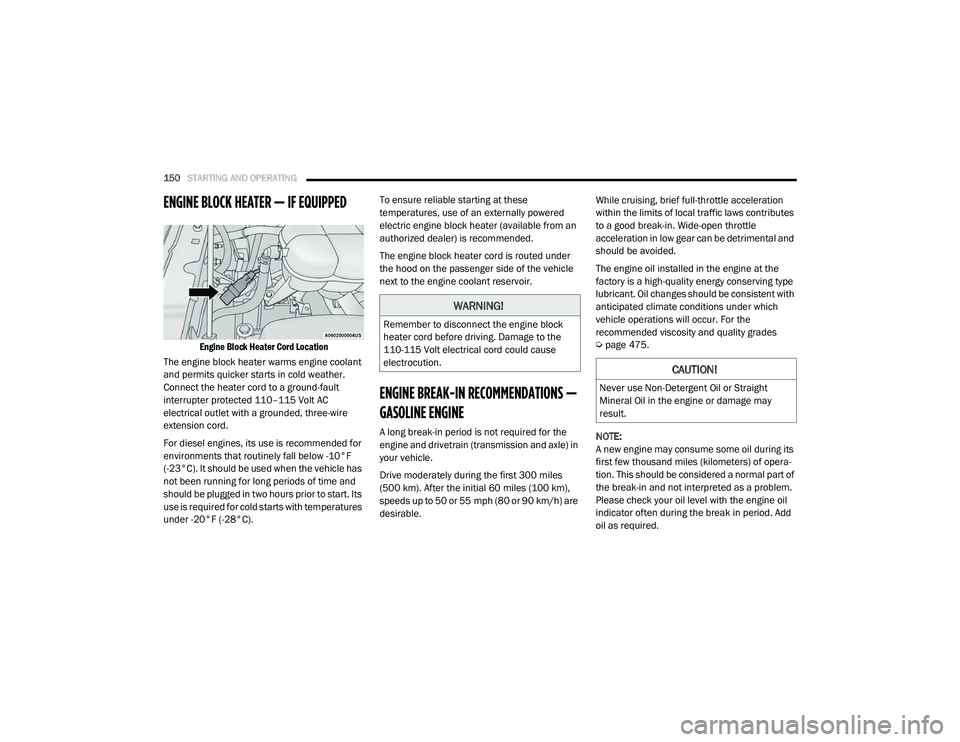
Engine Block Heater Cord Location
The engine block heater warms engine coolant
and permits quicker starts in cold weather.
Connect the heater cord to a ground-fault
interrupter protected 110–115 Volt AC
electrical outlet with a grounded, three-wire
extension cord.
For diesel engines, its use is recommended for
environments that routinely fall below -10°F
(-23°C). It should be used when the vehicle has
not been running for long periods of time and
should be plugged in two hours prior to start. Its
use is required for cold starts with temperatures
under -20°F (-28°C). To ensure reliable starting at these
temperatures, use of an externally powered
electric engine block heater (available from an
authorized dealer) is recommended.
The engine block heater cord is routed under
the hood on the passenger side of the vehicle
next to the engine coolant reservoir.
ENGINE BREAK-IN RECOMMENDATIONS —
GASOLINE ENGINE
A long break-in period is not required for the
engine and drivetrain (transmission and axle) in
your vehicle.
Drive moderately during the first 300 miles
(500 km). After the initial 60 miles (100 km),
speeds up to 50 or 55 mph (80 or 90 km/h) are
desirable.
While cruising, brief full-throttle acceleration
within the limits of local traffic laws contributes
to a good break-in. Wide-open throttle
acceleration in low gear can be detrimental and
should be avoided.
The engine oil installed in the engine at the
factory is a high-quality energy conserving type
lubricant. Oil changes should be consistent with
anticipated climate conditions under which
vehicle operations will occur. For the
recommended viscosity and quality grades
Ú
page 475.
NOTE:
A new engine may consume some oil during its
first few thousand miles (kilometers) of opera -
tion. This should be considered a normal part of
the break-in and not interpreted as a problem.
Please check your oil level with the engine oil
indicator often during the break in period. Add
oil as required.
WARNING!
Remember to disconnect the engine block
heater cord before driving. Damage to the
110-115 Volt electrical cord could cause
electrocution.
CAUTION!
Never use Non-Detergent Oil or Straight
Mineral Oil in the engine or damage may
result.
21_DT_OM_EN_USC_t.book Page 150
Page 153 of 496

STARTING AND OPERATING151
ENGINE BREAK-IN RECOMMENDATIONS —
DIESEL ENGINE
The diesel engine does not require a break-in
period due to its construction. Normal operation
is allowed, providing the following
recommendations are followed:
Warm up the engine before placing it under
load.
Do not operate the engine at idle for
prolonged periods.
Observe vehicle oil pressure and tempera -
ture indicators.
Check the coolant and oil levels frequently.
Vary throttle position at highway speeds
when carrying or towing significant weight.
NOTE:
Light duty operation such as light trailer towing
or no load operation will extend the time before
the engine is at full efficiency. Reduced fuel
economy and power may be seen at this time.
The engine oil installed in the engine at the
factory is a high-quality energy conserving type
lubricant. Oil changes should be consistent with anticipated climate conditions under which
vehicle operations will occur. For the
recommended viscosity and quality grades
Ú
page 475.
NOTE:
NON-DETERGENT OR STRAIGHT MINERAL OILS
MUST NEVER BE USED.
PARKING BRAKE
ELECTRIC PARK BRAKE (EPB)
Your vehicle is equipped with an EPB that offers
simple operation, and some additional features
that make the parking brake more convenient
and useful.
The parking brake is primarily intended to
prevent the vehicle from rolling while parked.
Before leaving the vehicle, make sure that the
parking brake is applied. Also, be certain to
leave the transmission in PARK.
You can engage the parking brake in two ways:
Manually, by applying the parking brake
switch.
Automatically, by enabling the Auto Park
Brake feature in the customer programmable
features section of the Uconnect settings. The parking brake switch is located on the
instrument panel to the left of the steering
wheel (below the headlamp switch).
Electric Park Brake Switch
To apply the parking brake manually, pull up on
the switch momentarily. You may hear a slight
sound from the back of the vehicle while the
parking brake engages. Once the park brake is
fully engaged, the BRAKE telltale light in the
instrument cluster and an indicator on the
switch will illuminate. If your foot is on the brake
pedal while you apply the parking brake, you
may notice a small amount of brake pedal
movement. The parking brake can be applied
even when the ignition switch is OFF but the
BRAKE telltale light will not illuminate, however,
it can only be released when the ignition is in
the ON/RUN mode.
4
21_DT_OM_EN_USC_t.book Page 151