fuel RAM 1500 2022 Workshop Manual
[x] Cancel search | Manufacturer: RAM, Model Year: 2022, Model line: 1500, Model: RAM 1500 2022Pages: 496, PDF Size: 18.03 MB
Page 378 of 496

376IN CASE OF EMERGENCY
6. Block both the front and rear wheel diagonally opposite of each jacking position. For example,
if the driver’s front wheel is being changed,
block the passenger’s rear wheel.
Wheel Blocked
NOTE:Passengers should not remain in the vehicle when
the vehicle is being raised or lifted.
JACK LOCATION
The jack and tools are stored under the front
passenger seat.
REMOVAL OF JACK AND TOOLS
To access the jack and tools, you must remove the
plastic access cover located on the side of the
front passenger’s seat. To remove the cover, pull
the front part of the cover (closest to the front of
the seat) toward you to release a locking tab. Once
the front of the cover is loose, slide the cover
toward the front of the seat until it is free from the
seat frame.
Pull Jack Access Cover From Front
Remove the jack and tools by turning the wing bolt
counterclockwise. After removing the wing bolt,
slide the assembly out from under the seat.
Jack And Tools
Fuel Funnel Location
22_DT_OM_EN_USC_t.book Page 376
Page 388 of 496

386IN CASE OF EMERGENCY
3. Connect the negative (-) end of the jumper
cable to the negative (-) post of the booster
battery.
4. Connect the opposite end of the negative (-)
jumper cable to a good engine ground. A
“ground” is an exposed metallic/unpainted
part of the engine, frame or chassis, such as
an accessory bracket or large bolt. The ground
must be away from the battery and the fuel
injection system.
Jump Starting Label
5. Start the engine in the vehicle that has the
booster battery, let the engine idle a few
minutes, and then start the engine in the
vehicle with the discharged battery.
6. Once the engine is started, follow the discon -
nection procedure below.
Disconnecting The Jumper Cables
1. Disconnect the negative
(-)
end of the jumper
cable from the engine ground of the vehicle
with the discharged battery.
2. Disconnect the opposite end of the negative (-)
jumper cable from the negative (-) post of the
booster battery.
3. Disconnect the positive (+) end of the jumper
cable from the positive (+) post of the booster
battery.
4. Disconnect the opposite end of the positive (+)
jumper cable from the positive (+) post of the
vehicle with the discharged battery, and
reinstall the protective cap. If frequent jump starting is required to start your
vehicle you should have the battery and charging
system inspected at an authorized dealer.
REFUELING IN EMERGENCY – IF EQUIPPED
The vehicle is equipped with a refueling funnel for
a Cap-Less Fuel System. The refueling funnel can
be found with the jack and tools Ú
page 376. If
refueling is necessary, while using an approved
gas can, insert the refueling funnel into the filler
neck opening. Take care to open both flappers with
the funnel to avoid spills.
NOTE:In certain cold conditions, ice may prevent the fuel
door from opening. If this occurs, lightly push on
the fuel door to break the ice buildup and
re-release the fuel door using the inside release
button. Do not pry on the door.WARNING!
Do not connect the jumper cable to the negative
(-) post of the discharged battery. The resulting
electrical spark could cause the battery to
explode and could result in personal injury.
CAUTION!
Do not connect jumper cable to any of the fuses
on the positive battery terminal. The resulting
electrical current will blow the fuse.
CAUTION!
Accessories plugged into the vehicle power
outlets draw power from the vehicle’s battery,
even when not in use (i.e., cellular devices, etc.).
Eventually, if plugged in long enough without
engine operation, the vehicle’s battery will
discharge sufficiently to degrade battery life
and/or prevent the engine from starting.
22_DT_OM_EN_USC_t.book Page 386
Page 389 of 496

IN CASE OF EMERGENCY387
(Continued)
Refueling Funnel
Emergency Gas Can Refueling:
Most gas cans will not open the flapper doors. A
funnel is provided to allow emergency refueling
with a gas can.
See below steps for refueling:
1. Retrieve funnel from the spare tire storage area.
2. Insert funnel into same filler pipe opening as the fuel nozzle.
Inserting Funnel
3. Ensure funnel is inserted fully to hold flapper doors open.
4. Pour fuel into funnel opening.
5. Remove funnel from filler pipe, clean off prior to putting back in the spare tire storage area.
IF YOUR ENGINE OVERHEATS
If the vehicle is overheating, it will need to be
serviced by an authorized dealer.
In any of the following situations, you can reduce
the potential for overheating by taking the
appropriate action.
On the highways — slow down.
In city traffic — while stopped, place the trans -
mission in NEUTRAL (N), but do not increase the
engine idle speed while preventing vehicle
motion with the brakes.
CAUTION!
To avoid fuel spillage and overfilling, do not “top
off” the fuel tank after filling.
WARNING!
Never have any smoking materials lit in or
near the vehicle when the fuel door is open or
the tank is being filled.
Never add fuel when the engine is running.
This is in violation of most state and federal
fire regulations and may cause the Malfunc -
tion Indicator Light to turn on.
A fire may result if fuel is pumped into a
portable container that is inside of a vehicle.
You could be burned. Always place fuel
containers on the ground while filling.
WARNING!
7
22_DT_OM_EN_USC_t.book Page 387
Page 401 of 496

SERVICING AND MAINTENANCE399
MAINTENANCE PLAN — DIESEL FUEL UP TO B5 BIODIESEL
Refer to the Maintenance Schedules for required maintenance.
NOTE:Using white lithium grease, lubricate the door hinge roller pivot joints twice a year to prevent premature wear.
At Every Oil Change Interval As Indicated By Oil Change Indicator System:
Change oil and filter.
Completely fill the Diesel Exhaust Fluid tank.
Drain water from fuel filter assembly.
Rotate the tires. Rotate at the first sign of irregular wear, even if it occurs before the oil indicator system turns on.
Inspect battery and clean and tighten terminals as required.
Inspect the CV/Universal joints.
Inspect brake pads, shoes, rotors, drums, hoses and parking brake.
Inspect engine cooling system protection and hoses.
Inspect exhaust system.
Inspect engine air cleaner filter if using in dusty or off-road conditions. Replace engine air cleaner, as necessary.
At Every Second Oil Change Interval As Indicated By Oil Change Indicator System:
Change fuel filter.
8
22_DT_OM_EN_USC_t.book Page 399
Page 403 of 496

SERVICING AND MAINTENANCE401
Additional Maintenance
Replace cabin air filter. To be replaced every 12,000 mi (19,000 km).
Drain water from fuel filter assembly. X X X X X X X X X X X X X X X
Replace fuel filter and drain water from the fuel filter assembly.
1Fuel filter replacement intervals should be every second oil change and must not exceed 20,000 miles (32,000 km) if using diesel fuel up to B5.
Replace engine air cleaner. XXXXX
Flush and replace the engine coolant at 10 years or 150,
000 miles (240,000 km) whichever comes first. X
X
Replace accessory drive belt(s). X
Mileage or time passed (whichever comes first)
10,000
20,000
30,000
40,000
50,000
60,000
70,000
80,000
90,000
100,000
110,000
120,000
130,000
140,000
150,000
Or Years: 1 2 3 4 5 6 7 8 9 10 11 12 13 14 15
Or Kilometers:
16,000
32,000
48,000
64,000
80,000
96,000
112,000
128,000
144,000
160,000
176,000
192,000
208,000
224,000
240,000
8
22_DT_OM_EN_USC_t.book Page 401
Page 404 of 496
402SERVICING AND MAINTENANCE
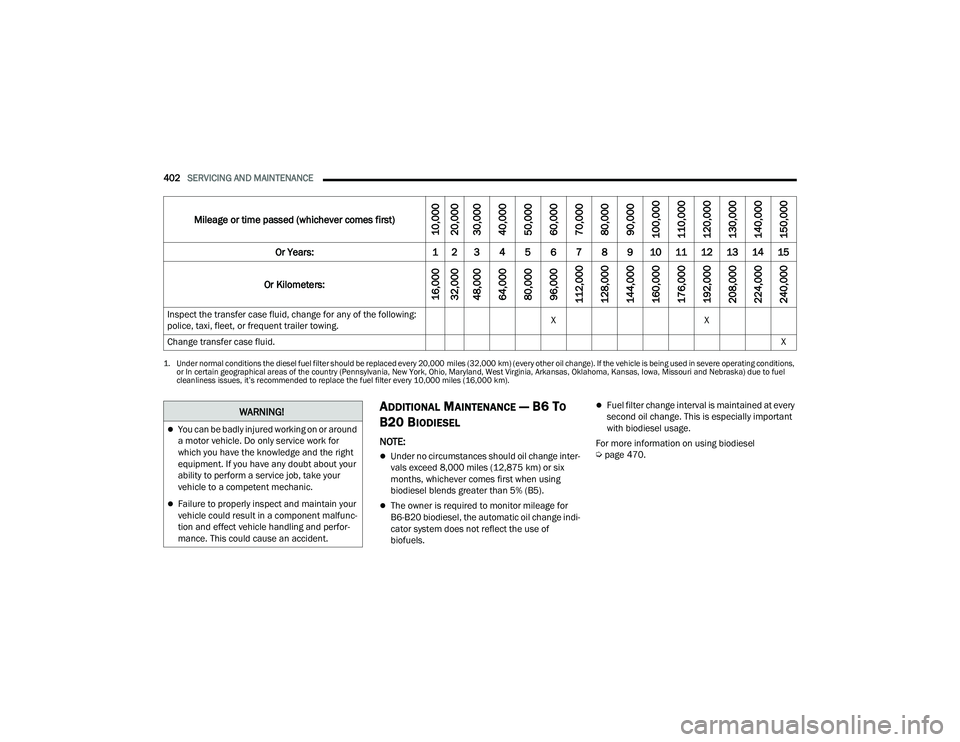
ADDITIONAL MAINTENANCE — B6 TO
B20 B
IODIESEL
NOTE:
Under no circumstances should oil change inter -
vals exceed 8,000 miles (12,875 km) or six months, whichever comes first when using
biodiesel blends greater than 5% (B5).
The owner is required to monitor mileage for
B6-B20 biodiesel, the automatic oil change indi -
cator system does not reflect the use of
biofuels.
Fuel filter change interval is maintained at every
second oil change. This is especially important
with biodiesel usage.
For more information on using biodiesel
Ú page 470.
Inspect the transfer case fluid, change for any of the following:
police, taxi, fleet, or frequent trailer towing.
X
X
Change transfer case fluid. X
1. Under normal conditions the diesel fuel filter should be replaced every 20,000 miles (32,000 km) (every other oil change). If the vehicle is being used in severe operating conditions,
or In certain geographical areas of the country (Pennsylvania, New York, Ohio, Maryland, West Virginia, Arkansas, Oklahoma, Kansas, Iowa, Missouri and Nebraska) due to fuel
cleanliness issues, it’s recommended to replace the fuel filter every 10,000 miles (16,000 km).
Mileage or time passed (whichever comes first)
10,000
20,000
30,000
40,000
50,000
60,000
70,000
80,000
90,000
100,000
110,000
120,000
130,000
140,000
150,000
Or Years: 1 2 3 4 5 6 7 8 9 10 11 12 13 14 15
Or Kilometers:
16,000
32,000
48,000
64,000
80,000
96,000
112,000
128,000
144,000
160,000
176,000
192,000
208,000
224,000
240,000
WARNING!
You can be badly injured working on or around
a motor vehicle. Do only service work for
which you have the knowledge and the right
equipment. If you have any doubt about your
ability to perform a service job, take your
vehicle to a competent mechanic.
Failure to properly inspect and maintain your
vehicle could result in a component malfunc -
tion and effect vehicle handling and perfor -
mance. This could cause an accident.
22_DT_OM_EN_USC_t.book Page 402
Page 409 of 496
SERVICING AND MAINTENANCE407
CHECKING OIL LEVEL
To ensure proper engine lubrication, the engine oil
must be maintained at the correct level. Check the
oil level at regular intervals, such as every fuel
stop. The best time to check the engine oil level is
about five minutes after a fully warmed up engine
is shut off.
Checking the oil while the vehicle is on level ground
will improve the accuracy of the oil level readings.
There are four possible dipstick types:
Crosshatched zone.
Crosshatched zone marked SAFE.
Crosshatched zone marked with MIN at the low
end of the range and MAX at the high end of the
range.
Crosshatched zone marked with dimples at the
MIN and the MAX ends of the range.
NOTE:Always maintain the oil level within the crosshatch
markings on the dipstick.
Adding 1 quart (1.0 liter) of oil when the reading is
at the low end of the dipstick range will raise the oil
level to the high end of the range marking.
ADDING WASHER FLUID
The fluid reservoir is located under the hood and
should be checked for fluid level at regular
intervals. Fill the reservoir with windshield washer
solvent only (not radiator antifreeze). When
refilling the washer fluid reservoir, take some
washer fluid and apply it to a cloth or towel and
wipe the wiper blades clean. This will help blade
performance.
To prevent freeze-up of your windshield washer
system in cold weather, select a solution or mixture
that meets or exceeds the temperature range of
your climate. This rating information can be found
on most washer fluid containers. After the engine has warmed up, operate the
defroster for a few minutes to reduce the
possibility of smearing or freezing the fluid on the
cold windshield. Windshield washer solution used
with water as directed on the container, aids
cleaning action, reduces the freezing point to avoid
line clogging, and is not harmful to paint or trim.
CAUTION!
Overfilling or underfilling the crankcase will
cause oil aeration or loss of oil pressure. This
could damage your engine.
WARNING!
Commercially available windshield washer
solvents are flammable. They could ignite and
burn you. Care must be exercised when filling or
working around the washer solution.
8
22_DT_OM_EN_USC_t.book Page 407
Page 414 of 496

412SERVICING AND MAINTENANCE
G/T AIR FILTER MAINTENANCE
Clean Engine Air Filter
The scheduled air filter cleaning interval is 30,
000 miles (48,280 km), or if in a dusty
environment the engine air filter should be
checked periodically to ensure optimal air flow.
1. Spray the air filter with the recommended
Mopar® air filter cleaner or apply mild
dishwashing detergent and water and let sit
for at least 10 minutes to loosen dir before
rinsing.
NOTE:Never use strong detergents, high pressure, or
gasoline on the air filter.
2. Rinse the air filter with cool low-pressure water applied from the inside (clean side) out in
order to flush the dirt out of the filter. Continue
to rinse the filter until all traces of the cleaner
have been removed.
NOTE:It may be necessary to repeat steps 1 and 2 if the
air filter is not completely clean.
3. After rinsing the air filter, gently shake off the excess water and allow air filter to dry
naturally.
NOTE:Do not use forced air pressure as it may damage
the filtering capabilities of the filter’s microfibers
and also void its warranty.
DRAINING FUEL/WATER SEPARATOR
F
ILTER — DIESEL ENGINE
The fuel/water separator filter housing is located
inside the frame rail, behind the left front wheel.
The best access to this water drain valve is from
under the vehicle.
If water is detected in the water separator while the
engine is running, or while the ignition switch is in
the ON/RUN position, the Water In Fuel Indicator
Light will illuminate and an audible chime will be
heard. At this point, you should stop the engine
and drain the water from the filter housing.
Fuel Filter Assembly
If the Water In Fuel Indicator Light comes on and a
single chime is heard while you are driving, or with
the ignition in the ON position, there may be a
problem with your water separator wiring or
sensor. See an authorized dealer for service.
CAUTION!
Do not drain the fuel/water separator filter
when the engine is running.
Diesel fuel will damage blacktop paving
surfaces. Drain the filter into an appropriate
container.
1 — Water In Fuel Drain Valve
CAUTION!
If the Water In Fuel Indicator Light remains on,
DO NOT START the engine before you drain water
from the fuel filter to avoid engine damage.
22_DT_OM_EN_USC_t.book Page 412
Page 415 of 496

SERVICING AND MAINTENANCE413
Upon proper draining of the water from the fuel
filter, the Water In Fuel Indicator Light will remain
illuminated for approximately 10 seconds. If the
water was drained while the engine was running,
the Water In Fuel Indicator Light may remain on for
approximately three minutes.
NOTE:Care should be taken in disposing of used fluids
from your vehicle. Used fluids, indiscriminately
discarded, can present a problem to the envi -
ronment. Contact an authorized dealer, service
station, or government agency for advice on recy -
cling programs and for where used fluids and
filters can be properly disposed of in your area.
Drain the fuel/water separator filter when the
Water In Fuel Indicator Light is ON. Within
10 minutes of vehicle shutdown, turn the filter
drain valve (located on the bottom of the filter
housing) counterclockwise to drain fuel/water,
then turn the ignition switch to the ON position,
and allow any accumulated water to drain. Leave
the drain valve open until all water and
contaminants have been removed. When clean
fuel is visible, close the drain valve by turning it
clockwise, and turn the ignition switch to OFF.
If more than two ounces or 60 milliliters of fuel
have been drained Ú page 414.
UNDERBODY MOUNTED FUEL FILTER
R
EPLACEMENT — DIESEL ENGINE
NOTE:Using a fuel filter that does not meet the manufac -
turer’s filtration and water separating require -
ments can severely impact fuel system life and reli -
ability. Under normal conditions the diesel fuel
filter should be replaced every 20,000 miles (every
other oil change). If the vehicle is being used in
severe operating conditions, or In certain
geographical areas of the country (Pennsylvania,
New York, Ohio, Maryland, West Virginia, Arkansas,
Oklahoma, Kansas, Iowa, Missouri and Nebraska)
due to fuel cleanliness issues, it’s recommended
to replace the fuel filter every 10,000 miles.
Fuel Filter Assembly
1. Turn engine off.
2. Place a drain pan under the fuel filter assembly.
3. Open the water drain valve, and let any accumulated water drain.
4. Close the water drain valve.
5. Remove bottom cover using a strap wrench. Rotate counterclockwise for removal. Remove
the used o-ring and discard it.
CAUTION!
Diesel fuel will damage blacktop paving
surfaces. Drain the filter into an appropriate
container.
Do not prefill the fuel filter when installing a
new fuel filter. There is a possibility debris
could be introduced into the fuel filter during
this action. It is best to install the filter dry and
allow the in-tank lift pump to prime the fuel
system.
1 — Water In Fuel Drain Valve
2 — Fuel Filter Access
8
22_DT_OM_EN_USC_t.book Page 413
Page 416 of 496
414SERVICING AND MAINTENANCE
6. Remove the used filter cartridge from the housing and dispose of it according to your
local regulations.
7. Wipe the sealing surfaces of the lid and housing clean.
8. Install a new o-ring into the ring groove on the filter housing and lubricate with clean engine
oil.
PRIMING IF THE ENGINE HAS RUN OUT
O
F FUEL — DIESEL ENGINE
1. Add a substantial amount of fuel to the tank,
approximately 2 to 5 gal (8 L to 19 L).
2. Press ignition switch twice without your foot on brake to put vehicle in ON/RUN position. This
will activate the in tank fuel pump for approxi -
mately 30 seconds. Repeat this process twice. 3. Start the engine using the “Normal Starting”
procedure Ú page 144.
NOTE:The engine may run rough until the air is forced
from all the fuel lines.
NOTE:
Use of biodiesel mixture in excess of 20% can
negatively impact the fuel filter's ability to sepa -
rate water from the fuel, resulting in high pres -
sure fuel system corrosion or damage.
In addition, commercially available fuel addi -
tives are not necessary for the proper operation
of your diesel engine.
For extreme cold conditions, "Mopar® Premium
Diesel Fuel Treatment" is recommended to
assist with cold starting.
INTERVENTION REGENERATION
S
TRATEGY — MESSAGE PROCESS FLOW
(D
IESEL ENGINE)
This engine meets all required diesel engine
emissions standards. To achieve these emissions
standards, your vehicle is equipped with a
state-of-the-art engine and exhaust system. These
systems are seamlessly integrated into your
vehicle and managed by the Powertrain Control
Module (PCM). The PCM manages engine
combustion to allow the exhaust system’s catalyst
to trap and burn Particulate Matter (PM)
pollutants, with no input or interaction on your part.
Additionally, your vehicle has the ability to alert you
to additional maintenance required on your vehicle
or engine Ú page 114.
WARNING!
Do not open the high pressure fuel system with
the engine running. Engine operation causes
high fuel pressure. High pressure fuel spray can
cause serious injury or death.
CAUTION!
The starter motor will engage for approximately
30 seconds at a time. Allow two minutes
between cranking intervals.
WARNING!
Do not use alcohol or gasoline as a fuel blending
agent. They can be unstable under certain
conditions and be hazardous or explosive when
mixed with diesel fuel.
CAUTION!
Due to lack of lubricants in alcohol or gasoline,
the use of these fuels can cause damage to the
fuel system.
22_DT_OM_EN_USC_t.book Page 414