brake RAM 1500 2023 Owners Manual
[x] Cancel search | Manufacturer: RAM, Model Year: 2023, Model line: 1500, Model: RAM 1500 2023Pages: 416, PDF Size: 20.59 MB
Page 337 of 416

SERVICING AND MAINTENANCE335
Mileage Or Time Passed (Whichever Comes
First)
20,000
30,000
40,000
50,000
60,000
70,000
80,000
90,000
100,000
110,000
120,000
130,000
140,000
150,000
Or Years: 2 3 4 5 6 7 8 9 10 11 12 13 14 15
Or Kilometers:
32,000
48,000
64,000
80,000
96,000
112,000
128,000
144,000
160,000
176,000
192,000
208,000
224,000
240,000
Additional Inspections
Inspect the CV/Universal joints. X X X X X X X X X X X X X X
Inspect front suspension, tie rod ends, and
replace if necessary. X
X X XX XX
Inspect the front and rear axle surfaces. If gear
oil leakage is suspected, check the fluid level.
If using your vehicle for police, taxi, fleet,
off-road or frequent trailer towing, change
axle fluid. X
X XXX
Inspect the brake linings, replace as necessary. X XX XX XX
Inspect transfer case fluid. X
Additional Maintenance
Replace cabin air filter. To be replaced every 12,000 miles (19,000 km).
For severe dusty driving conditions, inspect and
replace the Evaporative System Fresh Air Filter
as necessary; replacement may be more
frequent depending on conditions. X X X X X X X X X X X X X X
Replace engine air cleaner filter. XX XXX
If equipped with Stop/Start, replace accessory
drive belt with OEM grade Mopar® belt. X
8
23_DT_OM_EN_USC_t.book Page 335
Page 339 of 416

SERVICING AND MAINTENANCE337
ENGINE COMPARTMENT
3.6L ENGINE WITH STOP/START
1 — Motor Generator Unit Coolant Reservoir Pressure Cap 6 — Battery
2 — Engine Coolant Reservoir Pressure Cap 7 — Engine Air Cleaner Filter
3 — Engine Oil Dipstick 8 — Washer Fluid Reservoir Cap
4 — Engine Oil Fill 9 — Power Distribution Center (Fuses)
5 — Brake Fluid Reservoir
8
23_DT_OM_EN_USC_t.book Page 337
Page 340 of 416

338SERVICING AND MAINTENANCE
5.7L ENGINE WITHOUT STOP/START
1 — Engine Air Cleaner Filter 6 — Battery
2 — Engine Coolant Pressure Cap 7 — Engine Coolant Reservoir Cap
3 — Engine Oil Fill 8 — Washer Fluid Reservoir Cap
4 — Engine Oil Dipstick 9 — Power Distribution Center (Fuses)
5 — Brake Fluid Reservoir Cap
23_DT_OM_EN_USC_t.book Page 338
Page 341 of 416

SERVICING AND MAINTENANCE339
5.7L ENGINE WITH STOP/START
1 — Engine Air Cleaner Filter 6 — Battery
2 — Engine Coolant Pressure Cap 7 — Engine Coolant Reservoir Cap
3 — Engine Oil Fill 8 — Washer Fluid Reservoir Cap
4 — Engine Oil Dipstick 9 — Power Distribution Center (Fuses)
5 — Brake Fluid Reservoir Cap
8
23_DT_OM_EN_USC_t.book Page 339
Page 354 of 416

352SERVICING AND MAINTENANCE
(Continued)
Cooling System Notes
NOTE:When the vehicle is stopped after a few miles/kilometers
of operation, you may observe vapor coming from the front
of the engine compartment. This is normally a result of
moisture from rain, snow, or high humidity accumulating
on the radiator and being vaporized when the thermostat
opens, allowing hot engine coolant (antifreeze) to enter
the radiator.
If an examination of your engine compartment shows no
evidence of radiator or hose leaks, the vehicle may be
safely driven. The vapor will soon dissipate.
Do not overfill the coolant expansion bottle.
Check the coolant freeze point in the radiator and in
the coolant expansion bottle. If engine coolant needs
to be added, the contents of the coolant expansion
bottle must also be protected against freezing.
If frequent engine coolant additions are required, the
cooling system should be pressure tested for leaks.
Maintain engine coolant concentration at a minimum
of 50% OAT coolant (conforming to MS.90032) and
distilled water for proper corrosion protection of your
engine which contains aluminum components.
Make sure that the coolant expansion bottle overflow
hoses are not kinked or obstructed.
Keep the front of the radiator clean. If your vehicle is
equipped with air conditioning, keep the front of the
condenser clean.
Do not change the thermostat for Summer or Winter
operation. If replacement is ever necessary, install
ONLY the correct type thermostat. Other designs may
result in unsatisfactory engine cooling performance,
poor gas mileage, and increased emissions.
BRAKE SYSTEM
In order to ensure brake system performance, all brake
system components should be inspected periodically
Úpage 334.
Fluid Level Check — Brake Master Cylinder
The fluid level of the brake master cylinder should be
checked whenever the vehicle is serviced, or immediately
if the Brake System Warning Light is on. If necessary, add
fluid to bring level within the designated marks on the side
of the reservoir of the brake master cylinder. Be sure to
clean the top of the master cylinder area before removing
cap. With disc brakes, fluid level can be expected to fall as
the brake pads wear. Brake fluid level should be checked
when pads are replaced. If the brake fluid is abnormally
low, check the system for leaks
Úpage 397.
WARNING!
Riding the brakes can lead to brake failure and possibly
a collision. Driving with your foot resting or riding on the
brake pedal can result in abnormally high brake
temperatures, excessive lining wear, and possible brake
damage. You would not have your full braking capacity
in an emergency.
WARNING!
Use only manufacturer's recommended brake fluid Úpage 397. Using the wrong type of brake fluid can
severely damage your brake system and/or impair its
performance. The proper type of brake fluid for your
vehicle is also identified on the original factory
installed hydraulic master cylinder reservoir.
To avoid contamination from foreign matter or
moisture, use only new brake fluid or fluid that has
been in a tightly closed container. Keep the master
cylinder reservoir cap secured at all times. Brake
fluid in an open container absorbs moisture from the
air resulting in a lower boiling point. This may cause
it to boil unexpectedly during hard or prolonged
braking, resulting in sudden brake failure. This could
result in a collision.
23_DT_OM_EN_USC_t.book Page 352
Page 355 of 416

SERVICING AND MAINTENANCE353
AUTOMATIC TRANSMISSION
Special Additives
The manufacturer strongly recommends against using any
special additives in the transmission. Automatic
Transmission Fluid (ATF) is an engineered product and its
performance may be impaired by supplemental additives.
Therefore, do not add any fluid additives to the
transmission. Avoid using transmission sealers as they
may adversely affect seals.
Fluid Level Check
The fluid level is preset at the factory and does not require
adjustment under normal operating conditions. Routine
fluid level checks are not required, therefore the
transmission has no dipstick. An authorized dealer can
check your transmission fluid level using special
service tools.
If you notice fluid leakage or transmission malfunction,
visit an authorized dealer immediately to have the
transmission fluid level checked. Operating the vehicle
with an improper fluid level can cause severe
transmission damage.
Fluid And Filter Changes
Under normal operating conditions, the fluid installed at
the factory will provide satisfactory lubrication for the life
of the vehicle.
Routine fluid and filter changes are not required. However,
change the fluid and filter if the fluid becomes
contaminated (with water, etc.), or if the transmission is
disassembled for any reason.
Selection Of Lubricant
It is important to use the proper transmission fluid to
ensure optimum transmission performance and life. Use
only the manufacturer recommended transmission fluid
Úpage 397. It is important to maintain the transmission
fluid at the correct level using the recommended fluid. No
chemical flushes should be used in any transmission; only
the approved lubricant should be used.
REAR AXLE AND 4X4 FRONT DRIVING
A
XLE FLUID LEVEL
For normal service, periodic fluid level checks are not
required. When the vehicle is serviced for other reasons
the exterior surfaces of the axle assembly should be
inspected. If gear oil leakage is suspected inspect the fluid
level
Úpage 397. This inspection should be made with
the vehicle in a level position.
The fluid level should be even with the bottom of the fill
hole (within 1/4 in (6.4 mm) of edge of hole) for the front
axle and rear axle.
Overfilling the brake fluid reservoir can result in
spilling brake fluid on hot engine parts, causing the
brake fluid to catch fire. Brake fluid can also damage
painted and vinyl surfaces, care should be taken to
avoid its contact with these surfaces.
Do not allow petroleum based fluid to contaminate
the brake fluid. Brake seal components could be
damaged, causing partial or complete brake failure.
This could result in a collision.CAUTION!
Do not use chemical flushes in your transmission as the
chemicals can damage your transmission components.
Such damage is not covered by the New Vehicle Limited
Warranty.
WARNING!
CAUTION!
If a transmission fluid leak occurs, visit an authorized
dealer immediately. Severe transmission damage may
occur. An authorized dealer has the proper tools to
adjust the fluid level accurately.
CAUTION!
Using a transmission fluid other than the
manufacturer’s recommended fluid may cause
deterioration in transmission shift quality and/or torque
converter shudder
Úpage 397.
8
23_DT_OM_EN_USC_t.book Page 353
Page 360 of 416
358SERVICING AND MAINTENANCE
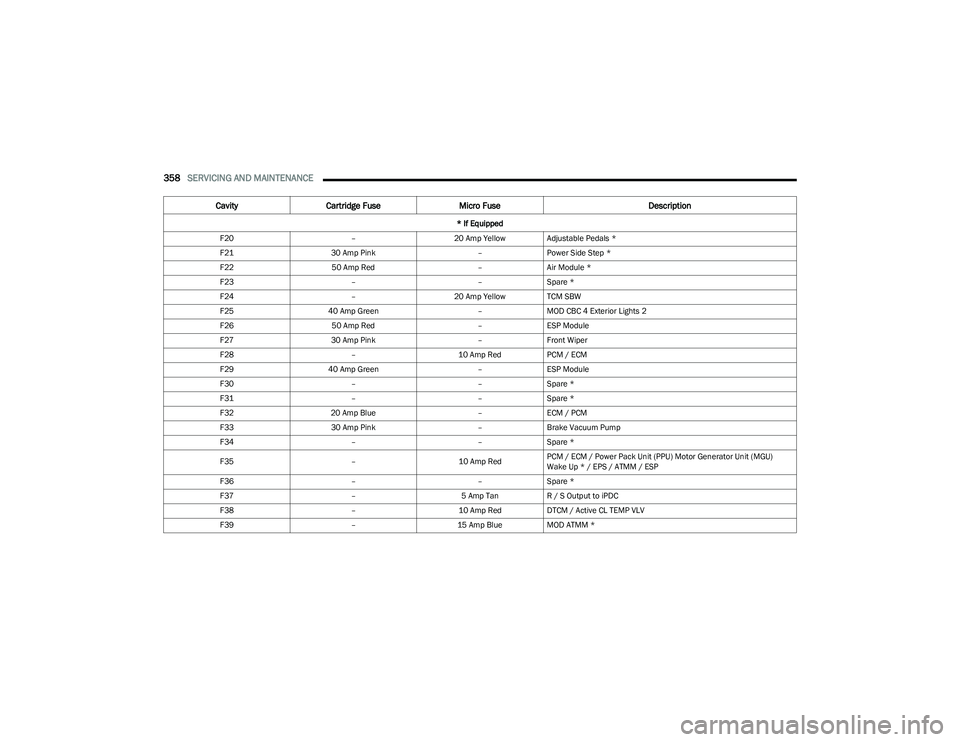
F20 –20 Amp Yellow Adjustable Pedals *
F21 30 Amp Pink –Power Side Step *
F22 50 Amp Red –Air Module *
F23 ––Spare *
F24 –20 Amp Yellow TCM SBW
F25 40 Amp Green –MOD CBC 4 Exterior Lights 2
F26 50 Amp Red –ESP Module
F27 30 Amp Pink –Front Wiper
F28 –10 Amp RedPCM / ECM
F29 40 Amp Green –ESP Module
F30 ––Spare *
F31 ––Spare *
F32 20 Amp Blue –ECM / PCM
F33 30 Amp Pink –Brake Vacuum Pump
F34 ––Spare *
F35 –10 Amp RedPCM / ECM / Power Pack Unit (PPU) Motor Generator Unit (MGU)
Wake Up * / EPS / ATMM / ESP
F36 ––Spare *
F37 –5 Amp TanR / S Output to iPDC
F38 –10 Amp RedDTCM / Active CL TEMP VLV
F39 –15 Amp BlueMOD ATMM *
Cavity Cartridge Fuse Micro Fuse Description
* If Equipped
23_DT_OM_EN_USC_t.book Page 358
Page 364 of 416
362SERVICING AND MAINTENANCE
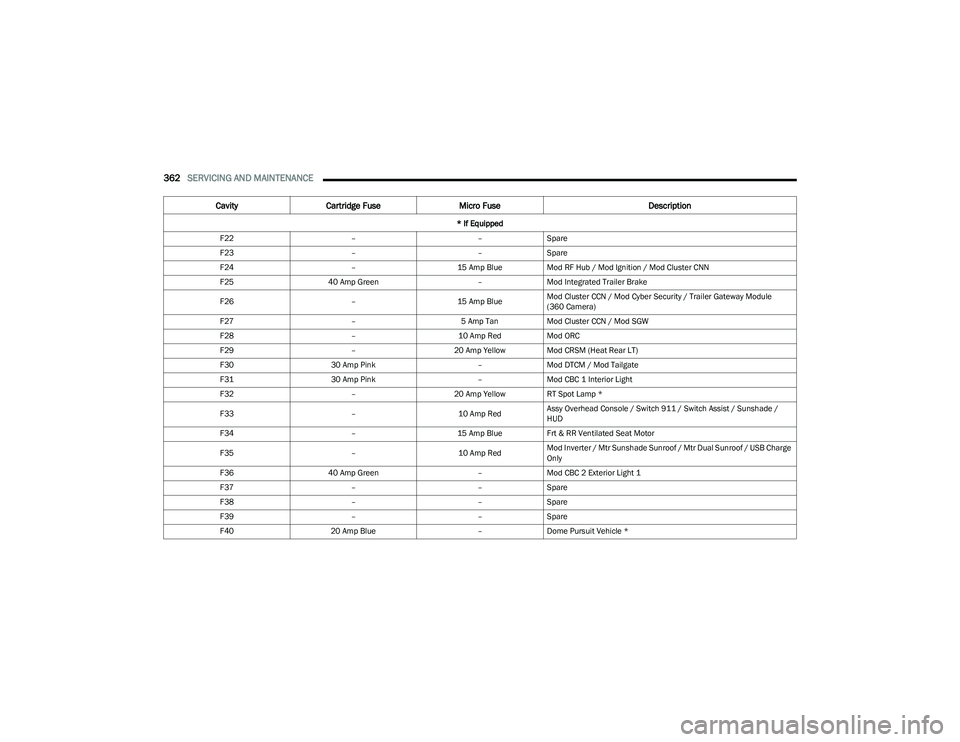
F22 ––Spare
F23 ––Spare
F24 –15 Amp BlueMod RF Hub / Mod Ignition / Mod Cluster CNN
F25 40 Amp Green –Mod Integrated Trailer Brake
F26 –15 Amp BlueMod Cluster CCN / Mod Cyber Security / Trailer Gateway Module
(360 Camera)
F27 –5 Amp TanMod Cluster CCN / Mod SGW
F28 –10 Amp RedMod ORC
F29 –20 Amp Yellow Mod CRSM (Heat Rear LT)
F30 30 Amp Pink –Mod DTCM / Mod Tailgate
F31 30 Amp Pink –Mod CBC 1 Interior Light
F32 –20 Amp Yellow RT Spot Lamp *
F33 –10 Amp RedAssy Overhead Console / Switch 911 / Switch Assist / Sunshade /
HUD
F34 –15 Amp BlueFrt & RR Ventilated Seat Motor
F35 –10 Amp RedMod Inverter / Mtr Sunshade Sunroof / Mtr Dual Sunroof / USB Charge
Only
F36 40 Amp Green –Mod CBC 2 Exterior Light 1
F37 ––Spare
F38 ––Spare
F39 ––Spare
F40 20 Amp Blue –Dome Pursuit Vehicle *
Cavity Cartridge Fuse Micro Fuse Description
* If Equipped
23_DT_OM_EN_USC_t.book Page 362
Page 365 of 416

SERVICING AND MAINTENANCE363
F41 A&B –15 Amp BlueLumbar Support & Pass SW / Steering Column Control Module / HVAC
Control Module / ICS Switch Bank / Upper Switch Bank
F42 A&B –10 Amp RedMod Transfer Case Switch Module (TCSM) / SBW / Electric Park Brake
SW / Module TPM Trailer / Module Gateway Can-C Trailer TPM / Seat
LT & RT Vent
F43 A&B –10 Amp RedPort Diagnostics / Front & Rear USB
F44 –20 Amp Yellow Radio / DCSD / Telematics Box Mod / Trailer Gateway Module (360)
F45 30 Amp Pink –Mod Door MUX Driver
F46 30 Amp Pink –Mod Door MUX Passenger
F47 ––Spare
F48A –10 Amp RedRear View Mirror / SW Window Passenger / Rear USB / Wireless
Charging Pad Mod
F49 –15 Amp BlueMod CVPM / SNSR Blind Spot / HDLP Adaptive Front Lighting Sensor
(AFLS)
F50A –10 Amp RedBattery PACK Control Mod (BPCM) *
F51 A&B ––Spare
F52 20 Amp Blue –Direct Battery Feed *
F53 –10 Amp RedTrailer Reverse Steering Control / Trailer Steering Control Knob
F54 A&B –20 Amp YellowPower Outlet Center Seat Battery Feed Position
Power Outlet Center Seat Ignition Feed Position
F55 25 Amp White –Upfitter *
F56 30 Amp Pink –Mod Network Interface *
F57 20 Amp Blue –Direct Battery Feed *
Cavity Cartridge Fuse Micro Fuse Description
* If Equipped
8
23_DT_OM_EN_USC_t.book Page 363
Page 385 of 416
SERVICING AND MAINTENANCE383
WHEEL AND WHEEL TRIM CARE
All wheels and wheel trim, especially aluminum and
chrome plated wheels, should be cleaned regularly using
mild (neutral Ph) soap and water to maintain their luster
and to prevent corrosion. Wash wheels with the same
soap solution recommended for the body of the vehicle
and remember to always wash when the surfaces are not
hot to the touch.
Your wheels are susceptible to deterioration caused by
salt, sodium chloride, magnesium chloride, calcium
chloride, etc., and other road chemicals used to melt ice
or control dust on dirt roads. Use a soft cloth or sponge
and mild soap to wipe away promptly. Do not use harsh
chemicals or a stiff brush. They can damage the wheel’s
protective coating that helps keep them from corroding
and tarnishing. When cleaning extremely dirty wheels including excessive
brake dust, care must be taken in the selection of tire and
wheel cleaning chemicals and equipment to prevent
damage to the wheels. Mopar® Wheel Treatment or
Mopar® Chrome Cleaner or their equivalent is
recommended or select a non-abrasive, non-acidic
cleaner for aluminum or chrome wheels.
NOTE:If you intend parking or storing your vehicle for an
extended period after cleaning the wheels with wheel
cleaner, drive your vehicle and apply the brakes to remove
the water droplets from the brake components. This
activity will remove the red rust on the brake rotors and
prevent vehicle vibration when braking.
Dark Vapor Chrome, Black Satin Chrome, or Low Gloss
Clear Coat WheelsCAUTION!
Avoid products or automatic car washes that use acidic
solutions or strong alkaline additives or harsh brushes.
Many aftermarket wheel cleaners and automatic car
washes may damage the wheel's protective finish. Such
damage is not covered by the New Vehicle Limited
Warranty. Only car wash soap, Mopar® Wheel Cleaner
or equivalent is recommended.
CAUTION!
Do not use scouring pads, steel wool, a bristle brush,
metal polishes or oven cleaner. These products may
damage the wheel's protective finish. Such damage is
not covered by the New Vehicle Limited Warranty. Only
car wash soap, Mopar® Wheel Cleaner or equivalent is
recommended.
CAUTION!
If your vehicle is equipped with these specialty wheels,
DO NOT USE wheel cleaners, abrasives, or polishing
compounds. They will permanently damage this finish
and such damage is not covered by the New Vehicle
Limited Warranty. HAND WASH ONLY USING MILD SOAP
AND WATER WITH A SOFT CLOTH. Used on a regular
basis; this is all that is required to maintain this finish.
8
23_DT_OM_EN_USC_t.book Page 383