seat adjustment RAM 1500 2023 Owners Manual
[x] Cancel search | Manufacturer: RAM, Model Year: 2023, Model line: 1500, Model: RAM 1500 2023Pages: 416, PDF Size: 20.59 MB
Page 4 of 416
2
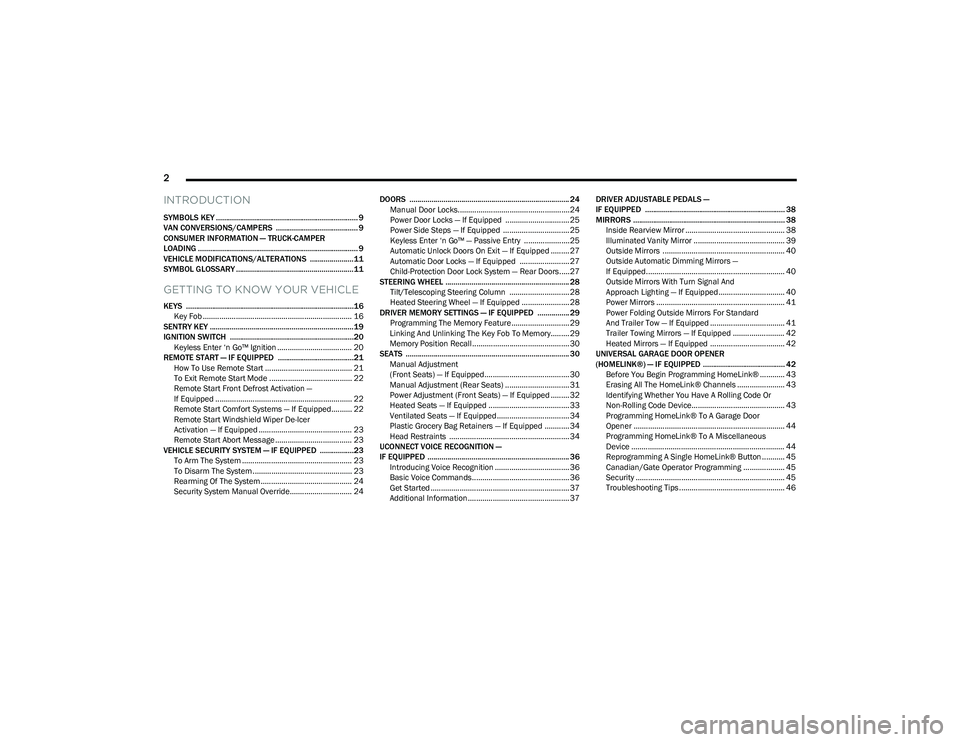
INTRODUCTION
SYMBOLS KEY ....................................................................... 9
VAN CONVERSIONS/CAMPERS ......................................... 9
CONSUMER INFORMATION — TRUCK-CAMPER
LOADING ................................................................................ 9
VEHICLE MODIFICATIONS/ALTERATIONS ......................11
SYMBOL GLOSSARY ...........................................................11
GETTING TO KNOW YOUR VEHICLE
KEYS ....................................................................................16 Key Fob ........................................................................ 16
SENTRY KEY ........................................................................19
IGNITION SWITCH ..............................................................20 Keyless Enter ‘n Go™ Ignition .................................... 20
REMOTE START — IF EQUIPPED ......................................21 How To Use Remote Start .......................................... 21
To Exit Remote Start Mode ........................................ 22
Remote Start Front Defrost Activation —
If Equipped .................................................................. 22
Remote Start Comfort Systems — If Equipped.......... 22
Remote Start Windshield Wiper De-Icer
Activation — If Equipped ............................................. 23
Remote Start Abort Message ..................................... 23
VEHICLE SECURITY SYSTEM — IF EQUIPPED .................23 To Arm The System ..................................................... 23
To Disarm The System ................................................ 23
Rearming Of The System ............................................ 24
Security System Manual Override.............................. 24 DOORS ................................................................................ 24
Manual Door Locks......................................................24
Power Door Locks — If Equipped ............................... 25
Power Side Steps — If Equipped ................................ 25
Keyless Enter ‘n Go™ — Passive Entry ...................... 25
Automatic Unlock Doors On Exit — If Equipped ......... 27
Automatic Door Locks — If Equipped ........................ 27
Child-Protection Door Lock System — Rear Doors.....27
STEERING WHEEL .............................................................. 28 Tilt/Telescoping Steering Column ............................. 28
Heated Steering Wheel — If Equipped ....................... 28
DRIVER MEMORY SETTINGS — IF EQUIPPED ................ 29 Programming The Memory Feature............................ 29
Linking And Unlinking The Key Fob To Memory......... 29
Memory Position Recall............................................... 30
SEATS .................................................................................. 30 Manual Adjustment
(Front Seats) — If Equipped......................................... 30
Manual Adjustment (Rear Seats) ............................... 31
Power Adjustment (Front Seats) — If Equipped ......... 32
Heated Seats — If Equipped ....................................... 33
Ventilated Seats — If Equipped................................... 34
Plastic Grocery Bag Retainers — If Equipped ............ 34
Head Restraints .......................................................... 34
UCONNECT VOICE RECOGNITION —
IF EQUIPPED ....................................................................... 36 Introducing Voice Recognition .................................... 36
Basic Voice Commands............................................... 36
Get Started ................................................................... 37
Additional Information................................................. 37 DRIVER ADJUSTABLE PEDALS —
IF EQUIPPED ...................................................................... 38
MIRRORS ............................................................................ 38
Inside Rearview Mirror ................................................ 38
Illuminated Vanity Mirror ............................................ 39
Outside Mirrors ........................................................... 40
Outside Automatic Dimming Mirrors —
If Equipped................................................................... 40
Outside Mirrors With Turn Signal And
Approach Lighting — If Equipped................................ 40
Power Mirrors .............................................................. 41
Power Folding Outside Mirrors For Standard
And Trailer Tow — If Equipped .................................... 41
Trailer Towing Mirrors — If Equipped ......................... 42
Heated Mirrors — If Equipped .................................... 42
UNIVERSAL GARAGE DOOR OPENER
(HOMELINK®) — IF EQUIPPED ......................................... 42 Before You Begin Programming HomeLink® ............ 43
Erasing All The HomeLink® Channels ....................... 43
Identifying Whether You Have A Rolling Code Or
Non-Rolling Code Device............................................. 43
Programming HomeLink® To A Garage Door
Opener ......................................................................... 44
Programming HomeLink® To A Miscellaneous
Device .......................................................................... 44
Reprogramming A Single HomeLink® Button ........... 45
Canadian/Gate Operator Programming .................... 45
Security ........................................................................ 45
Troubleshooting Tips ................................................... 46
23_DT_OM_EN_USC_t.book Page 2
Page 32 of 416

30GETTING TO KNOW YOUR VEHICLE
MEMORY POSITION RECALL
NOTE:If a recall is attempted when the vehicle is not in PARK, a
message will display in the instrument cluster display.
To recall the memory settings for driver one or two, push
the desired memory button number (1 or 2) or the unlock
button on the key fob linked to the desired memory
position.
A recall can be canceled by pushing any of the memory
buttons (S, 1, or 2) during a recall. When a recall is
canceled, the driver seat will stop moving. A delay of one
second will occur before another recall can be selected.
SEATS
Seats are a part of the Occupant Restraint system of the
vehicle.
MANUAL ADJUSTMENT
(F
RONT SEATS) — IF EQUIPPED
Manual Front Seat Forward/Rearward
Adjustment
Both front seats are adjustable forward or rearward. The
manual seat adjustment handle is located under the seat
cushion at the front edge of each seat.
Manual Seat Adjustment Bar
While sitting in the seat, pull up on the handle and slide
the seat forward or rearward. Release the bar once you
have reached the desired position. Then, using body
pressure, move forward and rearward on the seat to be
sure that the seat adjusters have latched.
WARNING!
It is dangerous to ride in a cargo area, inside or
outside of a vehicle. In a collision, people riding in
these areas are more likely to be seriously injured or
killed.
Do not allow people to ride in any area of your vehicle
that is not equipped with seats and seat belts. In a
collision, people riding in these areas are more likely
to be seriously injured or killed.
Be sure everyone in your vehicle is in a seat and
using a seat belt properly.
WARNING!
Adjusting a seat while the vehicle is moving is
dangerous. The sudden movement of the seat could
cause you to lose control. The seat belt might not be
adjusted properly and you could be injured. Adjust
the seat only while the vehicle is parked.
Do not ride with the seatback reclined so that the
shoulder belt is no longer resting against your chest.
In a collision you could slide under the seat belt and
be seriously or even fatally injured. Use the recliner
only when the vehicle is parked.
WARNING!
Adjusting a seat while driving may be dangerous.
Moving a seat while driving could result in loss of
control which could cause a collision and serious
injury or death.
Seats should be adjusted before fastening the
seat belts and while the vehicle is parked. Serious
injury or death could result from a poorly adjusted
seat belt.
23_DT_OM_EN_USC_t.book Page 30
Page 33 of 416
GETTING TO KNOW YOUR VEHICLE31
Manual Front Seat Recline Adjustment
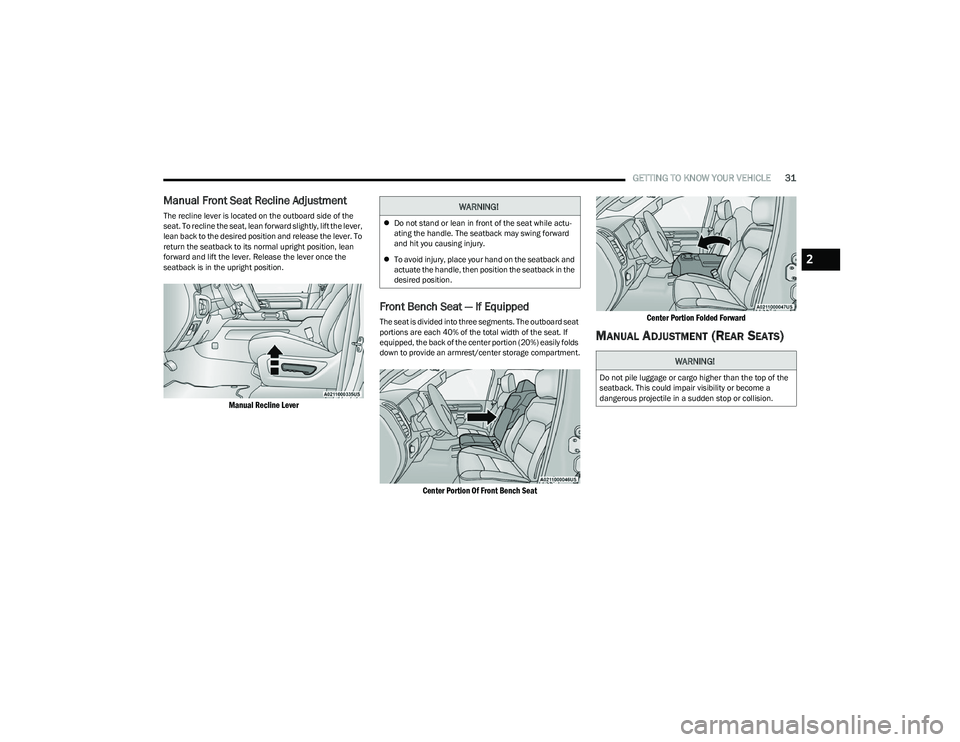
The recline lever is located on the outboard side of the
seat. To recline the seat, lean forward slightly, lift the lever,
lean back to the desired position and release the lever. To
return the seatback to its normal upright position, lean
forward and lift the lever. Release the lever once the
seatback is in the upright position.
Manual Recline Lever
Front Bench Seat — If Equipped
The seat is divided into three segments. The outboard seat
portions are each 40% of the total width of the seat. If
equipped, the back of the center portion (20%) easily folds
down to provide an armrest/center storage compartment.
Center Portion Of Front Bench Seat Center Portion Folded Forward
MANUAL ADJUSTMENT (REAR SEATS)
WARNING!
Do not stand or lean in front of the seat while actu-
ating the handle. The seatback may swing forward
and hit you causing injury.
To avoid injury, place your hand on the seatback and
actuate the handle, then position the seatback in the
desired position.
WARNING!
Do not pile luggage or cargo higher than the top of the
seatback. This could impair visibility or become a
dangerous projectile in a sudden stop or collision.
2
23_DT_OM_EN_USC_t.book Page 31
Page 34 of 416
32GETTING TO KNOW YOUR VEHICLE
Reclining Rear Seats — If Equipped
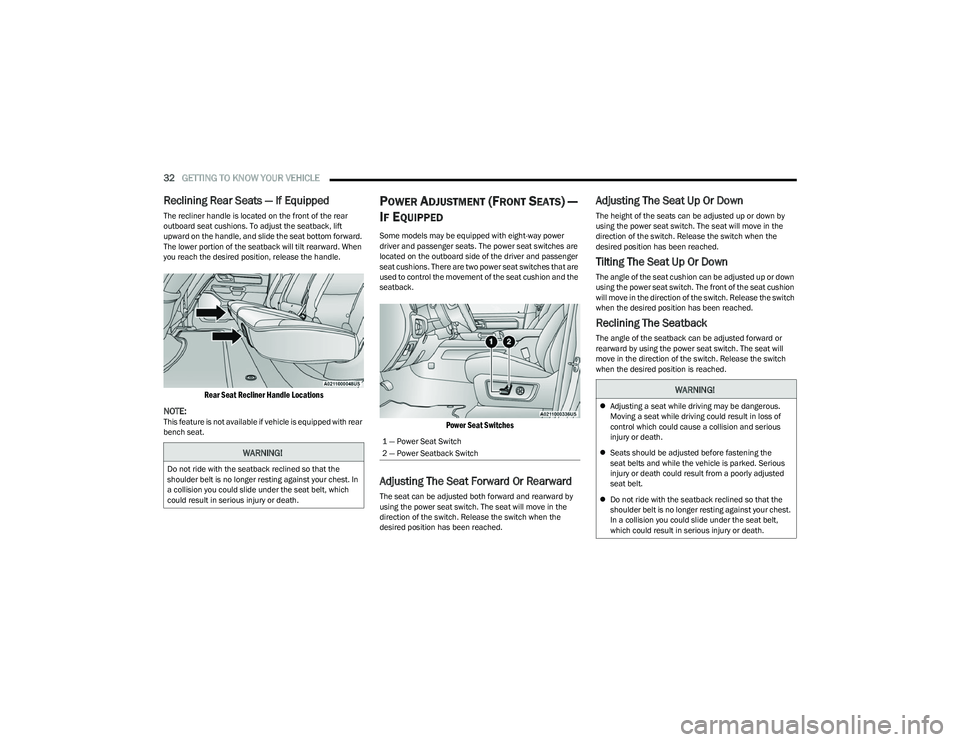
The recliner handle is located on the front of the rear
outboard seat cushions. To adjust the seatback, lift
upward on the handle, and slide the seat bottom forward.
The lower portion of the seatback will tilt rearward. When
you reach the desired position, release the handle.
Rear Seat Recliner Handle Locations
NOTE:
This feature is not available if vehicle is equipped with rear
bench seat.
POWER ADJUSTMENT (FRONT SEATS) —
I
F EQUIPPED
Some models may be equipped with eight-way power
driver and passenger seats. The power seat switches are
located on the outboard side of the driver and passenger
seat cushions. There are two power seat switches that are
used to control the movement of the seat cushion and the
seatback.
Power Seat Switches
Adjusting The Seat Forward Or Rearward
The seat can be adjusted both forward and rearward by
using the power seat switch. The seat will move in the
direction of the switch. Release the switch when the
desired position has been reached.
Adjusting The Seat Up Or Down
The height of the seats can be adjusted up or down by
using the power seat switch. The seat will move in the
direction of the switch. Release the switch when the
desired position has been reached.
Tilting The Seat Up Or Down
The angle of the seat cushion can be adjusted up or down
using the power seat switch. The front of the seat cushion
will move in the direction of the switch. Release the switch
when the desired position has been reached.
Reclining The Seatback
The angle of the seatback can be adjusted forward or
rearward by using the power seat switch. The seat will
move in the direction of the switch. Release the switch
when the desired position is reached.
WARNING!
Do not ride with the seatback reclined so that the
shoulder belt is no longer resting against your chest. In
a collision you could slide under the seat belt, which
could result in serious injury or death.
1 — Power Seat Switch
2 — Power Seatback Switch
WARNING!
Adjusting a seat while driving may be dangerous.
Moving a seat while driving could result in loss of
control which could cause a collision and serious
injury or death.
Seats should be adjusted before fastening the
seat belts and while the vehicle is parked. Serious
injury or death could result from a poorly adjusted
seat belt.
Do not ride with the seatback reclined so that the
shoulder belt is no longer resting against your chest.
In a collision you could slide under the seat belt,
which could result in serious injury or death.
23_DT_OM_EN_USC_t.book Page 32
Page 35 of 416
GETTING TO KNOW YOUR VEHICLE33
Power Lumbar — If Equipped
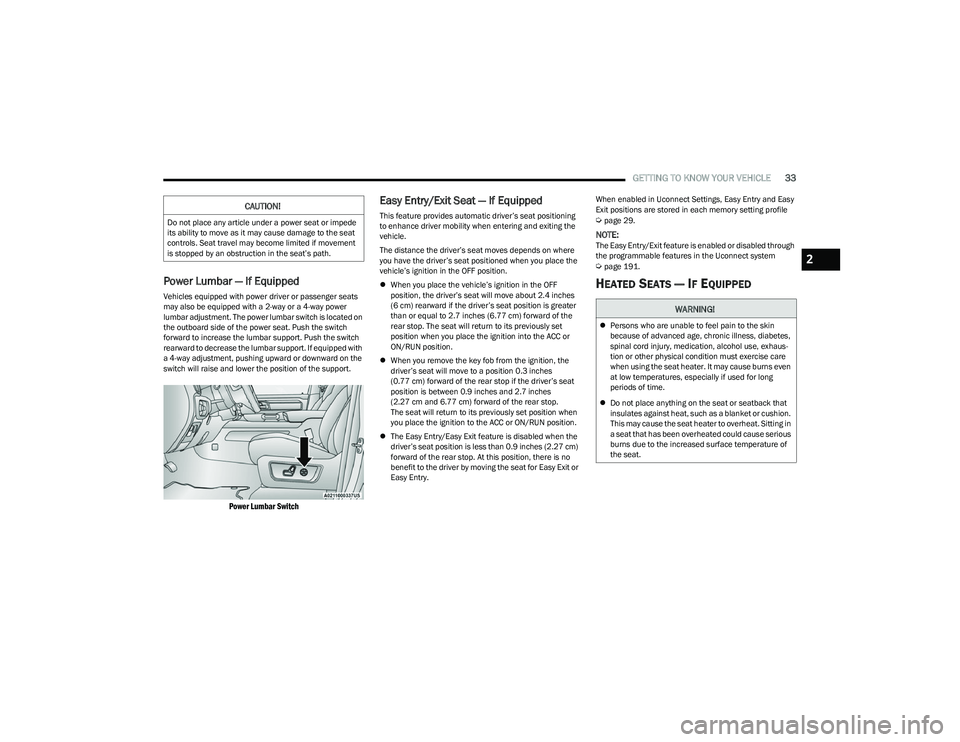
Vehicles equipped with power driver or passenger seats
may also be equipped with a 2-way or a 4-way power
lumbar adjustment. The power lumbar switch is located on
the outboard side of the power seat. Push the switch
forward to increase the lumbar support. Push the switch
rearward to decrease the lumbar support. If equipped with
a 4-way adjustment, pushing upward or downward on the
switch will raise and lower the position of the support.
Power Lumbar Switch
Easy Entry/Exit Seat — If Equipped
This feature provides automatic driver’s seat positioning
to enhance driver mobility when entering and exiting the
vehicle.
The distance the driver’s seat moves depends on where
you have the driver’s seat positioned when you place the
vehicle’s ignition in the OFF position.
When you place the vehicle’s ignition in the OFF
position, the driver’s seat will move about 2.4 inches
(6 cm) rearward if the driver’s seat position is greater
than or equal to 2.7 inches (6.77 cm) forward of the
rear stop. The seat will return to its previously set
position when you place the ignition into the ACC or
ON/RUN position.
When you remove the key fob from the ignition, the
driver’s seat will move to a position 0.3 inches
(0.77 cm) forward of the rear stop if the driver’s seat
position is between 0.9 inches and 2.7 inches
(2.27 cm and 6.77 cm) forward of the rear stop.
The seat will return to its previously set position when
you place the ignition to the ACC or ON/RUN position.
The Easy Entry/Easy Exit feature is disabled when the
driver’s seat position is less than 0.9 inches (2.27 cm)
forward of the rear stop. At this position, there is no
benefit to the driver by moving the seat for Easy Exit or
Easy Entry. When enabled in Uconnect Settings, Easy Entry and Easy
Exit positions are stored in each memory setting profile Úpage 29.
NOTE:The Easy Entry/Exit feature is enabled or disabled through
the programmable features in the Uconnect system
Úpage 191.
HEATED SEATS — IF EQUIPPED
CAUTION!
Do not place any article under a power seat or impede
its ability to move as it may cause damage to the seat
controls. Seat travel may become limited if movement
is stopped by an obstruction in the seat’s path.
WARNING!
Persons who are unable to feel pain to the skin
because of advanced age, chronic illness, diabetes,
spinal cord injury, medication, alcohol use, exhaus -
tion or other physical condition must exercise care
when using the seat heater. It may cause burns even
at low temperatures, especially if used for long
periods of time.
Do not place anything on the seat or seatback that
insulates against heat, such as a blanket or cushion.
This may cause the seat heater to overheat. Sitting in
a seat that has been overheated could cause serious
burns due to the increased surface temperature of
the seat.
2
23_DT_OM_EN_USC_t.book Page 33
Page 37 of 416
GETTING TO KNOW YOUR VEHICLE35
NOTE:Do not reverse the head restraints (making the rear of the
head restraint face forward) in an attempt to gain addi -
tional clearance to the back of your head.
Front Head Restraints
Your vehicle is equipped with front four-way driver and
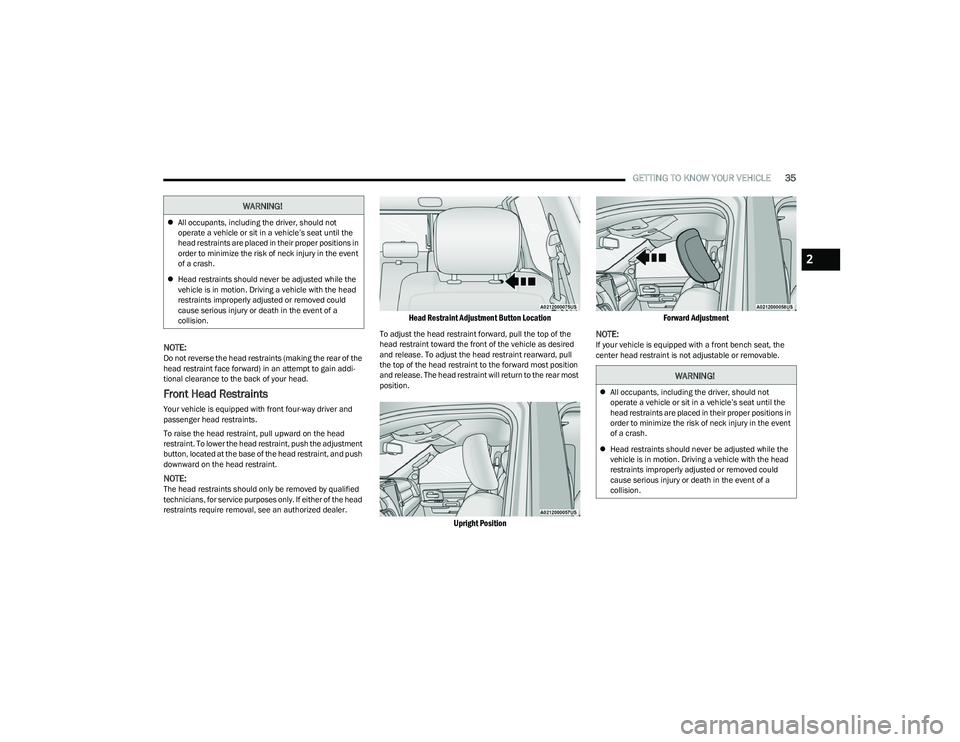
passenger head restraints.
To raise the head restraint, pull upward on the head
restraint. To lower the head restraint, push the adjustment
button, located at the base of the head restraint, and push
downward on the head restraint.
NOTE:The head restraints should only be removed by qualified
technicians, for service purposes only. If either of the head
restraints require removal, see an authorized dealer.
Head Restraint Adjustment Button Location
To adjust the head restraint forward, pull the top of the
head restraint toward the front of the vehicle as desired
and release. To adjust the head restraint rearward, pull
the top of the head restraint to the forward most position
and release. The head restraint will return to the rear most
position.
Upright Position Forward Adjustment
NOTE:
If your vehicle is equipped with a front bench seat, the
center head restraint is not adjustable or removable.
WARNING!
All occupants, including the driver, should not
operate a vehicle or sit in a vehicle’s seat until the
head restraints are placed in their proper positions in
order to minimize the risk of neck injury in the event
of a crash.
Head restraints should never be adjusted while the
vehicle is in motion. Driving a vehicle with the head
restraints improperly adjusted or removed could
cause serious injury or death in the event of a
collision.
WARNING!
All occupants, including the driver, should not
operate a vehicle or sit in a vehicle’s seat until the
head restraints are placed in their proper positions in
order to minimize the risk of neck injury in the event
of a crash.
Head restraints should never be adjusted while the
vehicle is in motion. Driving a vehicle with the head
restraints improperly adjusted or removed could
cause serious injury or death in the event of a
collision.
2
23_DT_OM_EN_USC_t.book Page 35
Page 40 of 416
38GETTING TO KNOW YOUR VEHICLE
DRIVER ADJUSTABLE PEDALS —
IF EQUIPPED
The adjustable pedals system is designed to allow a
greater range of driver comfort for steering wheel tilt and
seat position. This feature allows the brake and
accelerator pedals to move toward or away from the driver
to provide improved position with the steering wheel.
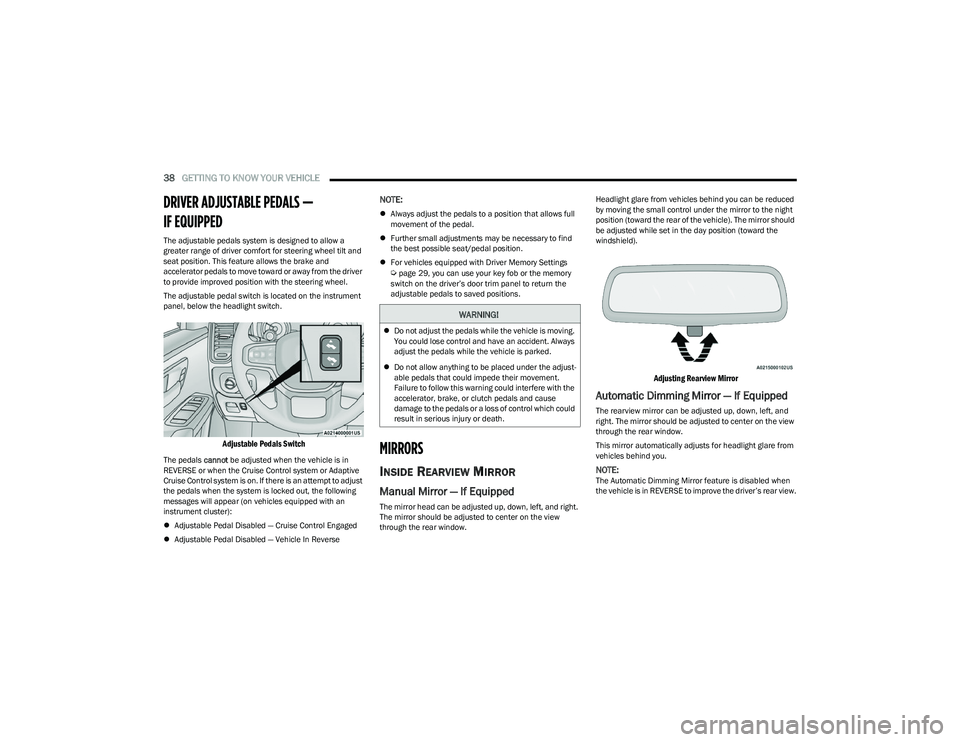
The adjustable pedal switch is located on the instrument
panel, below the headlight switch.
Adjustable Pedals Switch
The pedals cannot be adjusted when the vehicle is in
REVERSE or when the Cruise Control system or Adaptive
Cruise Control system is on. If there is an attempt to adjust
the pedals when the system is locked out, the following
messages will appear (on vehicles equipped with an
instrument cluster):
Adjustable Pedal Disabled — Cruise Control Engaged
Adjustable Pedal Disabled — Vehicle In Reverse
NOTE:
Always adjust the pedals to a position that allows full
movement of the pedal.
Further small adjustments may be necessary to find
the best possible seat/pedal position.
For vehicles equipped with Driver Memory Settings
Úpage 29, you can use your key fob or the memory
switch on the driver’s door trim panel to return the
adjustable pedals to saved positions.
MIRRORS
INSIDE REARVIEW MIRROR
Manual Mirror — If Equipped
The mirror head can be adjusted up, down, left, and right.
The mirror should be adjusted to center on the view
through the rear window. Headlight glare from vehicles behind you can be reduced
by moving the small control under the mirror to the night
position (toward the rear of the vehicle). The mirror should
be adjusted while set in the day position (toward the
windshield).
Adjusting Rearview Mirror
Automatic Dimming Mirror — If Equipped
The rearview mirror can be adjusted up, down, left, and
right. The mirror should be adjusted to center on the view
through the rear window.
This mirror automatically adjusts for headlight glare from
vehicles behind you.
NOTE:The Automatic Dimming Mirror feature is disabled when
the vehicle is in REVERSE to improve the driver’s rear view.
WARNING!
Do not adjust the pedals while the vehicle is moving.
You could lose control and have an accident. Always
adjust the pedals while the vehicle is parked.
Do not allow anything to be placed under the adjust -
able pedals that could impede their movement.
Failure to follow this warning could interfere with the
accelerator, brake, or clutch pedals and cause
damage to the pedals or a loss of control which could
result in serious injury or death.
23_DT_OM_EN_USC_t.book Page 38
Page 288 of 416
286SAFETY
Adjustable Upper Shoulder Belt Anchorage
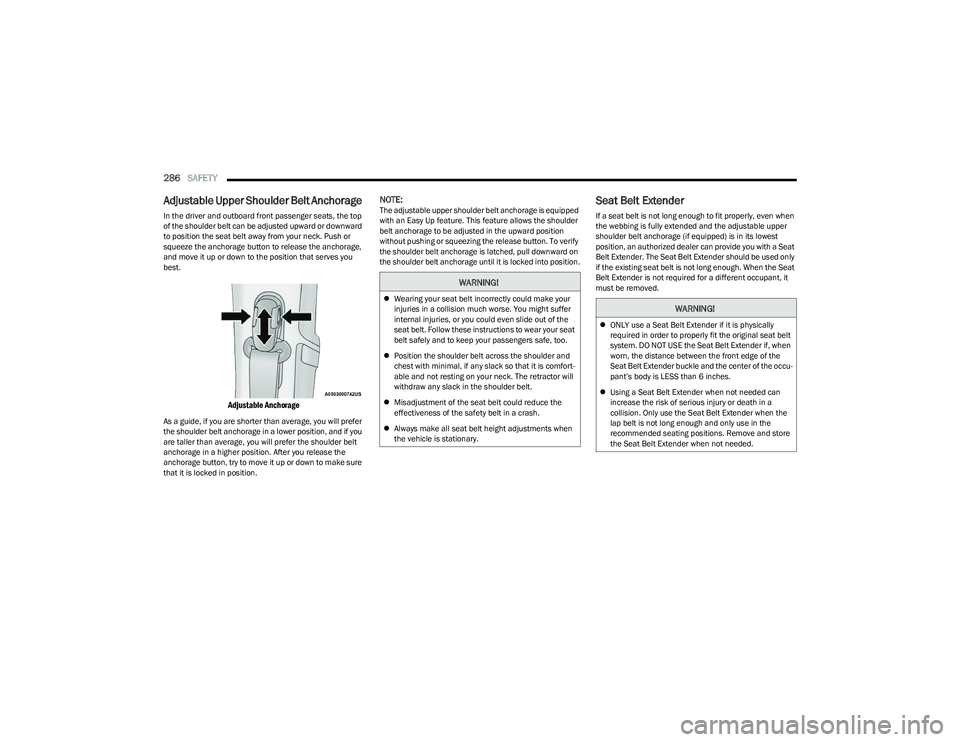
In the driver and outboard front passenger seats, the top
of the shoulder belt can be adjusted upward or downward
to position the seat belt away from your neck. Push or
squeeze the anchorage button to release the anchorage,
and move it up or down to the position that serves you
best.
Adjustable Anchorage
As a guide, if you are shorter than average, you will prefer
the shoulder belt anchorage in a lower position, and if you
are taller than average, you will prefer the shoulder belt
anchorage in a higher position. After you release the
anchorage button, try to move it up or down to make sure
that it is locked in position.
NOTE:The adjustable upper shoulder belt anchorage is equipped
with an Easy Up feature. This feature allows the shoulder
belt anchorage to be adjusted in the upward position
without pushing or squeezing the release button. To verify
the shoulder belt anchorage is latched, pull downward on
the shoulder belt anchorage until it is locked into position.Seat Belt Extender
If a seat belt is not long enough to fit properly, even when
the webbing is fully extended and the adjustable upper
shoulder belt anchorage (if equipped) is in its lowest
position, an authorized dealer can provide you with a Seat
Belt Extender. The Seat Belt Extender should be used only
if the existing seat belt is not long enough. When the Seat
Belt Extender is not required for a different occupant, it
must be removed.
WARNING!
Wearing your seat belt incorrectly could make your
injuries in a collision much worse. You might suffer
internal injuries, or you could even slide out of the
seat belt. Follow these instructions to wear your seat
belt safely and to keep your passengers safe, too.
Position the shoulder belt across the shoulder and
chest with minimal, if any slack so that it is comfort -
able and not resting on your neck. The retractor will
withdraw any slack in the shoulder belt.
Misadjustment of the seat belt could reduce the
effectiveness of the safety belt in a crash.
Always make all seat belt height adjustments when
the vehicle is stationary.WARNING!
ONLY use a Seat Belt Extender if it is physically
required in order to properly fit the original seat belt
system. DO NOT USE the Seat Belt Extender if, when
worn, the distance between the front edge of the
Seat Belt Extender buckle and the center of the occu -
pant’s body is LESS than 6 inches.
Using a Seat Belt Extender when not needed can
increase the risk of serious injury or death in a
collision. Only use the Seat Belt Extender when the
lap belt is not long enough and only use in the
recommended seating positions. Remove and store
the Seat Belt Extender when not needed.
23_DT_OM_EN_USC_t.book Page 286
Page 411 of 416
409
Rear Cross Path ........................................................... 271
Rear ParkSense System .............................................. 152
Rear Seat Reminder Alert............................................ 263
Rear Window, Sliding ...................................................... 71
Reclining Rear Seats ...................................................... 32
Recreational Towing .................................................... 186Four-Wheel Drive Models ....................................... 187
Shifting Into Transfer Case Neutral (N) ................. 187
Shifting Out Of Transfer Case Neutral (N) ............. 188Two-Wheel Drive Models ........................................ 186
Reformulated Gasoline................................................ 393
Refrigerant.................................................................... 344
Registering SiriusXM Guardian ................................... 238
Release, Hood .................................................................74 Release, Tailgate............................................................. 74
Reminder, Seat Belt..................................................... 283
Remote Features, Door Lock/Unlock ................ 242
, 249
Remote Features, Horn And Lights............................. 243
Remote Features, Starting ................................. 243
, 250
Remote Keyless Entry Panic Alarm ................................................................17
Programming Additional Key Fobs ...........................19
Remote Sound System (Radio) Control ...................... 218
Remote Start (Gasoline) .................................................21
Remote Starting Comfort Systems ....................................................... 22
Exit Remote Start Mode ............................................22
Remote Starting System.................................................21
Remove, Tailgate ............................................................76
Replacement Bulbs...................................................... 365
Replacement Tires ....................................................... 380
Reporting Safety Defects............................................. 401 Restraints, Child ...........................................................298
Restraints, Head ............................................................. 34
Roadside Assistance .......................................... 244
, 249
Rotation, Tires ............................................................... 386
SSafety.............................................................................217
Safety Checks Inside Vehicle ....................................... 311
Safety Checks Outside Vehicle ....................................312
Safety Defects, Reporting ............................................401
Safety Features............................................................. 217
Safety Information, Tire ................................................ 370
Safety Tips.....................................................................311
Safety, Exhaust Gas...................................................... 313
Satellite Radio............................................................... 220
Saved Radio Stations ...................................................224
Schedule, Maintenance ............................................... 333
Seat Belt Reminder ...................................................... 110
Seat Belts ............................................................ 282
, 311
Adjustable Shoulder Belt ........................................ 286
Adjustable Upper Shoulder Anchorage ..................286 Adjustable Upper Shoulder Belt Anchorage ..........286Automatic Locking Retractor (ALR) ........................ 287Child Restraints ....................................................... 298
Energy Management Feature ................................. 287
Extender ...................................................................286Front Seat ............................................. 282
, 283, 285
Inspection ................................................................ 311
Lap/Shoulder Belt Operation ................................. 285
Lap/Shoulder Belt Untwisting ................................ 285 Lap/Shoulder Belts ................................................. 283 Operating Instructions ............................................ 285
Pregnant Women .................................................... 287
Pretensioners .......................................................... 287
Rear Seat ................................................................. 283
Reminder ................................................................. 283
Seat Belt Extender .................................................. 286
Seat Belt Pretensioner............................................ 287
Seat Belt Reminder ................................................. 283
Untwisting Procedure.............................................. 285
Seat Belts Maintenance .............................................. 390
Seats ................................................................. 30
, 31, 32
Adjustment ......................................................... 30, 32
Easy Entry .................................................................. 33
Head Restraints ........................................................ 34
Memory ...................................................................... 29
Power ......................................................................... 32
Rear Folding .............................................................. 30
Reclining Rear ........................................................... 32
Tilting ......................................................................... 30
Second Row USB ............................................................ 65
Security System ..................................................... 23
, 110
Selec - Speed Control ................................................... 267
Selection Of Coolant (Antifreeze) ................................ 396
Send & Go ............................................................ 244
, 249
Sentry Key (Immobilizer) ................................................ 19 Service Assistance ....................................................... 398
Service Contract ........................................................... 400
Service Manuals ........................................................... 401
Settings, Audio.............................................................. 224
11
23_DT_OM_EN_USC_t.book Page 409