spare wheel Ram 2500 2011 User Guide
[x] Cancel search | Manufacturer: RAM, Model Year: 2011, Model line: 2500, Model: Ram 2500 2011Pages: 622
Page 489 of 622

Removing The Spare Tire
Remove the spare tire before attempting to jack up the
truck. Attach the wheel wrench to the jack extension tube.
Insert the tube through the access hole between the lower
tailgate and the top of the bumper and into the winchmechanism tube. Rotate the wheel wrench handle coun-
terclockwise until the spare tire is on the ground with
enough cable slack to allow you to pull it out from under
the vehicle. When the spare is clear, tilt the retainer at the
end of the cable and pull it through the center of the
wheel.
NOTE:Always stow the spare tire with the valve stem
facing the ground.
Jack and Tools (2500/3500 Series)
488 WHAT TO DO IN EMERGENCIES
Page 490 of 622
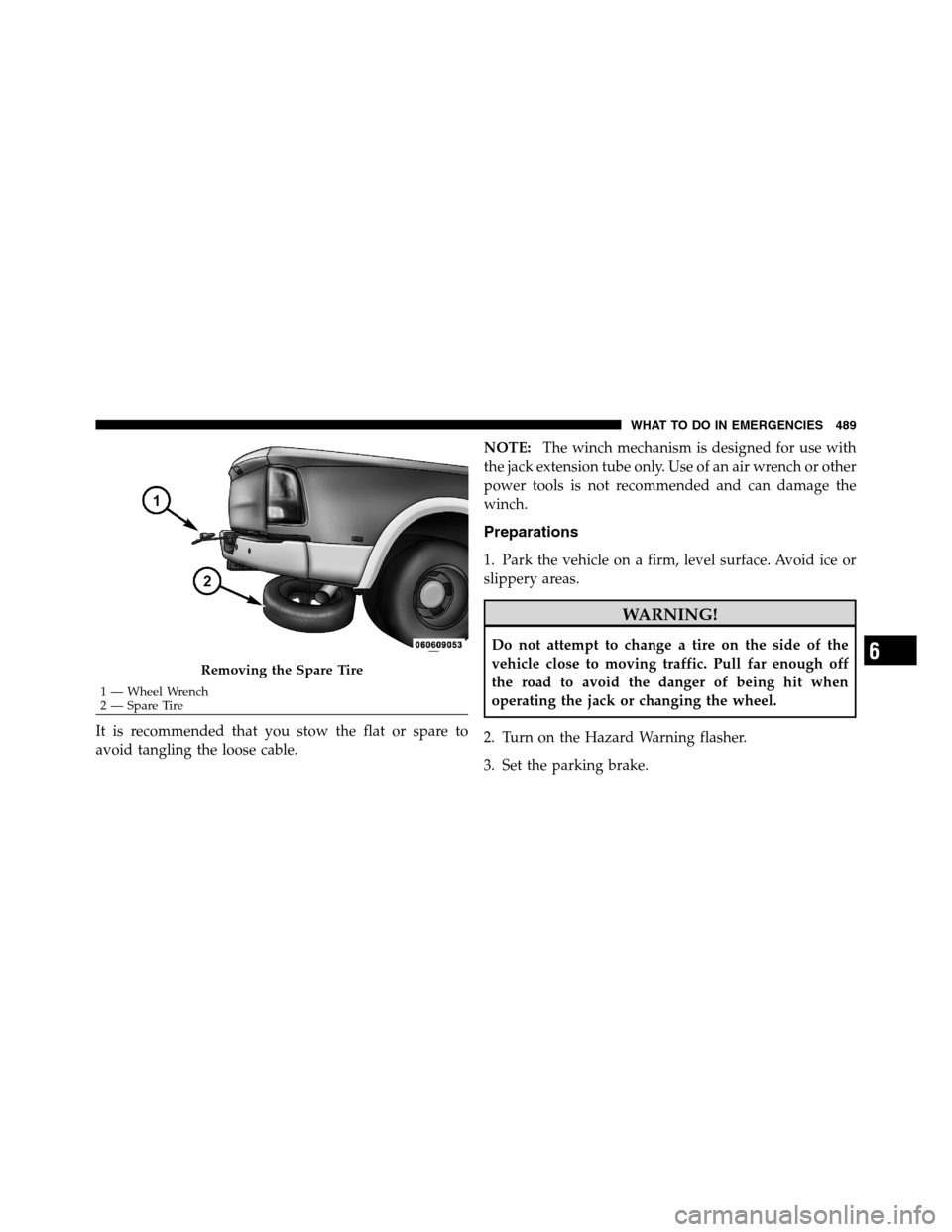
It is recommended that you stow the flat or spare to
avoid tangling the loose cable.NOTE:The winch mechanism is designed for use with
the jack extension tube only. Use of an air wrench or other
power tools is not recommended and can damage the
winch.
Preparations
1. Park the vehicle on a firm, level surface. Avoid ice or
slippery areas.
WARNING!
Do not attempt to change a tire on the side of the
vehicle close to moving traffic. Pull far enough off
the road to avoid the danger of being hit when
operating the jack or changing the wheel.
2. Turn on the Hazard Warning flasher.
3. Set the parking brake.
Removing the Spare Tire
1 — Wheel Wrench
2 — Spare Tire
6
WHAT TO DO IN EMERGENCIES 489
Page 492 of 622

WARNING! (Continued)
•Do not let anyone sit in the vehicle when it is on a
jack.
•Do not get under the vehicle when it is on a jack.
•Only use the jack in the positions indicated and
for lifting this vehicle during a tire change.
•If working on or near a roadway, be extremely
careful of motor traffic.
•To assure that spare tires, flat or inflated, are
securely stowed, spares must be stowed with the
valve stem facing the ground.1. Remove the spare wheel, jack, and tools from storage.
2. Using the wheel wrench, loosen, but do not remove,
the wheel nuts by turning them counterclockwise one
turn while the wheel is still on the ground.
3. Placement of the jack:
•1500 Series Trucks
When changing a front wheel, place the scissors jack
under the rear portion of the lower control arm as shown
below.
Jack Warning Label
6
WHAT TO DO IN EMERGENCIES 491
Page 497 of 622
5. Remove the wheel nuts and pull the wheel off. On
single rear-wheel (SRW) trucks, install the spare wheel
and wheel nuts with the cone shaped end of the wheel
nuts toward the wheel. On 3500 dual rear-wheel models
(DRW) the wheel nuts are a two-piece assembly with a
flat face. Lightly tighten the wheel nuts. To avoid the risk
of forcing the vehicle off the jack, do not fully tighten the
wheel nuts until the vehicle has been lowered.
6. Using the wheel wrench, finish tightening the wheel
nuts using a crisscross pattern. The correct wheel nut
tightness is 130 ft lbs (177 N·m) torque (1500 Series), 135 ft
lbs (183 N·m) torque for 2500/3500 single-rear wheel
(SRW) models, and 145 ft lbs (197 N·m) for 3500 dual
rear-wheel models. If in doubt about the correct tight-
ness, have them checked with a torque wrench by your
authorized dealer or at a service station.WARNING!
A loose tire or jack thrown forward in a collision or
hard stop could injure someone in the vehicle. Al-
ways stow the jack parts and the extra tire and wheel
in the places provided.
7. Install the wheel center cap and remove the wheel
blocks. Do not install chrome or aluminum wheel center
caps on the spare wheel. This may result in cap damage.
8. Lower the jack to its fully closed position. If the bottle
jack will not lower by turning the dial (thumbwheel) by
hand, it may be necessary to use the jack drive tube in
order to lower the jack. Stow the replaced tire, jack, and
tools as previously described.
9. Adjust the tire pressure when possible.
NOTE:Do not oil wheel studs. For chrome wheels, do
not substitute with chrome plated wheel nuts.
496 WHAT TO DO IN EMERGENCIES
Page 500 of 622

Slots in the wheels will assist in properly orienting the
inner and outer wheels. Align these slots when assem-
bling the wheels for best access to the tire valve on the
inner wheel. The tires of both dual wheels must be
completely off the ground when tightening, to ensure
wheel centering and maximum wheel clamping.Dual wheel models require a special heavy-duty lug nut
tightening adapter (included with the vehicle) to cor-
rectly tighten the lug nuts. Also, when it is necessary to
remove and install dual rear wheels, use a proper vehicle
lifting device.
NOTE:When installing a spare tire as part of a dual rear
wheel end combination, the tire diameter of the two
individual tires must be compared. If there is a significant
difference, the larger tire should be installed in a front
location. The correct direction of rotation for dual tire
installations must also be observed.
Oiling Location6
WHAT TO DO IN EMERGENCIES 499
Page 501 of 622

These dual rear wheels should be tightened as follows:
1. Tighten the wheel nuts in the numbered sequence to a
snug fit.
2. Retighten the wheel nuts in the same sequence to the
torques listed in the table. Go through the sequence asecond time to verify that specific torque has been
achieved. Retighten to specifications at 100 miles
(160 km) and after 500 miles (800 km).
It is recommended that wheel stud nuts be kept torqued
to specifications at all times. Torque wheel stud nuts to
specifications at each lubrication interval.
To Stow The Flat Or Spare
NOTE:Vehicles equipped with aluminum wheels can-
not be stored under the vehicle because the wheel
retainer will not fit through the wheel pilot hole. Secure
the flat tire in the bed of the truck.Have the flat tire
repaired or replaced immediately.
Tightening Pattern
500 WHAT TO DO IN EMERGENCIES
Page 502 of 622

WARNING!
A loose tire thrown forward in a collision or hard
stop could injure the occupants in the vehicle. Have
the deflated (flat) tire repaired or replaced immedi-
ately.
Turn the wheel so that the valve stem is down. Slide the
wheel retainer through the center of the wheel and
position it properly across the wheel opening.
For convenience in checking the spare tire inflation, stow
with the valve stem toward the rear of the vehicle.
Attach the wheel wrench to the extension tube. Rotate the
winch mechanism until the wheel is drawn into place
against the underside of the vehicle. Continue to rotate
until you feel the winch mechanism slip, or click three or
four times. It cannot be overtightened. Push against the
tire several times to be sure it is firmly in place.
HOISTING
A conventional floor jack may be used at the jacking
locations. Refer to the graphics that show jacking loca-
tions. However, a floor jack or frame hoist must never be
used on any other parts or the underbody.
CAUTION!
Never use a floor jack directly under the differential
housing of a loaded truck or damage to your vehicle
may result.
JUMP-STARTING PROCEDURES
If your vehicle has a discharged battery it can be jump-
started using a set of jumper cables and a battery in
another vehicle or by using a portable battery booster
pack. Jump-starting can be dangerous if done improperly
so please follow the procedures in this section carefully.
6
WHAT TO DO IN EMERGENCIES 501
Page 557 of 622
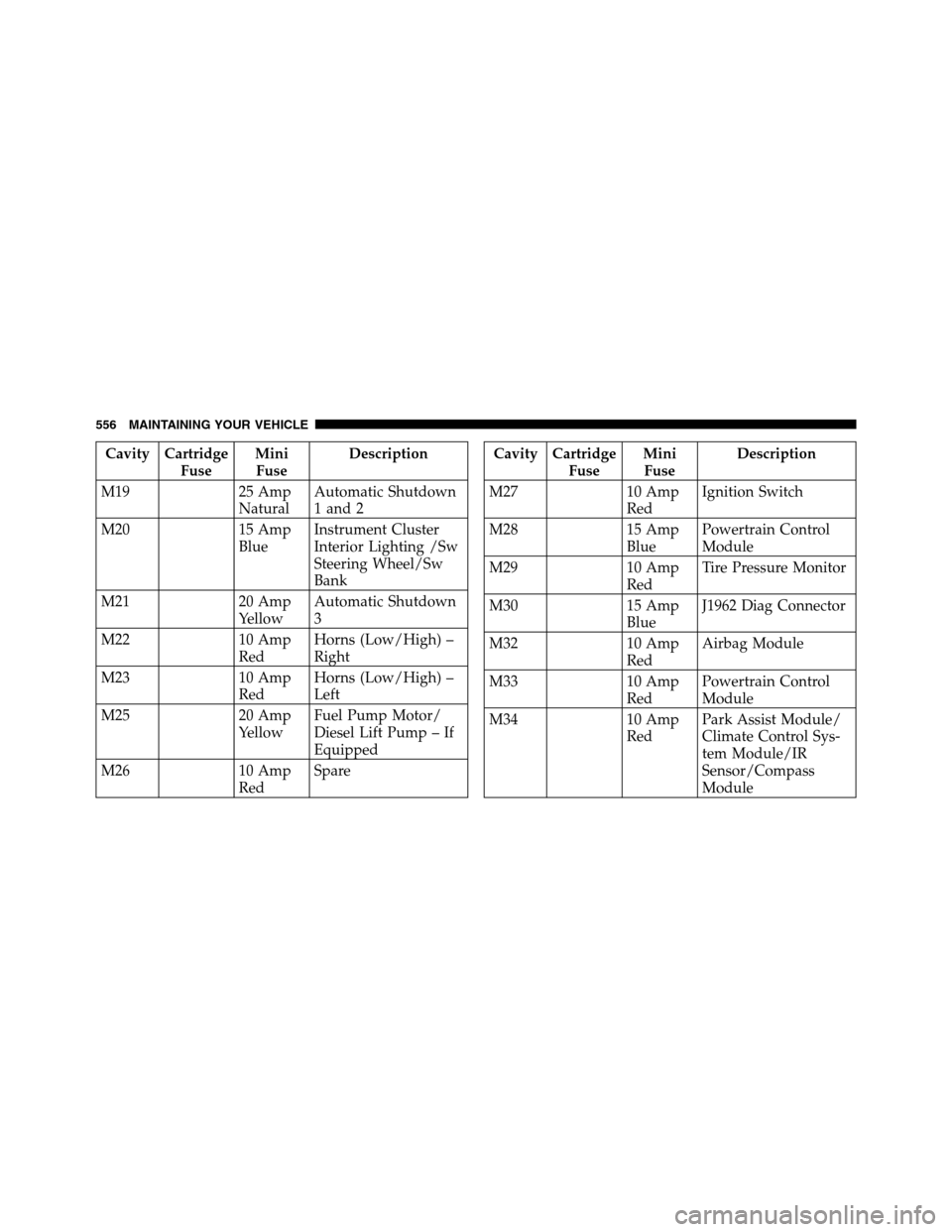
Cavity Cartridge
FuseMini
FuseDescription
M19 25 Amp
NaturalAutomatic Shutdown
1 and 2
M20 15 Amp
BlueInstrument Cluster
Interior Lighting /Sw
Steering Wheel/Sw
Bank
M21 20 Amp
YellowAutomatic Shutdown
3
M22 10 Amp
RedHorns (Low/High) –
Right
M23 10 Amp
RedHorns (Low/High) –
Left
M25 20 Amp
YellowFuel Pump Motor/
Diesel Lift Pump – If
Equipped
M26 10 Amp
RedSpareCavity Cartridge
FuseMini
FuseDescription
M27 10 Amp
RedIgnition Switch
M28 15 Amp
BluePowertrain Control
Module
M29 10 Amp
RedTire Pressure Monitor
M30 15 Amp
BlueJ1962 Diag Connector
M32 10 Amp
RedAirbag Module
M33 10 Amp
RedPowertrain Control
Module
M34 10 Amp
RedPark Assist Module/
Climate Control Sys-
tem Module/IR
Sensor/Compass
Module
556 MAINTAINING YOUR VEHICLE