brake light Ram 2500 2011 Owner's Guide
[x] Cancel search | Manufacturer: RAM, Model Year: 2011, Model line: 2500, Model: Ram 2500 2011Pages: 622
Page 388 of 622
CAUTION!
Do not use chemical flushes in your power steering
system as the chemicals can damage your power
steering components. Such damage is not covered by
the New Vehicle Limited Warranty.
WARNING!
Fluid level should be checked on a level surface and
with the engine off to prevent injury from moving
parts and to ensure accurate fluid level reading. Do
not overfill. Use only manufacturer’s recommended
power steering fluid.
If necessary, add fluid to restore to the proper indicated
level. With a clean cloth, wipe any spilled fluid from allsurfaces. Refer to “Fluids, Lubricants, and Genuine
Parts” in “Maintaining Your Vehicle” for further
information.
MULTI-DISPLACEMENT SYSTEM (MDS) (IF
EQUIPPED) — 5.7L ENGINE ONLY
This feature offers improved fuel economy by shutting
off four of the engine’s eight cylinders during light load
and cruise conditions. The system is automatic with no
driver inputs or additional driving skills required.
NOTE:The MDS system may take some time to return
to full functionality after a battery disconnect.
PARKING BRAKE
Before leaving the vehicle, make sure that the parking
brake is fully applied. Also, be certain to leave the
transmission in PARK.
5
STARTING AND OPERATING 387
Page 389 of 622
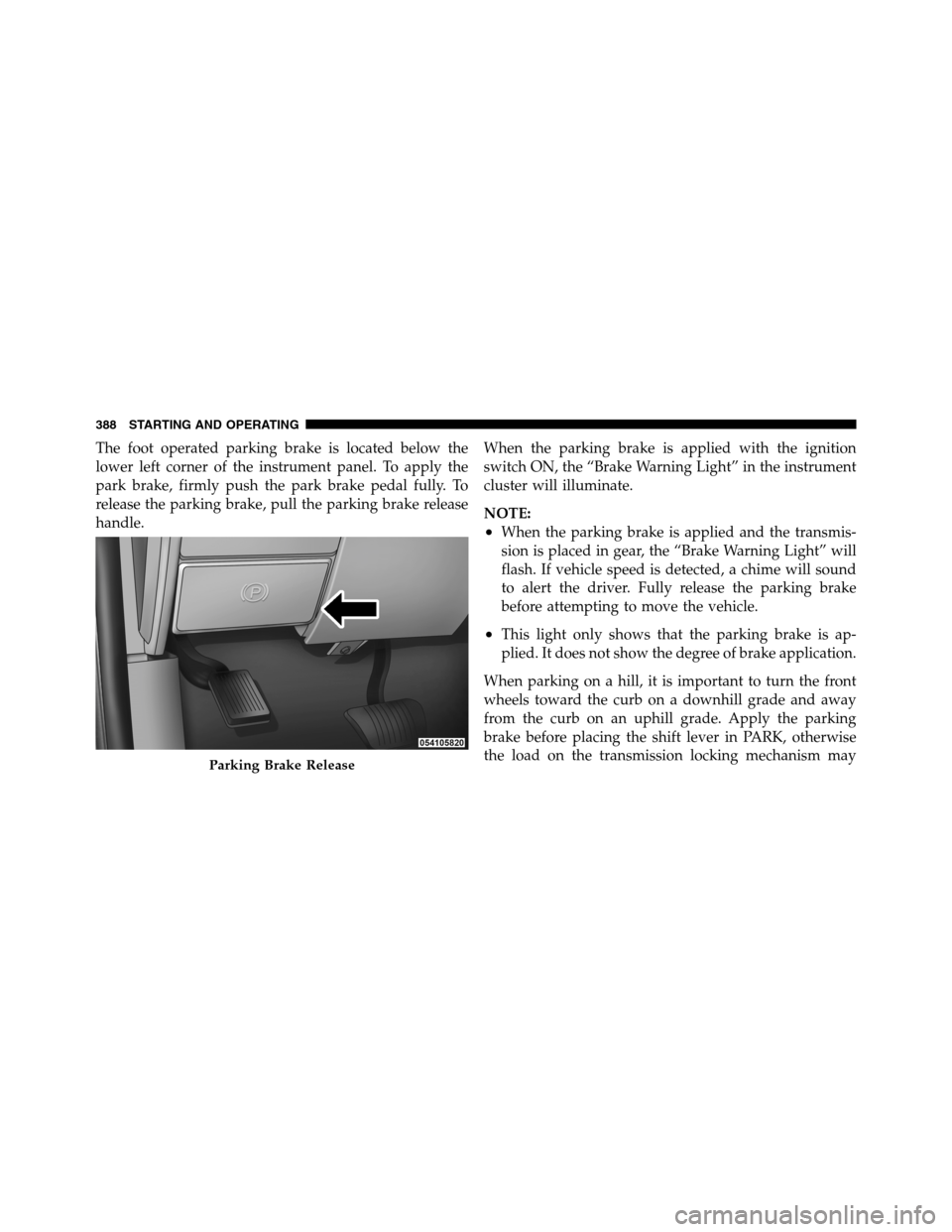
The foot operated parking brake is located below the
lower left corner of the instrument panel. To apply the
park brake, firmly push the park brake pedal fully. To
release the parking brake, pull the parking brake release
handle.When the parking brake is applied with the ignition
switch ON, the “Brake Warning Light” in the instrument
cluster will illuminate.
NOTE:
•When the parking brake is applied and the transmis-
sion is placed in gear, the “Brake Warning Light” will
flash. If vehicle speed is detected, a chime will sound
to alert the driver. Fully release the parking brake
before attempting to move the vehicle.
•This light only shows that the parking brake is ap-
plied. It does not show the degree of brake application.
When parking on a hill, it is important to turn the front
wheels toward the curb on a downhill grade and away
from the curb on an uphill grade. Apply the parking
brake before placing the shift lever in PARK, otherwise
the load on the transmission locking mechanism may
Parking Brake Release
388 STARTING AND OPERATING
Page 390 of 622

make it difficult to move the shift lever out of PARK. The
parking brake should always be applied whenever the
driver is not in the vehicle.
WARNING!
•Never use the PARK position as a substitute for
the parking brake. Always apply the parking
brake fully when parked to guard against vehicle
movement and possible injury or damage.
•Never leave children alone in a vehicle. Leaving
unattended children in a vehicle is dangerous for a
number of reasons. A child or others could be
seriously or fatally injured.
•Do not leave the key fob in the ignition switch. A
child could operate power windows, other con-
trols, or move the vehicle.
(Continued)
WARNING! (Continued)
•Be sure the parking brake is fully disengaged
before driving; failure to do so can lead to brake
failure and a collision.
•Always fully apply the parking brake when leav-
ing your vehicle or it may roll and cause damage or
injury. Also, be certain to leave the transmission in
PARK. Failure to do so may cause the vehicle to
roll and cause damage or injury.
CAUTION!
If the Brake System Warning Light remains on with
the parking brake released, a brake system malfunc-
tion is indicated. Have the brake system serviced by
an authorized dealer immediately.
5
STARTING AND OPERATING 389
Page 391 of 622

BRAKE SYSTEM
If power assist is lost for any reason (for example,
repeated brake applications with the engine off), the
brakes will still function. However, you will experience a
substantial increase in braking effort to stop the vehicle.
If either the front or rear hydraulic system loses normal
braking capability, the remaining system will still func-
tion with some loss of overall braking effectiveness. This
will be evident by increased pedal travel during applica-
tion, greater pedal force required to slow or stop, and
activation of the “Brake Warning Light” and the “ABS
Warning Light” (if equipped) during brake use.
3500 Dual Rear Wheel Models Only
The brake system power assist is provided by a hydro-
boost unit which shares fluid with the power steering
system. You may experience some clicking or hissing
noises from the hydro-boost system during hard braking
conditions.NOTE:Under cold temperatures, pedal effort will be
higher than normal until the power steering fluid reaches
operating temperature.
ELECTRONIC BRAKE CONTROL SYSTEM
Your vehicle is equipped with an advanced electronic
brake control system that includes Anti-Lock Brake Sys-
tem (ABS), Traction Control System (TCS), Brake Assist
System (BAS), Hill Start Assist (HSA), Electronic Stability
Control (ESC) and Trailer Sway Control (TSC). All of the
systems work together to enhance vehicle stability and
control in various driving conditions, and are commonly
referred to as ESC.
Anti-Lock Brake System (ABS)
The ABS aids the driver in maintaining vehicle control
under adverse braking conditions. The system controls
hydraulic brake pressure to prevent wheel lockup and
help avoid skidding on slippery surfaces during braking.
390 STARTING AND OPERATING
Page 394 of 622

Hill Start Assist (HSA) – If Equipped
The HSA system is designed to assist the driver in
launching a vehicle on an incline. HSA will maintain the
level of brake pressure the driver inputs for a short
duration once the driver takes his foot off of the brake
pedal. If the driver does not apply the throttle during this
short duration, the system will release brake pressure
and the vehicle will roll down the incline. The system will
release brake pressure in proportion to the amount of
throttle applied.
During operation, HSA will activate the brake control
system and a clicking noise may occur. If your foot is on
the brake pedal during operation you may feel a slight
pedal movement. The clicking and pedal movement is
normal and both will stop when HSA becomes inactive.
HSA Activation Criteria
The following criteria must be met in order for HSA to
activate:
•Vehicle must be stopped
•Vehicle must be on a 7% or greater incline
•Gear selection matches vehicle uphill direction (i.e.,
vehicle facing uphill is in forward gear; vehicle back-
ing uphill is in REVERSE gear).
WARNING!
There may be situations on minor hills (i.e., less than
7%), with a loaded vehicle or while pulling a trailer
where the system will not activate and slight rolling
may occur, which could cause a collision with an-
other vehicle or object. Always remember the driver
is responsible for braking the vehicle.
5
STARTING AND OPERATING 393
Page 395 of 622

The system will only work if the intended direction of the
vehicle and vehicle gear match. For example, if the
intended direction is forward up a hill and the vehicle is
in DRIVE and the activation criteria are met, HSA will
activate.
The system will work in REVERSE and all forward gears,
and will not activate if the vehicle is placed in
NEUTRAL.
Towing and Hauling with HSA
The HSA system does not know if your vehicle is loaded
or towing a trailer unless the TOW/HAUL switch, lo-
cated on the center stack, is selected. When activated, the
“TOW/HAUL Indicator Light” will illuminate in the
instrument cluster. Refer to “Automatic Transmission” in
“Starting and Operating” for further information. In
order to accommodate the extra weight entailed under
towing and hauling conditions and to increase driver
comfort while launching on a hill, the system recognizeswhen the TOW/HAUL switch is activated and compen-
sates by releasing brake pressure at a slower rate while
throttle is applied in order to prevent the vehicle from
rolling down the hill.
WARNING!
•If you use a trailer brake controller with your
trailer, your trailer brakes may be activated and
deactivated with the brake switch. If so, when the
brake pedal is released, there may not be enough
brake pressure to hold the vehicle and trailer on a
hill and this could cause a collision with another
vehicle or object behind you. In order to avoid
rolling down the incline while resuming accelera-
tion, manually activate the trailer brake or apply
more vehicle brake pressure prior to releasing the
brake pedal. Always remember the driver is re-
sponsible for braking the vehicle.
(Continued)
394 STARTING AND OPERATING
Page 396 of 622

WARNING! (Continued)
•HSA is not a parking brake. If you stop the vehicle
on a hill without putting the transmission in
PARK or using the parking brake, it will roll down
the incline and could cause a collision with an-
other vehicle or object. Always remember to use
the parking brake while parking on a hill and that
the driver is responsible for braking the vehicle.
HSA Off
Non-EVIC Equipped Vehicles
If you wish to turn off the HSA system, follow this
procedure:
1. Start with the engine OFF, and the vehicle in PARK
with the wheels straight.
2. Start the engine.3. With the engine running and the brake applied, rotate
the steering wheel 180° counterclockwise from center.
4. Press the “ESC Off” switch four times within 20 sec-
onds. The “ESC Off Indicator Light” should appear and
disappear four times.
5. Rotate the steering wheel 360° clockwise (180° clock-
wise from center).
6. Cycle ignition switch OFF then ON.
7. If the sequence was completed properly, the “ESC Off
Indicator Light” will blink several times to confirm HSA
is off.
Steps 1 through 7 must be completed within 90 seconds
to turn off HSA. Repeat steps 1 through 7 to re-enable
HSA functionality.
5
STARTING AND OPERATING 395
Page 401 of 622

Malfunction Indicator Light” begins to flash during ac-
celeration, ease up on the accelerator and apply as little
throttle as possible. Be sure to adapt your speed and
driving to the prevailing road conditions.
NOTE:
•The “ESC Activation/Malfunction Indicator Light”
and the “ESC OFF Indicator Light” come on momen-
tarily each time the ignition switch is turned ON.
•Each time the ignition is turned ON, the ESC system
will be ON even if it was turned off previously.
•The ESC system will make buzzing or clicking sounds
when it is active. This is normal; the sounds will stop
when ESC becomes inactive following the maneuver
that caused the ESC activation.
The “ESC OFF Indicator Light” indicates the
Electronic Stability Control (ESC) is off.
Trailer Sway Control (TSC) – If Equipped
The TSC system uses sensors in the vehicle to recognize
an excessively swaying trailer and will take the appro-
priate actions to attempt to stop the sway. The system
may reduce engine power and apply the brake of the
appropriate wheel(s) to counteract the sway of the trailer.
TSC will become active automatically once an excessively
swaying trailer is recognized. No driver action is re-
quired. Note that TSC cannot stop all trailers from
swaying. Always use caution when towing a trailer and
follow the trailer tongue weight recommendations. Refer
to “Trailer Towing” in “Starting and Operating” for
further information. When TSC is functioning, the “ESP
Off Indicator Light” will flash, the engine power may be
reduced and you may feel the brakes being applied to
individual wheels to attempt to stop the trailer from
swaying. TSC is disabled when the ESC system is in the
“Partial Off” or “Full Off” modes.
400 STARTING AND OPERATING
Page 460 of 622

NOTE:This module has been designed and verified for
electric trailer brakes. To determine the type of brakes on
your trailer, check with your trailer manufacturer or
dealer.The user interface consists of the following:
GAIN/ Brake Output Power Display
Shows the current GAIN setting.
This display may also be used to display diagnostic
information, if needed.
•SC — Short Circuit to Ground
•Sb — Short to Battery
•CF — Controller Fault – If this message appears on the
display, see your authorized dealer.
When the vehicle brakes are applied, the display will no
longer show GAIN and will change to the output to the
trailer brakes.
Manual Brake Control Lever
Slide the manual brake control lever to the right to
activate power to the trailer’s electric brakes independent
of the tow vehicle’s brakes. If the manual brake control
1 — GAIN/Brake Output Power Display
2 — Manual Brake Control Lever
3 — Trailer Brake Status Indicator Light
4 — GAIN Adjustment Buttons
5
STARTING AND OPERATING 459
Page 461 of 622

lever is activated while the brake is also applied, the
greater of the two inputs determines the power sent to
the trailer brakes.
The trailer and the vehicle’s brake lamps will come on
when either vehicle braking or manual trailer brakes are
applied.
Trailer Brake Status Indicator Light
This light indicates the trailer electrical connection status.
If no electrical connection is detected after the ignition is
turned on, pressing the GAIN adjustment button or
sliding the manual brake control lever will display the
GAIN setting for 10 seconds and the “Trailer Brake Status
Indicator Light” will not be displayed.
If a fault is detected in the trailer wiring or the Integrated
Trailer Brake Module (ITBM), the “Trailer Brake Status
Indicator Light” will flash.GAIN Adjustment Buttons (+/-)
Pressing these buttons will adjust the brake control
power output to the trailer brakes in 0.5 increments. The
GAIN setting can be increased to a maximum of 10 or
decreased to a minimum of 0 (no trailer braking).
GAIN
The GAIN setting is used to set the trailer brake control
for the specific towing condition and should be changed
as towing conditions change. Changes to towing condi-
tions include trailer load, vehicle load, road conditions
and weather.
Adjusting GAIN
NOTE:This should only be performed in a traffic free
environment at speeds of approximately 20–25 mph
(30–40 km/h).
460 STARTING AND OPERATING