fuel filter Ram 2500 2016 Diesel Supplement
[x] Cancel search | Manufacturer: RAM, Model Year: 2016, Model line: 2500, Model: Ram 2500 2016Pages: 406, PDF Size: 1.84 MB
Page 348 of 406
NOTE:Care should be taken in disposing of used fluids
from your vehicle. Used fluids, indiscriminately dis-
carded, can present a problem to the environment. Con-
tact an authorized dealer, service station, or government
agency for advice on recycling programs and for where
used fluids and filters can be properly disposed of in
your area.
Drain the fuel/water separator filters when the “Water In
Fuel Indicator Light” is ON. Within 10 minutes of vehicle
shutdown, turn the engine mounted filter drain valve
(located on the side of the filter assembly) counterclock-
wise 1/4 turn, and turn the under body mounted filter
drain valve (located on the bottom of the filter assembly)
counterclock wise 1 full turn. Then turn the ignition
switch to the ON position, and allow any accumulated
water to drain. Leave the drain valve open until all water
and contaminants have been removed. When clean fuel is
visible, close the drain valves by turning them fully
clockwise, and turn the ignition switch to OFF. If more than a couple ounces/milliliters of fuel have been
drained, follow the directions for “Priming If The Engine
Has Run Out Of Fuel.”
Engine Mounted Fuel Filter Replacement
NOTE:
•
Using a fuel filter that does not meet the manufactur-
er’s filtration and water separating requirements can
severely impact fuel system life and reliability.
• The engine mounted filter housing is equipped with a
No-Filter-No-Run (NFNR) feature. Engine will not run
if:
1. No filter is installed.
2. Inferior/Non-approved filter is used. Use of OEM filter is required to ensure vehicle will run.
346 MAINTAINING YOUR VEHICLE
Page 349 of 406
CAUTION!
•Diesel fuel will damage blacktop paving surfaces.
Drain the filter into an appropriate container.
• Do not prefill the fuel filter when installing a new
fuel filter. There is a possibility debris could be
introduced into the fuel filter during this action. It
is best to install the filter dry and allow the in-tank
lift pump to prime the fuel system.
1. Ensure engine is turned off.
2. Place drain pan under the fuel filter drain hose.
3. Open the water drain valve 1/4 turn counterclockwise and completely drain fuel and water into the ap-
proved container.
4. Close the water drain valve.
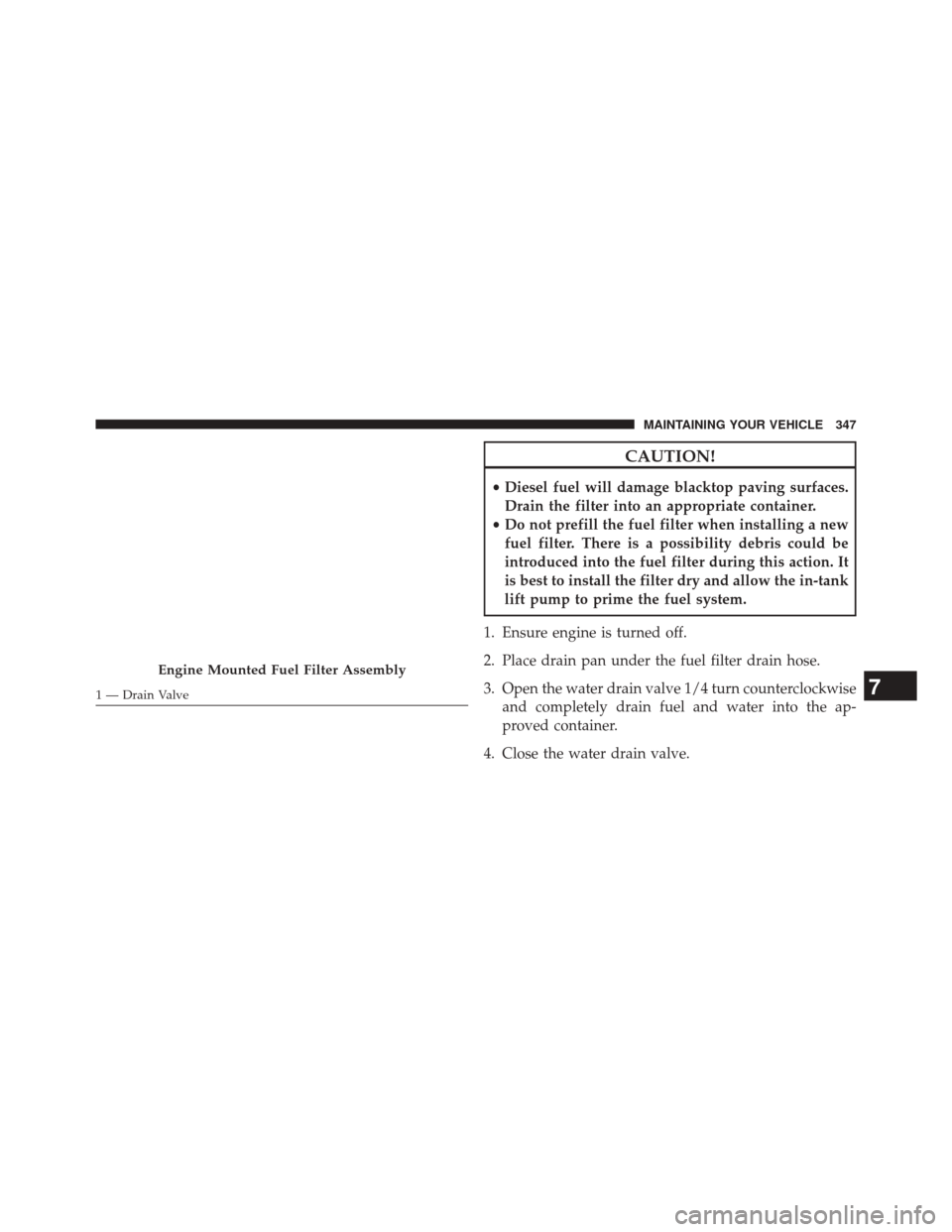
Engine Mounted Fuel Filter Assembly
1 — Drain Valve7
MAINTAINING YOUR VEHICLE 347
Page 350 of 406
5. Remove lid using a socket or strap wrench. Rotatecounterclockwise for removal. Remove used o-ring
and discard it.
6. Remove the used filter cartridge from the housing and dispose of according to your local regulations.
7. Wipe clean the sealing surfaces of the lid and housing.
8. Install new o-ring back into ring groove on the filter housing and lubricate with clean engine oil.
9. Remove new filter cartridge from plastic bag and install into housing.
NOTE: Do not remove cartridge from bag until you reach
this step in order to keep cartridge clean. 10. Push down on the cartridge to ensure it is properly
seated. Do not pre-fill the filter housing with fuel.
11. Install lid onto housing and tighten to 22.5 ft lbs (30.5 N.m). Do not overtighten the lid.
12. Prime the engine using the procedure in “Priming If The Engine Has Run Out Of Fuel.” Then start the
engine and confirm there are no leaks.
Underbody Mounted Fuel Filter Replacement
NOTE:
•Using a fuel filter that does not meet the manufactur-
er’s filtration and water separating requirements can
severely impact fuel system life and reliability.
348 MAINTAINING YOUR VEHICLE
Page 351 of 406
•The underbody mounted filter housing will cause the
engine not to run if:
1. No filter is installed.CAUTION!
• Diesel fuel will damage blacktop paving surfaces.
Drain the filter into an appropriate container.
• Do not prefill the fuel filter when installing a new
fuel filter. There is a possibility debris could be
introduced into the fuel filter during this action. It
is best to install the filter dry and allow the in-tank
lift pump to prime the fuel system.
1. Ensure engine is turned off.
2. Place drain pan under the fuel filter drain hose.
3. Open the water drain valve 1 full turn counterclock- wise and completely drain fuel and water into the
approved container.
4. Close the water drain valve.
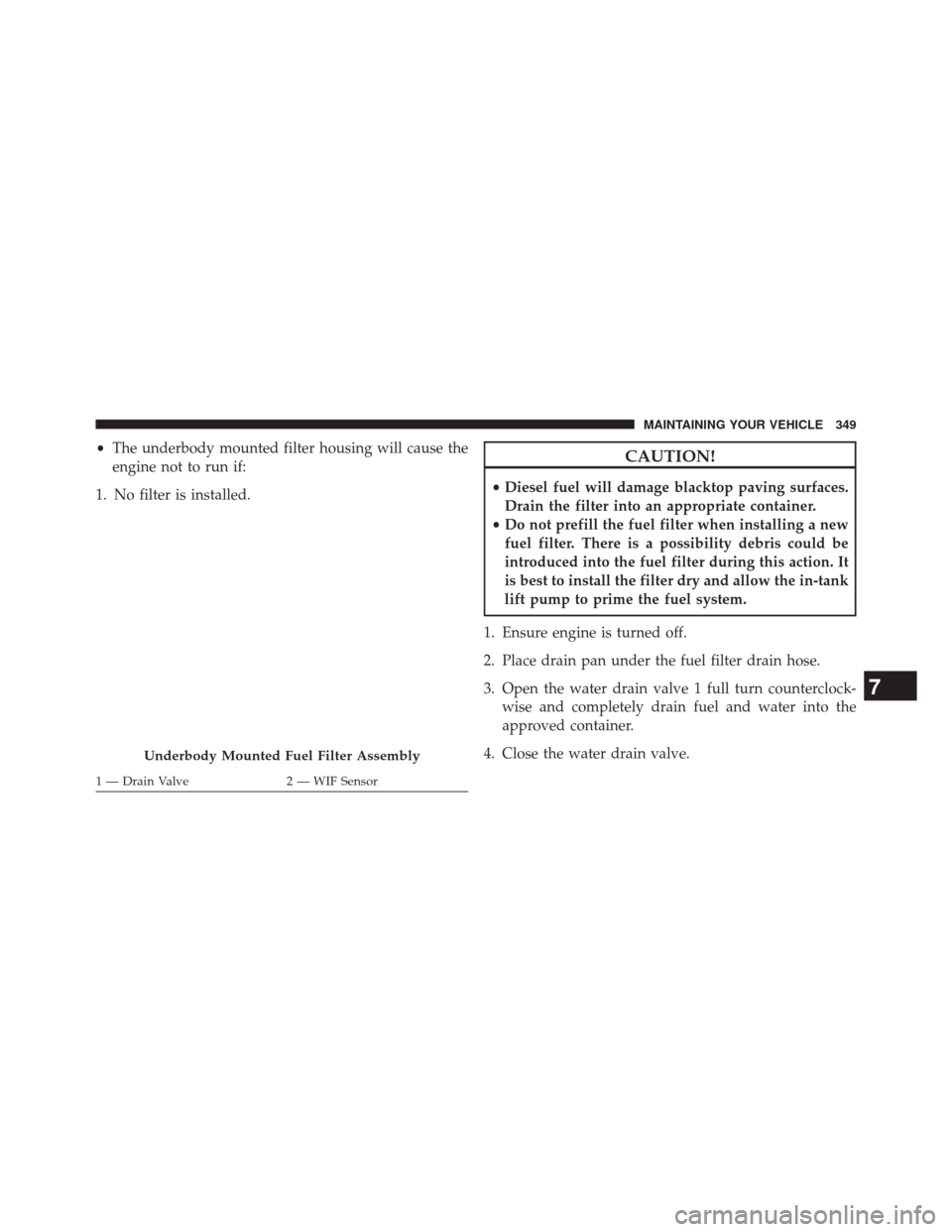
Underbody Mounted Fuel Filter Assembly
1 — Drain Valve 2 — WIF Sensor
7
MAINTAINING YOUR VEHICLE 349
Page 352 of 406
5. Remove lid using a socket or strap wrench. Rotatecounterclockwise for removal. Remove used o-ring
and discard it.
6. Remove the used filter cartridge from the housing and dispose of according to your local regulations.
7. Wipe clean the sealing surfaces of the lid and housing.
8. Install new o-ring back into ring groove on the filter housing and lubricate with clean engine oil.
NOTE: WIF sensor is re-usable. Service kit comes with
new o-ring for filter canister and WIF sensor.Priming If The Engine Has Run Out Of Fuel
WARNING!
Do not open the high pressure fuel system with the
engine running. Engine operation causes high fuel
pressure. High pressure fuel spray can cause serious
injury or death.
1. Add a substantial amount of fuel to the tank, approxi- mately 2 to 5 gal (8L to 19L).
2. Turn ignition switch to the start position to engage starter for one second, return ignition switch to run
position. This will activate in tank fuel pump for
approximately 15 seconds. Repeat this process twice.
3. Start the engine using the “Normal Starting” proce- dure. Refer to “Starting Procedures” in “Starting and
Operating” for further information.
350 MAINTAINING YOUR VEHICLE
Page 354 of 406
•Use of biodiesel mixture in excess of 20% can nega-
tively impact the fuel filter’s ability to separate water
from the fuel, resulting in high pressure fuel system
corrosion or damage.
• Ethanol blends are not recommended or approved for
use with your Cummins diesel engine.
• In addition, commercially available fuel additives are
not necessary for the proper operation of your Cum-
mins diesel engine.
Intervention Regeneration Strategy — Message
Process Flow
The Cummins diesel engine meets all EPA Heavy Duty
Diesel Engine Emissions Standards, resulting in one of
the lowest emitting diesel engines ever produced.
To achieve these emissions standards, your vehicle is
equipped with a state-of-the-art engine and exhaust
system. The engine and exhaust after-treatment system work together to achieve the EPA Heavy Duty Diesel
Engine Emissions Standards. These systems are seam-
lessly integrated into your vehicle and managed by the
Cummins Powertrain Control Module (PCM). The PCM
manages engine combustion to allow the exhaust sys-
tem’s catalyst to trap and burn Particulate Matter (PM)
pollutants, with no input or interaction on your part.
Additionally, your vehicle has the ability to alert you to
additional maintenance required on your truck or engine.
Refer to “Electronic Vehicle Information Center (EVIC)”
or “Driver Information Display (DID)” in “Understand-
ing Your Instrument Panel” for further information.
WARNING!
A hot exhaust system can start a fire if you park over
materials that can burn. Such materials might be
(Continued)
352 MAINTAINING YOUR VEHICLE
Page 375 of 406
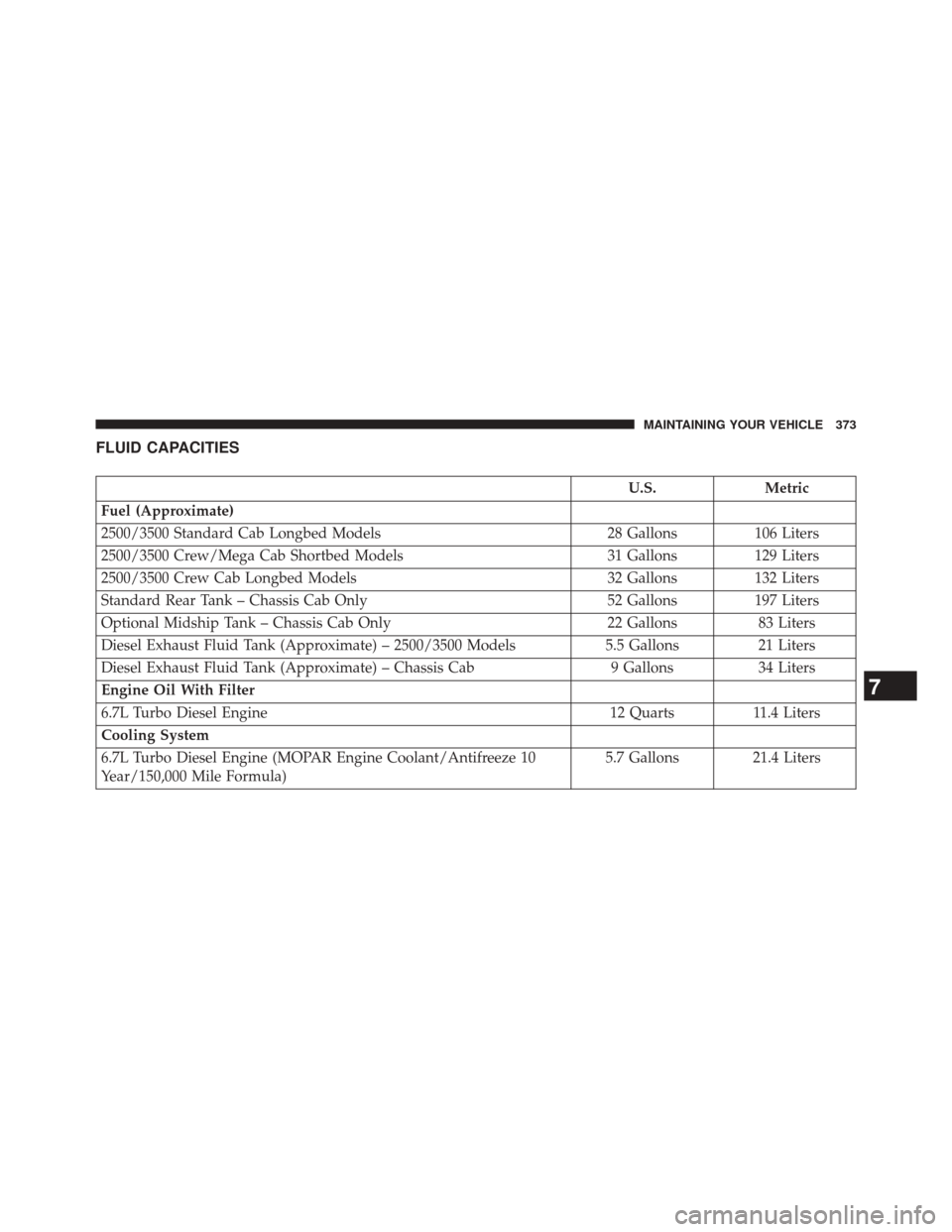
FLUID CAPACITIES
U.S.Metric
Fuel (Approximate)
2500/3500 Standard Cab Longbed Models 28 Gallons106 Liters
2500/3500 Crew/Mega Cab Shortbed Models 31 Gallons129 Liters
2500/3500 Crew Cab Longbed Models 32 Gallons132 Liters
Standard Rear Tank – Chassis Cab Only 52 Gallons197 Liters
Optional Midship Tank – Chassis Cab Only 22 Gallons83 Liters
Diesel Exhaust Fluid Tank (Approximate) – 2500/3500 Models 5.5 Gallons21 Liters
Diesel Exhaust Fluid Tank (Approximate) – Chassis Cab 9 Gallons34 Liters
Engine Oil With Filter
6.7L Turbo Diesel Engine 12 Quarts11.4 Liters
Cooling System
6.7L Turbo Diesel Engine (MOPAR Engine Coolant/Antifreeze 10
Year/150,000 Mile Formula) 5.7 Gallons
21.4 Liters
7
MAINTAINING YOUR VEHICLE 373
Page 377 of 406
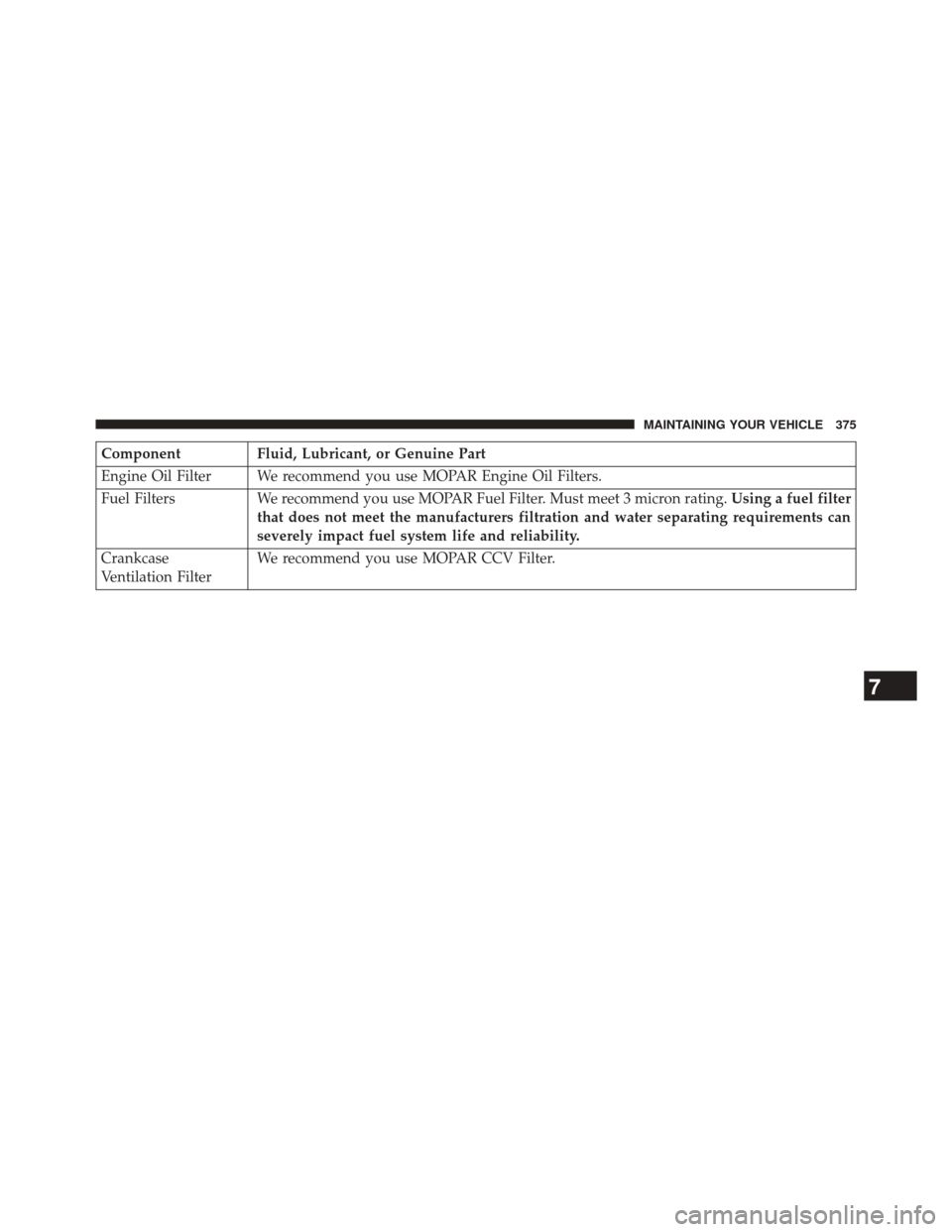
ComponentFluid, Lubricant, or Genuine Part
Engine Oil Filter We recommend you use MOPAR Engine Oil Filters.
Fuel Filters We recommend you use MOPAR Fuel Filter. Must meet 3 micron rating. Using a fuel filter
that does not meet the manufacturers filtration and water separating requirements can
severely impact fuel system life and reliability.
Crankcase
Ventilation Filter We recommend you use MOPAR CCV Filter.
7
MAINTAINING YOUR VEHICLE 375
Page 378 of 406
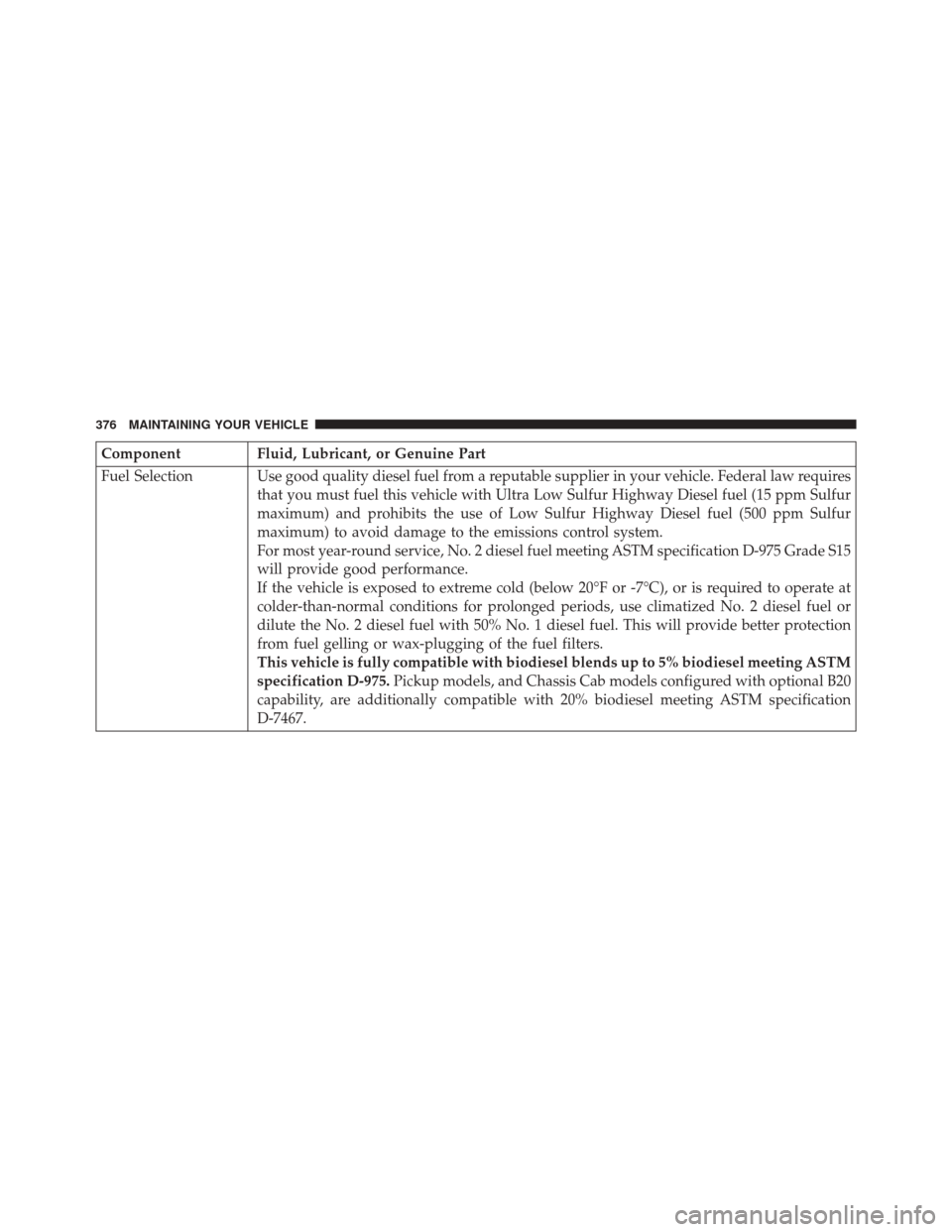
ComponentFluid, Lubricant, or Genuine Part
Fuel Selection Use good quality diesel fuel from a reputable supplier in your vehicle. Federal law requires that you must fuel this vehicle with Ultra Low Sulfur Highway Diesel fuel (15 ppm Sulfur
maximum) and prohibits the use of Low Sulfur Highway Diesel fuel (500 ppm Sulfur
maximum) to avoid damage to the emissions control system.
For most year-round service, No. 2 diesel fuel meeting ASTM specification D-975 Grade S15
will provide good performance.
If the vehicle is exposed to extreme cold (below 20°F or -7°C), or is required to operate at
colder-than-normal conditions for prolonged periods, use climatized No. 2 diesel fuel or
dilute the No. 2 diesel fuel with 50% No. 1 diesel fuel. This will provide better protection
from fuel gelling or wax-plugging of the fuel filters.
This vehicle is fully compatible with biodiesel blends up to 5% biodiesel meeting ASTM
specification D-975.Pickup models, and Chassis Cab models configured with optional B20
capability, are additionally compatible with 20% biodiesel meeting ASTM specification
D-7467.
376 MAINTAINING YOUR VEHICLE
Page 382 of 406
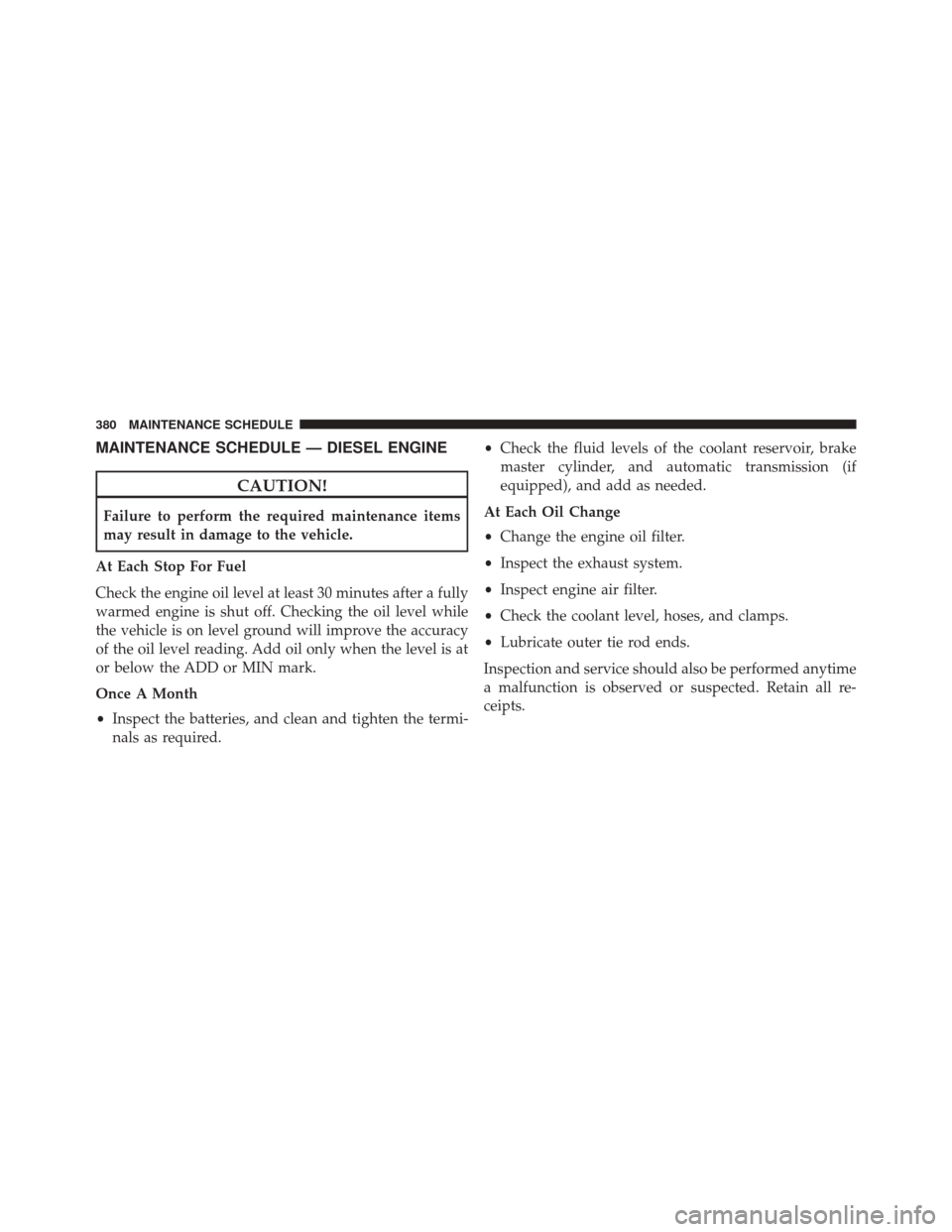
MAINTENANCE SCHEDULE — DIESEL ENGINE
CAUTION!
Failure to perform the required maintenance items
may result in damage to the vehicle.
At Each Stop For Fuel
Check the engine oil level at least 30 minutes after a fully
warmed engine is shut off. Checking the oil level while
the vehicle is on level ground will improve the accuracy
of the oil level reading. Add oil only when the level is at
or below the ADD or MIN mark.
Once A Month
• Inspect the batteries, and clean and tighten the termi-
nals as required. •
Check the fluid levels of the coolant reservoir, brake
master cylinder, and automatic transmission (if
equipped), and add as needed.
At Each Oil Change
• Change the engine oil filter.
• Inspect the exhaust system.
• Inspect engine air filter.
• Check the coolant level, hoses, and clamps.
• Lubricate outer tie rod ends.
Inspection and service should also be performed anytime
a malfunction is observed or suspected. Retain all re-
ceipts.
380 MAINTENANCE SCHEDULE