warning light Ram 2500 2016 Diesel Supplement
[x] Cancel search | Manufacturer: RAM, Model Year: 2016, Model line: 2500, Model: Ram 2500 2016Pages: 406, PDF Size: 1.84 MB
Page 299 of 406
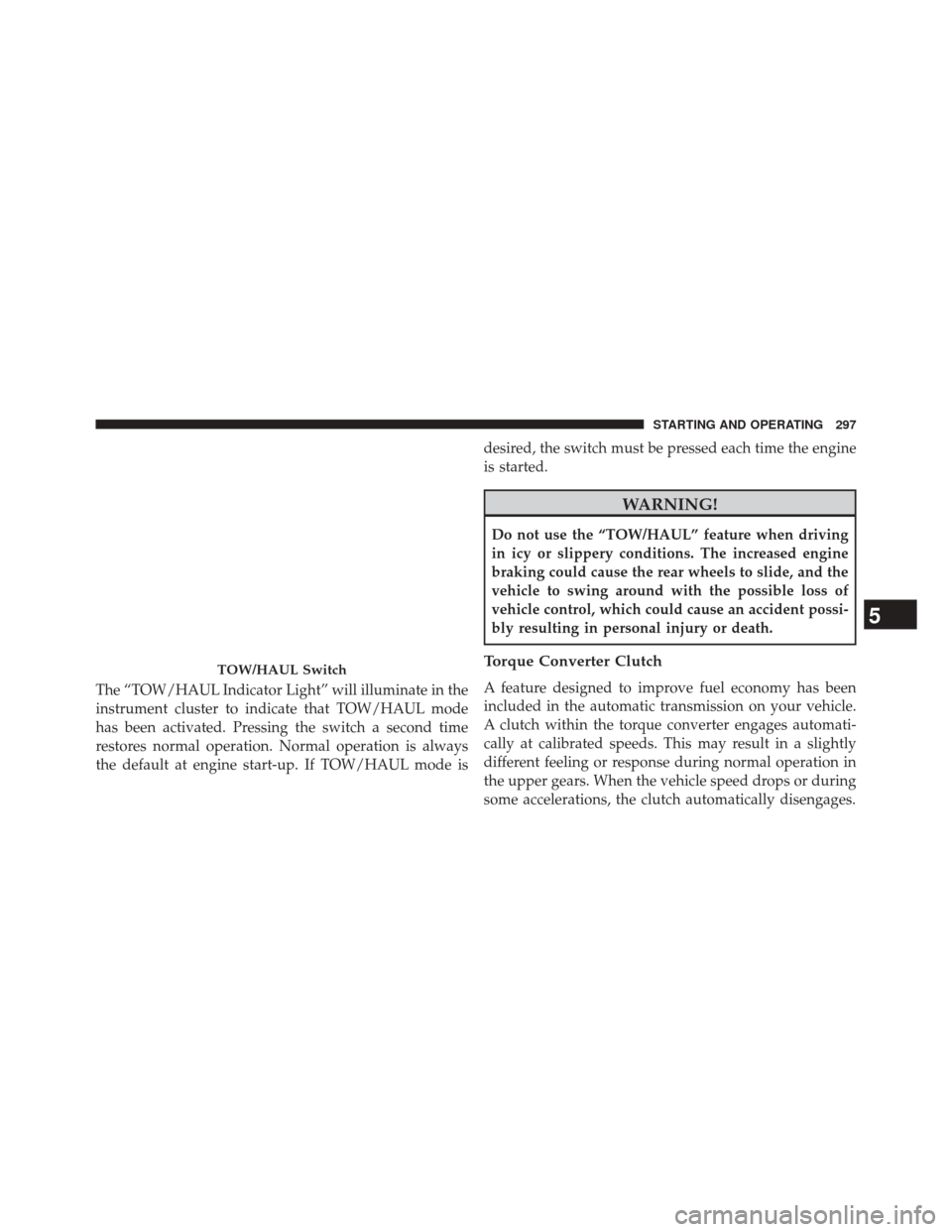
The “TOW/HAUL Indicator Light” will illuminate in the
instrument cluster to indicate that TOW/HAUL mode
has been activated. Pressing the switch a second time
restores normal operation. Normal operation is always
the default at engine start-up. If TOW/HAUL mode isdesired, the switch must be pressed each time the engine
is started.
WARNING!
Do not use the “TOW/HAUL” feature when driving
in icy or slippery conditions. The increased engine
braking could cause the rear wheels to slide, and the
vehicle to swing around with the possible loss of
vehicle control, which could cause an accident possi-
bly resulting in personal injury or death.
Torque Converter Clutch
A feature designed to improve fuel economy has been
included in the automatic transmission on your vehicle.
A clutch within the torque converter engages automati-
cally at calibrated speeds. This may result in a slightly
different feeling or response during normal operation in
the upper gears. When the vehicle speed drops or during
some accelerations, the clutch automatically disengages.
TOW/HAUL Switch
5
STARTING AND OPERATING 297
Page 310 of 406
WARNING!
Do not use alcohol or gasoline as a fuel blending
agent. They can be unstable under certain conditions
and hazardous or explosive when mixed with diesel
fuel.
Diesel fuel is seldom completely free of water. To prevent
fuel system trouble, drain the accumulated water from
the fuel/water separator using the fuel/water separator
drain provided on both fuel filters. If you buy good
quality fuel and follow the cold weather advice above,
fuel conditioners should not be required in your vehicle.
If available in your area, a high cetane “premium” diesel
fuel may offer improved cold-starting and warm-up
performance.
CAUTION!
If the “Water in Fuel Indicator Light” remains on, DO
NOT START engine before you drain the water from
the fuel filter(s) to avoid engine damage. Refer to
“Maintenance Procedures/Draining Fuel/Water Sepa-
rator Filter” in “Maintaining Your Vehicle” for fur-
ther information.
Fuel Specifications
The Cummins diesel engine has been developed to take
advantage of the high energy content and generally
lower cost No. 2 Ultra Low Sulfur diesel fuel or No. 2
Ultra Low Sulfur climatized diesel fuels. Experience has
shown that it also operates on No. 1 Ultra Low Sulfur
diesel fuels or other fuels within specification.
308 STARTING AND OPERATING
Page 317 of 406
CAUTION!
To avoid fuel spillage and overfilling, do not “top
off” the fuel tank after filling.
WARNING!
•Never have any smoking materials lit in or near the
vehicle when the fuel door is open or the tank is
being filled.
• Never add fuel when the engine is running. This is
in violation of most state and federal fire regula-
tions and may cause the “Malfunction Indicator
Light” to turn on.
• A fire may result if fuel is pumped into a portable
container that is inside of a vehicle. You could be
burned. Always place fuel containers on the
ground while filling.
ADDING FUEL — CHASSIS CAB MODELS
CAUTION!
To avoid fuel spillage and overfilling, do not “top
off” the fuel tank after filling.
NOTE:
• When the fuel nozzle “clicks” or shuts off, the fuel tank
is full.
• Tighten the fuel filler cap until you hear a “clicking”
sound. This is an indication that the fuel filler cap is
properly tightened.
• Make sure that the fuel filler cap is tightened each time
the vehicle is refueled.
5
STARTING AND OPERATING 315
Page 328 of 406
JUMP STARTING
WARNING!
•To prevent personal injury or damage to clothing,
do not allow battery fluid to contact eyes, skin or
fabrics. Do not lean over a battery when connecting
jumper cables or allow cable clamps to touch each
other. Keep open flames or sparks away from
battery vent holes. Always wear eye protection
when working with batteries.
• Do not use a booster battery or any other booster
source that has a greater than 12 Volt system, i.e., do
not use a 24 Volt power source.
NOTE: Replacement batteries should both be of equal
size to prevent damage to the vehicle’s charging system.
Your vehicle is equipped with two 12 Volt batteries. If it
becomes necessary to use a booster battery with jumper cables to start a vehicle’s engine because its batteries are
discharged, the following procedure should be used:
Set the parking brake and place an automatic transmis-
sion in PARK (or NEUTRAL for a manual transmission).
Turn off lights, heater and other electrical loads. Observe
charge indicator (if equipped) in both batteries. If the
indicator (if equipped) is light or yellow on either battery,
replace that battery.
CAUTION!
Use the jump start procedure only when the charge
indicator (if equipped) in both batteries is dark in the
center. Do not attempt jump starting when either
battery charge indicator (if equipped) is bright or
yellow. If the charge indicator (if equipped) has a
green dot in the center, failure to start is not due to a
discharged battery and cranking system should be
checked.
326 WHAT TO DO IN EMERGENCIES
Page 362 of 406
•Do not change the thermostat for Summer or Winter
operation. If replacement is ever necessary, install
ONLY the correct type thermostat. Other designs may
result in unsatisfactory engine coolant (antifreeze)
performance, poor gas mileage, and increased emis-
sions.
Charge Air Cooler — Inter-Cooler
The charge air cooler is positioned below the radiator and
the air conditioner condenser. Air enters the engine
through the air cleaner and passes through the turbo-
charger, where it is pressurized. This pressurized air
rapidly reaches high temperature. The air is then directed
through a hose to the charge air cooler and through
another hose to the intake manifold of the engine. The air
entering the engine has been cooled by about 50° to 100°F
(10° to 38°C). This cooling process enables more efficient
burning of fuel resulting in fewer emissions. To guarantee optimum performance of the system, keep
the surfaces of the charge air cooler, condenser and
radiator clean and free of debris. Periodically check the
hoses leading to and from the charge air cooler for cracks
or loose clamps resulting in loss of pressure and reduced
engine performance.
Brake System
Brake Master Cylinder — Brake Fluid Level Check
The fluid level of the master cylinder should be checked
when performing under the hood service, or immedi-
ately if the “Brake System Warning Light” indicates
system failure.
The brake master cylinder has a translucent plastic
reservoir. On the outboard side of the reservoir, there is a
“MAX” mark and a “MIN” mark. The fluid level must be
kept within these two marks. Do not add fluid above the
full mark because leakage may occur at the cap.
360 MAINTAINING YOUR VEHICLE
Page 394 of 406
Adding Engine Coolant (Antifreeze)............140
Adding Fuel .............................114
Air Bag Light .............................25
Air Cleaner, Engine (Engine Air Cleaner Filter) . . . .128
Alarm (Security Alarm) ......................28
Antifreeze (Engine Coolant) ..................139
Capacities ........................... .146
Disposal ............................. .142
Automatic Transmission Fluid Type ........................... .150
Axle Fluid ............................. .150
Battery .................................30
Charging System Light ....................30
Brake Fluid ............................ .150
Brake System ........................... .144
Fluid Check .......................... .144
Master Cylinder ....................... .144Warning Light
..........................26
Capacities, Antifreeze (Engine Coolant) ..........146
Capacities, Fluid ......................... .146
Caps, Filler Oil (Engine) .......................... .127
Radiator (Coolant Pressure) ................142
Charge Air Cooler ........................ .144
Coolant Pressure Cap (Radiator Cap) ...........142
Cooling System .......................... .138
Adding Coolant (Antifreeze) ...............140
Coolant Capacity ...................... .146
Coolant Level ......................... .138
Disposal Of Used Coolant .................142
Drain, Flush, And Refill ...................139
Points To Remember .....................143
Pressure Cap ......................... .142
Radiator Cap ......................... .142
Selection Of Coolant (Antifreeze) ........139 , 147
8
INDEX - RAM 1500 391
Page 395 of 406
Cruise Light..............................58
Diesel Fuel ............................. .108
Diesel Fuel Requirements ....................108
Bulk Storage Of ........................117
Diesel Fuel System, Re-Priming ...............135
Disposal Antifreeze (Engine Coolant) ................142
Door Ajar ...............................35
Door Ajar Light ...........................35
Draining Fuel/Water Separator Filter ...........131
Electronic Throttle Control Warning Light .........32
Electronic Vehicle Information Center (EVIC) ......63
Engine ................................ .124
Air Cleaner .......................... .128
Block Heater ...................... .100 , 107
Break-In Recommendations .................13
Compartment ......................... .124Coolant (Antifreeze)
.....................147
Identification ......................... .124
Idling .............................. .104
Oil............................. .126 , 147
Oil Filler Cap ......................... .127
Filters Air Cleaner .......................... .128
Engine Fuel .......................... .131
Engine Oil ....................... .128 , 147
Engine Oil Disposal .....................128
Flashers Turn Signal ............................57
Fluid Capacities ......................... .146
Fluid Level Checks Brake ............................... .144
Fluid, Brake ............................ .150
Fluids, Lubricants And Genuine Parts ...........147
Fog Lights ...............................46
392 INDEX - RAM 1500
Page 396 of 406
Fuel.................................. .108
Adding ..............................114
Diesel ........................... .108 , 147
Filter ............................... .131
Light .................................43
Requirements ......................... .108
Specifications ......................... .109
Tank Capacity ......................... .146
Fueling .................................114
Gauges Voltmeter ............................ .102
Information Center, Vehicle ...................63
Instrument Cluster .........................17
Intervention Regeneration Strategy ..............71
Keyless Enter-N-Go ........................99 Lights
AirBag ...............................25
Brake Warning ..........................26
Cruise .............................58,60
Engine Temperature Warning ................29
Fog ..................................46
Low Fuel ..............................43
Malfunction Indicator (Check Engine) ..........36
Park ..............................56,58
Seat Belt Reminder .......................24
Security Alarm ..........................28
Tire Pressure Monitoring (TPMS) .............40
Turn Signal ............................57
Warning (Instrument Cluster Description) . . . .29 , 57
Maintenance Procedures ....................125
Maintenance Schedule ..................... .152
Malfunction Indicator Light (Check Engine) .......36
8
INDEX - RAM 1500 393
Page 397 of 406
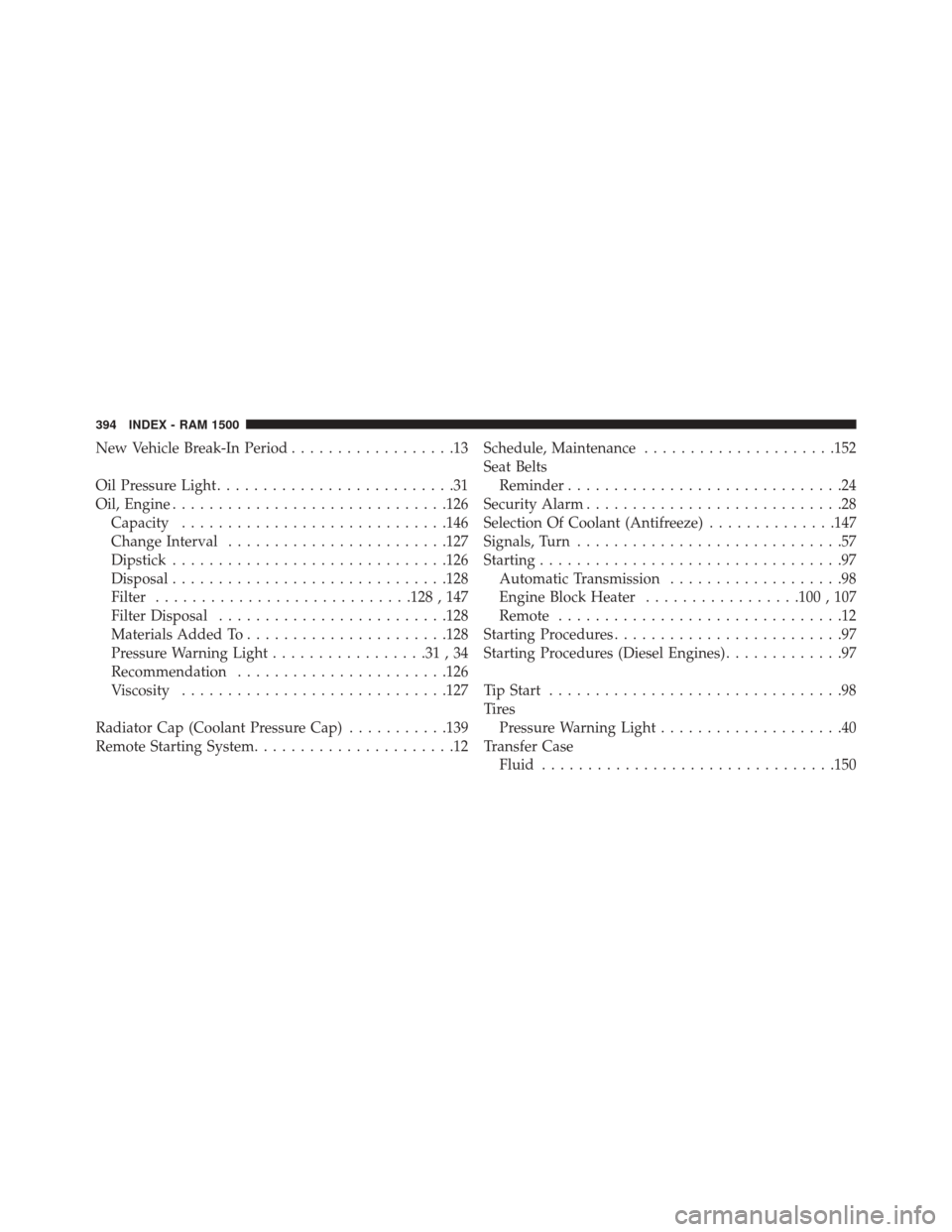
New Vehicle Break-In Period..................13
Oil Pressure Light ..........................31
Oil, Engine ............................. .126
Capacity ............................ .146
Change Interval ....................... .127
Dipstick ............................. .126
Disposal ............................. .128
Filter ........................... .128 , 147
Filter Disposal ........................ .128
Materials Added To ..................... .128
Pressure Warning Light .................31,34
Recommendation ...................... .126
Viscosity ............................ .127
Radiator Cap (Coolant Pressure Cap) ...........139
Remote Starting System ......................12 Schedule, Maintenance
.....................152
Seat Belts Reminder ..............................24
Security Alarm ............................28
Selection Of Coolant (Antifreeze) ..............147
Signals, Turn .............................57
Starting .................................97
Automatic Transmission ...................98
Engine Block Heater .................100 , 107
Remote ...............................12
Starting Procedures .........................97
Starting Procedures (Diesel Engines) .............97
Tip Start ................................98
Ti re s Pressure Warning Light ....................40
Transfer Case Fluid ............................... .150
394 INDEX - RAM 1500
Page 399 of 406
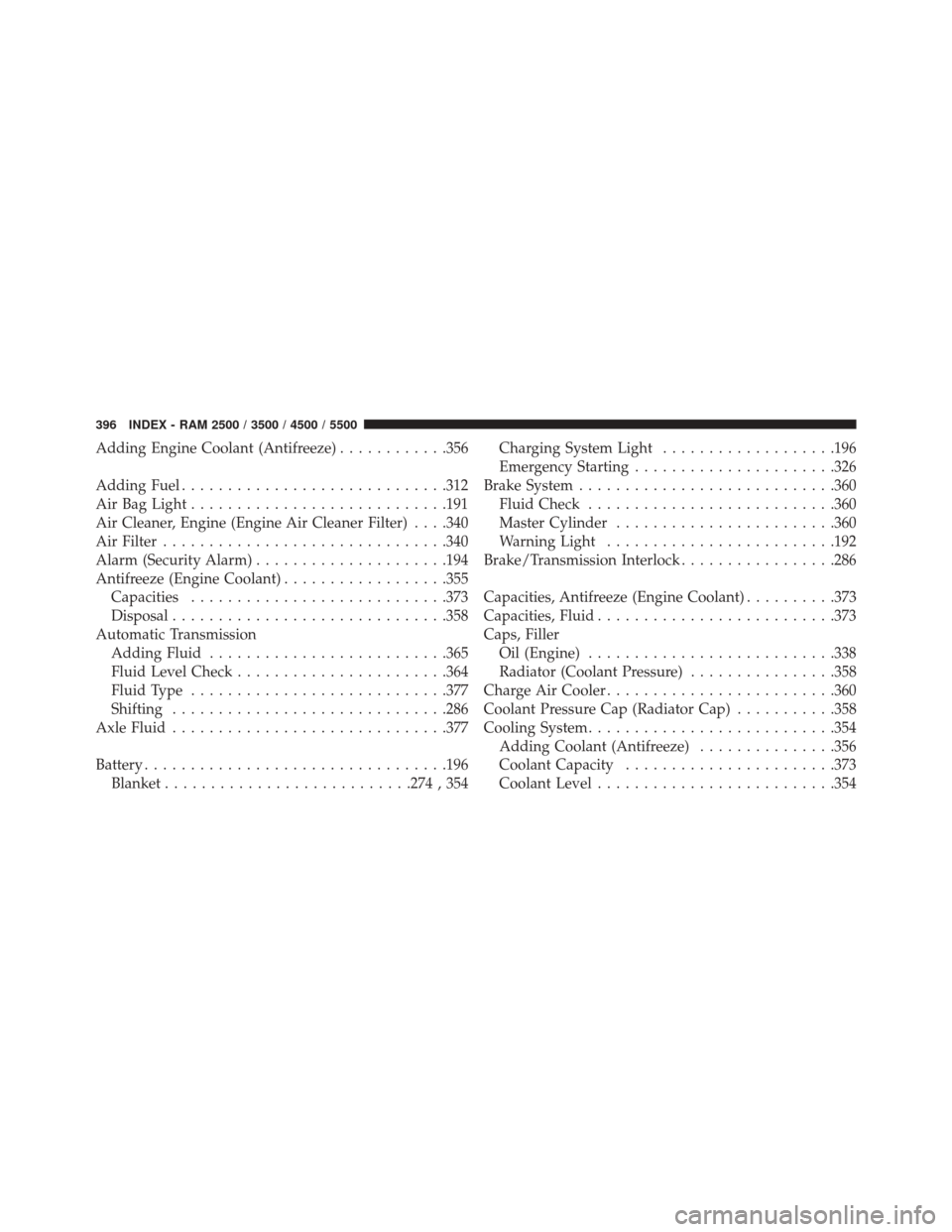
Adding Engine Coolant (Antifreeze)............356
Adding Fuel ............................ .312
Air Bag Light ........................... .191
Air Cleaner, Engine (Engine Air Cleaner Filter) . . . .340
Air Filter .............................. .340
Alarm (Security Alarm) .....................194
Antifreeze (Engine Coolant) ..................355
Capacities ........................... .373
Disposal ............................. .358
Automatic Transmission Adding Fluid ......................... .365
Fluid Level Check ...................... .364
Fluid Type ........................... .377
Shifting ............................. .286
Axle Fluid ............................. .377
Battery ................................ .196
Blanket .......................... .274 , 354Charging System Light
...................196
Emergency Starting ..................... .326
Brake System ........................... .360
Fluid Check .......................... .360
Master Cylinder ....................... .360
Warning Light ........................ .192
Brake/Transmission Interlock .................286
Capacities, Antifreeze (Engine Coolant) ..........373
Capacities, Fluid ......................... .373
Caps, Filler Oil (Engine) .......................... .338
Radiator (Coolant Pressure) ................358
Charge Air Cooler ........................ .360
Coolant Pressure Cap (Radiator Cap) ...........358
Cooling System .......................... .354
Adding Coolant (Antifreeze) ...............356
Coolant Capacity ...................... .373
Coolant Level ......................... .354
396 INDEX - RAM 2500 / 3500 / 4500 / 5500