brake Ram 3500 2011 Diesel Supplement
[x] Cancel search | Manufacturer: RAM, Model Year: 2011, Model line: 3500, Model: Ram 3500 2011Pages: 170, PDF Size: 0.66 MB
Page 47 of 170

CAUTION!
Do not crank engine for more than 15 seconds at a
time or starter motor damage may result. Turn the
ignition switch to the OFF position and wait at least
two minutes for the starter to cool before repeating
start procedure.
5. When the engine starts, release the key fob.
6. Check to see that there is oil pressure.
7. Release the parking brake.
Starting Procedure – Engine Manifold Air
Temperature 0°F to 66°F (–18°C to 19°C)
NOTE: The temperature displayed in the Electronic
Vehicle Information Center (EVIC) does not necessarily
reflect the engine manifold air temperature. Refer to “Electronic Vehicle Information Center (EVIC)” in “Un-
derstanding Your Instrument Panel” for further informa-
tion. When engine temperatures fall below 66°F (19°C)
the “Wait To Start Light” will remain on indicating the
intake manifold heater system is active.
Follow the steps in the “Normal Starting” procedure
except:
1. The “Wait To Start Light” will remain on for a period
of time (length of time depends on engine temperature).
CAUTION!
If the “Water in Fuel Indicator Light” remains on, DO
NOT START engine before you drain the water from
the fuel filter to avoid engine damage. Refer to
“Maintenance Procedures/Draining Fuel/Water Sepa-
rator Filter” in “Maintaining Your Vehicle” for fur-
ther information.
46 STARTING AND OPERATING
Page 48 of 170

2. After the “Wait To Start Light” goes off, turn the
ignition switch to the START position. Do not press the
accelerator during starting.
CAUTION!
Do not crank engine for more than 15 seconds at a
time or starter motor damage may result. Turn the
ignition switch to the OFF position and wait at least
two minutes for the starter to cool before repeating
start procedure.
3. After engine start-up, check to see that there is oil
pressure.
4. Allow the engine to idle about three minutes until the
manifold heaters have completed the post-heat cycle.
5. Release the parking brake and drive. NOTE:
•Engine idle speed will automatically increase to 1,000
RPM at low coolant temperatures to improve engine
warm-up.
•If the engine stalls, or if the ignition switch is left ON
for more than two minutes after the “Wait To Start
Light” goes out, reset the grid heaters by turning the
ignition switch to the OFF position for at least five
seconds and then back ON. Repeat steps 1 through 5 of
“Starting Procedure – Engine Manifold Air Tempera-
ture Below 66°F (19°C).”
Starting Procedure – Engine Manifold Air
Temperature Below 0°F (-18°C)
In extremely cold weather below 0°F (-18°C) it may be
beneficial to cycle the manifold heaters twice before
attempting to start the engine. This can be accomplished
by turning the ignition OFF for at least five seconds and
then back ON after the “Wait To Start Light” has turned
4
STARTING AND OPERATING 47
Page 53 of 170

Your vehicle is equipped with a turbo speed limiter, this
feature limits the engine speed to 1,200 RPM when
engine coolant temperatures are below 70°F (21°C). This
feature is designed to protect the turbocharger from
damage and will only operate in PARK or NEUTRAL.
If temperatures are below 32°F (0°C), operate the engine
at moderate speeds for five minutes before full loads are
applied.
NOTE:
•If ambient temperatures are low and the coolant
temperature is below 180°F (82°C), the engine idle
speed will slowly increase to 1,000 RPM after two
minutes of idle, if the following conditions are met:
•foot is off brake pedal and throttle pedal
•automatic transmission is in PARK
•vehicle speed is zero
•Applying the throttle will cancel fast idle
•If the engine is equipped with an exhaust brake,
operating the exhaust brake at idle will greatly im-
prove warm up rate and will help keep the engine
close to operating temperature during extended idle.
Engine Idling
Avoid prolonged idling, long periods of idling may be
harmful to your engine because combustion chamber
temperatures can drop so low that the fuel may not burn
completely. Incomplete combustion allows carbon and
varnish to form on piston rings, engine valves, and
injector nozzles. Also, the unburned fuel can enter the
crankcase, diluting the oil and causing rapid wear to the
engine.
If the engine is allowed to idle, under some conditions
the idle speed may increase to 900 RPM then return to
normal idle speed. This is normal operation.
52 STARTING AND OPERATING
Page 54 of 170

NOTE:For EVIC messages related to the vehicle’s
exhaust system, refer to “Maintenance Procedures/
Intervention Regeneration Strategy – EVIC Message Pro-
cess Flow” in “Maintaining Your Vehicle” for further
information.
Idle-Up Feature – Automatic Transmission Only
The driver-controlled high idle speed feature will help
increase cylinder temperatures and provide additional
cab heat, however, excessive idling may still cause the
exhaust aftertreatment system to not properly regenerate.
Extended periods of idle time should be avoided.
The Idle-Up feature uses the speed control switches to
increase engine idle speed and quickly warm the vehi-
cle’s interior.
1. With the transmission in PARK, the parking brake
applied, and the engine running, press the speed control
switch to the ON position, then press the SET switch. 2. The engine RPM will go up to 1100 RPM. To increase
the RPM, press and hold the ACCEL/RESUME switch
and the idle speed will increase to approximately 1500
RPM. To decrease the RPM, press and hold the DECEL
switch and the idle speed will decrease to approximately
1100 RPM.
3. To cancel the Idle–Up feature, either press the CAN-
CEL switch, press the ON/OFF switch, or press the brake
pedal.
Stopping The Engine
Idle the engine a few minutes before routine shutdown.
After full load operation, idle the engine three to five
minutes before shutting it down. This idle period will
allow the lubricating oil and coolant to carry excess heat
away from the combustion chamber, bearings, internal
components, and turbocharger. This is especially impor-
tant for turbocharged, charge air-cooled engines.
4
STARTING AND OPERATING 53
Page 56 of 170

Engine Speed Control
CAUTION!
Prevent overspeeding the engine going downhill.
When descending steep grades, use a combination of
gears and service brakes to control vehicle/engine
speed. Overspeed can cause severe engine damage.
Operating Precautions
Avoid Overheating The Engine
The temperature of the engine coolant (antifreeze) (a
mixture of 50% ethylene-glycol and 50% water) must not
exceed the normal range of the temperature gauge 240°F
(116°C) with a 16 psi (110 kPa) radiator cap.
Usually the engine coolant (antifreeze) temperature indi-
cated during operation will be to the left of center in the
normal range of the gauge.
Avoid Low Coolant Temperature Operation
Continual operation at low engine coolant (antifreeze)
temperature below the normal range on the gauge 140°F
(60°C) can be harmful to the engine. Low engine coolant
(antifreeze) temperature can cause incomplete combus-
tion which allows carbon and varnish to form on piston
rings and injector nozzles. Also, the unburned fuel can
enter the crankcase, diluting the lubricating oil and
causing rapid wear to the engine.
Cooling System Tips – Automatic Transmission
To reduce potential for engine and transmission over-
heating in high ambient temperature conditions, take the
following actions:
•City Driving —
When stopped, shift the transmission into NEUTRAL
and increase engine idle speed.
•Highway Driving —
Reduce your speed.
4
STARTING AND OPERATING 55
Page 59 of 170
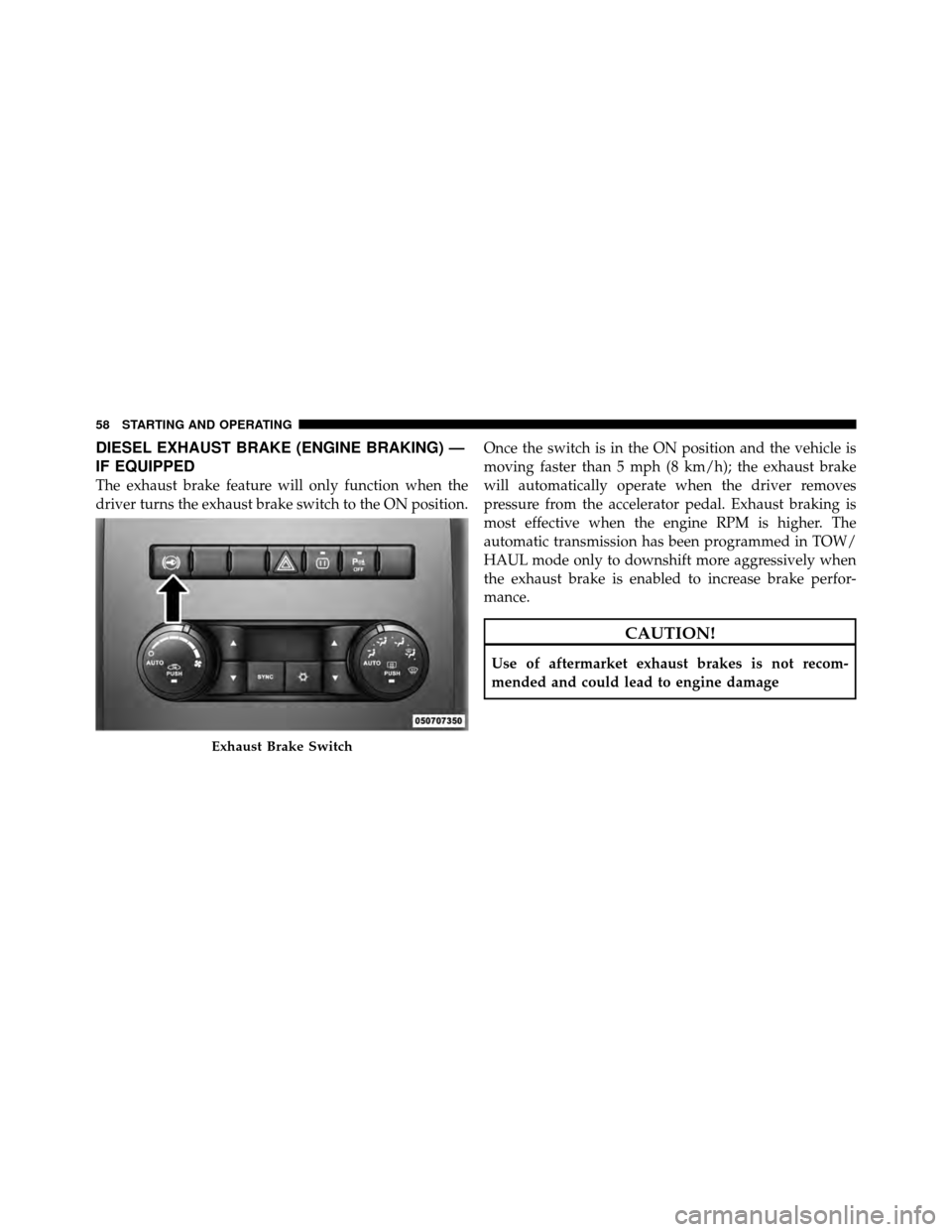
DIESEL EXHAUST BRAKE (ENGINE BRAKING) —
IF EQUIPPED
The exhaust brake feature will only function when the
driver turns the exhaust brake switch to the ON position.Once the switch is in the ON position and the vehicle is
moving faster than 5 mph (8 km/h); the exhaust brake
will automatically operate when the driver removes
pressure from the accelerator pedal. Exhaust braking is
most effective when the engine RPM is higher. The
automatic transmission has been programmed in TOW/
HAUL mode only to downshift more aggressively when
the exhaust brake is enabled to increase brake perfor-
mance.
CAUTION!
Use of aftermarket exhaust brakes is not recom-
mended and could lead to engine damage
Exhaust Brake Switch
58 STARTING AND OPERATING
Page 60 of 170

WARNING!
Do not use the exhaust brake feature when driving in
icy or slippery conditions as the increased engine
braking can cause the rear wheels to slide and the
vehicle to swing around with the possible loss of
vehicle control, which may cause an accident possi-
bly resulting in personal injury or death.
NOTE: For optimum braking power it is recommended
to use the exhaust brake while in TOW/HAUL mode.
The purpose of the exhaust brake (engine braking) fea-
ture is to supply negative (braking) torque to the engine.
Typically, the engine braking is used for, but not limited
to, vehicle towing applications where vehicle braking can
be achieved by the internal engine power, thereby spar-
ing the mechanical brakes of the vehicle. Benefits of the exhaust brake are:•vehicle driving control
•reduced brake fade
•longer brake life
•faster cab warm-up.
The exhaust brake feature can also be used to reduce the
engine warm up time. To use the exhaust brake as a
warm-up device, the vehicle must be stopped or moving
less than 5 mph (8 km/h), the exhaust brake switch must
be in the ON position, and the coolant temperature must
be below 180°F (82°C) and ambient temperature below
60°F (16°C).
4
STARTING AND OPERATING 59
Page 61 of 170

AUTOMATIC TRANSMISSION — IF EQUIPPED
CAUTION!
Damage to the transmission may occur if the follow-
ing precautions are not observed:
•Shift into PARK only after the vehicle has come to
a complete stop.
•Shift into or out of REVERSE only after the
vehicle has come to a complete stop and the engine
is at idle speed.
•Do not shift from REVERSE, PARK, or NEUTRAL
into any forward gear when the engine is above
idle speed.
•Before shifting into any gear, make sure your foot
is firmly on the brake pedal.
WARNING!
•Unintended movement of a vehicle could injure
those in and near the vehicle. As with all vehicles,
you should never exit a vehicle while the engine is
running. Before exiting a vehicle, you should
always shift the transmission into PARK, remove
the key fob from the ignition, and apply the
parking brake. Once the key fob is removed from
the ignition, the shift lever is locked in the PARK
position, securing the vehicle against unwanted
movement. Furthermore, you should never leave
unattended children inside a vehicle.(Continued)
60 STARTING AND OPERATING
Page 62 of 170

WARNING! (Continued)
•It is dangerous to move the shift lever out of PARK
or NEUTRAL if the engine speed is higher than
idle speed. If your foot is not firmly on the brake
pedal, the vehicle could accelerate quickly forward
or in reverse. You could lose control of the vehicle
and hit someone or something. Only shift into
gear when the engine is idling normally and when
your right foot is firmly on the brake pedal.
Brake/Transmission Shift Interlock System
This vehicle is equipped with a Brake Transmission Shift
Interlock System (BTSI) that holds the shift lever in the
PARK position when the ignition switch is in the LOCK
position. To move the shift lever out of the PARK
position, the ignition switch must be turned to any other
switch position (ACC, ON, or START) (engine running or
not) and the brake pedal must be pressed.
Brake/Transmission Interlock Manual Override
Column Shifter
There is an override for the BTSI that allows you to move
the shift lever out of the PARK position if an electrical
system malfunction occurs (i.e., dead battery).
1. Turn the ignition switch to the ACC or ON position
without starting the engine.
2. Tilt the steering wheel to the full up position
3. Firmly set the parking brake.
4. Press and maintain firm pressure on the brake pedal.
4
STARTING AND OPERATING 61
Page 63 of 170
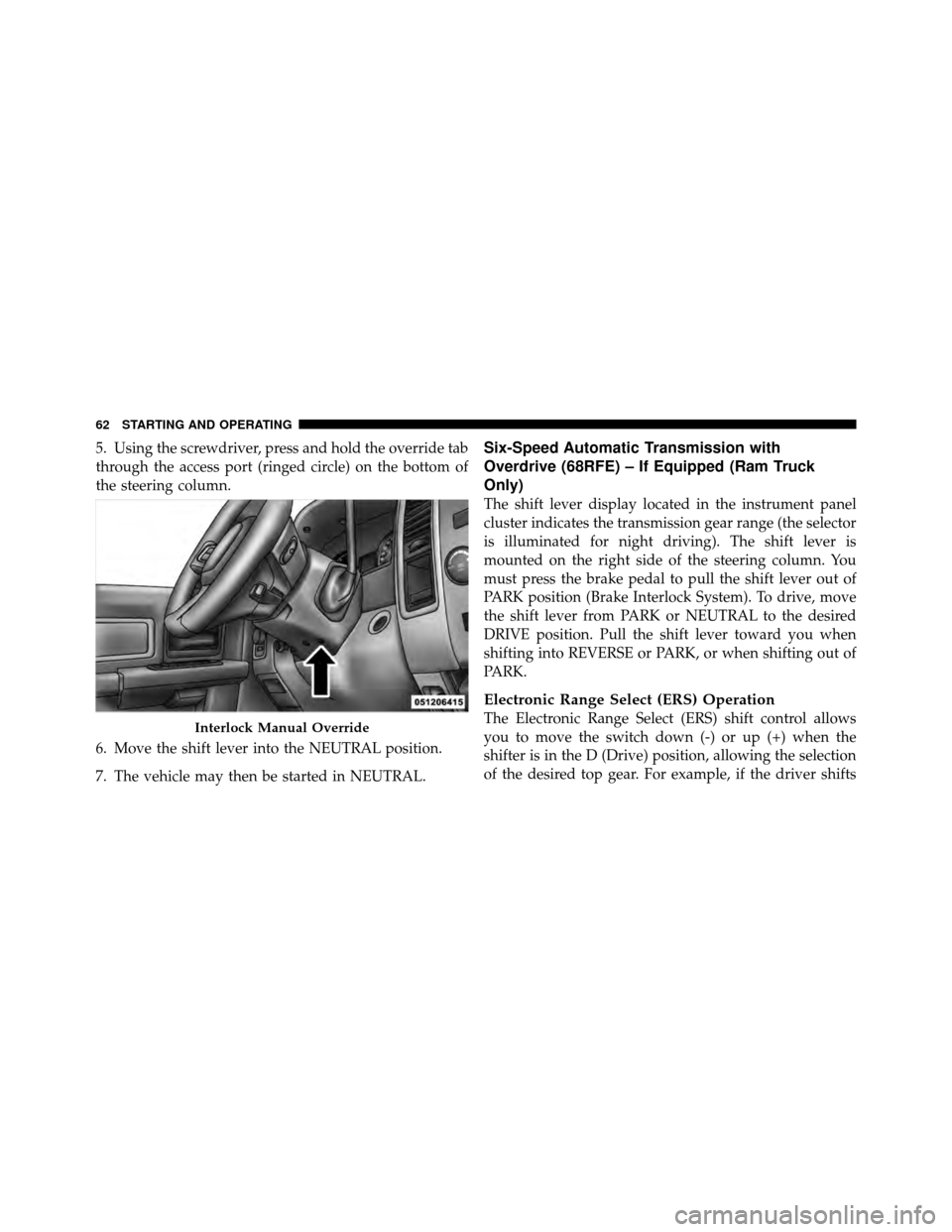
5. Using the screwdriver, press and hold the override tab
through the access port (ringed circle) on the bottom of
the steering column.
6. Move the shift lever into the NEUTRAL position.
7. The vehicle may then be started in NEUTRAL.Six-Speed Automatic Transmission with
Overdrive (68RFE) – If Equipped (Ram Truck
Only)
The shift lever display located in the instrument panel
cluster indicates the transmission gear range (the selector
is illuminated for night driving). The shift lever is
mounted on the right side of the steering column. You
must press the brake pedal to pull the shift lever out of
PARK position (Brake Interlock System). To drive, move
the shift lever from PARK or NEUTRAL to the desired
DRIVE position. Pull the shift lever toward you when
shifting into REVERSE or PARK, or when shifting out of
PARK.
Electronic Range Select (ERS) Operation
The Electronic Range Select (ERS) shift control allows
you to move the switch down (-) or up (+) when the
shifter is in the D (Drive) position, allowing the selection
of the desired top gear. For example, if the driver shiftsInterlock Manual Override
62 STARTING AND OPERATING