transmission Ram 3500 2011 Repair Manual
[x] Cancel search | Manufacturer: RAM, Model Year: 2011, Model line: 3500, Model: Ram 3500 2011Pages: 622, PDF Size: 50.78 MB
Page 475 of 622

Shifting Into Neutral (N) – Manual Shift Transfer
Case (If Equipped)
Use the following procedure to prepare your vehicle for
recreational towing.
WARNING!
You or others could be injured if you leave the
vehicle unattended with the transfer case in the
Neutral (N) position without first fully engaging the
parking brake. The transfer case Neutral (N) position
disengages both the front and rear driveshafts from
the powertrain and will allow the vehicle to move,
even if the transmission is in PARK. The parking
brake should always be applied when the driver is
not in the vehicle.
CAUTION!
It is necessary to follow these steps to be certain that
the transfer case is fully in Neutral (N) before recre-
ational towing to prevent damage to internal parts.
1. Bring the vehicle to a complete stop.
2. Turn OFF the engine.
3. Press and hold the brake pedal.
4. Shift the automatic transmission into NEUTRAL or
depress the clutch pedal on a manual transmission.
5. Shift the transfer case lever into Neutral (N).
6. Start the engine.
7. Shift the transmission into REVERSE.
474 STARTING AND OPERATING
Page 476 of 622

8. Release the brake pedal (and clutch pedal on manual
transmissions) for five seconds and ensure that there is
no vehicle movement.
9. Repeat steps 7 and 8 with automatic transmission in
DRIVE or manual transmission in first gear.
10. Turn OFF the engine.
11. Firmly apply the parking brake.
12. Shift the transmission into PARK or place manual
transmission in gear (not in Neutral).
CAUTION!
Damage to the transmission may occur if the trans-
mission is shifted into PARK with the transfer case in
Neutral (N) and the engine running. With the trans-
fer case in Neutral (N) ensure that the engine is OFF
prior to shifting the transmission into PARK.13. Remove the key fob from the ignition switch.
14. Attach the vehicle to the tow vehicle using a suitable
tow bar.
15. Release the parking brake.
Shifting Out of Neutral (N) – Manual Shift
Transfer Case (If Equipped)
Use the following procedure to prepare your vehicle for
normal usage.
1. Bring the vehicle to a complete stop, leaving it con-
nected to the tow vehicle.
2. Firmly apply the parking brake.
3. Insert the key fob into the ignition switch and turn it to
the ON/RUN position, but do not start the engine.
4. Press and hold the brake pedal.
5. Shift the transmission into NEUTRAL.
5
STARTING AND OPERATING 475
Page 477 of 622

6. Shift the transfer case lever to the desired position.
NOTE:When shifting out of transfer case Neutral (N),
turning the engine OFF may be required to avoid gear
clash.
7. Shift the automatic transmission into PARK, or place
manual transmission in Neutral.
8. Release the brake pedal.
9. Disconnect vehicle from the tow vehicle.
10. Start the engine.
11. Press and hold the brake pedal.
12. Release the parking brake.
13. Shift the transmission into gear, release the brake
pedal (and clutch pedal on manual transmissions), and
check that the vehicle operates normally.Shifting Into Neutral – Electronic Shift Transfer
Case (If Equipped)
Use the following procedure to prepare your vehicle for
recreational towing:
WARNING!
You or others could be injured if you leave the
vehicle unattended with the transfer case in the
NEUTRAL position without first fully engaging the
parking brake. The transfer case NEUTRAL position
disengages both the front and rear driveshafts from
the powertrain and will allow the vehicle to move,
even if the transmission is in PARK. The parking
brake should always be applied when the driver is
not in the vehicle.
476 STARTING AND OPERATING
Page 478 of 622

CAUTION!
It is necessary to follow these steps to be certain that
the transfer case is fully in NEUTRAL before recre-
ational towing to prevent damage to internal parts.
1. Bring the vehicle to a complete stop. Shift automatic
transmission into PARK.
2. Turn OFF the engine.
3. Turn the ignition switch to the ON/RUN position, but
do not start the engine.
4. Press and hold the brake pedal.
5. Shift the automatic transmission into NEUTRAL or
press the clutch pedal on a manual transmission.
6. Press and hold the transfer case NEUTRAL button
(located by the selector switch). The NEUTRAL indicatorlight will blink while the shift is in progress. The light
will stop blinking (stay on solid) when the shift to
NEUTRAL is complete.
7. After the shift is completed and the NEUTRAL light
stays on, release the NEUTRAL button.
8. Start the engine.
9. Shift the transmission into REVERSE.
10. Release the brake pedal (and clutch pedal on manual
transmissions) for five seconds and ensure that there is
no vehicle movement.
11. Repeat steps 9 and 10 with automatic transmission in
DRIVE or manual transmission in first gear.
12. Turn OFF the engine.
13. Firmly apply the parking brake.
5
STARTING AND OPERATING 477
Page 479 of 622

14. Shift the transmission into PARK or place manual
transmission in gear (not in Neutral).
CAUTION!
Damage to the transmission may occur if the trans-
mission is shifted into PARK with the transfer case in
NEUTRAL and the engine running. With the transfer
case in NEUTRAL, ensure that the engine is OFF
prior to shifting the transmission into PARK.
15. Remove the key fob from the ignition switch.
16. Attach the vehicle to the tow vehicle using a suitable
tow bar.
17. Release the parking brake.
NOTE:
•The transfer case cannot be shifted into NEUTRAL
from the 4WD AUTO (if equipped) position.
•Steps 1 through 5 are requirements that must be met
prior to pressing the NEUTRAL button, and must
continue to be met until the shift has been completed.
If any of these requirements are not met prior to
pressing the NEUTRAL button or are no longer met
during the shift, the NEUTRAL indicator light will
flash continuously until all requirements are met or
until the NEUTRAL button is released.
•The ignition switch must be in the ON/RUN position
for a shift to take place and for the position indicator
lights to be operable. If the ignition switch is not in the
ON/RUN position, the shift will not take place and no
position indicator lights will be on or flashing.
•A flashing NEUTRAL indicator light indicates that
shift requirements have not been met.
478 STARTING AND OPERATING
Page 480 of 622

Shifting Out of Neutral – Electronic Shift Transfer
Case (If Equipped)
Use the following procedure to prepare your vehicle for
normal usage:
1. Bring the vehicle to a complete stop, leaving it con-
nected to the tow vehicle.
2. Firmly apply the parking brake.
3. Insert the key fob into the ignition switch and turn it to
the ON/RUN position, but do not start the engine.
4. Press and hold the brake pedal.
5. Shift the transmission into NEUTRAL.
6. Press and hold the transfer case NEUTRAL button
(located by the selector switch) until the NEUTRAL
indicator light turns off.
7. After the NEUTRAL indicator light turns off, release
the NEUTRAL button.8. After the NEUTRAL button has been released, the
transfer case will shift to the position identified by the
selector switch.
NOTE:When shifting out of transfer case NEUTRAL,
turning the engine OFF may be required to avoid gear
clash.
9. Shift the automatic transmission into PARK, or place
manual transmission in Neutral.
10. Release the brake pedal.
11. Disconnect vehicle from the tow vehicle.
12. Start the engine.
13. Press and hold the brake pedal.
14. Release the parking brake.
5
STARTING AND OPERATING 479
Page 481 of 622
15. Shift the transmission into gear, release the brake
pedal (and clutch pedal on manual transmissions), and
check that the vehicle operates normally.
NOTE:
•Steps 1 through 5 are requirements that must be met
prior to pressing the transfer case NEUTRAL button
and must continue to be met until the shift has been
completed. If any of these requirements are not met
prior to pressing the NEUTRAL button, or are no
longer met during the shift, the NEUTRAL indicator
light will flash continuously until all requirements are
met or until the NEUTRAL button is released.
•The ignition switch must be in the ON/RUN position
for a transfer case shift to take place and for the
position indicator lights to be operable. If the ignition
switch is not in the ON/RUN position, the shift will
not take place and no position indicator lights will be
on or flashing.
•A flashing NEUTRAL position indicator light indicates
that shift requirements have not been met.
480 STARTING AND OPERATING
Page 491 of 622
4. Place the shift lever into PARK. On four-wheel drive
vehicles, shift the transfer case to the 4L position.
5. Turn the ignition OFF.
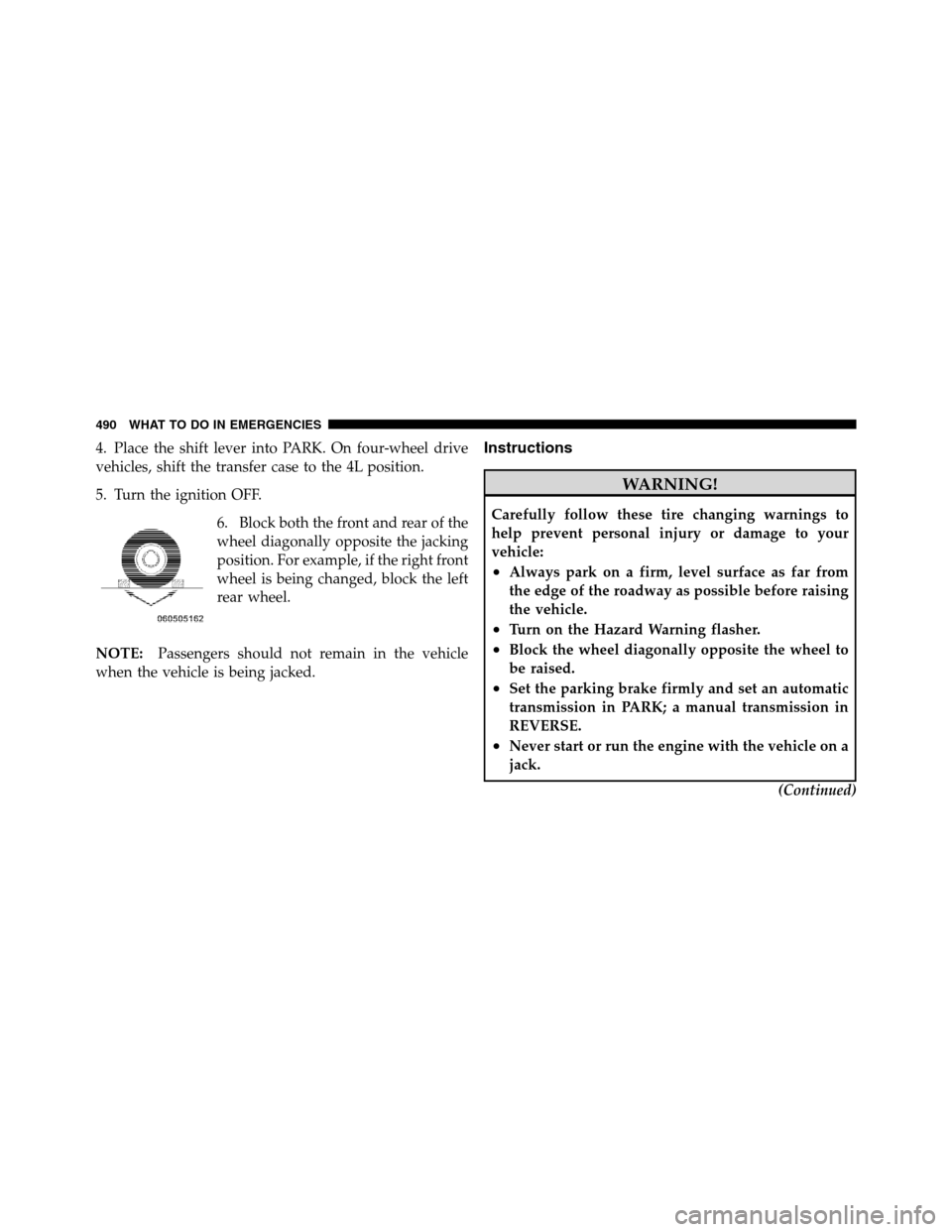
6. Block both the front and rear of the
wheel diagonally opposite the jacking
position. For example, if the right front
wheel is being changed, block the left
rear wheel.
NOTE:Passengers should not remain in the vehicle
when the vehicle is being jacked.Instructions
WARNING!
Carefully follow these tire changing warnings to
help prevent personal injury or damage to your
vehicle:
•Always park on a firm, level surface as far from
the edge of the roadway as possible before raising
the vehicle.
•Turn on the Hazard Warning flasher.
•Block the wheel diagonally opposite the wheel to
be raised.
•Set the parking brake firmly and set an automatic
transmission in PARK; a manual transmission in
REVERSE.
•Never start or run the engine with the vehicle on a
jack.
(Continued)
490 WHAT TO DO IN EMERGENCIES
Page 504 of 622

WARNING!
•Take care to avoid the radiator cooling fan when-
ever the hood is raised. It can start anytime the
ignition switch is on. You can be injured by
moving fan blades.
•Remove any metal jewelry such as watch bands or
bracelets that might make an inadvertent electrical
contact. You could be seriously injured.
•Batteries contain sulfuric acid that can burn your
skin or eyes and generate hydrogen gas which is
flammable and explosive. Keep open flames or
sparks away from the battery.
1. Set the parking brake, shift the automatic transmission
into PARK and turn the ignition to LOCK.
2. Turn off the heater, radio, and all unnecessary electri-
cal accessories.3. If using another vehicle to jump-start the battery, park
the vehicle within the jumper cables reach, set the
parking brake and make sure the ignition is OFF.
WARNING!
Do not allow vehicles to touch each other as this
could establish a ground connection and personal
injury could result.
Jump-Starting Procedure
WARNING!
Failure to follow this procedure could result in per-
sonal injury or property damage due to battery ex-
plosion.
6
WHAT TO DO IN EMERGENCIES 503
Page 506 of 622

8. Disconnect the opposite end of the positive(+)jumper
cable from the positive(+)post of the booster battery.
9. Disconnect the positive(+)end of the jumper cable
from the positive(+)post of the discharged vehicle.
If frequent jump-starting is required to start your vehicle
you should have the battery and charging system in-
spected at your authorized dealer.
CAUTION!
Accessories that can be plugged into the vehicle
power outlets draw power from the vehicle’s battery,
even when not in use (i.e., cellular phones, etc.).
Eventually, if plugged in long enough, the vehicle’s
battery will discharge sufficiently to degrade battery
life and/or prevent the engine from starting.
FREEING A STUCK VEHICLE
If the vehicle becomes stuck in snow, sand or mud, it can
often be moved by a rocking motion. Move the shift lever
rhythmically between DRIVE and REVERSE while ap-
plying slight pressure to the accelerator. In general, the
least amount of accelerator pedal pressure to maintain
the rocking motion without spinning the wheels or racing
the engine is most effective.
CAUTION!
Racing the engine or spinning the wheels may lead to
transmission overheating and failure. Allow the en-
gine to idle with the shift lever in NEUTRAL for at
least one minute after every five rocking-motion
cycles. This will minimize overheating and reduce
the risk of transmission failure during prolonged
efforts to free a stuck vehicle.6
WHAT TO DO IN EMERGENCIES 505