air condition Ram 3500 2014 Diesel Supplement
[x] Cancel search | Manufacturer: RAM, Model Year: 2014, Model line: 3500, Model: Ram 3500 2014Pages: 360, PDF Size: 2.02 MB
Page 218 of 360
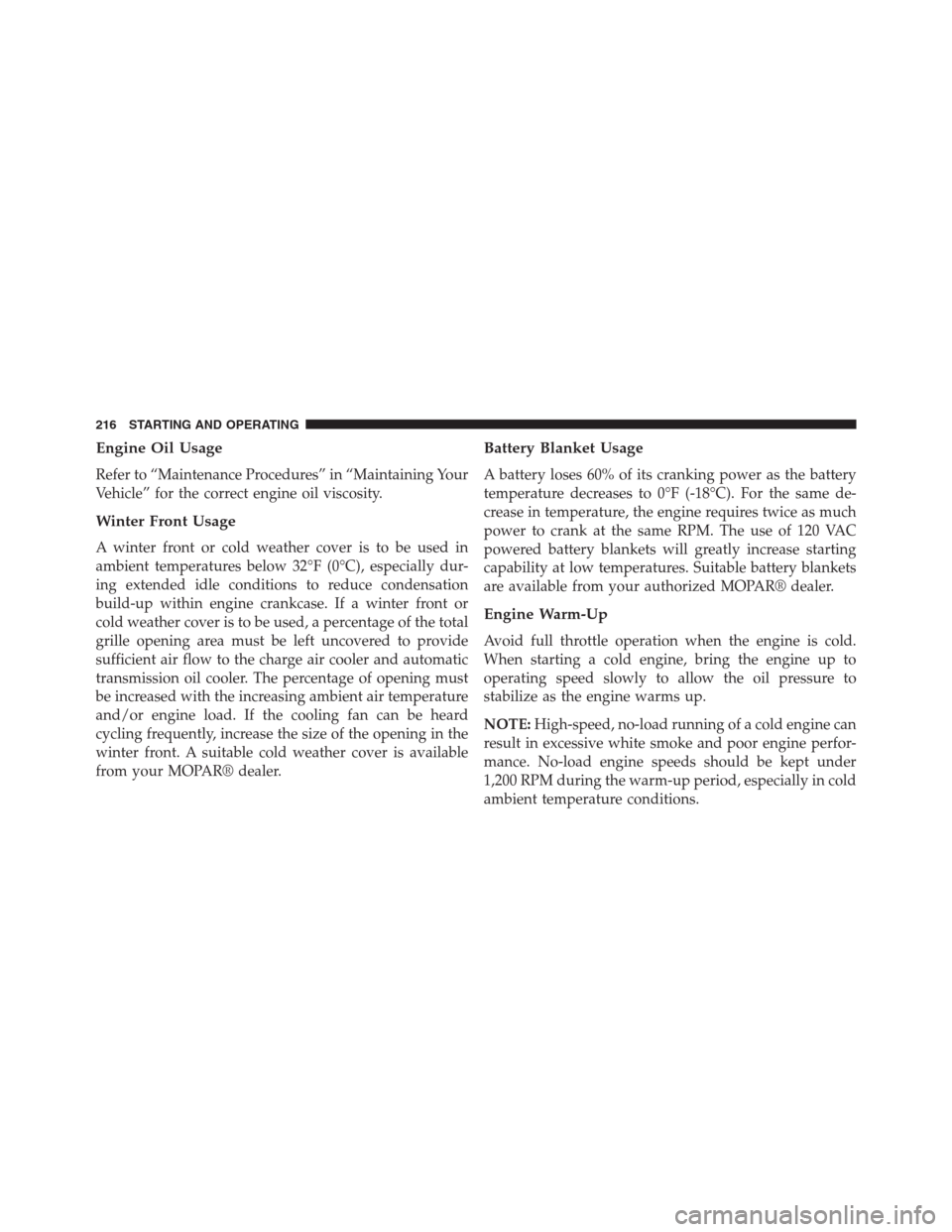
Engine Oil Usage
Refer to “Maintenance Procedures” in “Maintaining Your
Vehicle” for the correct engine oil viscosity.
Winter Front Usage
A winter front or cold weather cover is to be used in
ambient temperatures below 32°F (0°C), especially dur-
ing extended idle conditions to reduce condensation
build-up within engine crankcase. If a winter front or
cold weather cover is to be used, a percentage of the total
grille opening area must be left uncovered to provide
sufficient air flow to the charge air cooler and automatic
transmission oil cooler. The percentage of opening must
be increased with the increasing ambient air temperature
and/or engine load. If the cooling fan can be heard
cycling frequently, increase the size of the opening in the
winter front. A suitable cold weather cover is available
from your MOPAR® dealer.
Battery Blanket Usage
A battery loses 60% of its cranking power as the battery
temperature decreases to 0°F (-18°C). For the same de-
crease in temperature, the engine requires twice as much
power to crank at the same RPM. The use of 120 VAC
powered battery blankets will greatly increase starting
capability at low temperatures. Suitable battery blankets
are available from your authorized MOPAR® dealer.
Engine Warm-Up
Avoid full throttle operation when the engine is cold.
When starting a cold engine, bring the engine up to
operating speed slowly to allow the oil pressure to
stabilize as the engine warms up.
NOTE:High-speed, no-load running of a cold engine can
result in excessive white smoke and poor engine perfor-
mance. No-load engine speeds should be kept under
1,200 RPM during the warm-up period, especially in cold
ambient temperature conditions.
216 STARTING AND OPERATING
Page 221 of 360
allow the lubricating oil and coolant to carry excess heat
away from the combustion chamber, bearings, internal
components, and turbocharger. This is especially impor-
tant for turbocharged, charge air-cooled engines.
NOTE:
•During engine shut down on vehicles equipped with
manual transmissions, it is normal for the diesel en-
gine to resonate heavily for a moment during engine
shut off. When the engine is connected to a manual
transmission, this resonance causes load gear rattle
from the transmission. This is commonly referred to as
“shut down rattle.” The manufacturer recommends
performing engine shut down with the clutch pedal
pushed to the floor (clutch disengaged). When engine
shut down is performed in this manner the rattle is
reduced (not eliminated).
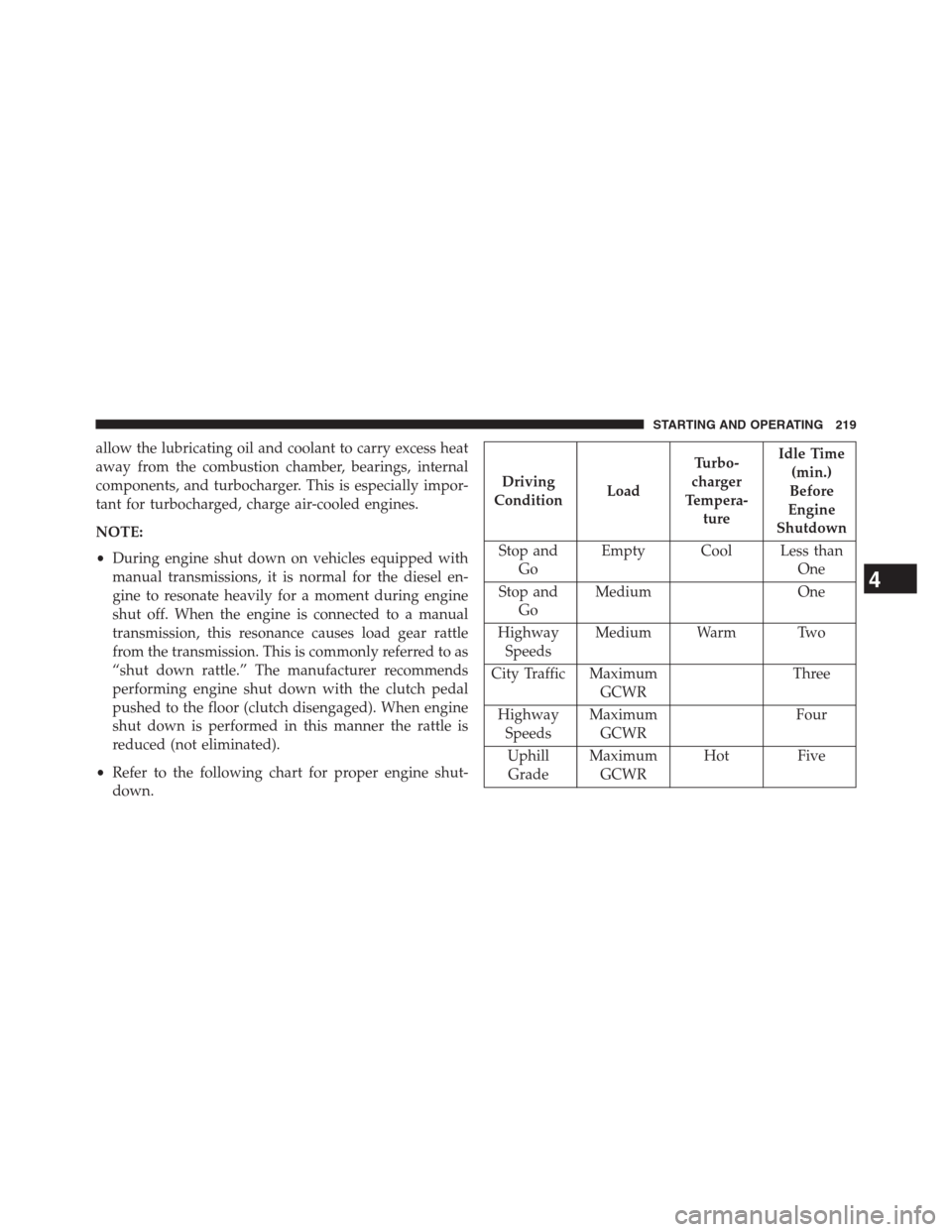
•Refer to the following chart for proper engine shut-
down.
Driving
ConditionLoadTurbo-
charger
Tempera-
tureIdle Time
(min.)
Before
Engine
Shutdown
Stop and
GoEmpty Cool Less than
One
Stop and
GoMedium One
Highway
SpeedsMedium Warm Two
City Traffic Maximum
GCWRThree
Highway
SpeedsMaximum
GCWRFour
Uphill
GradeMaximum
GCWRHot Five
4
STARTING AND OPERATING 219
Page 223 of 360
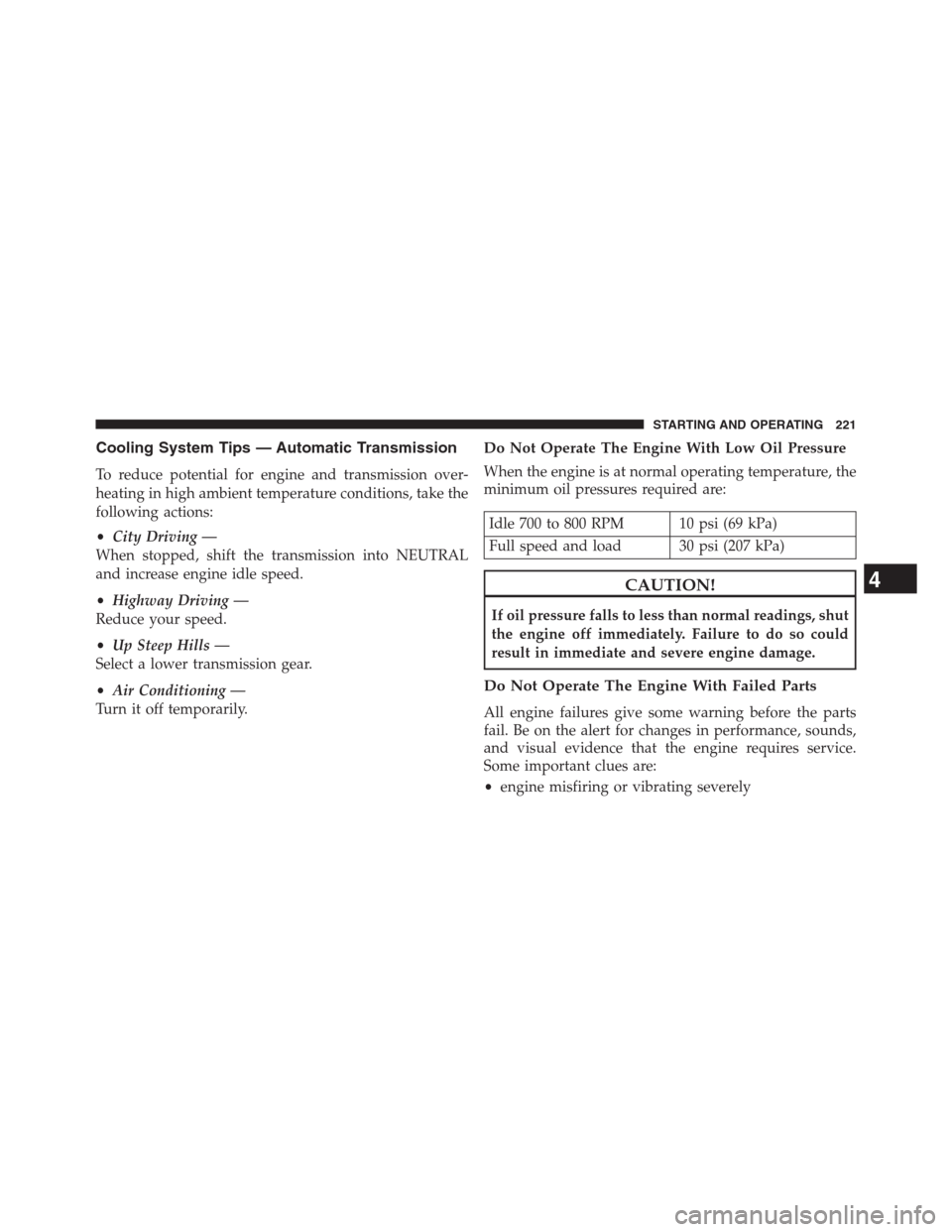
Cooling System Tips — Automatic Transmission
To reduce potential for engine and transmission over-
heating in high ambient temperature conditions, take the
following actions:
•City Driving —
When stopped, shift the transmission into NEUTRAL
and increase engine idle speed.
•Highway Driving —
Reduce your speed.
•Up Steep Hills —
Select a lower transmission gear.
•Air Conditioning —
Turn it off temporarily.
Do Not Operate The Engine With Low Oil Pressure
When the engine is at normal operating temperature, the
minimum oil pressures required are:
Idle 700 to 800 RPM 10 psi (69 kPa)
Full speed and load 30 psi (207 kPa)
CAUTION!
If oil pressure falls to less than normal readings, shut
the engine off immediately. Failure to do so could
result in immediate and severe engine damage.
Do Not Operate The Engine With Failed Parts
All engine failures give some warning before the parts
fail. Be on the alert for changes in performance, sounds,
and visual evidence that the engine requires service.
Some important clues are:
•engine misfiring or vibrating severely
4
STARTING AND OPERATING 221
Page 249 of 360
NOTE:For application specific information with respect
to PTO and pump requirements and additional vehicle
information (wiring schematics, preset idle values, en-
gine speed limits, and vehicle hardware and software
requirements) please refer to the Body Builders Guide by
accessingwww.rambodybuilder.comand choosing the
appropriate links.
Power Take Off — Aftermarket Installation
If you did not order the PTO (Power Take Off) Prep
Package from the factory and want to convert your
vehicle, refer to the Body Builder’s Guide at
www.rambodybuilder.comor contact the manufacturer
directly at (866) 205–4102 (toll free).
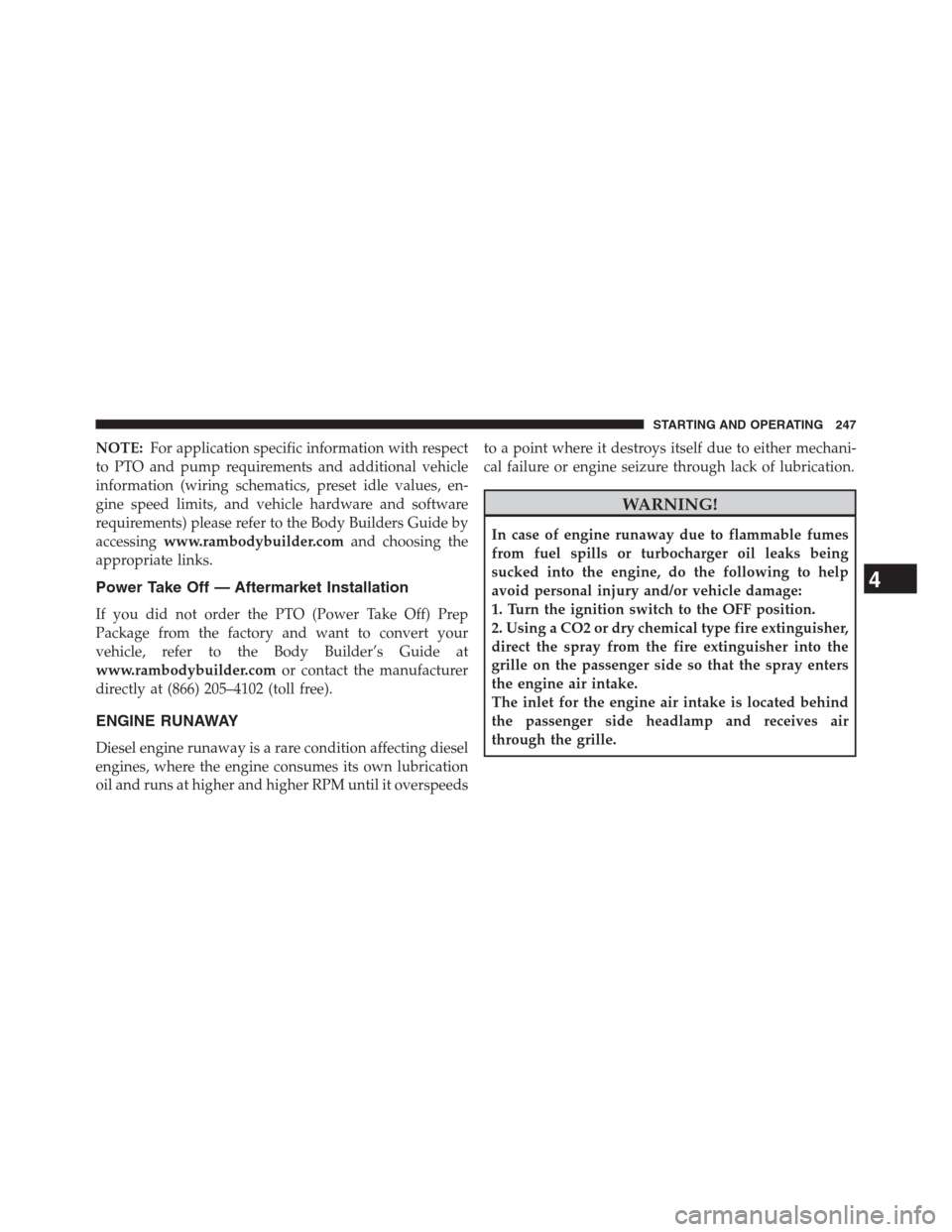
ENGINE RUNAWAY
Diesel engine runaway is a rare condition affecting diesel
engines, where the engine consumes its own lubrication
oil and runs at higher and higher RPM until it overspeedsto a point where it destroys itself due to either mechani-
cal failure or engine seizure through lack of lubrication.
WARNING!
In case of engine runaway due to flammable fumes
from fuel spills or turbocharger oil leaks being
sucked into the engine, do the following to help
avoid personal injury and/or vehicle damage:
1. Turn the ignition switch to the OFF position.
2. Using a CO2 or dry chemical type fire extinguisher,
direct the spray from the fire extinguisher into the
grille on the passenger side so that the spray enters
the engine air intake.
The inlet for the engine air intake is located behind
the passenger side headlamp and receives air
through the grille.
4
STARTING AND OPERATING 247
Page 280 of 360
Tow/Haul Mode
To reduce potential for automatic transmission overheat-
ing, activate TOW/HAUL mode when driving in hilly
areas, or select a lower gear range (using the Electronic
Range Select (ERS) shift control) on more severe grades.
Electronic Speed Control — If Equipped
•Do not use in hilly terrain or with heavy loads.
•When using the speed control, if you experience speed
drops greater than 10 mph (16 km/h), disengage until
you can get back to cruising speed.
•Use speed control in flat terrain and with light loads to
maximize fuel efficiency.
Cooling System
To reduce potential for engine and transmission over-
heating, take the following actions:
City Driving
When stopped for short periods of time, shift the trans-
mission into NEUTRAL and increase engine idle speed.
Highway Driving
Reduce speed.
Air Conditioning
Turn off temporarily.
278 STARTING AND OPERATING
Page 293 of 360
MAINTENANCE PROCEDURES
The pages that follow contain therequiredmaintenance
services determined by the engineers who designed your
vehicle.
Besides those maintenance items specified in the fixed
maintenance schedule, there are other components which
may require servicing or replacement in the future.
CAUTION!
•Failure to properly maintain your vehicle or per-
form repairs and service when necessary could
result in more costly repairs, damage to other
components or negatively impact vehicle perfor-
mance. Immediately have potential malfunctions
examined by an authorized dealership or qualified
repair center.
(Continued)
CAUTION!(Continued)
•Your vehicle has been built with improved fluids
that protect the performance and durability of your
vehicle and also allow extended maintenance inter-
vals. Do not use chemical flushes in these compo-
nents as the chemicals can damage your engine,
transmission, power steering or air conditioning.
Such damage is not covered by the New Vehicle
Limited Warranty. If a flush is needed because of
component malfunction, use only the specified
fluid for the flushing procedure.
6
MAINTAINING YOUR VEHICLE 291
Page 298 of 360
Disposing Of Used Engine Oil And Oil Filters
Care should be taken in disposing of used engine oil and
oil filters from your vehicle. Used oil and oil filters,
indiscriminately discarded, can present a problem to the
environment. Contact your authorized dealer, service
station or governmental agency for advice on how and
where used oil and oil filters can be safely discarded in
your area.
Engine Air Cleaner Filter
CAUTION!
All air entering the engine intake must be filtered.
The abrasive particles in unfiltered air will cause
rapid wear to engine components.
WARNING!
The air induction system (air cleaner, hoses, etc.)
provides a measure of protection. Do not remove the
air induction system (air cleaner, hoses, etc.) unless
such removal is necessary for repair or maintenance.
Make sure that no one is near the engine compart-
ment before starting the vehicle with the air induc-
tion system (air cleaner, hoses, etc.) removed. Failure
to do so can result in serious personal injury.
The condition of the air cleaner filter is monitored by the
Engine Control Module. The “SERVICE AIR FILTER” mes-
sage will display in the Electronic Vehicle Information
Center (EVIC) when service is required. Refer to “Elec-
tronic Vehicle Information Center (EVIC)” in “Understand-
ing Your Instrument Panel” for further information.
296 MAINTAINING YOUR VEHICLE
Page 299 of 360
The “SERVICE AIR FILTER” message could be displayed
periodically. This is because engine air flow requirements
change based on driving conditions. As the filter becomes
more restrictive and air flow requirements increase the
“SERVICE AIR FILTER” message will be displayed. The
message may not be displayed in subsequent drive cycles
if the same conditions are not met. The air filter element
should be replaced within 250 miles (402 km) from the
first time this message is displayed to ensure proper
engine operation during all driving conditions.
CAUTION!
Driving with a restricted air filter can cause engine
damage. Driving in dusty environments for extended
periods will lead to rapid air filter plugging. Action
should be taken as soon as the “SERVICE AIR
FILTER” message is displayed.If the vehicle experiences a sudden loss of engine power
while being driven in heavy snow or rain, or when
plowing snow, and/or the “SERVICE AIR FILTER” mes-
sage is displayed on the EVIC along with a chime that
repeats every 60 seconds, visually inspect the air filter for
snow/ice build up or extreme water saturation. If the air
filter is not damaged, remove all snow/ice and reinstall
air filter. If the air filter is damaged, replace filter element.
NOTE:The air filter housing contains a Mass Air Flow
sensor. This sensor is critical to proper engine operation
and component longevity. Any damage or modification
to this sensor could result in major engine and/or
exhaust aftertreatment damage. We recommend you use
MOPAR® brand parts.
Even though your vehicle is equipped with an Air Filter
Monitor, a visual inspection of the air cleaner filter
element is recommended every 15,000 miles (24,000km)
6
MAINTAINING YOUR VEHICLE 297
Page 308 of 360
Priming If The Engine Has Run Out Of Fuel
WARNING!
Do not open the high pressure fuel system with the
engine running. Engine operation causes high fuel
pressure. High pressure fuel spray can cause serious
injury or death.
1. Add a substantial amount of fuel to the tank, approxi-
mately 2 to 5 gal (8L to 19L).
2. Turn ignition switch to the start position to engage
starter for one second, return ignition switch to run
position. This will activate in tank fuel pump for
approximately 15 seconds. Repeat this process twice.
3. Start the engine using the “Normal Starting” proce-
dure. Refer to “Starting Procedures” in “Starting and
Operating” for further information.
CAUTION!
Do not engage the starter motor for more than 15
seconds at a time. Allow two minutes between the
cranking intervals.
NOTE:The engine may run rough until the air is forced
from all the fuel lines.
WARNING!
Do not use alcohol or gasoline as a fuel blending
agent. They can be unstable under certain conditions
and be hazardous or explosive when mixed with
diesel fuel.
306 MAINTAINING YOUR VEHICLE
Page 317 of 360
•If frequent engine coolant (antifreeze) additions are
required, the cooling system should be pressure tested
for leaks.
•Maintain engine coolant (antifreeze) concentration at a
minimum of 50% OAT coolant (conforming to MS-
12106) and distilled water for proper corrosion protec-
tion of your engine which contains aluminum compo-
nents.
•Make sure that the coolant expansion bottle overflow
hoses are not kinked or obstructed.
•Keep the front of the radiator clean. If your vehicle is
equipped with air conditioning, keep the front of the
condenser clean.
•
Do not change the thermostat for Summer or Winter
operation. If replacement is ever necessary, install ONLY
the correct type thermostat. Other designs may result in
unsatisfactory engine coolant (antifreeze) performance,
poor gas mileage, and increased emissions.
Charge Air Cooler — Inter-Cooler
The charge air cooler is positioned below the radiator and
the air conditioner condenser. Air enters the engine
through the air cleaner and passes through the turbo-
charger, where it is pressurized. This pressurized air
rapidly reaches high temperature. The air is then directed
through a hose to the charge air cooler and through
another hose to the intake manifold of the engine. The air
entering the engine has been cooled by about 50° to 100°F
(10° to 38°C). This cooling process enables more efficient
burning of fuel resulting in fewer emissions.
To guarantee optimum performance of the system, keep
the surfaces of the charge air cooler, condenser and
radiator clean and free of debris. Periodically check the
hoses leading to and from the charge air cooler for cracks
or loose clamps resulting in loss of pressure and reduced
engine performance.
6
MAINTAINING YOUR VEHICLE 315