maintenance schedule Ram 3500 2017 Diesel Supplement
[x] Cancel search | Manufacturer: RAM, Model Year: 2017, Model line: 3500, Model: Ram 3500 2017Pages: 228, PDF Size: 1.35 MB
Page 82 of 228
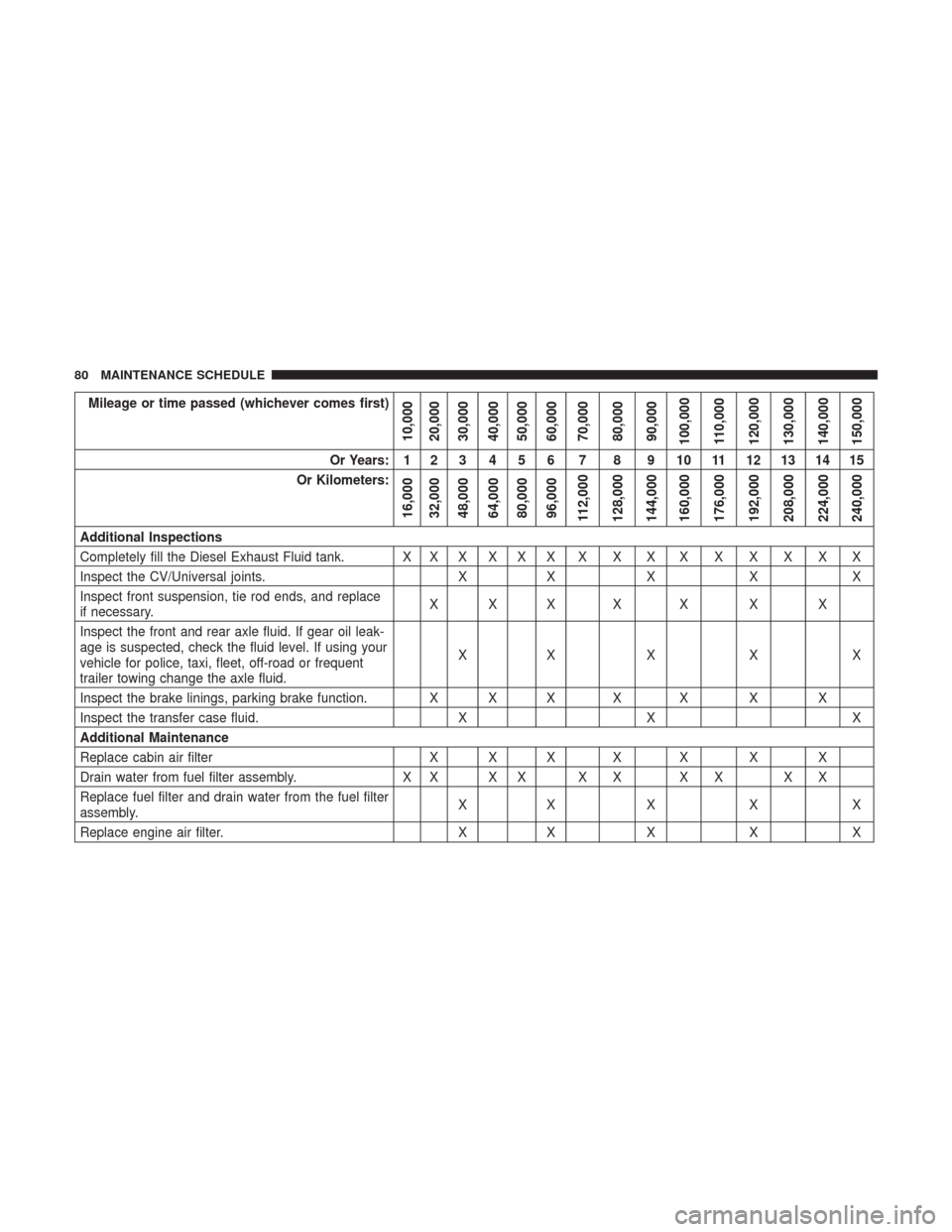
Mileage or time passed (whichever comes first)
10,000
20,000
30,000
40,000
50,000
60,000
70,000
80,000
90,000
100,000
110,000
120,000
130,000
140,000
150,000
Or Years: 1 2 3 4 5 6 7 8 9 10 11 12 13 14 15
Or Kilometers:
16,000
32,000
48,000
64,000
80,000
96,000
112,000
128,000
144,000
160,000
176,000
192,000
208,000
224,000
240,000
Additional Inspections
Completely fill the Diesel Exhaust Fluid tank. X X X X X X X X X X X X X X X
Inspect the CV/Universal joints. XX X X X
Inspect front suspension, tie rod ends, and replace
if necessary. XXX X X X X
Inspect the front and rear axle fluid. If gear oil leak-
age is suspected, check the fluid level. If using your
vehicle for police, taxi, fleet, off-road or frequent
trailer towing change the axle fluid. XX X X X
Inspect the brake linings, parking brake function. X X X X X X X
Inspect the transfer case fluid. XX X
Additional Maintenance
Replace cabin air filter X X X X X X X
Drain water from fuel filter assembly. X X X X X X X X X X
Replace fuel filter and drain water from the fuel filter
assembly. XX X X X
Replace engine air filter. XX X X X
80 MAINTENANCE SCHEDULE
Page 83 of 228
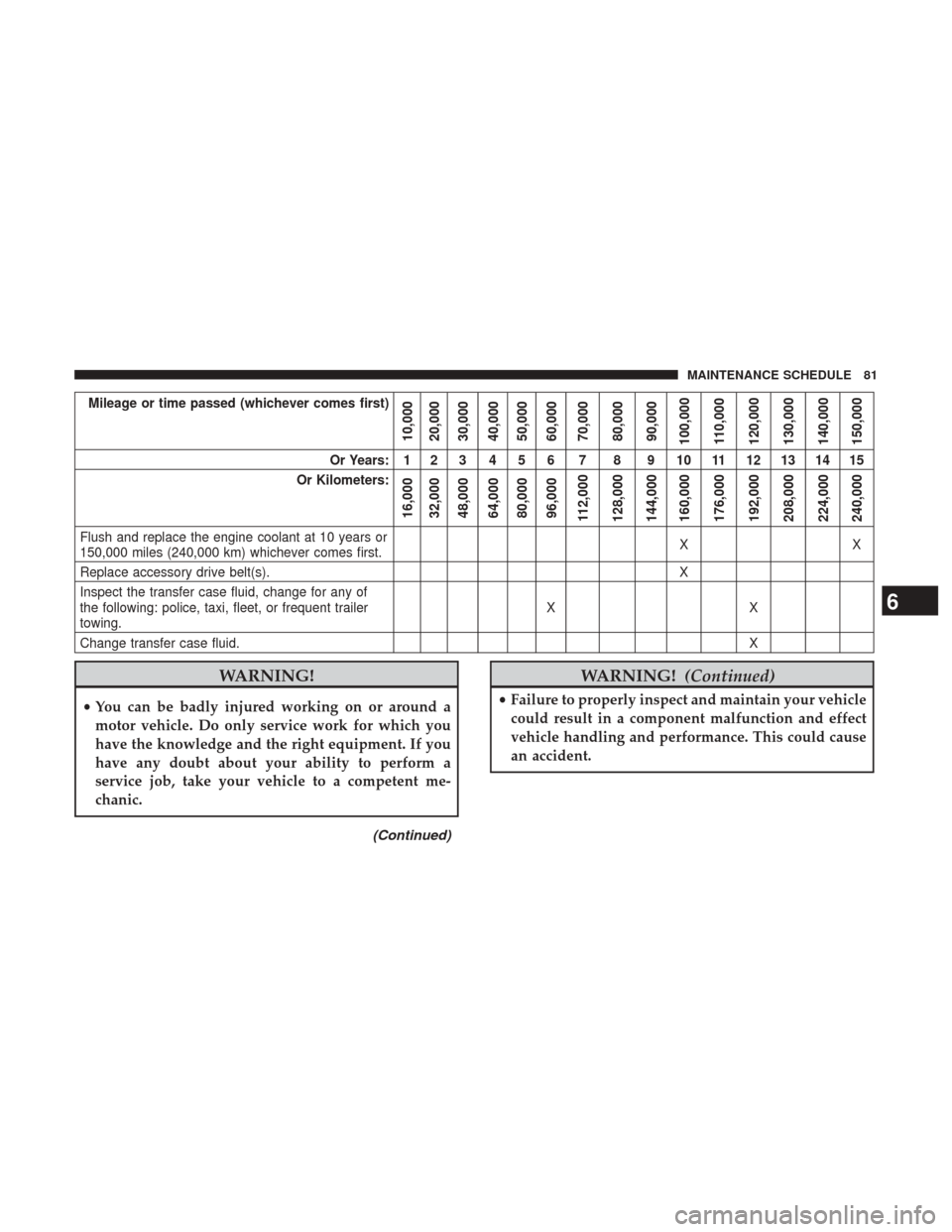
Mileage or time passed (whichever comes first)
10,000
20,000
30,000
40,000
50,000
60,000
70,000
80,000
90,000
100,000
110,000
120,000
130,000
140,000
150,000
Or Years: 1 2 3 4 5 6 7 8 9 10 11 12 13 14 15
Or Kilometers:
16,000
32,000
48,000
64,000
80,000
96,000
112,000
128,000
144,000
160,000
176,000
192,000
208,000
224,000
240,000
Flush and replace the engine coolant at 10 years or
150,000 miles (240,000 km) whichever comes first. XX
Replace accessory drive belt(s). X
Inspect the transfer case fluid, change for any of
the following: police, taxi, fleet, or frequent trailer
towing. XX
Change transfer case fluid. X
WARNING!
•You can be badly injured working on or around a
motor vehicle. Do only service work for which you
have the knowledge and the right equipment. If you
have any doubt about your ability to perform a
service job, take your vehicle to a competent me-
chanic.
(Continued)
WARNING! (Continued)
•Failure to properly inspect and maintain your vehicle
could result in a component malfunction and effect
vehicle handling and performance. This could cause
an accident.
6
MAINTENANCE SCHEDULE 81
Page 84 of 228
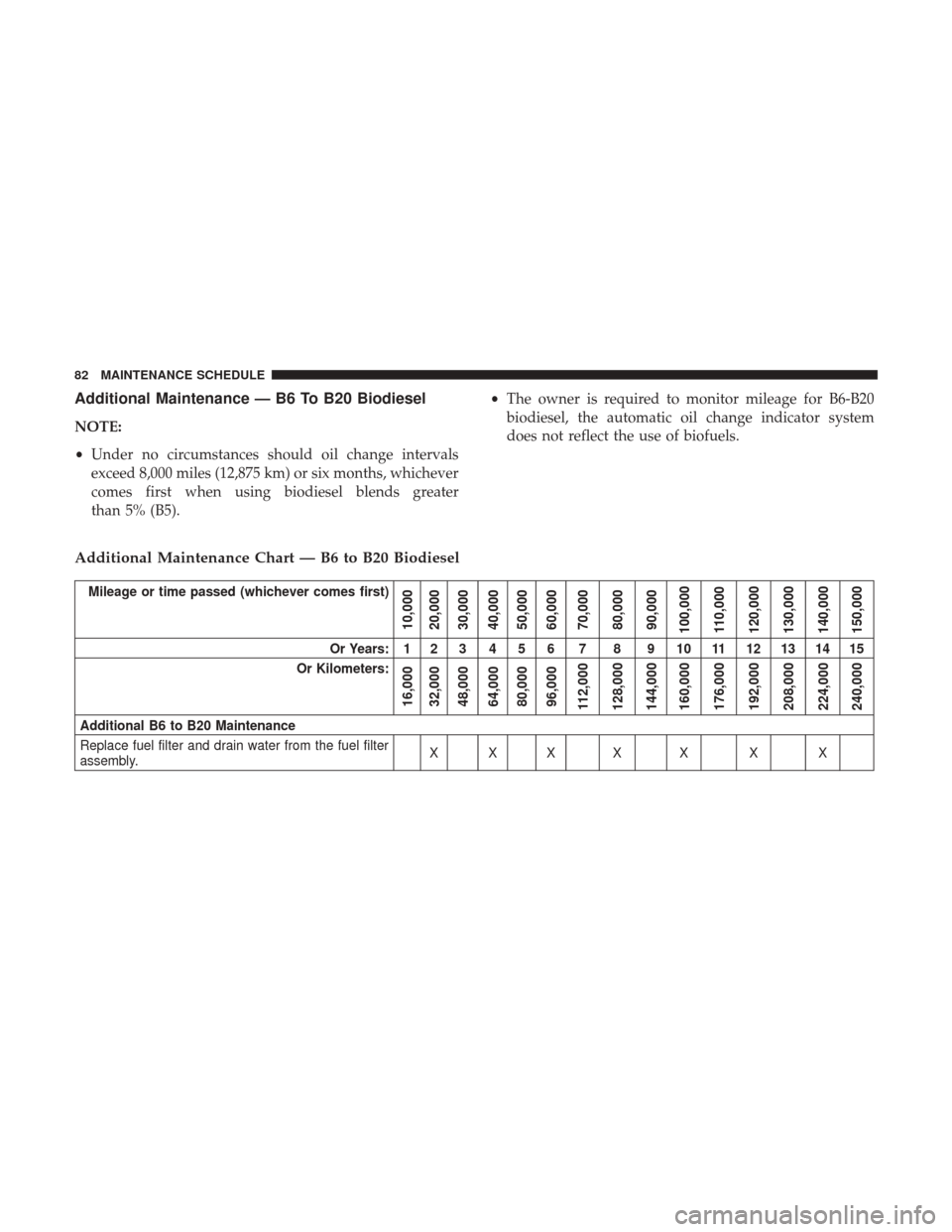
Additional Maintenance — B6 To B20 Biodiesel
NOTE:
•Under no circumstances should oil change intervals
exceed 8,000 miles (12,875 km) or six months, whichever
comes first when using biodiesel blends greater
than 5% (B5). •
The owner is required to monitor mileage for B6-B20
biodiesel, the automatic oil change indicator system
does not reflect the use of biofuels.
Additional Maintenance Chart — B6 to B20 Biodiesel
Mileage or time passed (whichever comes first)
10,000
20,000
30,000
40,000
50,000
60,000
70,000
80,000
90,000
100,000
110,000
120,000
130,000
140,000
150,000
Or Years: 1 2 3 4 5 6 7 8 9 10 11 12 13 14 15
Or Kilometers:
16,000
32,000
48,000
64,000
80,000
96,000
112,000
128,000
144,000
160,000
176,000
192,000
208,000
224,000
240,000
Additional B6 to B20 Maintenance
Replace fuel filter and drain water from the fuel filter
assembly. XXX X X X X
82 MAINTENANCE SCHEDULE
Page 85 of 228
WARNING!
•You can be badly injured working on or around a
motor vehicle. Do only service work for which you
have the knowledge and the right equipment. If you
have any doubt about your ability to perform a
service job, take your vehicle to a competent me-
chanic.
• Failure to properly inspect and maintain your vehicle
could result in a component malfunction and effect
vehicle handling and performance. This could cause
an accident.
6
MAINTENANCE SCHEDULE 83
Page 86 of 228

84 MAINTENANCE SCHEDULE
Page 89 of 228
TABLE OF CONTENTSSECTIONPAGE
1
INTRODUCTION .................................................................89
2
THINGS TO KNOW BEFORE STARTING YOUR VEHICLE ................................91
3
UNDERSTANDING THE FEATURES OF YOUR VEHICLE .................................95
4
UNDERSTANDING YOUR INSTRUMENT PANEL ......................................101
5
STARTING AND OPERATING ......................................................119
6
WHAT TO DO IN EMERGENCIES ...................................................169
7
MAINTAINING YOUR VEHICLE ....................................................173
8
MAINTENANCE SCHEDULE .......................................................209
1
2
3
4
5
6
7
8
Page 178 of 228
MAINTENANCE PROCEDURES
The pages that follow contain therequiredmaintenance
services determined by the engineers who designed your
vehicle.
Besides those maintenance items specified in the fixed
maintenance schedule, there are other components which
may require servicing or replacement in the future.
CAUTION!
• Failure to properly maintain your vehicle or perform
repairs and service when necessary could result in
more costly repairs, damage to other components or
negatively impact vehicle performance. Immediately
have potential malfunctions examined by an autho-
rized dealership or qualified repair center.
(Continued)
CAUTION! (Continued)
•Your vehicle has been built with improved fluids
that protect the performance and durability of your
vehicle and also allow extended maintenance inter-
vals. Do not use chemical flushes in these compo-
nents as the chemicals can damage your engine,
transmission, power steering or air conditioning.
Such damage is not covered by the New Vehicle
Limited Warranty. If a flush is needed because of
component malfunction, use only the specified fluid
for the flushing procedure.
Engine Oil
Checking Oil Level
To assure proper lubrication of your vehicle’s engine, the
engine oil must be maintained at the correct level. Check
the oil level at regular intervals. The best time to check the
oil level is before starting the engine after it has been
parked overnight. When checking oil after operating the
engine, first ensure the engine is at full operating tempera-
ture, then wait for 30 minutes after engine shutdown to
check the oil.
176 MAINTAINING YOUR VEHICLE
Page 179 of 228
Checking the oil while the vehicle is on level ground will
improve the accuracy of the oil level readings. Add oil only
when the level on the dipstick is below the “ADD” mark.
The total capacity from the ADD mark to the Full mark is
2 qts (1.9L).
CAUTION!
Overfilling or underfilling the crankcase will cause oil
aeration or loss of oil pressure. This could damage your
engine.
Never operate the engine with oil level below the “ADD”
mark or above the upper “SAFE” mark.
Change Engine Oil
Refer to the “Maintenance Schedule” for the proper main-
tenance intervals.
Engine Oil Selection
For best performance and maximum protection under all
types of operating conditions, the manufacturer only rec-
ommends engine oils that are API CJ-4 certified and meet
the requirements of FCA LLC. Use MOPAR or an equiva-
lent oil meeting FCA Material Standard MS-10902. Prod-
ucts meeting Cummins CES 20081 may also be used. The
identification of these engine oils are typically located on
the back of the oil container.
Engine Oil Dipstick
1 — ADD Range
2—FullMark
3 — SAFE Range7
MAINTAINING YOUR VEHICLE 177
Page 194 of 228
Cooling System — Drain Flush And Refill
If the engine coolant (antifreeze) is dirty or contains a
considerable amount of sediment, clean and flush with a
reliable cooling system cleaner. Follow with a thorough
rinsing to remove all deposits and chemicals. Properly
dispose of old engine coolant (antifreeze).
Refer to the “Maintenance Schedule” for the proper main-
tenance intervals.
Selection Of Coolant
Refer to “Fluids, Lubricants, And Genuine Parts” in “Main-
taining Your Vehicle” for further information.
CAUTION!
•Mixing of engine coolant (antifreeze) other than speci-
fied Organic Additive Technology (OAT) engine cool-
ant (antifreeze), may result in engine damage and may
decrease corrosion protection. Organic Additive Tech-
nology (OAT) engine coolant is different and should
not be mixed with Hybrid Organic Additive Technol-
ogy (HOAT) engine coolant (antifreeze) or any “glob-
ally compatible” coolant (antifreeze). If a non-OAT
(Continued)
CAUTION! (Continued)
engine coolant (antifreeze) is introduced into the cool-
ing system in an emergency, the cooling system will
need to be drained, flushed, and refilled with fresh
OAT coolant (conforming to MS.90032), by an autho-
rized dealer as soon as possible.
•Do not use water alone or alcohol-based engine
coolant (antifreeze) products. Do not use additional
rust inhibitors or antirust products, as they may not
be compatible with the engine coolant and may plug
the radiator.
• This vehicle has not been designed for use with
propylene glycol-based engine coolant (antifreeze).
Use of propylene glycol-based engine coolant (anti-
freeze) is not recommended.
Adding Coolant
Your vehicle has been built with an improved engine
coolant (OAT coolant conforming to MS.90032) that allows
extended maintenance intervals. This engine coolant (anti-
freeze) can be used up to ten years or 150,000 miles
(240,000 km) before replacement. To prevent reducing this
extended maintenance period, it is important that you use
192 MAINTAINING YOUR VEHICLE
Page 199 of 228
Transfer Case — If Equipped
Drain And Refill
Refer to the “Maintenance Schedule” for the proper main-
tenance intervals.
Selection of Lubricant
Refer to “Fluids, Lubricants, and Genuine Parts” in “Main-
taining Your Vehicle” for fluid specifications.
Fluid Level Check
This fluid level can be checked by removing the filler plug.
The fluid level should be to the bottom edge of the filler
plug hole with the vehicle in a level position.
Manual Transmission — If Equipped
Selection of Lubricant
Refer to “Fluids, Lubricants, and Genuine Parts” in “Main-
taining Your Vehicle” for fluid specifications.
Fluid Level Check
The fluid level can be checked by removing the filler plug.
If the level of the lubricant is more than 1/2 in (12 mm)
below the bottom of the filler hole while the vehicle is onlevel ground, enough lubricant should be added to bring
the level to 1/4 in (6 mm) below the bottom of the filler
hole.
Automatic Transmission — If Equipped
Selection of Lubricant
It is important to use the proper transmission fluid to
ensure optimum transmission performance and life. Use
only the manufacturer ’s specified transmission fluid. Refer
to “Fluids, Lubricants, and Genuine Parts” in this section
for fluid specifications. It is important to maintain the
transmission fluid at the correct level using the recom-
mended fluid.
No chemical flushes should be used in any transmission;
only the approved lubricant should be used.
CAUTION!
Using a transmission fluid other than the manufactur-
er ’s recommended fluid may cause deterioration in
transmission shift quality and/or torque converter
shudder, and will require more frequent fluid and
filter changes. Refer to “Fluids, Lubricants, and Genu-
ine Parts” in this section for fluid specifications.
7
MAINTAINING YOUR VEHICLE 197