Amp Ram 3500 2019 Manual Online
[x] Cancel search | Manufacturer: RAM, Model Year: 2019, Model line: 3500, Model: Ram 3500 2019Pages: 696, PDF Size: 13.89 MB
Page 478 of 696

476 IN CASE OF EMERGENCY
Preparations For Jacking
1. Park the vehicle on a firm, level surface. Avoid ice or slip-
pery areas.
2. Place the gear selector into PARK. On four-wheel drive vehicles, shift the transfer case to the 4L position.
3. Turn on the Hazard Warning flasher.
4. Apply the parking brake.
5. Turn the ignition OFF. 6. Block both the front and rear of the wheel diagonally
opposite the jacking position. For example, if the right
front wheel is being changed, block the left rear wheel.
Wheel Blocked
NOTE:
Passengers should not remain in the vehicle when the
vehicle is being jacked.
WARNING!
Do not attempt to change a tire on the side of the vehicle
close to moving traffic. Pull far enough off the road to
avoid being hit when operating the jack or changing the
wheel.
Page 497 of 696

IN CASE OF EMERGENCY 495
TOWING A DISABLED VEHICLE
This section describes procedures for towing a disabled
vehicle using a commercial towing service.
If the transmission and drivetrain are operable, disabled
vehicles may also be towed as described under “Recreational
Towing” in the “Starting And Operating” section.
NOTE:
Vehicles equipped with the Air Suspension System must be
placed in Transport mode, before tying them down (from the
body) on a trailer or flatbed truck. If the vehicle cannot be
placed in Transport mode (for example, engine will not run),
tie-downs must be fastened to the axles (not to the body).
Failure to follow these instructions may cause fault codes to
be set and/or cause loss of proper tie-down tension.
Refer to "Air Suspension System — If Equipped" in "Starting
And Operating" for more information.
CAUTION!
• Racing the engine or spinning the wheels may lead to transmission overheating and failure. Allow the engine
to idle with the transmission in NEUTRAL for at least
one minute after every five rocking-motion cycles. This
will minimize overheating and reduce the risk of trans -
mission failure during prolonged efforts to free a stuck
vehicle.
• When “rocking” a stuck vehicle by shifting between DRIVE and REVERSE, do not spin the wheels faster
than 15 mph (24 km/h), or drivetrain damage may
result.
• Revving the engine or spinning the wheels too fast may lead to transmission overheating and failure. It can also
damage the tires. Do not spin the wheels above 30 mph
(48 km/h) while in gear (no transmission shifting occur -
ring).
6
Page 508 of 696
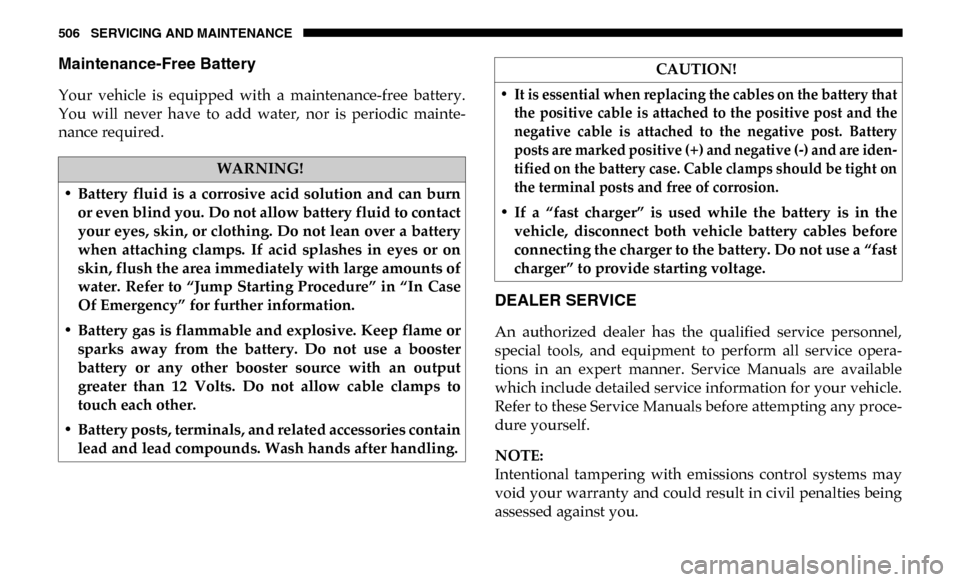
506 SERVICING AND MAINTENANCE
Maintenance-Free Battery
Your vehicle is equipped with a maintenance-free battery.
You will never have to add water, nor is periodic mainte-
nance required.
DEALER SERVICE
An authorized dealer has the qualified service personnel,
special tools, and equipment to perform all service opera -
tions in an expert manner. Service Manuals are available
which include detailed service information for your vehicle.
Refer to these Service Manuals before attempting any proce -
dure yourself.
NOTE:
Intentional tampering with emissions control systems may
void your warranty and could result in civil penalties being
assessed against you.
WARNING!
• Battery fluid is a corrosive acid solution and can burn or even blind you. Do not allow battery fluid to contact
your eyes, skin, or clothing. Do not lean over a battery
when attaching clamps. If acid splashes in eyes or on
skin, flush the area immediately with large amounts of
water. Refer to “Jump Starting Procedure” in “In Case
Of Emergency” for further information.
• Battery gas is flammable and explosive. Keep flame or sparks away from the battery. Do not use a booster
battery or any other booster source with an output
greater than 12 Volts. Do not allow cable clamps to
touch each other.
• Battery posts, terminals, and related accessories contain lead and lead compounds. Wash hands after handling.
CAUTION!
• It is essential when replacing the cables on the battery that the positive cable is attached to the positive post and the
negative cable is attached to the negative post. Battery
posts are marked positive (+) and negative (-) and are iden -
tified on the battery case. Cable clamps should be tight on
the terminal posts and free of corrosion.
• If a “fast charger” is used while the battery is in the vehicle, disconnect both vehicle battery cables before
connecting the charger to the battery. Do not use a “fast
charger” to provide starting voltage.
Page 512 of 696

510 SERVICING AND MAINTENANCE
Engine Air Cleaner Filter Inspection And Replacement
Inspect engine air cleaner filter for dirt and or debris, if you
find evidence of either dirt or debris you should change your
air cleaner filter.
Engine Air Cleaner Filter Removal
1. With suitable tool fully loosen (six) fasteners on aircleaner filter.
Air Cleaner Filter 2. Lift the air cleaner cover to access the air cleaner filter.
3. Remove the air cleaner filter element from the housing
assembly.
Open Air Cleaner Filter Assembly
1 — Fasteners
2 — Air Hose Clamp
3 — Air Cleaner Cover
1 — Air Cleaner Cover
2 — Air Cleaner Filter
Page 523 of 696

SERVICING AND MAINTENANCE 521
(Continued)
Under normal operating conditions, the catalytic converter
will not require maintenance. However, it is important to
keep the engine properly tuned to assure proper catalyst
operation and prevent possible catalyst damage.
NOTE:
Intentional tampering with emissions control systems can
result in civil penalties being assessed against you.
In unusual situations involving grossly malfunctioning
engine operation, a scorching odor may suggest severe and
abnormal catalyst overheating. If this occurs, stop the
vehicle, turn off the engine and allow it to cool. Service,
including a tune-up to manufacturer's specifications, should
be obtained immediately.
WARNING!
• Exhaust gases can injure or kill. They contain carbon monoxide (CO), which is colorless and odorless.
Breathing it can make you unconscious and can eventu -
ally poison you. To avoid breathing CO, refer to “Safety
Tips” in “Safety” for further information.
• A hot exhaust system can start a fire if you park over materials that can burn. Such materials might be grass
or leaves coming into contact with your exhaust system.
Do not park or operate your vehicle in areas where your
exhaust system can contact anything that can burn.
CAUTION!
• The catalytic converter requires the use of unleaded fuel only. Leaded gasoline will destroy the effective -
ness of the catalyst as an emissions control device and
may seriously reduce engine performance and cause
serious damage to the engine.
• Damage to the catalytic converter can result if your vehicle is not kept in proper operating condition. In the
event of engine malfunction, particularly involving
engine misfire or other apparent loss of performance,
have your vehicle serviced promptly. Continued opera -
tion of your vehicle with a severe malfunction could
cause the converter to overheat, resulting in possible
damage to the converter and vehicle. CAUTION!
(Continued)
7
Page 529 of 696

SERVICING AND MAINTENANCE 527
(Continued)
Brake System
In order to assure brake system performance, all brake
system components should be inspected periodically. Refer
to the “Maintenance Plan” in this section for the proper
maintenance intervals.
Fluid Level Check — Brake Master Cylinder
The fluid level of the master cylinder should be checked
when performing under the hood service or immediately if
the brake system warning lamp indicates system failure.
If necessary, add fluid to bring level within the designated
marks on the side of the reservoir of the brake master
cylinder. Be sure to clean the top of the master cylinder area
before removing cap.With disc brakes the fluid level can be expected to fall as the
brake linings wear. However, an unexpected drop in fluid
level may be caused by a leak and a system check should be
conducted.
Refer to “Fluids And Lubricants” in “Technical Specifica
-
tions” for further information.
WARNING!
Riding the brakes can lead to brake failure and possibly
a collision. Driving with your foot resting or riding on
the brake pedal can result in abnormally high brake
temperatures, excessive lining wear, and possible brake
damage. You would not have your full braking capacity
in an emergency.
WARNING!
• Use only manufacturer's recommended brake fluid. Refer to “Fluids And Lubricants” in “Technical Speci -
fications” for further information. Using the wrong
type of brake fluid can severely damage your brake
system and/or impair its performance. The proper type
of brake fluid for your vehicle is also identified on the
original factory installed hydraulic master cylinder
reservoir.
• To avoid contamination from foreign matter or mois -
ture, use only new brake fluid or fluid that has been in
a tightly closed container. Keep the master cylinder
reservoir cap secured at all times. Brake fluid in a open
container absorbs moisture from the air resulting in a
lower boiling point. This may cause it to boil unexpect -
edly during hard or prolonged braking, resulting in
sudden brake failure. This could result in a collision.
7
Page 534 of 696

532 SERVICING AND MAINTENANCE
NOTE:
• P (Passenger) — Metric tire sizing is based on U.S. designstandards. P-Metric tires have the letter “P” molded into
the sidewall preceding the size designation. Example:
P215/65R15 95H.
• European — Metric tire sizing is based on European design standards. Tires designed to this standard have the
tire size molded into the sidewall beginning with the
section width. The letter "P" is absent from this tire size
designation. Example: 215/65R15 96H. • LT (Light Truck) — Metric tire sizing is based on U.S.
design standards. The size designation for LT-Metric tires
is the same as for P-Metric tires except for the letters “LT”
that are molded into the sidewall preceding the size desig -
nation. Example: LT235/85R16.
• Temporary spare tires are designed for temporary emergency use only. Temporary high pressure compact spare tires have
the letter “T” or “S” molded into the sidewall preceding the
size designation. Example: T145/80D18 103M.
• High flotation tire sizing is based on U.S. design standards and it begins with the tire diameter molded into the side -
wall. Example: 31x10.5 R15 LT.
Page 535 of 696

SERVICING AND MAINTENANCE 533
Tire Sizing Chart EXAMPLE:
Example Size Designation: P215/65R15XL 95H, 215/65R15 96H, LT235/85R16C, T145/80D18 103M, 31x10.5 R15 LT
P = Passenger car tire size based on U.S. design standards, or
"....blank...." = Passenger car tire based on European design standards, or
LT = Light truck tire based on U.S. design standards, or
T or S = Temporary spare tire or
31 = Overall diameter in inches (in)
215, 235, 145 = Section width in millimeters (mm)
65, 85, 80 = Aspect ratio in percent (%)
• Ratio of section height to section width of tire, or
10.5 = Section width in inches (in)
R = Construction code
• "R" means radial construction, or
• "D" means diagonal or bias construction
15, 16, 18 = Rim diameter in inches (in)
Service Description:
95 = Load Index
• A numerical code associated with the maximum load a tire can carry
7
Page 536 of 696

534 SERVICING AND MAINTENANCE
H = Speed Symbol
• A symbol indicating the range of speeds at which a tire can carry a load corresponding to its load index under certain oper -
ating conditions
• The maximum speed corresponding to the speed symbol should only be achieved under specified operating conditions (i.e., tire pressure, vehicle loading, road conditions, and posted speed limits)
Load Identification:
Absence of the following load identification symbols on the sidewall of the tire indicates a Standard Load (SL) tire:
• XL = Extra load (or reinforced) tire, or
• LL = Light load tire or
• C, D, E, F, G = Load range associated with the maximum load a tire can carry at a specified pressure
Maximum Load – Maximum load indicates the maximum load this tire is designed to carry
Maximum Pressure – Maximum pressure indicates the maximum permissible cold tire inflation pressure for this tire EXAMPLE:
Page 537 of 696

SERVICING AND MAINTENANCE 535
Tire Identification Number (TIN)
The TIN may be found on one or both sides of the tire; however, the date code may only be on one side. Tires with white side-
walls will have the full TIN, including the date code, located on the white sidewall side of the tire. Look for the TIN on the
outboard side of black sidewall tires as mounted on the vehicle. If the TIN is not found on the outboard side, then you will
find it on the inboard side of the tire.
EXAMPLE:
DOT MA L9 ABCD 0301
DOT = Department of Transportation
• This symbol certifies that the tire is in compliance with the U.S. Department of Transportation tire safety standards and is approved for highway use
MA = Code representing the tire manufacturing location (two digits)
L9 = Code representing the tire size (two digits)
ABCD = Code used by the tire manufacturer (one to four digits)
03 = Number representing the week in which the tire was manufactured (two digits)
• 03 means the 3rd week
01 = Number representing the year in which the tire was manufactured (two digits)
• 01 means the year 2001
• Prior to July 2000, tire manufacturers were only required to have one number to represent the year in which the tire was manufactured. Example: 031 could represent the 3rd week of 1981 or 1991
7