engine overheat Ram 3500 Chassis Cab 2019 User Guide
[x] Cancel search | Manufacturer: RAM, Model Year: 2019, Model line: 3500 Chassis Cab, Model: Ram 3500 Chassis Cab 2019Pages: 607, PDF Size: 10.72 MB
Page 355 of 607

STARTING AND OPERATING 353
Seven-Pin Connector
Towing Tips
Before setting out on a trip, practice turning, stopping, and
backing up the trailer in an area located away from heavy
traffic.Automatic Transmission
The DRIVE range can be selected when towing. The trans
-
mission controls include a drive strategy to avoid frequent
shifting when towing. However, if frequent shifting does
occur while in DRIVE, select TOW/HAUL mode or select a
lower gear range (using the Electronic Range Select (ERS)
shift control).
NOTE:
Using TOW/HAUL mode or selecting a lower gear range
(using the ERS shift control) while operating the vehicle
under heavy loading conditions will improve performance
and extend transmission life by reducing excessive shifting
and heat build up. This action will also provide better engine
braking.
Six-Speed Automatic Transmission Only
When towing a loaded trailer up steep grades at low speeds
(20 mph [32 km/h] or below), holding your vehicle in first
gear (using the ERS shift control) can help to avoid transmis -
sion overheating.
1 — Battery 5 — Ground
2 — Backup Lamps 6 — Left Stop/Turn
3 — Right Stop/Turn 7 — Running Lamps
4 — Electric Brakes5
Page 356 of 607

354 STARTING AND OPERATING
If you regularly tow a trailer for more than 45 minutes of
continuous operation, then change the automatic transmis-
sion fluid and filter(s) as specified for "police, taxi, fleet, or
frequent trailer towing." Refer to the “Maintenance Plan” for
the proper maintenance intervals.
NOTE:
Check the automatic transmission fluid level before towing
(Six-speed automatic only).
Tow/Haul Mode
To reduce potential for automatic transmission overheating,
activate TOW/HAUL mode when driving in hilly areas, or
select a lower gear range (using the Electronic Range Select
(ERS) shift control) on more severe grades.
Speed Control — If Equipped
• Do not use on hilly terrain or with heavy loads.
• When using the speed control, if you experience speed drops greater than 10 mph (16 km/h), disengage until you
can get back to cruising speed.
• Use speed control in flat terrain and with light loads to maximize fuel efficiency. Cooling System
To reduce potential for engine and transmission over
-
heating, take the following actions:
City Driving
• In city traffic — while stopped, place the transmission in NEUTRAL, but do not increase engine idle speed.
Highway Driving
• Reduce speed.
• Temporarily turn off air conditioning.
Air Suspension System
To aid in attaching/detaching the trailer from the vehicle,
the air suspension system can be used. Refer to “Air Suspen -
sion System” in “Starting And Operating” for further infor -
mation.
NOTE:
The vehicle must remain in the engine running position
while attaching a trailer for proper leveling of the air suspen -
sion system.
Page 359 of 607

STARTING AND OPERATING 357
Over The Road Operation With Snowplow Attached
The blade restricts air flow to the radiator and causes the
engine to operate at higher than normal temperatures.
Therefore, when transporting the plow, angle the blade
completely and position it as low as road or surface condi-
tions permit. Do not exceed 40 mph (64 km/h). The operator
should always maintain a safe stopping distance and allow
adequate passing clearance.
Operating Tips
Under ideal snow plowing conditions, 20 mph (32 km/h)
should be maximum operating speed. The operator should
be familiar with the area and surface to be cleaned. Reduce
speed and use extreme caution when plowing unfamiliar
areas or under poor visibility. General Maintenance
Snowplows should be maintained in accordance with the
plow manufacturer's instructions.
Keep all snowplow electrical connections and battery termi
-
nals clean and free of corrosion.
When plowing snow, to avoid transmission and drivetrain
damage, the following precautions should be observed.
• Operate with transfer case in 4LO when plowing small or congested areas where speeds are not likely to exceed
15 mph (24 km/h). At higher speeds operate in 4HI.
• Vehicles with automatic transmissions should use 4LO range when plowing deep or heavy snow for extended
periods of time to avoid transmission overheating.
• Do not shift the transmission unless the engine has returned to idle and wheels have stopped. Make a practice
of stepping on the brake pedal while shifting the transmis -
sion.
5
Page 403 of 607

IN CASE OF EMERGENCY 401
6. Once the engine is started, remove the jumper cables inthe reverse sequence:
Disconnecting The Jumper Cables
1. Disconnect the negative (-) end of the jumper cable from
the engine ground of the vehicle with the discharged
battery.
2. Disconnect the opposite end of the negative (-) jumper
cable from the negative (-) post of the booster battery.
3. Disconnect the positive (+) end of the jumper cable from
the positive (+) post of the booster battery.
4. Disconnect the opposite end of the positive (+) jumper
cable from the positive (+) post of the vehicle with the
discharged battery.
If frequent jump starting is required to start your vehicle you
should have the battery and charging system inspected at an
authorized dealer.
IF YOUR ENGINE OVERHEATS
In any of the following situations, you can reduce the poten -
tial for overheating by taking the appropriate action.
• On the highways — slow down.
• In city traffic — while stopped, place the transmission in NEUTRAL, but do not increase the engine idle speed while
preventing vehicle motion with the brakes.
NOTE:
There are steps that you can take to slow down an impending
overheat condition:
• If your air conditioner (A/C) is on, turn it off. The A/C system adds heat to the engine cooling system and turning
the A/C off can help remove this heat. CAUTION!
Accessories plugged into the vehicle power outlets draw
power from the vehicle’s battery, even when not in use
(i.e., cellular devices, etc.). Eventually, if plugged in long
enough without engine operation, the vehicle’s battery
will discharge sufficiently to degrade battery life and/or
prevent the engine from starting.
6
Page 407 of 607
IN CASE OF EMERGENCY 405
(Continued)
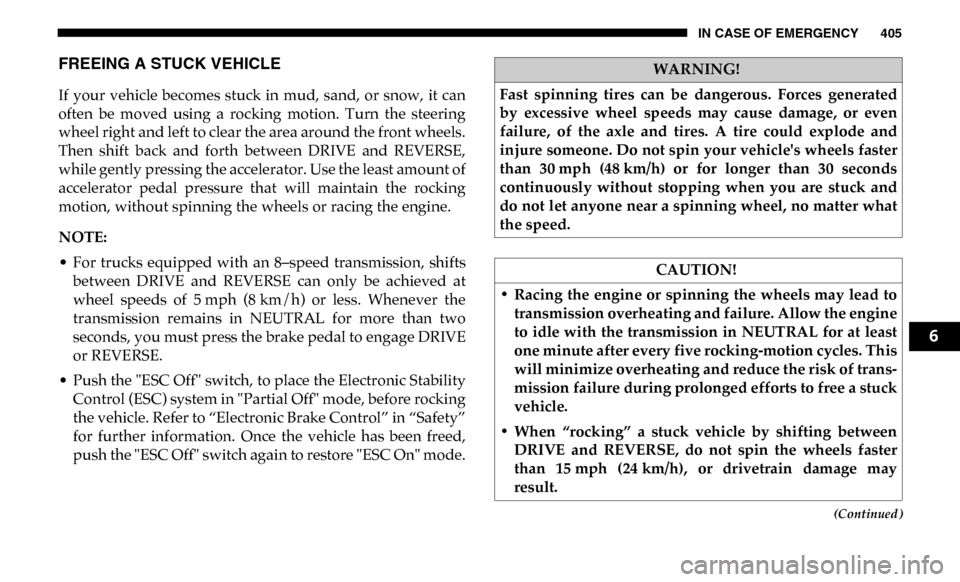
FREEING A STUCK VEHICLE
If your vehicle becomes stuck in mud, sand, or snow, it can
often be moved using a rocking motion. Turn the steering
wheel right and left to clear the area around the front wheels.
Then shift back and forth between DRIVE and REVERSE,
while gently pressing the accelerator. Use the least amount of
accelerator pedal pressure that will maintain the rocking
motion, without spinning the wheels or racing the engine.
NOTE:
• For trucks equipped with an 8–speed transmission, shiftsbetween DRIVE and REVERSE can only be achieved at
wheel speeds of 5 mph (8 km/h) or less. Whenever the
transmission remains in NEUTRAL for more than two
seconds, you must press the brake pedal to engage DRIVE
or REVERSE.
• Push the "ESC Off" switch, to place the Electronic Stability Control (ESC) system in "Partial Off" mode, before rocking
the vehicle. Refer to “Electronic Brake Control” in “Safety”
for further information. Once the vehicle has been freed,
push the "ESC Off" switch again to restore "ESC On" mode.
WARNING!
Fast spinning tires can be dangerous. Forces generated
by excessive wheel speeds may cause damage, or even
failure, of the axle and tires. A tire could explode and
injure someone. Do not spin your vehicle's wheels faster
than 30 mph (48 km/h) or for longer than 30 seconds
continuously without stopping when you are stuck and
do not let anyone near a spinning wheel, no matter what
the speed.
CAUTION!
• Racing the engine or spinning the wheels may lead to transmission overheating and failure. Allow the engine
to idle with the transmission in NEUTRAL for at least
one minute after every five rocking-motion cycles. This
will minimize overheating and reduce the risk of trans -
mission failure during prolonged efforts to free a stuck
vehicle.
• When “rocking” a stuck vehicle by shifting between DRIVE and REVERSE, do not spin the wheels faster
than 15 mph (24 km/h), or drivetrain damage may
result.
6
Page 408 of 607

406 IN CASE OF EMERGENCY
TOWING A DISABLED VEHICLE
This section describes procedures for towing a disabled
vehicle using a commercial towing service. If the transmis-
sion and drivetrain are operable, disabled vehicles may also
be towed as described under “Recreational Towing” in the
“Starting And Operating” section.
• Revving the engine or spinning the wheels too fast may lead
to transmission overheating and failure. It can also damage
the tires. Do not spin the wheels above 30 mph (48 km/h)
while in gear (no transmission shifting occurring).
CAUTION!
(Continued)
Towing
Condition Wheels OFF
The Ground 2WD Models
4WD Models
Flat Tow NONE If transmission is operable:
• Transmission in NEUTRAL
• 30 mph (48 km/h) max speed
• 15 miles (24 km) max distance (6–speed
transmission)
• 30 miles (48 km) max distance (8–speed
transmission) See instructions in “Recreational Towing”
under “Starting And Operating”
• Auto Transmission in PARK
• Transfer Case in NEUTRAL
• Tow in forward direction
Wheel Lift Or Dolly Tow Front
NOT ALLOWED
Rear OK NOT ALLOWED
Flatbed ALL
BEST METHOD BEST METHOD
Page 434 of 607

432 SERVICING AND MAINTENANCE
system and adjacent body areas for broken, damaged, dete-
riorated, or mispositioned parts. Open seams or loose
connections could permit exhaust fumes to seep into the
passenger compartment. In addition, have the exhaust
system inspected each time the vehicle is raised for lubrica -
tion or oil change. Replace as required.
Under normal operating conditions, the catalytic converter
will not require maintenance. However, it is important to
keep the engine properly tuned to assure proper catalyst
operation and prevent possible catalyst damage.
NOTE:
Intentional tampering with emissions control systems can
result in civil penalties being assessed against you.
WARNING!
• Exhaust gases can injure or kill. They contain carbon monoxide (CO), which is colorless and odorless.
Breathing it can make you unconscious and can eventu -
ally poison you. To avoid breathing CO, refer to “Safety
Tips” in “Safety” for further information.
• A hot exhaust system can start a fire if you park over materials that can burn. Such materials might be grass
or leaves coming into contact with your exhaust system.
Do not park or operate your vehicle in areas where your
exhaust system can contact anything that can burn.
CAUTION!
• The catalytic converter requires the use of unleaded fuel only. Leaded gasoline will destroy the effective -
ness of the catalyst as an emissions control device and
may seriously reduce engine performance and cause
serious damage to the engine.
• Damage to the catalytic converter can result if your vehicle is not kept in proper operating condition. In the
event of engine malfunction, particularly involving
engine misfire or other apparent loss of performance,
have your vehicle serviced promptly. Continued opera -
tion of your vehicle with a severe malfunction could
cause the converter to overheat, resulting in possible
damage to the converter and vehicle.
Page 435 of 607
SERVICING AND MAINTENANCE 433
In unusual situations involving grossly malfunctioning
engine operation, a scorching odor may suggest severe and
abnormal catalyst overheating. If this occurs, stop the
vehicle, turn off the engine and allow it to cool. Service,
including a tune-up to manufacturer's specifications, should
be obtained immediately.
To minimize the possibility of catalytic converter damage:
• Do not interrupt the ignition when the transmission is ingear and the vehicle is in motion.
• Do not try to start the vehicle by pushing or towing the vehicle.
• Do not idle the engine with any ignition components disconnected or removed, such as when diagnostic testing,
or for prolonged periods during very rough idle or
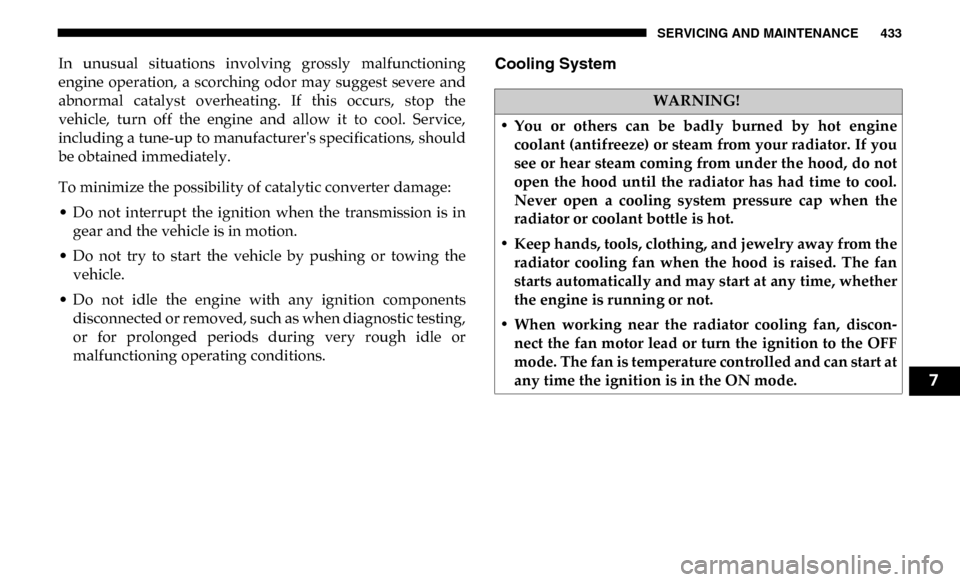
malfunctioning operating conditions.Cooling System
WARNING!
• You or others can be badly burned by hot engine coolant (antifreeze) or steam from your radiator. If you
see or hear steam coming from under the hood, do not
open the hood until the radiator has had time to cool.
Never open a cooling system pressure cap when the
radiator or coolant bottle is hot.
• Keep hands, tools, clothing, and jewelry away from the radiator cooling fan when the hood is raised. The fan
starts automatically and may start at any time, whether
the engine is running or not.
• When working near the radiator cooling fan, discon -
nect the fan motor lead or turn the ignition to the OFF
mode. The fan is temperature controlled and can start at
any time the ignition is in the ON mode.
7
Page 595 of 607

593
Differential, Limited Slip ....................................................... 281
Dipsticks Power Steering..................................................................... 284
Disabled Vehicle Towing ....................................................... 406
Disposal Antifreeze (Engine Coolant) .............................................. 436
Do Not Disturb ........................................................................ 579
Door Ajar.................................................................................. 150
Door Ajar Light ....................................................................... 150
Door Locks Automatic ............................................................................... 37
Doors........................................................................................... 32
Drag And Drop Menu ............................................................ 487
Driver’s Seat Back Tilt .............................................................. 39
Driving
Through Flowing, Rising, Or Shallow Standing Water ....364
Dual Rear Wheels ................................................... 396, 467, 477 E
Electric Brake Control System ............................................... 162 Anti-Lock Brake System ..................................................... 161
Electronic Roll Mitigation .......................................... 166, 170
Electrical Power Outlets......................................................... 117
Electronic Range Select (ERS)........................................ 262, 270
Electronic Stability Control (ESC) ........................................ 166
Electronic Throttle Control Warning Light ......................... 149
Electronically Shifted Transfer Case .................................... 272 Emergency Braking.................................................................252
Emergency, In Case Of Freeing Vehicle When Stuck ..............................................405Hazard Warning Flasher ....................................................366
Jacking...................................................................................390
Jump Starting .......................................................................398
Emission Control System Maintenance ...............................159
Engine .......................................................................................415 Air Cleaner ...........................................................................420
Break-In Recommendations...............................................251Compartment Identification ..............................................415Coolant (Antifreeze)............................................................ 484
Exhaust Gas Caution................................................... 240, 482Fails To Start.........................................................................249
Flooded, Starting .................................................................249
Fuel Requirements ..............................................................479
Jump Starting .......................................................................398Oil ..................................................................................418, 484
Oil Filler Cap ................................................................415, 419
Oil Filter ................................................................................419Oil Reset ................................................................................130Oil Selection .........................................................................418
Oil Synthetic .........................................................................419
Overheating..........................................................................401
Starting..................................................................................246
Engine Oil Viscosity................................................................419
11
Page 600 of 607

598
O
Occupant Restraints................................................................ 187
Octane Rating, Gasoline (Fuel) ............................................. 479
Oil Filter, Change .................................................................... 419
Oil Filter, Selection.................................................................. 419
Oil Pressure Light ................................................................... 148
Oil Reset ................................................................................... 130
Oil, Engine ....................................................................... 418, 484 Capacity ................................................................................ 483
Change Interval ................................................................... 418Dipstick................................................................................. 416
Disposal ................................................................................ 419
Filter .............................................................................. 419, 484
Filter Disposal ...................................................................... 419
Identification Logo.............................................................. 418Materials Added To ............................................................ 419
Pressure Warning Light ..................................................... 148
Recommendation ................................................................ 418
Synthetic ............................................................................... 419Viscosity ............................................................................... 419
Onboard Diagnostic System .................................................. 158
Operating Precautions............................................................ 158
Operator Manual Owner's Manual ............................................................ 13, 589
Outside Rearview Mirrors ....................................................... 58
Overdrive ................................................................................. 263 Overdrive OFF Switch............................................................263
Overheating, Engine ...............................................................401 P
Paint Care .................................................................................470
Panic Alarm ...............................................................................18
Parking Brake ..........................................................................252
ParkSense System, Rear .................................................309, 317
Passive Entry..............................................................................34
Pedals, Adjustable .....................................................................55
Personalized Main Menu .......................................................487
Pets ............................................................................................240
Placard, Tire And Loading Information ..............................450
Power Distribution Center (Fuses)................................................381
Door Locks .............................................................................33
Mirrors ....................................................................................59
Outlet (Auxiliary Electrical Outlet) ..........................117, 119 Seats.........................................................................................42
Sliding Rear Window............................................................94
Steering ...................................................................59, 283, 284 Take-Off Adapter ................................................................281
Take-Off Operation .............................................................281
Windows.................................................................................92
Power Seats Down .......................................................................................42
Forward ..................................................................................42