seats Ram 3500 Chassis Cab 2019 User Guide
[x] Cancel search | Manufacturer: RAM, Model Year: 2019, Model line: 3500 Chassis Cab, Model: Ram 3500 Chassis Cab 2019Pages: 607, PDF Size: 10.72 MB
Page 51 of 607

GETTING TO KNOW YOUR VEHICLE 49
There are two heated seat switches that allow the rear
passengers to operate the seats independently. You can
choose from HI, MED, LO, or OFF heat settings. Amber indi-
cator lights in each switch indicate the level of heat in use.
• Push the heated seat button once to turn the HI setting on.
• Push the heated seat button a second time to turn the MED setting on.
• Push the heated seat button a third time to turn the LO setting on.
• Push the heated seat button a fourth time to turn the heating elements off.
NOTE:
• The level of heat selected will stay on until the operator changes it.
• Once a heat setting is selected, heat will be felt within two to five minutes.
• The engine must be running for the heated seats to operate.Ventilated Seats — If Equipped
Front Ventilated Seats
Located in the seat cushion are small fans that draw the air
from the passenger compartment and move air through fine
perforations in the seat cover to help keep the driver and
front passenger cooler in higher ambient temperatures. The
fans operate at three speeds, HI, MED and LO.
The front ventilated seats control buttons are located on the
center instrument panel below the touchscreen, and are also
located within the climate or controls screen of the touch -
screen.
• Press the ventilated seat button once to choose HI.
• Press the ventilated seat button a second time to choose MED.
• Press the ventilated seat button a third time to choose LO.
• Press the ventilated seat button a fourth time to turn the ventilation off.
NOTE:
The engine must be running for the ventilated seats to
operate.
2
Page 52 of 607

50 GETTING TO KNOW YOUR VEHICLE
(Continued)
Vehicles Equipped With Remote Start
On models that are equipped with remote start, the venti-
lated seats can be programmed to come on during a remote
start.
This feature can be programmed through the Uconnect
system. Refer to “Uconnect Settings” in “Multimedia” for
further information.
HEAD RESTRAINTS
Head restraints are designed to reduce the risk of injury by
restricting head movement in the event of a rear impact.
Head restraints should be adjusted so that the top of the head
restraint is located above the top of your ear. NOTE:
Do not reverse the head restraints (making the rear of the
head restraint face forward) in an attempt to gain additional
clearance to the back of your head.Front Head Restraints
Four-Way Head Restraints — If Equipped
Your vehicle may be equipped with front four-way driver
and passenger head restraints.
To raise the head restraint, pull upward on the head
restraint. To lower the head restraint, push the adjustment
button, located at the base of the head restraint, and push
downward on the head restraint.
WARNING!
• All occupants, including the driver, should not operate a vehicle or sit in a vehicle’s seat until the head
restraints are placed in their proper positions in order
to minimize the risk of neck injury in the event of a
crash.
• Head restraints should never be adjusted while thevehicle is in motion. Driving a vehicle with the head
restraints improperly adjusted or removed could cause
serious injury or death in the event of a collision.
WARNING! (Continued)
Page 54 of 607

52 GETTING TO KNOW YOUR VEHICLE
Rear Head Restraint Adjustment
The rear seats are equipped with adjustable and removable
head restraints. To raise the head restraint, pull upward on
the head restraint. To lower the head restraint, push the
adjustment button located on the base of the head restraint
and push downward on the head restraint.Release/Adjustment Buttons
NOTE:
• The rear center head restraint (Crew Cab) has only one adjustment position that is used to aid in the routing of a
tether. Refer to “Occupant Restraint Systems” in “Safety”
for further information.
• Do not reposition the head restraint 180 degrees to the incorrect position in an attempt to gain additional clear -
ance to the back of the head.
WARNING!
• All occupants, including the driver, should not operate a vehicle or sit in a vehicle’s seat until the head
restraints are placed in their proper positions in order
to minimize the risk of neck injury in the event of a
crash.
• Head restraints should never be adjusted while the vehicle is in motion. Driving a vehicle with the head
restraints improperly adjusted or removed could cause
serious injury or death in the event of a collision.
1 — Release Button
2 — Adjustment Button
Page 108 of 607
106 GETTING TO KNOW YOUR VEHICLE
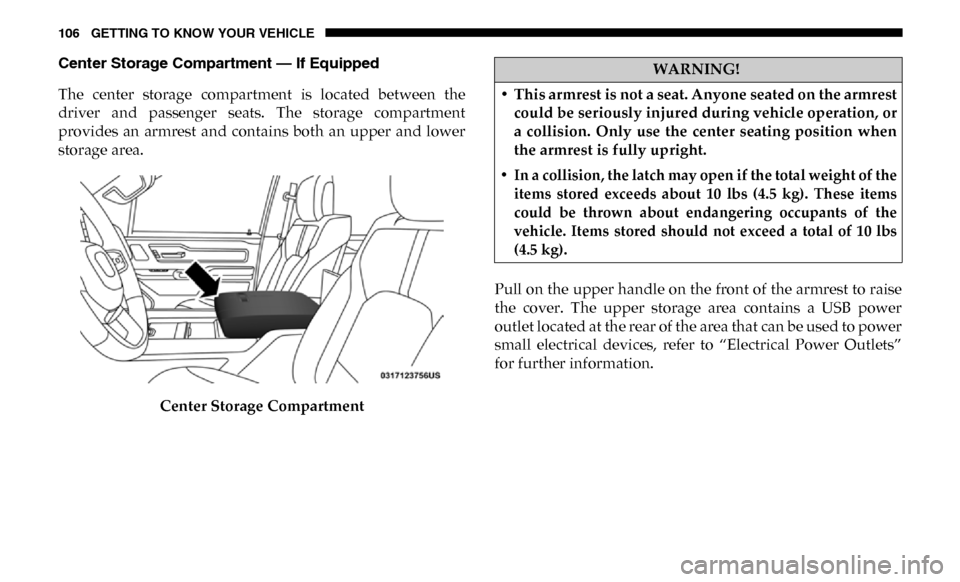
Center Storage Compartment — If Equipped
The center storage compartment is located between the
driver and passenger seats. The storage compartment
provides an armrest and contains both an upper and lower
storage area.Center Storage Compartment Pull on the upper handle on the front of the armrest to raise
the cover. The upper storage area contains a USB power
outlet located at the rear of the area that can be used to power
small electrical devices, refer to “Electrical Power Outlets”
for further information.WARNING!
• This armrest is not a seat. Anyone seated on the armrest could be seriously injured during vehicle operation, or
a collision. Only use the center seating position when
the armrest is fully upright.
• In a collision, the latch may open if the total weight of the items stored exceeds about 10 lbs (4.5 kg). These items
could be thrown about endangering occupants of the
vehicle. Items stored should not exceed a total of 10 lbs
(4.5 kg).
Page 112 of 607

110 GETTING TO KNOW YOUR VEHICLE
Seatback Storage
Located in the back of both the driver and passenger front
seats are pockets that can be used for storage.Driver’s Side Seatback Storage
Second Row In-Floor Storage Bin — If Equipped
In-floor storage bins are located in front of the second row
seats and can be used for extra storage. The storage bins have
removable liners that can be easily removed for cleaning. To open the in-floor storage bin, lift upward on the handle of
the latch and open the lid.
In-Floor Storage Bin Latch
NOTE:
The front seat may have to be moved forward to fully open
the lid.
Page 114 of 607
112 GETTING TO KNOW YOUR VEHICLE
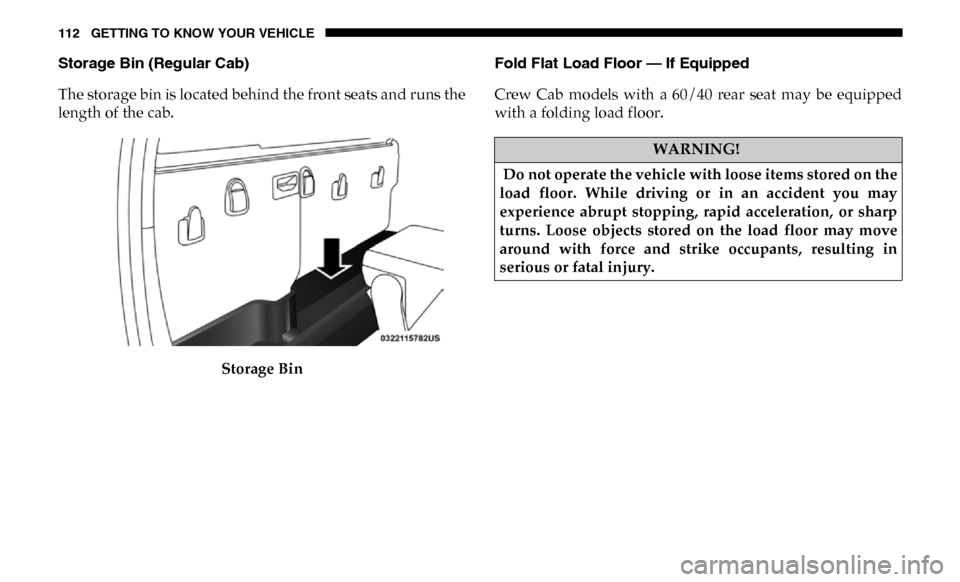
Storage Bin (Regular Cab)
The storage bin is located behind the front seats and runs the
length of the cab.Storage Bin Fold Flat Load Floor — If Equipped
Crew Cab models with a 60/40 rear seat may be equipped
with a folding load floor.
WARNING!
Do not operate the vehicle with loose items stored on the
load floor. While driving or in an accident you may
experience abrupt stopping, rapid acceleration, or sharp
turns. Loose objects stored on the load floor may move
around with force and strike occupants, resulting in
serious or fatal injury.
Page 117 of 607
GETTING TO KNOW YOUR VEHICLE 115
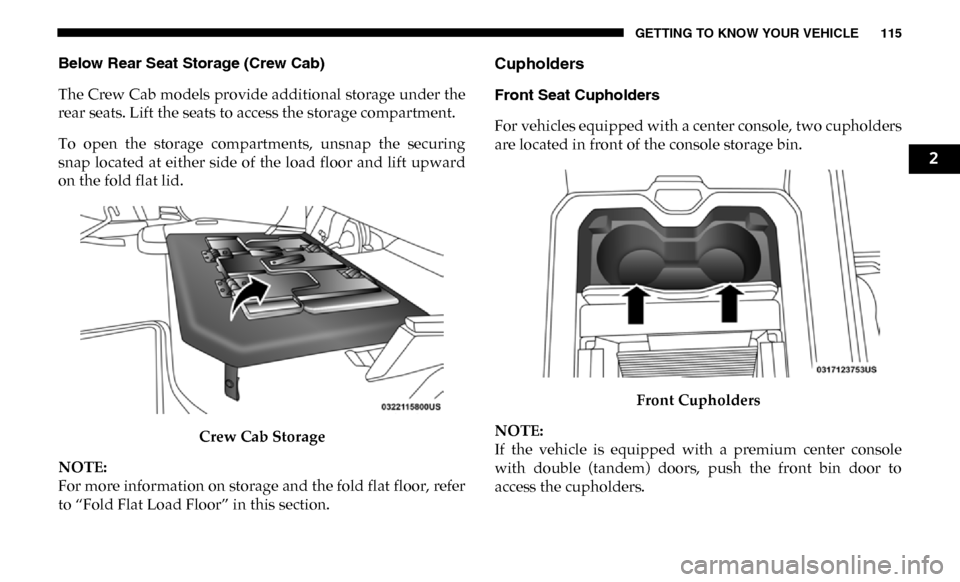
Below Rear Seat Storage (Crew Cab)
The Crew Cab models provide additional storage under the
rear seats. Lift the seats to access the storage compartment.
To open the storage compartments, unsnap the securing
snap located at either side of the load floor and lift upward
on the fold flat lid.Crew Cab Storage
NOTE:
For more information on storage and the fold flat floor, refer
to “Fold Flat Load Floor” in this section.Cupholders
Front Seat Cupholders
For vehicles equipped with a center console, two cupholders
are located in front of the console storage bin.
Front Cupholders
NOTE:
If the vehicle is equipped with a premium center console
with double (tandem) doors, push the front bin door to
access the cupholders.
2
Page 118 of 607
116 GETTING TO KNOW YOUR VEHICLE
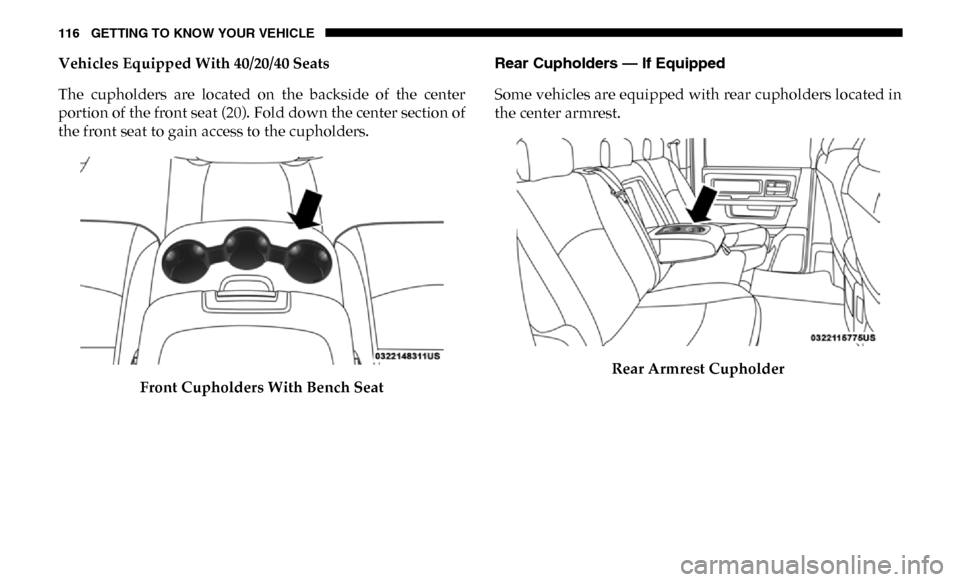
Vehicles Equipped With 40/20/40 Seats
The cupholders are located on the backside of the center
portion of the front seat (20). Fold down the center section of
the front seat to gain access to the cupholders.Front Cupholders With Bench Seat Rear Cupholders — If Equipped
Some vehicles are equipped with rear cupholders located in
the center armrest.
Rear Armrest Cupholder
Page 146 of 607

144 GETTING TO KNOW YOUR INSTRUMENT PANEL
Battery Saver On/Battery Saver Mode Message —
Electrical Load Reduction Actions — If Equipped
This vehicle is equipped with an Intelligent Battery Sensor
(IBS) to perform additional monitoring of the electrical
system and status of the vehicle battery.
In cases when the IBS detects charging system failure, or the
vehicle battery conditions are deteriorating, electrical load
reduction actions will take place to extend the driving time
and distance of the vehicle. This is done by reducing power
to or turning off non-essential electrical loads.
Load reduction is only active when the engine is running. It
will display a message if there is a risk of battery depletion to
the point where the vehicle may stall due to lack of electrical
supply, or will not restart after the current drive cycle.
When load reduction is activated, the message “Battery
Saver On Some Systems May Have Reduced Power” will
appear in the instrument cluster.
These messages indicate the vehicle battery has a low state of
charge and continues to lose electrical charge at a rate that
the charging system cannot sustain.NOTE:
• The charging system is independent from load reduction.
The charging system performs a diagnostic on the
charging system continuously.
• If the Battery Charge Warning Light is on it may indicate a problem with the charging system. Refer to “Battery
Charge Warning Light” in “Getting To Know Your Instru -
ment Panel” for further information.
The electrical loads that may be switched off (if equipped),
and vehicle functions which can be affected by load reduc -
tion:
• Heated Seats/Vented Seats/Heated Wheel
• Rear Defroster And Heated Mirrors
• HVAC System
• 115V AC Power Inverter System
• Audio and Telematics System
Page 190 of 607
188 SAFETY
(Continued)
Important Safety Precautions
Please pay close attention to the information in this section.
It tells you how to use your restraint system properly, to
keep you and your passengers as safe as possible.
Here are some simple steps you can take to minimize the risk
of harm from a deploying air bag:
1. Children 12 years old and under should always ridebuckled up in the rear seat of a vehicle with a rear seat.
2. A child who is not big enough to wear the vehicle seat belt properly (Refer to “Child Restraints” in this section for
further information) must be secured in the appropriate
child restraint or belt-positioning booster seat in a rear
seating position.
3. If a child from 2 to 12 years old (not in a rear-facing child restraint) must ride in the front passenger seat, move the
seat as far back as possible and use the proper child
restraint (Refer to “Child Restraints” in this section for
further information).
4. Never allow children to slide the shoulder belt behind them or under their arm. 5. You should read the instructions provided with your
child restraint to make sure that you are using it properly.
6. All occupants should always wear their lap and shoulder belts properly.
7. The driver and front passenger seats should be moved back as far as practical to allow the front air bags room to
inflate.
8. Do not lean against the door or window. If your vehicle has side air bags, and deployment occurs, the side air
bags will inflate forcefully into the space between occu -
pants and the door and occupants could be injured.
9. If the air bag system in this vehicle needs to be modified to accommodate a disabled person, refer to the
“Customer Assistance” section for customer service
contact information.
WARNING!
• Never place a rear-facing child restraint in front of an air bag. A deploying passenger front air bag can cause
death or serious injury to a child 12 years or younger,
including a child in a rear-facing child restraint.