service Ram 3500 Chassis Cab 2019 Manual Online
[x] Cancel search | Manufacturer: RAM, Model Year: 2019, Model line: 3500 Chassis Cab, Model: Ram 3500 Chassis Cab 2019Pages: 607, PDF Size: 10.72 MB
Page 439 of 607

SERVICING AND MAINTENANCE 437
Checking Coolant Level — 6.4L Engine
The level of the coolant in the pressurized coolant bottle
should be between the “MIN” and “MAX” range on the
bottle when the engine is cold.
The radiator normally remains completely full, so there is no
need to remove the cap unless checking for coolant freeze
point or replacing engine coolant (antifreeze). Advise your
service attendant of this. As long as the engine operating
temperature is satisfactory, the coolant bottle need only be
checked once a month. When additional engine coolant
(antifreeze) is needed to maintain the proper level, it should
be added to the coolant bottle. Do not overfill.
Points To Remember
NOTE:
When the vehicle is stopped after a few miles/kilometers of
operation, you may observe vapor coming from the front of
the engine compartment. This is normally a result of mois-
ture from rain, snow, or high humidity accumulating on the
radiator and being vaporized when the thermostat opens,
allowing hot engine coolant (antifreeze) to enter the radiator. If an examination of your engine compartment shows no
evidence of radiator or hose leaks, the vehicle may be safely
driven. The vapor will soon dissipate.
• Do not overfill the coolant expansion bottle.
• Check the coolant freeze point in the radiator and in the
coolant expansion bottle. If engine coolant (antifreeze)
needs to be added, the contents of the coolant expansion
bottle must also be protected against freezing.
• If frequent engine coolant (antifreeze) additions are required, the cooling system should be pressure tested for leaks.
• Maintain engine coolant (antifreeze) concentration at a minimum of 50% OAT coolant (conforming to MS.90032)
and distilled water for proper corrosion protection of your
engine which contains aluminum components.
• Make sure that the coolant expansion bottle overflow hoses are not kinked or obstructed.
• Keep the front of the radiator clean. If your vehicle is equipped with air conditioning, keep the front of the
condenser clean.
• Do not change the thermostat for Summer or Winter oper -
ation. If replacement is ever necessary, install ONLY the
correct type thermostat. Other designs may result in unsat -
isfactory engine coolant (antifreeze) performance, poor
gas mileage, and increased emissions.
7
Page 440 of 607
438 SERVICING AND MAINTENANCE
(Continued)
Brake System
In order to assure brake system performance, all brake
system components should be inspected periodically. Refer
to the “Maintenance Plan” in this section for the proper
maintenance intervals.
Fluid Level Check — Brake Master Cylinder
The fluid level of the master cylinder should be checked
when performing under the hood service or immediately if
the brake system warning lamp indicates system failure.
If necessary, add fluid to bring level within the designated
marks on the side of the reservoir of the brake master
cylinder. Be sure to clean the top of the master cylinder area
before removing cap.With disc brakes the fluid level can be expected to fall as the
brake linings wear. However, an unexpected drop in fluid
level may be caused by a leak and a system check should be
conducted.
Refer to “Fluids And Lubricants” in “Technical Specifica
-
tions” for further information.
WARNING!
Riding the brakes can lead to brake failure and possibly
a collision. Driving with your foot resting or riding on
the brake pedal can result in abnormally high brake
temperatures, excessive lining wear, and possible brake
damage. You would not have your full braking capacity
in an emergency.
WARNING!
• Use only manufacturer's recommended brake fluid. Refer to “Fluids And Lubricants” in “Technical Speci -
fications” for further information. Using the wrong
type of brake fluid can severely damage your brake
system and/or impair its performance. The proper type
of brake fluid for your vehicle is also identified on the
original factory installed hydraulic master cylinder
reservoir.
• To avoid contamination from foreign matter or mois -
ture, use only new brake fluid or fluid that has been in
a tightly closed container. Keep the master cylinder
reservoir cap secured at all times. Brake fluid in a open
container absorbs moisture from the air resulting in a
lower boiling point. This may cause it to boil unexpect -
edly during hard or prolonged braking, resulting in
sudden brake failure. This could result in a collision.
Page 442 of 607

440 SERVICING AND MAINTENANCE
Fluid Level Check — Eight-Speed Transmission
The fluid level is preset at the factory and does not require
adjustment under normal operating conditions. Routine
fluid level checks are not required, therefore the transmis-
sion has no dipstick. An authorized dealer can check your
transmission fluid level using special service tools.
If you notice fluid leakage or transmission malfunction, visit
an authorized dealer immediately to have the transmission
fluid level checked. Operating the vehicle with an improper
fluid level can cause severe transmission damage. Fluid Level Check — Six-Speed Transmission
It is best to check the fluid level when the transmission is at
normal operating temperature (158-176°F / 70-80°C). This
normally occurs after at least 15 miles (25 km) of driving. At
normal operating temperature the fluid cannot be held
comfortably between the fingertips. You can read the trans
-
mission sump temperature in the instrument cluster screen
(refer to “Instrument Cluster Display” for further informa -
tion).
Use the following procedure to check the transmission fluid
level properly:
1. Monitor the transmission temperature using the instru -
ment cluster display, and operate the vehicle as required
to reach the normal operating temperature. If the trans-
mission is not functioning properly, or the vehicle cannot
be driven, see the NOTE and CAUTION below about
checking the fluid level at colder temperatures.
2. Park the vehicle on level ground.
3. Run the engine at normal idle speed for at least 60 seconds, and leave the engine running for the rest of this
procedure.
4. Fully apply the parking brake, and press the brake pedal.
CAUTION!
Do not use chemical flushes in your transmission as the
chemicals can damage your transmission components.
Such damage is not covered by the New Vehicle Limited
Warranty.
CAUTION!
If a transmission fluid leak occurs, visit an authorized
dealer immediately. Severe transmission damage may
occur. An authorized dealer has the proper tools to adjust
the fluid level accurately.
Page 443 of 607

SERVICING AND MAINTENANCE 441
5. Place the gear selector momentarily into each gear posi-
tion (allowing time for the transmission to fully engage in
each position), ending with the transmission in PARK.
6. Remove the dipstick, wipe it clean and reinsert it until seated.
7. Remove the dipstick again and note the fluid level on both sides. The fluid level reading is only valid if there is
a solid coating of oil on both sides of the dipstick. Note
that the holes in the dipstick will be full of fluid if the
actual level is at or above the hole. The fluid level should
be between the “HOT” (upper) reference holes on the
dipstick at normal operating temperature. If the fluid
level is low, add fluid through the dipstick tube to bring
it to the proper level. Do not overfill. Use ONLY the spec -
ified fluid (see "Fluids And Lubricants" for fluid specifica -
tions). After adding any quantity of oil through the
dipstick tube, wait a minimum of two minutes for the oil
to fully drain into the transmission before rechecking the
fluid level.
NOTE:
If it is necessary to check the transmission below the oper -
ating temperature, the fluid level should be between the two
“COLD” (lower) holes on the dipstick with the fluid at
60-70°F / 16-21°C. Only use the COLD region of the dipstick as a rough reference when setting the fluid level after a trans
-
mission service or fluid change. Re-check the fluid level, and
adjust as required, once the transmission reaches normal
operating temperature.
8. Reinsert the dipstick. Check for leaks. Release the parking brake.
NOTE:
If it is necessary to check the transmission below the oper -
ating temperature, the fluid level should be between the two
COLD (lower) holes on the dipstick with the fluid at 68-86°F
/ 20-30°C. Only use the COLD region of the dipstick as a
rough reference when setting the fluid level after a transmis -
sion service or fluid change. Re-check the fluid level, and
adjust as required, once the transmission reaches normal
operating temperature. CAUTION!
If the fluid temperature is below 50 °F (10 °C) it may not
register on the dipstick. Do not add fluid until the
temperature is elevated enough to produce an accurate
reading. Run the engine at idle, in PARK, to warm the
fluid.
7
Page 444 of 607

442 SERVICING AND MAINTENANCE
Fluid And Filter Changes — Eight-Speed Transmission
Under normal operating conditions, the fluid installed at the
factory will provide satisfactory lubrication for the life of the
vehicle.
Routine fluid and filter changes are not required. However,
change the fluid and filter if the fluid becomes contaminated
(with water, etc.), or if the transmission is disassembled for
any reason.
Fluid And Filter Changes — Six Speed Transmission
Refer to the “Maintenance Plan” for the proper maintenance
intervals.
In addition, change the fluid and filters if the fluid becomes
contaminated (with water, etc.), or if the transmission is
disassembled for any reason.
Rear Axle And 4x4 Front Driving Axle Fluid Level
For models with 9.25 in Front Axles and 11.5 in Rear Axles,
refer to “Fluids And Lubricants” in “Servicing And Mainte-
nance” for further information. For normal service, periodic
fluid level checks are not required. When the vehicle is
serviced for other reasons, the exterior surfaces of the axle
assembly should be inspected.
When checking the fluid level, the vehicle should be in a
level position. The fluid level at room temperature should be
as follows:
3500 Front Axle: ¼ in ± ¼ in (6.4 mm ± 6.4 mm) below the
bottom of the fill hole.
3500 Rear Axle: ¼ in ± ¼ in (6.4 mm ± 6.4 mm) below the
bottom of the fill hole.
4500/5500 Front Axle: ¼ in +/- ¼ in (6.4 mm ± 6.4 mm)
below the bottom of the fill hole.
4500/5500 Rear Axle: 1/8 in +/- 1/8 in (3.2 mm +/- 3.2 mm)
below the bottom of the fill hole.
CAUTION!
If the fluid temperature is below 50°F (10°C) it may not
register on the dipstick. Do not add fluid until the
temperature is elevated enough to produce an accurate
reading. Run the engine at idle, in PARK, to warm the
fluid.
Page 445 of 607
SERVICING AND MAINTENANCE 443
Drain And Refill
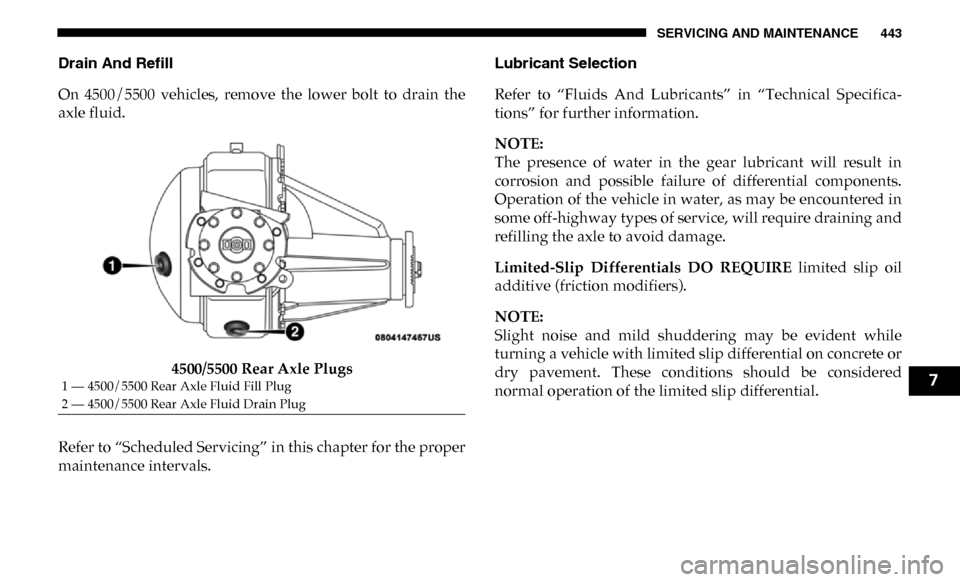
On 4500/5500 vehicles, remove the lower bolt to drain the
axle fluid.4500/5500 Rear Axle Plugs
Refer to “Scheduled Servicing” in this chapter for the proper
maintenance intervals. Lubricant Selection
Refer to “Fluids And Lubricants” in “Technical Specifica
-
tions” for further information.
NOTE:
The presence of water in the gear lubricant will result in
corrosion and possible failure of differential components.
Operation of the vehicle in water, as may be encountered in
some off-highway types of service, will require draining and
refilling the axle to avoid damage.
Limited-Slip Differentials DO REQUIRE limited slip oil
additive (friction modifiers).
NOTE:
Slight noise and mild shuddering may be evident while
turning a vehicle with limited slip differential on concrete or
dry pavement. These conditions should be considered
normal operation of the limited slip differential.
1 — 4500/5500 Rear Axle Fluid Fill Plug
2 — 4500/5500 Rear Axle Fluid Drain Plug7
Page 447 of 607

SERVICING AND MAINTENANCE 445
Tire Markings
Tire Markings
NOTE:
• P (Passenger) — Metric tire sizing is based on U.S. designstandards. P-Metric tires have the letter “P” molded into
the sidewall preceding the size designation. Example:
P215/65R15 95H.
• European — Metric tire sizing is based on European design standards. Tires designed to this standard have the
tire size molded into the sidewall beginning with the
section width. The letter "P" is absent from this tire size
designation. Example: 215/65R15 96H.
• LT (Light Truck) — Metric tire sizing is based on U.S. design standards. The size designation for LT-Metric tires
is the same as for P-Metric tires except for the letters “LT”
that are molded into the sidewall preceding the size desig -
nation. Example: LT235/85R16.
• Temporary spare tires are designed for temporary emer -
gency use only. Temporary high pressure compact spare
tires have the letter “T” or “S” molded into the sidewall
preceding the size designation. Example: T145/80D18
103M.
• High flotation tire sizing is based on U.S. design standards and it begins with the tire diameter molded into the side -
wall. Example: 31x10.5 R15 LT.
1 — U.S. DOT Safety
Standards Code (TIN) 4 — Maximum Load
2 — Size Designation 5 — Maximum Pressure
3 — Service Description 6 — Treadwear, Traction and Temperature Grades
7
Page 448 of 607

446 SERVICING AND MAINTENANCE
Tire Sizing Chart EXAMPLE:
Example Size Designation: P215/65R15XL 95H, 215/65R15 96H, LT235/85R16C, T145/80D18 103M, 31x10.5 R15 LT
P = Passenger car tire size based on U.S. design standards, or
"....blank...." = Passenger car tire based on European design standards, or
LT = Light truck tire based on U.S. design standards, or
T or S = Temporary spare tire or
31 = Overall diameter in inches (in)
215, 235, 145 = Section width in millimeters (mm)
65, 85, 80 = Aspect ratio in percent (%)
• Ratio of section height to section width of tire, or
10.5 = Section width in inches (in)
R = Construction code
• "R" means radial construction, or
• "D" means diagonal or bias construction
15, 16, 18 = Rim diameter in inches (in)
Service Description:
95 = Load Index
• A numerical code associated with the maximum load a tire can carry
Page 458 of 607

456 SERVICING AND MAINTENANCE
Tire pressure may increase from 2 to 6 psi (13 to 40 kPa)
during operation. DO NOT reduce this normal pressure
build up or your tire pressure will be too low.
Tire Pressures For High Speed Operation
The manufacturer advocates driving at safe speeds and
within posted speed limits. Where speed limits or conditions
are such that the vehicle can be driven at high speeds, main-
taining correct tire inflation pressure is very important.
Increased tire pressure and reduced vehicle loading may be
required for high-speed vehicle operation. Refer to an autho -
rized tire dealer or original equipment vehicle dealer for
recommended safe operating speeds, loading and cold tire
inflation pressures. Radial Ply Tires
Tire Repair
If your tire becomes damaged, it may be repaired if it meets
the following criteria:
• The tire has not been driven on when flat.
• The damage is only on the tread section of your tire (side
-
wall damage is not repairable).
• The puncture is no greater than a ¼ of an inch (6 mm).
Consult an authorized tire dealer for tire repairs and addi -
tional information.
Damaged Run Flat tires, or Run Flat tires that have experi -
enced a loss of pressure should be replaced immediately
with another Run Flat tire of identical size and service
description (Load Index and Speed Symbol). Replace the tire
pressure sensor as well as it is not designed to be reused.
WARNING!
High speed driving with your vehicle under maximum
load is dangerous. The added strain on your tires could
cause them to fail. You could have a serious collision. Do
not drive a vehicle loaded to the maximum capacity at
continuous speeds above 75 mph (120 km/h).
WARNING!
Combining radial ply tires with other types of tires on
your vehicle will cause your vehicle to handle poorly.
The instability could cause a collision. Always use radial
ply tires in sets of four. Never combine them with other
types of tires.
Page 460 of 607

458 SERVICING AND MAINTENANCE
Tread Wear Indicators
Tread wear indicators are in the original equipment tires to
help you in determining when your tires should be replaced.Tire Tread
These indicators are molded into the bottom of the tread
grooves. They will appear as bands when the tread depth
becomes a 1/16 of an inch (1.6 mm). When the tread is worn
to the tread wear indicators, the tire should be replaced. Refer to “Replacement Tires” in this section for further infor
-
mation.
Life Of Tire
The service life of a tire is dependent upon varying factors
including, but not limited to:
• Driving style.
• Tire pressure - Improper cold tire inflation pressures can cause uneven wear patterns to develop across the tire
tread. These abnormal wear patterns will reduce tread life,
resulting in the need for earlier tire replacement.
• Distance driven.
• Performance tires, tires with a speed rating of V or higher, and Summer tires typically have a reduced tread life. Rota -
tion of these tires per the vehicle scheduled maintenance is
highly recommended.
1 — Worn Tire
2 — New Tire
WARNING!
Tires and the spare tire should be replaced after six
years, regardless of the remaining tread. Failure to follow
this warning can result in sudden tire failure. You could
lose control and have a collision resulting in serious
injury or death.