traction control Ram 4500 Chassis Cab 2018 User Guide
[x] Cancel search | Manufacturer: RAM, Model Year: 2018, Model line: 4500 Chassis Cab, Model: Ram 4500 Chassis Cab 2018Pages: 529, PDF Size: 5.89 MB
Page 267 of 529

2. Shift the transmission into NEUTRAL.
3. While still rolling, rotate the transfer case control switchto the desired position.
4. After the desired position indicator light is ON (not flashing), shift the transmission back into gear.
Alternate Procedure
1. Bring the vehicle to a complete stop.
2. With the ignition switch in the ON position and the engine running, shift the transmission into NEUTRAL.
3. Rotate the transfer case control switch to the desired position.
4. After the desired position indicator light is ON (not flashing), shift the transmission back into gear.
NOTE:
• If Steps 1 or 2 of either the Preferred or Alternate
Procedure are not satisfied prior to attempting the shift,
then the desired position indicator light will flash con-
tinuously while the original position indicator light is
ON, until all requirements have been met. •
The ignition switch must be in the ON position for a
shift to take place and for the position indicator lights to
be operable. If the ignition switch is not in the ON
position, the shift will not take place and no position
indicator lights will be on or flashing.
LIMITED-SLIP DIFFERENTIAL
The limited-slip differential provides additional traction on
snow, ice, mud, sand and gravel, particularly when there is
a difference between the traction characteristics of the
surface under the right and left rear wheels. During normal
driving and cornering, the limited-slip unit performs simi-
larly to a conventional differential. On slippery surfaces,
however, the differential delivers more of the driving effort
to the rear wheel having the better traction.
The limited-slip differential is especially helpful during
slippery driving conditions. With both rear wheels on a
slippery surface, a slight application of the accelerator will
supply maximum traction. When starting with only one
rear wheel on an excessively slippery surface, slight mo-
mentary application of the parking brake may be necessary
to gain maximum traction.
6
STARTING AND OPERATING 265
Page 319 of 529
WARNING!
Rapid acceleration on slippery surfaces is dangerous.
Unequal traction can cause sudden pulling of the rear
wheels. You could lose control of the vehicle and
possibly have a collision. Accelerate slowly and care-
fully whenever there is likely to be poor traction (ice,
snow, wet, mud, loose sand, etc.).
Driving Through Water
Driving through water more than a few inches/centimeters
deep will require extra caution to ensure safety and pre-
vent damage to your vehicle.
Flowing/Rising Water
WARNING!
Do not drive on or across a road or path where water is
flowing and/or rising (as in storm run-off). Flowing
water can wear away the road or path’s surface and
cause your vehicle to sink into deeper water. Further-
more, flowing and/or rising water can carry your ve-
hicle away swiftly. Failure to follow this warning may
result in injuries that are serious or fatal to you, your
passengers, and others around you.
Shallow Standing Water
Although your vehicle is capable of driving through shal-
low standing water, consider the following Cautions and
Warnings before doing so.
WARNING!
•Driving through standing water limits your vehicle’s
traction capabilities. Do not exceed 5 mph (8 km/h)
when driving through standing water.
• Driving through standing water limits your vehicle’s
braking capabilities, which increases stopping dis-
tances. Therefore, after driving through standing
water, drive slowly and lightly press on the brake
pedal several times to dry the brakes.
• Failure to follow these warnings may result in inju-
ries that are serious or fatal to you, your passengers,
and others around you.
6
STARTING AND OPERATING 317
Page 412 of 529
WARNING!(Continued)
•Never use a tire with a smaller load index or capacity,
other than what was originally equipped on your
vehicle. Using a tire with a smaller load index could
result in tire overloading and failure. You could lose
control and have a collision.
• Failure to equip your vehicle with tires having ad-
equate speed capability can result in sudden tire
failure and loss of vehicle control.
CAUTION!
Replacing original tires with tires of a different size
may result in false speedometer and odometer read-
ings.
Tire Types
All Season Tires — If Equipped
All Season tires provide traction for all seasons (Spring,
Summer, Fall, and Winter). Traction levels may vary between
different all season tires. All season tires can be identified by
the M+S, M&S, M/S or MS designation on the tire sidewall.
Use all season tires only in sets of four; failure to do so may
adversely affect the safety and handling of your vehicle.
Summer Or Three Season Tires — If Equipped
Summer tires provide traction in both wet and dry condi-
tions, and are not intended to be driven in snow or on ice.
If your vehicle is equipped with Summer tires, be aware
these tires are not designed for Winter or cold driving
conditions. Install Winter tires on your vehicle when am-
bient temperatures are less than 40°F (5°C) or if roads are
covered with ice or snow. For more information, contact an
authorized dealer.
Summer tires do not contain the all season designation or
mountain/snowflake symbol on the tire sidewall. Use
Summer tires only in sets of four; failure to do so may
adversely affect the safety and handling of your vehicle.
WARNING!
Do not use Summer tires in snow/ice conditions. You
could lose vehicle control, resulting in severe injury or
death. Driving too fast for conditions also creates the
possibility of loss of vehicle control.
410 SERVICING AND MAINTENANCE
Page 418 of 529
WARNING!
Using tires of different size and type (M+S, Snow)
between front and rear axles can cause unpredictable
handling. You could lose control and have a collision.
CAUTION!
To avoid damage to your vehicle or tires, observe the
following precautions:
•Because of restricted traction device clearance be-
tween tires and other suspension components, it is
important that only traction devices in good condi-
tion are used. Broken devices can cause serious
damage. Stop the vehicle immediately if noise occurs
that could indicate device breakage. Remove the
damaged parts of the device before further use.
• Install device as tightly as possible and then re-
tighten after driving about ½ mile (0.8 km).
• Do not exceed 30 mph (48 km/h).
• Drive cautiously and avoid severe turns and large
bumps, especially with a loaded vehicle.
• Do not drive for a prolonged period on dry pave-
ment.
(Continued)
CAUTION! (Continued)
•Observe the traction device manufacturer ’s instruc-
tions on the method of installation, operating speed,
and conditions for use. Always use the suggested
operating speed of the device manufacturer ’s if it is
less than 30 mph (48 km/h).
• Do not use traction devices on a compact spare tire.
Tire Rotation Recommendations
Tires on the front and rear axles of vehicles operate at
different loads and perform different steering, driving, and
braking functions. For these reasons, they wear at unequal
rates.
These effects can be reduced by timely rotation of tires. The
benefits of rotation are especially worthwhile with aggres-
sive tread designs such as those on On/Off Road type tires.
Rotation will increase tread life, help to maintain mud,
snow, and wet traction levels, and contribute to a smooth,
quiet ride.
Refer to the “Maintenance Plan” for the proper mainte-
nance intervals. More frequent rotation is permissible if
desired. The reasons for any rapid or unusual wear should
be corrected prior to rotation being performed.
416 SERVICING AND MAINTENANCE
Page 421 of 529
times as well on the government course as a tire graded
100. The relative performance of tires depends upon the
actual conditions of their use, however, and may depart
significantly from the norm due to variations in driving
habits, service practices, and differences in road charac-
teristics and climate.
Traction Grades
The Traction grades, from highest to lowest, are AA, A,
B, and C. These grades represent the tire’s ability to stop
on wet pavement, as measured under controlled condi-
tions on specified government test surfaces of asphalt
and concrete. A tire marked C may have poor traction
performance.
WARNING!
The traction grade assigned to this tire is based on
straight-ahead braking traction tests, and does not
include acceleration, cornering, hydroplaning, or
peak traction characteristics.
Temperature Grades
The Temperature grades are A (the highest), B, and C,
representing the tire’s resistance to the generation of heat and its ability to dissipate heat, when tested under
controlled conditions on a specified indoor laboratory
test wheel.
Sustained high temperature can cause the material of
the tire to degenerate and reduce tire life, and excessive
temperature can lead to sudden tire failure. The grade C
corresponds to a level of performance, which all pas-
senger vehicle tires must meet under the Federal Motor
Vehicle Safety Standard No. 109. Grades B and A
represent higher levels of performance on the laboratory
test wheel, than the minimum required by law.
WARNING!
The temperature grade for this tire is established for
a tire that is properly inflated and not overloaded.
Excessive speed, under-inflation, or excessive load-
ing, either separately or in combination, can cause
heat buildup and possible tire failure.
STORING THE VEHICLE
If you are storing your vehicle for more than 21 days, we
recommend that you take the following steps to minimize
the drain on your vehicle’s battery:
• Disconnect the negative cable from battery.
8
SERVICING AND MAINTENANCE 419
Page 517 of 529

Door Ajar Light........................... .153
Door Locks, Automatic .......................40
Door Opener, Garage ....................... .102
Driver’s Seat Back Tilt ........................43
Driving Through Flowing, Rising, Or Shallow Standing
Water ................................ .317
Dual Rear Wheels ....................343, 417, 427
Electrical Power Outlets ..................... .123
Electronically Shifted Transfer Case ..............260
Electronic Brake Control System ................165
Anti-Lock Brake System ....................164
Electronic Roll Mitigation ...................173
Traction Control System ....................168
Electronic Range Select (ERS)..................254
Electronic Speed Control (Cruise Control) .........270
Electronic Stability Control (ESC) ...............169
Electronic Throttle Control Warning Light .........152
Emergency Brake .......................... .245
Emergency, In Case Of Freeing Vehicle When Stuck .................350
Hazard Warning Flasher ...................320
Jacking ............................... .339
Jump Starting .......................... .345Emission Control System Maintenance
............160
Engine ................................. .364
Air Cleaner ............................ .368
Break-In Recommendations .................244
Compartment Identification .................364
Coolant (Antifreeze) ..................... .435
Exhaust Gas Caution ...................233, 433
Fails To Start ........................... .243
Flooded, Starting ........................ .243
Fuel Requirements ....................... .429
Jump Starting .......................... .345
Oil .............................. .367, 435
Oil Filler Cap ....................... .364, 368
Oil Filter .............................. .368
Oil
Selection ........................... .367
Oil Synthetic ........................... .368
Overheating ........................... .348
Engine Oil Viscosity ........................ .368
Enhanced Accident Response Feature .........206, 355
Entry System, Illuminated .....................78
Ethanol ................................. .431
Exhaust Gas Caution .....................233, 433
Exhaust System ....................... .233, 382
Exterior Lighting ............................69
12
INDEX 515
Page 521 of 529

Passing................................72
Seat Belt Reminder ...................... .150
Security Alarm ......................... .151
Service ............................... .325
Tire Pressure Monitoring (TPMS) ..........155, 176
Traction Control ........................ .172
Transfer Case .......................... .260
Turn Signal ....................75, 158, 236, 326
Warning (Instrument Cluster Description) . . . .151, 158
Limited-Slip Differential ..................265, 393
Loading Vehicle ........................... .290
Tires................................. .400
Load Shed Battery Saver Mode ...................... .148
Battery Saver On ........................ .148
Electrical Load Reduction ...................148
Intelligent Battery Sensor ...................148
Locks Automatic Door ..........................40
Child Protection ..........................41
Power Door .............................37
Low Tire Pressure System .....................176
Lubrication, Body ......................... .379
Lug Nuts ............................ .343, 427Maintenance Free Battery
.....................365
Maintenance Schedule ...................... .359
Malfunction Indicator Light (Check Engine) . . . .153, 160
Manual, Service ........................... .510
Manual Transmission Fluid Level Check ....................... .393
Memory Feature (Memory Seat) .................43
Memory Seat ........................... .43, 48
Memory Seats And Radio .....................43
Methanol ............................... .431
Mirrors ..................................60
Electric Powered ..........................63
Heated .................................67
Memory ................................48
Outside ................................62
Rearview ...................... .60, 61, 62, 320
Trailer Towing ...........................67
Modifications/Alterations,
Vehicle................7
Monitor, Tire Pressure System ..................176
Mopar Parts ............................. .509
Multi-Function Control Lever ...................71
Navigation System (Uconnect GPS) ..............286
New Vehicle Break-In Period ..................244
12
INDEX 519
Page 526 of 529
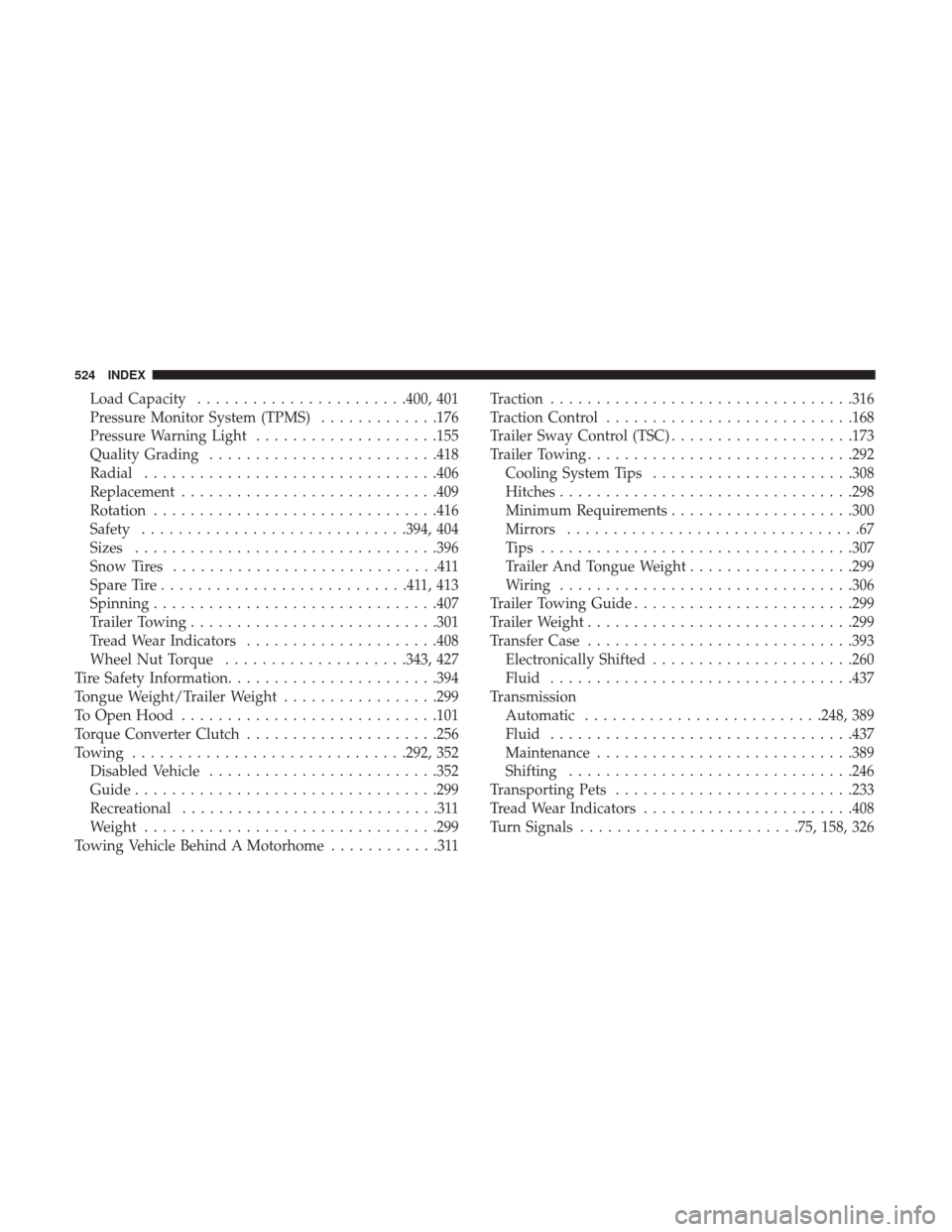
Load Capacity...................... .400, 401
Pressure Monitor System (TPMS) .............176
Pressure Warning Light ....................155
Quality Grading ........................ .418
Radial ............................... .406
Replacement ........................... .409
Rotation .............................. .416
Safety ............................ .394, 404
Sizes ................................ .396
Snow Tires .............................411
Spare Tire ...........................411,413
Spinning .............................. .407
Trailer Towing .......................... .301
Tread Wear Indicators .....................408
Wheel Nut Torque ....................343, 427
Tire Safety Information ...................... .394
Tongue Weight/Trailer Weight .................299
To Open Hood ........................... .101
Torque Converter Clutch .....................256
Towing ............................. .292, 352
Disabled Vehicle ........................ .352
Guide ................................ .299
Recreational ............................311
Weight ............................... .299
Towing Vehicle Behind A Motorhome ............311Traction
................................ .316
Traction Control .......................... .168
Trailer Sway Control (TSC) ....................173
Trailer Towing ............................ .292
Cooling System Tips ..................... .308
Hitches ............................... .298
Minimum Requirements ....................300
Mirrors ................................67
Tips ................................. .307
Trailer And Tongue Weight ..................299
Wiring ............................... .306
T
railer Towing Guide ....................... .299
Trailer Weight ............................ .299
Transfer Case ............................ .393
Electronically Shifted ..................... .260
Fluid ................................ .437
Transmission Automatic ......................... .248, 389
Fluid ................................ .437
Maintenance ........................... .389
Shifting .............................. .246
Transporting Pets ......................... .233
Tread Wear Indicators ...................... .408
Turn Signals ....................... .75, 158, 326
524 INDEX