air condition Ram 4500 Chassis Cab 2019 Owner's Guide
[x] Cancel search | Manufacturer: RAM, Model Year: 2019, Model line: 4500 Chassis Cab, Model: Ram 4500 Chassis Cab 2019Pages: 607, PDF Size: 10.72 MB
Page 423 of 607
SERVICING AND MAINTENANCE 421
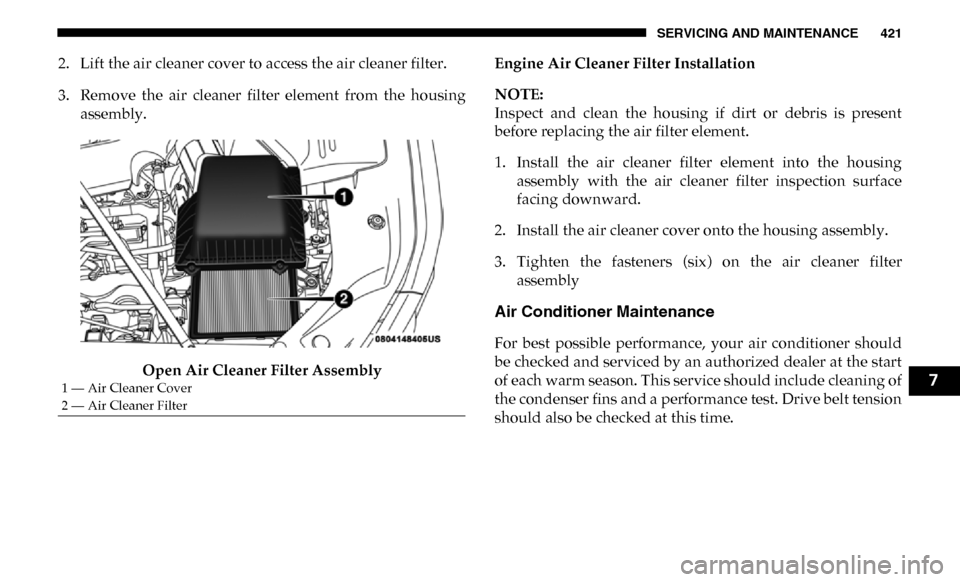
2. Lift the air cleaner cover to access the air cleaner filter.
3. Remove the air cleaner filter element from the housingassembly.
Open Air Cleaner Filter Assembly Engine Air Cleaner Filter Installation
NOTE:
Inspect and clean the housing if dirt or debris is present
before replacing the air filter element.
1. Install the air cleaner filter element into the housing
assembly with the air cleaner filter inspection surface
facing downward.
2. Install the air cleaner cover onto the housing assembly.
3. Tighten the fasteners (six) on the air cleaner filter assembly
Air Conditioner Maintenance
For best possible performance, your air conditioner should
be checked and serviced by an authorized dealer at the start
of each warm season. This service should include cleaning of
the condenser fins and a performance test. Drive belt tension
should also be checked at this time.
1 — Air Cleaner Cover
2 — Air Cleaner Filter7
Page 424 of 607

422 SERVICING AND MAINTENANCE
Refrigerant Recovery And Recycling R-134a — If
Equipped
R-134a Air Conditioning Refrigerant is a hydrofluorocarbon
(HFC) that is an ozone-friendly substance. The manufacturer
recommends that air conditioning service be performed by
an authorized dealer or other service facilities using recovery
and recycling equipment.
NOTE:
Use only manufacturer approved A/C system PAG
compressor oil and refrigerants.
Refrigerant Recovery And Recycling — R–1234yf
R–1234yf Air Conditioning Refrigerant is a hydrofluo-
roolefin (HFO) that is endorsed by the Environmental
Protection Agency and is an ozone-friendly substance with a
low global-warming potential. The manufacturer recom -
mends that air conditioning service be performed by an
authorized dealer using recovery and recycling equipment.
NOTE:
Use only manufacturer approved A/C system PAG
compressor oil, and refrigerants.WARNING!
• Use only refrigerants and compressor lubricants approved by the manufacturer for your air condi -
tioning system. Some unapproved refrigerants are
flammable and can explode, injuring you. Other unap -
proved refrigerants or lubricants can cause the system
to fail, requiring costly repairs. Refer to Warranty Infor -
mation Book, for further warranty information.
• The air conditioning system contains refrigerant under high pressure. To avoid risk of personal injury or
damage to the system, adding refrigerant or any repair
requiring lines to be disconnected should be done by
an experienced technician.
CAUTION!
Do not use chemical flushes in your air conditioning
system as the chemicals can damage your air
conditioning components. Such damage is not covered
by the New Vehicle Limited Warranty.
Page 439 of 607

SERVICING AND MAINTENANCE 437
Checking Coolant Level — 6.4L Engine
The level of the coolant in the pressurized coolant bottle
should be between the “MIN” and “MAX” range on the
bottle when the engine is cold.
The radiator normally remains completely full, so there is no
need to remove the cap unless checking for coolant freeze
point or replacing engine coolant (antifreeze). Advise your
service attendant of this. As long as the engine operating
temperature is satisfactory, the coolant bottle need only be
checked once a month. When additional engine coolant
(antifreeze) is needed to maintain the proper level, it should
be added to the coolant bottle. Do not overfill.
Points To Remember
NOTE:
When the vehicle is stopped after a few miles/kilometers of
operation, you may observe vapor coming from the front of
the engine compartment. This is normally a result of mois-
ture from rain, snow, or high humidity accumulating on the
radiator and being vaporized when the thermostat opens,
allowing hot engine coolant (antifreeze) to enter the radiator. If an examination of your engine compartment shows no
evidence of radiator or hose leaks, the vehicle may be safely
driven. The vapor will soon dissipate.
• Do not overfill the coolant expansion bottle.
• Check the coolant freeze point in the radiator and in the
coolant expansion bottle. If engine coolant (antifreeze)
needs to be added, the contents of the coolant expansion
bottle must also be protected against freezing.
• If frequent engine coolant (antifreeze) additions are required, the cooling system should be pressure tested for leaks.
• Maintain engine coolant (antifreeze) concentration at a minimum of 50% OAT coolant (conforming to MS.90032)
and distilled water for proper corrosion protection of your
engine which contains aluminum components.
• Make sure that the coolant expansion bottle overflow hoses are not kinked or obstructed.
• Keep the front of the radiator clean. If your vehicle is equipped with air conditioning, keep the front of the
condenser clean.
• Do not change the thermostat for Summer or Winter oper -
ation. If replacement is ever necessary, install ONLY the
correct type thermostat. Other designs may result in unsat -
isfactory engine coolant (antifreeze) performance, poor
gas mileage, and increased emissions.
7
Page 457 of 607

SERVICING AND MAINTENANCE 455
Fuel Economy
Underinflated tires will increase tire rolling resistance
resulting in higher fuel consumption.
Tread Wear
Improper cold tire inflation pressures can cause abnormal
wear patterns and reduced tread life, resulting in the need
for earlier tire replacement.
Ride Comfort And Vehicle Stability
Proper tire inflation contributes to a comfortable ride.
Over-inflation produces a jarring and uncomfortable ride.
Tire Inflation Pressures
The proper cold tire inflation pressure is listed on the driver's
side B-Pillar or rear edge of the driver's side door.
At least once a month:
• Check and adjust tire pressure with a good qualitypocket-type pressure gauge. Do not make a visual judge -
ment when determining proper inflation. Tires may look
properly inflated even when they are under-inflated.
• Inspect tires for signs of tire wear or visible damage. Inflation pressures specified on the placard are always “cold
tire inflation pressure”. Cold tire inflation pressure is
defined as the tire pressure after the vehicle has not been
driven for at least three hours, or driven less than 1 mile
(1.6 km) after sitting for a minimum of three hours. The cold
tire inflation pressure must not exceed the maximum infla
-
tion pressure molded into the tire sidewall.
Check tire pressures more often if subject to a wide range of
outdoor temperatures, as tire pressures vary with tempera -
ture changes.
Tire pressures change by approximately 1 psi (7 kPa) per 12°F
(7°C) of air temperature change. Keep this in mind when
checking tire pressure inside a garage, especially in the Winter.
Example: If garage temperature = 68°F (20°C) and the
outside temperature = 32°F (0°C) then the cold tire inflation
pressure should be increased by 3 psi (21 kPa), which equals
1 psi (7 kPa) for every 12°F (7°C) for this outside temperature
condition. CAUTION!
After inspecting or adjusting the tire pressure, always
reinstall the valve stem cap. This will prevent moisture
and dirt from entering the valve stem, which could
damage the valve stem.
7
Page 458 of 607
456 SERVICING AND MAINTENANCE
Tire pressure may increase from 2 to 6 psi (13 to 40 kPa)
during operation. DO NOT reduce this normal pressure
build up or your tire pressure will be too low.
Tire Pressures For High Speed Operation
The manufacturer advocates driving at safe speeds and
within posted speed limits. Where speed limits or conditions
are such that the vehicle can be driven at high speeds, main-
taining correct tire inflation pressure is very important.
Increased tire pressure and reduced vehicle loading may be
required for high-speed vehicle operation. Refer to an autho -
rized tire dealer or original equipment vehicle dealer for
recommended safe operating speeds, loading and cold tire
inflation pressures. Radial Ply Tires
Tire Repair
If your tire becomes damaged, it may be repaired if it meets
the following criteria:
• The tire has not been driven on when flat.
• The damage is only on the tread section of your tire (side
-
wall damage is not repairable).
• The puncture is no greater than a ¼ of an inch (6 mm).
Consult an authorized tire dealer for tire repairs and addi -
tional information.
Damaged Run Flat tires, or Run Flat tires that have experi -
enced a loss of pressure should be replaced immediately
with another Run Flat tire of identical size and service
description (Load Index and Speed Symbol). Replace the tire
pressure sensor as well as it is not designed to be reused.
WARNING!
High speed driving with your vehicle under maximum
load is dangerous. The added strain on your tires could
cause them to fail. You could have a serious collision. Do
not drive a vehicle loaded to the maximum capacity at
continuous speeds above 75 mph (120 km/h).
WARNING!
Combining radial ply tires with other types of tires on
your vehicle will cause your vehicle to handle poorly.
The instability could cause a collision. Always use radial
ply tires in sets of four. Never combine them with other
types of tires.
Page 459 of 607
SERVICING AND MAINTENANCE 457
Run Flat Tires — If Equipped
Run Flat tires allow you the capability to drive 50 miles
(80 km) at 50 mph (80 km/h) after a rapid loss of inflation
pressure. This rapid loss of inflation is referred to as the Run
Flat mode. A Run Flat mode occurs when the tire inflation
pressure is of/or below 14 psi (96 kPa). Once a Run Flat tire
reaches the run flat mode it has limited driving capabilities
and needs to be replaced immediately. A Run Flat tire is not
repairable. When a run flat tire is changed after driving with
underinflated tire condition, please replace the TPM sensor
as it is not designed to be reused when driven under run flat
mode (14 psi (96 kPa)) condition.
NOTE:
TPM Sensor must be replaced after driving the vehicle on a
flat tire condition.
It is not recommended driving a vehicle loaded at full
capacity or to tow a trailer while a tire is in the run flat mode.
See the tire pressure monitoring section for more informa-
tion. Tire Spinning
When stuck in mud, sand, snow, or ice conditions, do not
spin your vehicle's wheels above 30 mph (48 km/h) or for
longer than 30 seconds continuously without stopping.
Refer to “Freeing A Stuck Vehicle” in “In Case Of Emer
-
gency” for further information.
WARNING!
Fast spinning tires can be dangerous. Forces generated
by excessive wheel speeds may cause tire damage or
failure. A tire could explode and injure someone. Do not
spin your vehicle's wheels faster than 30 mph (48 km/h)
for more than 30 seconds continuously when you are
stuck, and do not let anyone near a spinning wheel, no
matter what the speed.
7
Page 472 of 607

470 SERVICING AND MAINTENANCE
STORING THE VEHICLE
If you are storing your vehicle for more than 21 days, we
recommend that you take the following steps to minimize
the drain on your vehicle's battery:
• Disconnect the negative cable from battery.
• Any time you store your vehicle or keep it out of service(i.e., vacation) for two weeks or more, run the air condi -
tioning system at idle for about five minutes in the fresh air
and high blower setting. This will ensure adequate system
lubrication to minimize the possibility of compressor
damage when the system is started again.
BODYWORK
Protection From Atmospheric Agents
Vehicle body care requirements vary according to
geographic locations and usage. Chemicals that make roads
passable in snow and ice and those that are sprayed on trees
and road surfaces during other seasons are highly corrosive
to the metal in your vehicle. Outside parking, which exposes
your vehicle to airborne contaminants, road surfaces on
which the vehicle is operated, extreme hot or cold weather
and other extreme conditions will have an adverse effect on
paint, metal trim, and underbody protection.
The following maintenance recommendations will enable
you to obtain maximum benefit from the corrosion resistance
built into your vehicle.
WARNING!
The temperature grade for this tire is established for a
tire that is properly inflated and not overloaded.
Excessive speed, under-inflation, or excessive loading,
either separately or in combination, can cause heat
buildup and possible tire failure.
Page 484 of 607

482 TECHNICAL SPECIFICATIONS
NOTE:
Intentional tampering with the emissions control system can
result in civil penalties being assessed against you.
Carbon Monoxide Warnings
• An out-of-tune engine or certain fuel or ignitionmalfunctions can cause the catalytic converter to over -
heat. If you notice a pungent burning odor or some
light smoke, your engine may be out of tune or
malfunctioning and may require immediate service.
Contact an authorized dealer for service assistance.
• The use of fuel additives, which are now being sold as octane enhancers, is not recommended. Most of these
products contain high concentrations of methanol. Fuel
system damage or vehicle performance problems
resulting from the use of such fuels or additives is not
the responsibility of the manufacturer and may void or
not be covered under the New Vehicle Limited
Warranty. CAUTION!
(Continued)WARNING!
Carbon monoxide (CO) in exhaust gases is deadly.
Follow the precautions below to prevent carbon
monoxide poisoning:
• Do not inhale exhaust gases. They contain carbon monoxide, a colorless and odorless gas, which can kill.
Never run the engine in a closed area, such as a garage,
and never sit in a parked vehicle with the engine
running for an extended period. If the vehicle is
stopped in an open area with the engine running for
more than a short period, adjust the ventilation system
to force fresh, outside air into the vehicle.
• Guard against carbon monoxide with proper mainte -
nance. Have the exhaust system inspected every time
the vehicle is raised. Have any abnormal conditions
repaired promptly. Until repaired, drive with all side
windows fully open.
Page 558 of 607

556 MULTIMEDIA
Regulatory And Safety Information
USA/CANADA
Exposure to Radio Frequency Radiation
The radiated output power of the internal wireless radio is
far below the FCC and IC radio frequency exposure limits.
Nevertheless, the wireless radio will be used in such a
manner that the radio is 8 in (20 cm) or further from the
human body.
The internal wireless radio operates within guidelines found
in radio frequency safety standards and recommendations,
which reflect the consensus of the scientific community.
The radio manufacturer believes the internal wireless radio
is safe for use by consumers. The level of energy emitted is
far less than the electromagnetic energy emitted by wireless
devices such as mobile phones. However, the use of wireless
radios may be restricted in some situations or environments,
such as aboard airplanes. If you are unsure of restrictions,
you are encouraged to ask for authorization before turning
on the wireless radio.The following regulatory statement applies to all Radio
Frequency (RF) devices equipped in this vehicle:
This device complies with Part 15 of the FCC Rules and with
Industry Canada license-exempt RSS standard(s). Operation
is subject to the following two conditions:
1. This device may not cause harmful interference, and
2. This device must accept any interference received,
including interference that may cause undesired operation.
NOTE:
Changes or modifications not expressly approved by the
party responsible for compliance could void the user’s
authority to operate the equipment.
Page 586 of 607

584 MULTIMEDIA
NOTE:
Changes or modifications not expressly approved by the
party responsible for compliance could void the user’s
authority to operate the equipment.
Additional Information
© 2019 FCA US LLC. All rights reserved. Mopar and Ucon-
nect are registered trademarks and Mopar Owner Connect is
a trademark of FCA US LLC. Android is a trademark of
Google Inc. SiriusXM and all related marks and logos are
trademarks of SiriusXM Radio Inc.
Uconnect System Support:
• U.S. residents visit www.DriveUconnect.com or call:
1-877-855-8400(24 hours a day 7 days a week)
• Canadian residents visit www.DriveUconnect.ca or call:
1-800-465-2001(English) or 1-800-387-9983(French)
SiriusXM Guardian services support:
• U.S. residents visit www.siriusxm.com/guardian or call:
1-844-796-4827
• Canadian residents visit www.siriusxm.ca/guardian or
call: 1-877-324-9091
CD/DVD DISC MAINTENANCE
To keep a CD/DVD in good condition, take the following
precautions:
• Handle the disc by its edge; avoid touching the surface.
• If the disc is stained, clean the surface with a soft cloth, wiping from center to edge.
• Do not apply paper or tape to the disc; avoid scratching the disc.
• Do not use solvents such as benzene, thinner, cleaners, or anti-static sprays.
• Store the disc in its case after playing.
• Do not expose the disc to direct sunlight.
• Do not store the disc where temperatures may become too high.
NOTE:
If you experience difficulty in playing a particular disc, it
may be damaged (e.g., scratched, reflective coating removed,
a hair, moisture or dew on the disc), oversized, or have
protection encoding. Try a known good disc before consid -
ering disc player service.