tire size Ram 5500 Chassis Cab 2011 User Guide
[x] Cancel search | Manufacturer: RAM, Model Year: 2011, Model line: 5500 Chassis Cab, Model: Ram 5500 Chassis Cab 2011Pages: 476, PDF Size: 7.32 MB
Page 317 of 476

WARNING!
•Do not use a tire, wheel size or rating other than
that specified for your vehicle. Some combinations
of unapproved tires and wheels may change sus-
pension dimensions and performance characteris-
tics, resulting in changes to steering, handling, and
braking of your vehicle. This can cause unpredict-
able handling and stress to steering and suspen-
sion components. You could lose control and have
an accident resulting in serious injury or death.
Use only the tire and wheel sizes with load ratings
approved for your vehicle.(Continued)
WARNING! (Continued)
•Never use a tire with a smaller load index or
capacity, other than what was originally equipped
on your vehicle. Using a tire with a smaller load
index could result in tire overloading and failure.
You could lose control and have an accident result-
ing in serious injury or death.
•Failure to equip your vehicle with tires having
adequate speed capability can result in sudden tire
failure and loss of vehicle control resulting in
serious injury or death.
CAUTION!
Replacing original tires with tires of a different size
may result in false speedometer and odometer read-
ings.
316 STARTING AND OPERATING
Page 318 of 476
![Ram 5500 Chassis Cab 2011 User Guide SUPPLEMENTAL TIRE PRESSURE INFORMATION
— IF EQUIPPED
A light load vehicle condition is defined as two passen-
gers [150 lbs (68 kg) each] plus 200 lbs (91 kg) of cargo.
Cold tire inflation pressures](/img/34/12630/w960_12630-317.png "Ram 5500 Chassis Cab 2011 User Guide SUPPLEMENTAL TIRE PRESSURE INFORMATION
— IF EQUIPPED
A light load vehicle condition is defined as two passen-
gers [150 lbs (68 kg) each] plus 200 lbs (91 kg) of cargo.
Cold tire inflation pressures")
SUPPLEMENTAL TIRE PRESSURE INFORMATION
— IF EQUIPPED
A light load vehicle condition is defined as two passen-
gers [150 lbs (68 kg) each] plus 200 lbs (91 kg) of cargo.
Cold tire inflation pressures for a lightly loaded vehicle
will be found on the face of the driver’s door.
TIRE CHAINS
Use “Class U” chains or other traction aids that meet SAE
Type “U” specifications.
NOTE:Chains must be the proper size for the vehicle,
as recommended by the chain manufacturer.
CAUTION!
To avoid damage to your vehicle, tires or chains,
observe the following precautions:
(Continued)
CAUTION! (Continued)
•Because of limited chain clearance between tires
and other suspension components, it is important
that only chains in good condition are used. Bro-
ken chains can cause serious vehicle damage. Stop
the vehicle immediately if noise occurs that could
suggest chain breakage. Remove the damaged
parts of the chain before further use.
•Install chains as tightly as possible and then
retighten after driving about 1/2 mi (0.8 km).
•Do not exceed 45 mph (72 km/h).
•Drive cautiously and avoid severe turns and large
bumps, especially with a loaded vehicle.
•Do not install tire chains on front wheels of 4x2
vehicles.
•Do not drive for a prolonged period on dry pave-
ment.(Continued)
5
STARTING AND OPERATING 317
Page 319 of 476
CAUTION! (Continued)
•Observe the tire chain manufacturer’s instructions
on method of installation, operating speed, and
conditions for usage. Always use the lower sug-
gested operating speed of the chain manufacturer
if different than the speed recommended by the
manufacturer.
These cautions apply to all chain traction devices, includ-
ing link and cable (radial) chains.
Tire chain use is permitted only on the rear tires of your
4X2 trucks.
NOTE:
•The use of class “U” chains is permitted on the front
and rear of 4X4 vehicles, trucks with dual rear wheels
and LT235/80R17E tires.
•On 4X2 vehicles, class “U” snow chains are permitted
on the rear wheels only of vehicles equipped with
LT245/70R17, LT265/70R17, and LT235/80R17 size
tires.
•On 4X4 Single Rear Wheel (SRW) vehicles, class “U”
snow chains are permitted on the rear wheels only on
vehicles equipped with LT265/70R17.
CAUTION!
Do not use tire chains on the 4X2 front wheels of
SRW (Single Rear Wheels) equipped with LT245/
70R17, LT265/70R17 tires or 4X4 front tires of vehicles
equipped with LT265/70R17tires. There may not be
adequate clearance for the chains and you are risking
structural or body damage to your vehicle.
318 STARTING AND OPERATING
Page 320 of 476
SNOW TIRES
Snow tires should be of the same size and type construc-
tion as the front tires. Consult the manufacturer of the
snow tire to determine any maximum vehicle speed
requirement associated with the tire. These tires should
always be operated at the vehicle maximum capacity
inflation pressures under any load condition.
While studded tires improve performance on ice, skid
and traction capability on wet or dry surfaces may be
poorer than that of non-studded tires. Some states pro-
hibit studded tires; therefore, local laws should be
checked before using these tire types.
TIRE ROTATION RECOMMENDATIONS
Tires on the front and rear axles of vehicles operate at
different loads and perform different steering, driving,
and braking functions. For these reasons, they wear at
unequal rates, and develop irregular wear patterns.
These effects can be reduced by timely rotation of tires.
The benefits of rotation are especially worthwhile with
aggressive tread designs such as those on On/Off Road
type tires. Rotation will increase tread life, help to main-
tain mud, snow, and wet traction levels, and contribute to
a smooth, quiet ride.
5
STARTING AND OPERATING 319
Page 330 of 476
Tire Size
The tire size on the Label represents the actual tire size on
your vehicle. Replacement tires must be equal to the load
capacity of this tire size.
Rim Size
This is the rim size that is appropriate for the tire size
listed.
Inflation Pressure
This is the cold tire inflation pressure for your vehicle for
all loading conditions up to full GAWR.
Curb Weight
The curb weight of a vehicle is defined as the total weight
of the vehicle with all fluids, including vehicle fuel, at full
capacity conditions, and with no occupants or cargo
loaded into the vehicle. The front and rear curb weight
values are determined by weighing your vehicle on a
commercial scale before any occupants or cargo are
added.
Loading
The actual total weight and the weight of the front and
rear of your vehicle at the ground can best be determined
by weighing it when it is loaded and ready for operation.
The entire vehicle should first be weighed on a commer-
cial scale to insure that the GVWR has not been exceeded.
The weight on the front and rear of the vehicle should
then be determined separately to be sure that the load is
properly distributed over front and rear axle. Weighing
the vehicle may show that the GAWR of either the front
or rear axles has been exceeded but the total load is
within the specified GVWR. If so, weight must be shifted
from front to rear or rear to front as appropriate until the
specified weight limitations are met. Store the heavier
items down low and be sure that the weight is distributed
equally. Stow all loose items securely before driving.
5
STARTING AND OPERATING 329
Page 370 of 476
Wheel Nut Torque
All wheel nuts should be tightened occasionally to elimi-
nate the possibility of wheel studs being sheared or the
bolt holes in the wheels becoming elongated. This is
especially important during the first few hundred miles/
kilometers of operation to allow the wheel nuts to
become properly set. All nuts should first be firmlyseated against the wheel. The nuts should then be
tightened to recommended torque. Tighten the nuts to
final torque in increments. Progress around the bolt
circle, tightening the nut opposite to the nut just previ-
ously tightened until final torque is achieved. Recom-
mended torques are shown in the following chart.
Disc Wheels Type Nut
Stud SizeTorque Ft Lbs Torque Newton
Meters
Cone 9/16-18120-150160-200
Flanged 9/16-18130-160190-220
To Stow The Flat Or Spare — If Equipped
Refer to Upfitters Body Builders Guide for information
on stowing your spare tire (if equipped).
6
WHAT TO DO IN EMERGENCIES 369
Page 473 of 476
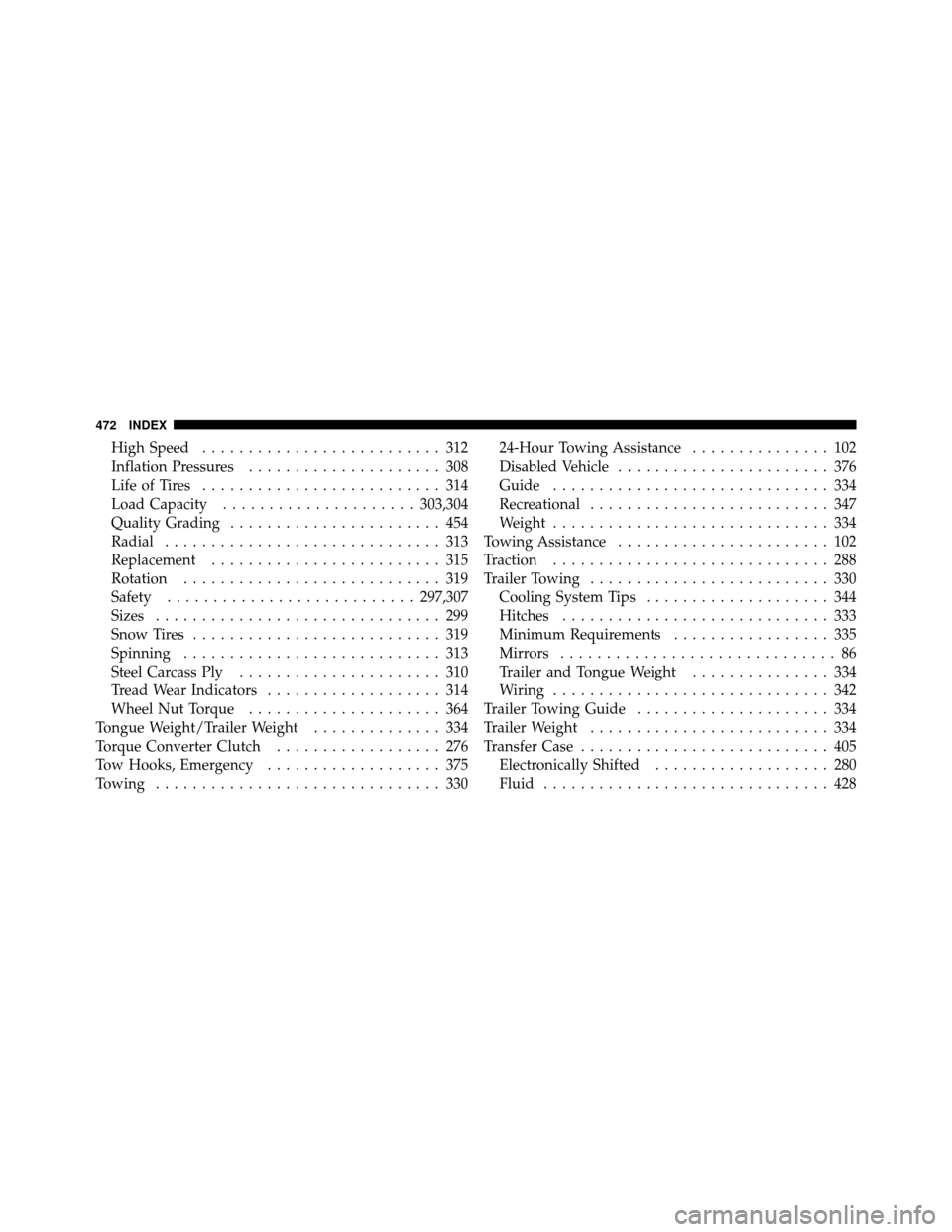
High Speed.......................... 312
Inflation Pressures ..................... 308
Life of Tires .......................... 314
Load Capacity ..................... 303,304
Quality Grading ....................... 454
Radial .............................. 313
Replacement ......................... 315
Rotation ............................ 319
Safety ........................... 297,307
Sizes ............................... 299
Snow Tires ........................... 319
Spinning ............................ 313
Steel Carcass Ply ...................... 310
Tread Wear Indicators ................... 314
Wheel Nut Torque ..................... 364
Tongue Weight/Trailer Weight .............. 334
Torque Converter Clutch .................. 276
Tow Hooks, Emergency ................... 375
Towing ............................... 330 24-Hour Towing Assistance
............... 102
Disabled Vehicle ....................... 376
Guide .............................. 334
Recreational .......................... 347
Weight .............................. 334
Towing Assistance ....................... 102
Traction .............................. 288
Trailer Towing .......................... 330
Cooling System Tips .................... 344
Hitches ............................. 333
Minimum Requirements ................. 335
Mirrors .............................. 86
Trailer and Tongue Weight ............... 334
Wiring .............................. 342
Trailer Towing Guide ..................... 334
Trailer Weight .......................... 334
Transfer Case ........................... 405
Electronically Shifted ................... 280
Fluid ............................... 428
472 INDEX