light Ram 5500 Chassis Cab 2012 Owner's Manual
[x] Cancel search | Manufacturer: RAM, Model Year: 2012, Model line: 5500 Chassis Cab, Model: Ram 5500 Chassis Cab 2012Pages: 508, PDF Size: 7.01 MB
Page 365 of 508
Automatic Transmission
The “DRIVE” range can be selected when towing. How-
ever, if frequent shifting occurs while in this range, select
“TOW/HAUL” mode or select a lower gear using the
Electronic Range Select (ERS) feature.
NOTE:Using “TOW/HAUL” mode or a lower gear
range while operating the vehicle under heavy operating
conditions will improve performance and extend trans-
mission life by reducing excessive shifting and heat build
up. This action will also provide better engine braking.
The automatic transmission fluid and filter should be
changed if you regularly tow a trailer for more than
45 minutes of continuous operation. Refer to “Mainte-
nance Schedule” for the proper maintenance intervals.
NOTE:Check the automatic transmission fluid level
before towing.
Tow/Haul
To reduce potential for automatic transmission overheat-
ing, turn the “TOW/HAUL” feature ON when driving in
hilly areas, or select a lower gear range (using the
Electronic Range Select (ERS) feature) on more severe
grades.
Electronic Speed Control – If Equipped
Do not use in hilly terrain or with heavy loads.
When using the speed control, if you experience speed
drops greater than 10 mph (16 km/h), disengage until
you can get back to cruising speed.
Use speed control in flat terrain and with light loads to
maximize fuel efficiency.
5
STARTING AND OPERATING 363
Page 367 of 508
Before Plowing
•
Check the hydraulic system for leaks and proper fluid
level.
•Check the mounting bolts and nuts for proper tight-
ness.
•Check the runners and cutting edge for excessive wear.
The cutting edge should be 1/4 to 1/2 in (6 cm to
1.2 cm) above ground in snow plowing position.
•Check that snowplow lighting is connected and func-
tioning properly.
Snowplow Prep Package Model Availability
For Information about snowplow applications visit
www.dodge.com or refer to the current Dodge Body
Builders Guide.
1. The maximum number of occupants in the truck
should not exceed two.2. The total GVWR or the Front GAWR or the Rear
GAWR should never be exceeded.
3. Cargo capacity will be reduced by the addition of
options or passengers, etc.
The loaded vehicle weight, including the snowplow
system, all aftermarket accessories, driver, passengers,
options, and cargo, must not exceed either the Gross
Vehicle Weight (GVWR) or Gross Axle Weight (GAWR)
ratings. These weights are specified on the Safety Com-
pliance Certification Label on the driver’s side door
opening.
NOTE:Detach the snowplow when transporting pas-
sengers.
Vehicle front end wheel alignment was set to specifica-
tions at the factory without consideration for the weight
of the plow. Front end toe-in should be checked and reset
5
STARTING AND OPERATING 365
Page 376 of 508

CAUTION!
It is necessary to follow these steps to be certain that
the transfer case is fully in NEUTRAL before recre-
ational towing to prevent damage to internal parts.
1. Bring the vehicle to a complete stop. Shift automatic
transmission into PARK.
2. Turn OFF the engine.
3. Turn the ignition switch to the ON/RUN position, but
do not start the engine.
4. Press and hold the brake pedal.
5. Shift the automatic transmission into NEUTRAL or
press the clutch pedal on a manual transmission.
6. Press and hold the transfer case NEUTRAL button
(located by the selector switch). The NEUTRAL indicatorlight will blink while the shift is in progress. The light
will stop blinking (stay on solid) when the shift to
NEUTRAL is complete.
7. After the shift is completed and the NEUTRAL light
stays on, release the NEUTRAL button.
8. Start the engine.
9. Shift the transmission into REVERSE.
10. Release the brake pedal (and clutch pedal on manual
transmissions) for five seconds and ensure that there is
no vehicle movement.
11. Repeat steps 9 and 10 with automatic transmission in
DRIVE or manual transmission in first gear.
12. Turn OFF the engine.
13. Firmly apply the parking brake.
374 STARTING AND OPERATING
Page 377 of 508

14. Shift the transmission into PARK or place manual
transmission in gear (not in Neutral).
CAUTION!
Damage to the transmission may occur if the trans-
mission is shifted into PARK with the transfer case in
NEUTRAL and the engine running. With the transfer
case in NEUTRAL, ensure that the engine is OFF
prior to shifting the transmission into PARK.
15. Remove the key fob from the ignition switch.
16. Attach the vehicle to the tow vehicle using a suitable
tow bar.
17. Release the parking brake.
NOTE:
•The transfer case cannot be shifted into NEUTRAL
from the 4WD AUTO (if equipped) position.
•Steps 1 through 5 are requirements that must be met
prior to pressing the NEUTRAL button, and must
continue to be met until the shift has been completed.
If any of these requirements are not met prior to
pressing the NEUTRAL button or are no longer met
during the shift, the NEUTRAL indicator light will
flash continuously until all requirements are met or
until the NEUTRAL button is released.
•The ignition switch must be in the ON/RUN position
for a shift to take place and for the position indicator
lights to be operable. If the ignition switch is not in the
ON/RUN position, the shift will not take place and no
position indicator lights will be on or flashing.
•A flashing NEUTRAL indicator light indicates that
shift requirements have not been met.
5
STARTING AND OPERATING 375
Page 378 of 508

Shifting Out Of NEUTRAL – Electronic Shift
Transfer Case (If Equipped)
Use the following procedure to prepare your vehicle for
normal usage:
1. Bring the vehicle to a complete stop, leaving it con-
nected to the tow vehicle.
2. Firmly apply the parking brake.
3. Turn the ignition switch to the ON/RUN position, but
do not start the engine.
4. Press and hold the brake pedal.
5. Shift the transmission into NEUTRAL.
6. Press and hold the transfer case NEUTRAL button
(located by the selector switch) until the NEUTRAL
indicator light turns off.
7. After the NEUTRAL indicator light turns off, release
the NEUTRAL button.8. After the NEUTRAL button has been released, the
transfer case will shift to the position indicated by the
selector switch.
NOTE:When shifting out of transfer case NEUTRAL,
turning the engine OFF may be required to avoid gear
clash.
9. Shift the automatic transmission into PARK, or place
manual transmission in NEUTRAL.
10. Release the brake pedal.
11. Disconnect vehicle from the tow vehicle.
12. Start the engine.
13. Press and hold the brake pedal.
14. Release the parking brake.
376 STARTING AND OPERATING
Page 379 of 508
15. Shift the transmission into gear, release the brake
pedal (and clutch pedal on manual transmissions), and
check that the vehicle operates normally.
NOTE:
•Steps 1 through 5 are requirements that must be met
prior to pressing the transfer case NEUTRAL button
and must continue to be met until the shift has been
completed. If any of these requirements are not met
prior to pressing the NEUTRAL button, or are no
longer met during the shift, the NEUTRAL indicator
light will flash continuously until all requirements are
met or until the NEUTRAL button is released.
•The ignition switch must be in the ON/RUN position
for a transfer case shift to take place and for the
position indicator lights to be operable. If the ignition
switch is not in the ON/RUN position, the shift will
not take place and no position indicator lights will be
on or flashing.
•A flashing NEUTRAL position indicator light indicates
that shift requirements have not been met.
5
STARTING AND OPERATING 377
Page 388 of 508

4. By rotating the wheel wrench clockwise, raise the
vehicle until the wheel just clears the surface.
WARNING!
Raising the vehicle higher than necessary can make
the vehicle unstable and cause a collision. It could
slip off the jack and hurt someone near it. Raise the
vehicle only enough to remove the tire.
5. Remove the wheel nuts and pull the wheel off. Install
the spare wheel and wheel nuts with the cone shaped end
of the nuts toward the wheel on single rear wheel (SRW)
models. On dual rear wheel models (DRW) the lug nuts
are a two-piece assembly with a flat face. Lightly tighten
the nuts. To avoid risk of forcing the vehicle off the jack,
do not fully tighten the nuts until the vehicle has been
lowered.6. Using the wheel wrench, finish tightening the nuts
using a crisscross pattern. The correct nut tightness is
135 ft lbs (183 N·m) torque for single rear wheel (SRW)
models and 145 ft lbs (197 N·m) for dual rear wheel
models. If in doubt about the correct tightness, have them
checked with a torque wrench by your authorized dealer
or at a service station.
WARNING!
A loose tire or jack thrown forward in a collision or
hard stop could injure someone in the vehicle. Al-
ways stow the jack parts and the extra tire and wheel
in the places provided.
7. Install wheel center cap (if equipped) and remove
wheel blocks. Do not install chrome or aluminum wheel
center caps on the spare wheel. This may result in cap
damage.
386 WHAT TO DO IN EMERGENCIES
Page 395 of 508
Preparations For Jump-Start
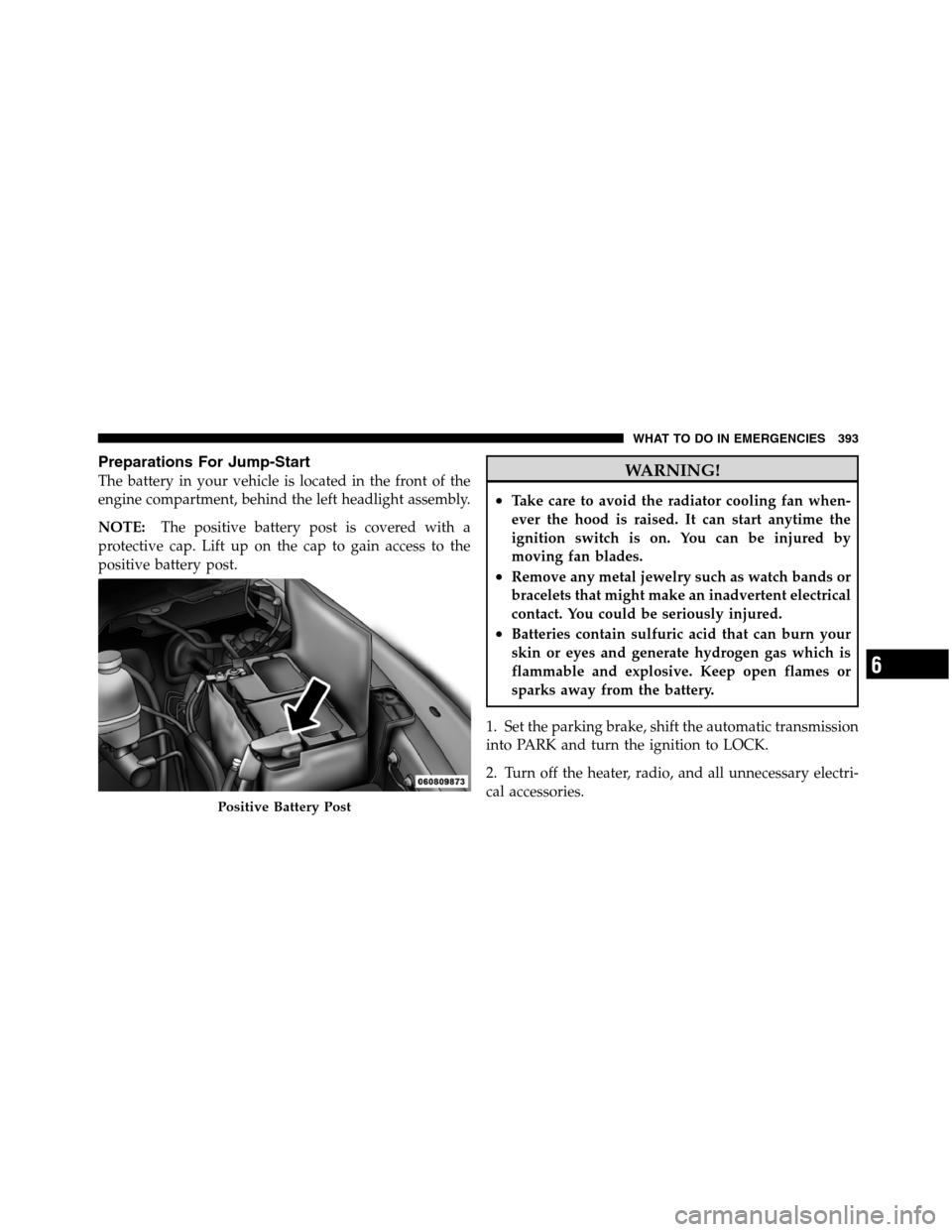
The battery in your vehicle is located in the front of the
engine compartment, behind the left headlight assembly.
NOTE:The positive battery post is covered with a
protective cap. Lift up on the cap to gain access to the
positive battery post.WARNING!
•Take care to avoid the radiator cooling fan when-
ever the hood is raised. It can start anytime the
ignition switch is on. You can be injured by
moving fan blades.
•Remove any metal jewelry such as watch bands or
bracelets that might make an inadvertent electrical
contact. You could be seriously injured.
•Batteries contain sulfuric acid that can burn your
skin or eyes and generate hydrogen gas which is
flammable and explosive. Keep open flames or
sparks away from the battery.
1. Set the parking brake, shift the automatic transmission
into PARK and turn the ignition to LOCK.
2. Turn off the heater, radio, and all unnecessary electri-
cal accessories.
Positive Battery Post
6
WHAT TO DO IN EMERGENCIES 393
Page 398 of 508

FREEING A STUCK VEHICLE
If the vehicle becomes stuck in snow, sand, or mud, it can
often be moved by a rocking motion. Move the shift lever
rhythmically between DRIVE/1st and REVERSE while
applying slight pressure to the accelerator.
CAUTION!
•Racing the engine or spinning the wheels may
lead to transmission overheating and failure. Al-
low the engine to idle with the shift lever in
NEUTRAL for at least one minute after every five
rocking-motion cycles. This will minimize over-
heating and reduce the risk of transmission failure
during prolonged efforts to free a stuck vehicle.
(Continued)
CAUTION! (Continued)
•When “rocking” a stuck vehicle by moving be-
tween DRIVE/1st and REVERSE, do not spin the
wheels faster than 15 mph (24 km/h), or drivetrain
damage may result.
•Revving the engine or spinning the wheels too fast
may lead to transmission overheating and failure.
It can also damage the tires. Do not spin the
wheels above 30 mph (48 km/h) while in gear (no
transmission shifting occurring).
396 WHAT TO DO IN EMERGENCIES
Page 408 of 508

ONBOARD DIAGNOSTIC SYSTEM (OBD II)
Your vehicle is equipped with a sophisticated onboard
diagnostic system called OBD II. This system monitors
the performance of the emissions, engine, and automatic
transmission control systems. When these systems are
operating properly, your vehicle will provide excellent
performance and fuel economy, as well as engine emis-
sions well within current government regulations.
If any of these systems require service, the OBD II system
will turn on the “Malfunction Indicator Light (MIL).” It
will also store diagnostic codes and other information to
assist your service technician in making repairs. Al-
though your vehicle will usually be drivable and not
need towing, see your authorized dealer for service as
soon as possible.CAUTION!
•Prolonged driving with the MIL on could cause
further damage to the emission control system. It
could also affect fuel economy and drivability. The
vehicle must be serviced before any emissions
tests can be performed.
•If the MIL is flashing, while the engine is running,
severe catalytic converter damage and power loss
will soon occur. Immediate service is required.
Loose Fuel Filler Cap Message
If the vehicle diagnostic system determines
that the fuel filler cap is loose, improperly
installed, or damaged, a loose gascap indicator
will display in the EVIC telltale display area.
Refer to “Electronic Vehicle Information Center (EVIC) in
“Understanding Your Instrument Panel” for further in-
formation. Tighten the fuel filler cap properly and press
406 MAINTAINING YOUR VEHICLE