engine overheat Ram 5500 Chassis Cab 2012 User Guide
[x] Cancel search | Manufacturer: RAM, Model Year: 2012, Model line: 5500 Chassis Cab, Model: Ram 5500 Chassis Cab 2012Pages: 508, PDF Size: 7.01 MB
Page 346 of 508

Materials Added To Fuel
All gasolines sold in the United States are required to
contain effective detergent additives. Use of additional
detergents or other additives is not needed under normal
conditions and would result in unnecessary cost. There-
fore, you should not have to add anything to the fuel.
Fuel System Cautions
CAUTION!
Follow these guidelines to maintain your vehicle’s
performance:
•The use of leaded gas is prohibited by Federal law.
Using leaded gasoline can impair engine perfor-
mance, damage the emission control system.
(Continued)
CAUTION! (Continued)
•An out-of-tune engine, or certain fuel or ignition
malfunctions, can cause the catalytic converter to
overheat. If you notice a pungent burning odor or
some light smoke, your engine may be out of tune
or malfunctioning and may require immediate
service. Contact your authorized dealer for service
assistance.
•When pulling a heavy load or driving a fully-
loaded vehicle when the humidity is low and the
temperature is high, use a premium unleaded fuel
to help prevent spark knock. If spark knock per-
sists, lighten the load, or engine piston damage
may result.
(Continued)
344 STARTING AND OPERATING
Page 365 of 508
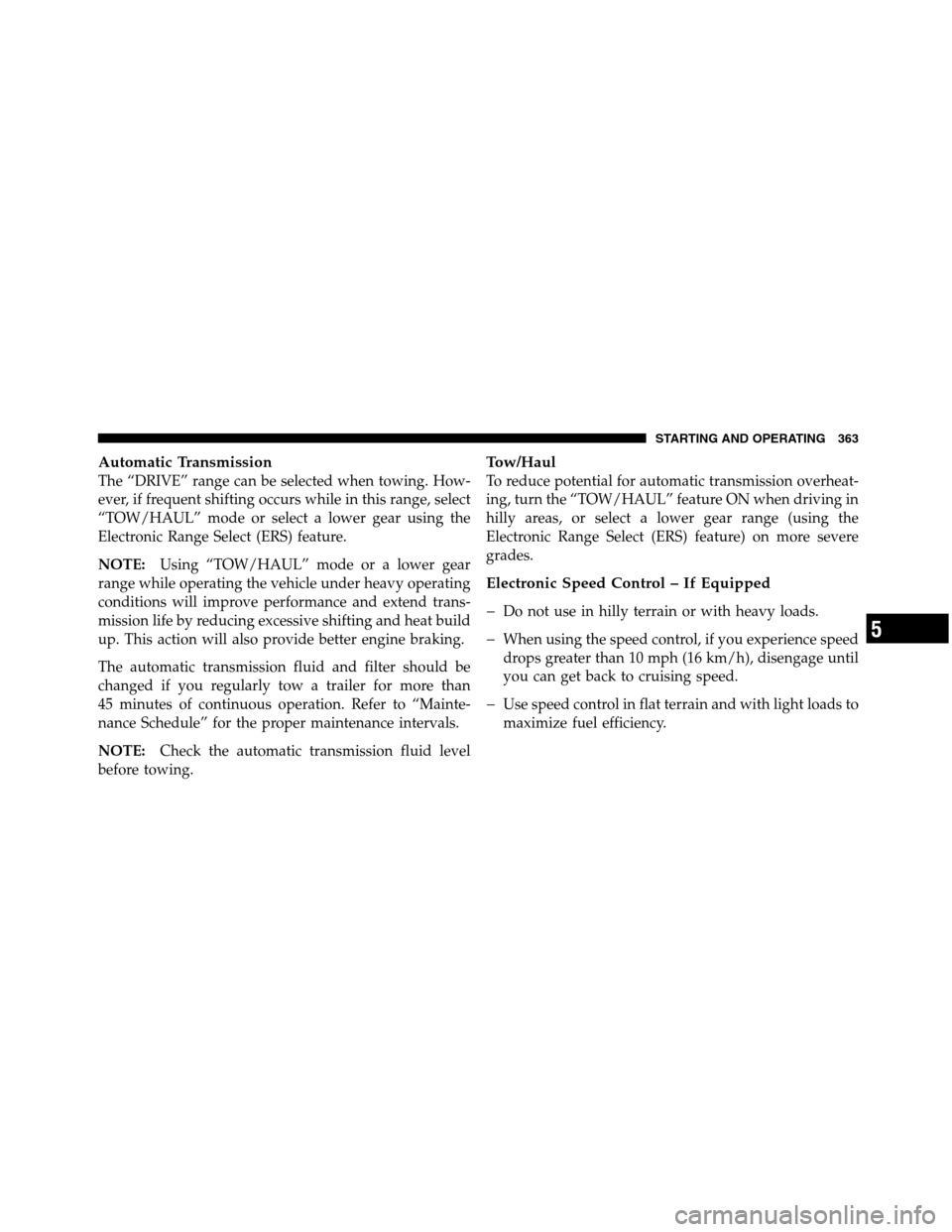
Automatic Transmission
The “DRIVE” range can be selected when towing. How-
ever, if frequent shifting occurs while in this range, select
“TOW/HAUL” mode or select a lower gear using the
Electronic Range Select (ERS) feature.
NOTE:Using “TOW/HAUL” mode or a lower gear
range while operating the vehicle under heavy operating
conditions will improve performance and extend trans-
mission life by reducing excessive shifting and heat build
up. This action will also provide better engine braking.
The automatic transmission fluid and filter should be
changed if you regularly tow a trailer for more than
45 minutes of continuous operation. Refer to “Mainte-
nance Schedule” for the proper maintenance intervals.
NOTE:Check the automatic transmission fluid level
before towing.
Tow/Haul
To reduce potential for automatic transmission overheat-
ing, turn the “TOW/HAUL” feature ON when driving in
hilly areas, or select a lower gear range (using the
Electronic Range Select (ERS) feature) on more severe
grades.
Electronic Speed Control – If Equipped
Do not use in hilly terrain or with heavy loads.
When using the speed control, if you experience speed
drops greater than 10 mph (16 km/h), disengage until
you can get back to cruising speed.
Use speed control in flat terrain and with light loads to
maximize fuel efficiency.
5
STARTING AND OPERATING 363
Page 369 of 508

General Maintenance
Snowplows should be maintained in accordance with the
plow manufacturer’s instructions.
Keep all snowplow electrical connections and battery
terminals clean and free of corrosion.
When plowing snow, to avoid transmission and drive-
train damage, the following precautions should be ob-
served.
•Operate with transfer case in 4L when plowing small
or congested areas where speeds are not likely to
exceed 15 mph (24 km/h). At higher speeds operate in
4H.
•Vehicles with automatic transmissions should use 4L
range when plowing deep or heavy snow for extended
periods of time to avoid transmission overheating.
•Do not shift the transmission unless the engine has
returned to idle and wheels have stopped. Make a
practice of stepping on the brake pedal before shifting
the transmission.
5
STARTING AND OPERATING 367
Page 398 of 508

FREEING A STUCK VEHICLE
If the vehicle becomes stuck in snow, sand, or mud, it can
often be moved by a rocking motion. Move the shift lever
rhythmically between DRIVE/1st and REVERSE while
applying slight pressure to the accelerator.
CAUTION!
•Racing the engine or spinning the wheels may
lead to transmission overheating and failure. Al-
low the engine to idle with the shift lever in
NEUTRAL for at least one minute after every five
rocking-motion cycles. This will minimize over-
heating and reduce the risk of transmission failure
during prolonged efforts to free a stuck vehicle.
(Continued)
CAUTION! (Continued)
•When “rocking” a stuck vehicle by moving be-
tween DRIVE/1st and REVERSE, do not spin the
wheels faster than 15 mph (24 km/h), or drivetrain
damage may result.
•Revving the engine or spinning the wheels too fast
may lead to transmission overheating and failure.
It can also damage the tires. Do not spin the
wheels above 30 mph (48 km/h) while in gear (no
transmission shifting occurring).
396 WHAT TO DO IN EMERGENCIES
Page 422 of 508

CAUTION!
•The catalytic converter requires the use of un-
leaded fuel only. Leaded gasoline will destroy the
effectiveness of the catalyst as an emissions con-
trol device and may seriously reduce engine per-
formance and cause serious damage to the engine.
•Damage to the catalytic converter can result if your
vehicle is not kept in proper operating condition.
In the event of engine malfunction, particularly
involving engine misfire or other apparent loss of
performance, have your vehicle serviced promptly.
Continued operation of your vehicle with a severe
malfunction could cause the converter to overheat,
resulting in possible damage to the converter and
vehicle.Under normal operating conditions, the catalytic con-
verter will not require maintenance. However, it is im-
portant to keep the engine properly tuned to assure
proper catalyst operation and prevent possible catalyst
damage.
NOTE:Intentional tampering with emissions control
systems can result in civil penalties being assessed
against you.
In unusual situations involving grossly malfunctioning
engine operation, a scorching odor may suggest severe
and abnormal catalyst overheating. If this occurs, stop
the vehicle, turn off the engine and allow it to cool.
Service, including a tune-up to manufacturer’s specifica-
tions, should be obtained immediately.
420 MAINTAINING YOUR VEHICLE
Page 426 of 508
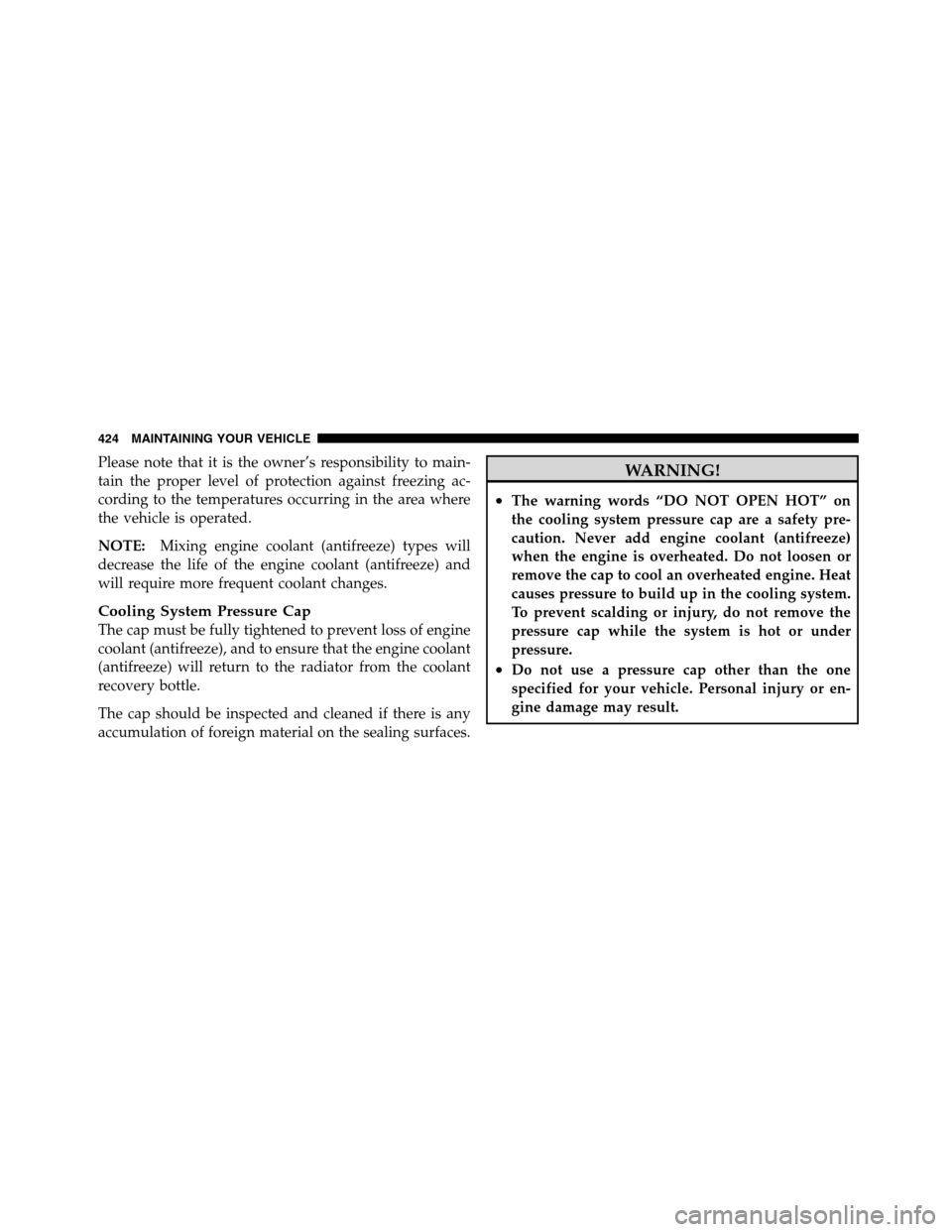
Please note that it is the owner’s responsibility to main-
tain the proper level of protection against freezing ac-
cording to the temperatures occurring in the area where
the vehicle is operated.
NOTE:Mixing engine coolant (antifreeze) types will
decrease the life of the engine coolant (antifreeze) and
will require more frequent coolant changes.
Cooling System Pressure Cap
The cap must be fully tightened to prevent loss of engine
coolant (antifreeze), and to ensure that the engine coolant
(antifreeze) will return to the radiator from the coolant
recovery bottle.
The cap should be inspected and cleaned if there is any
accumulation of foreign material on the sealing surfaces.
WARNING!
•The warning words “DO NOT OPEN HOT” on
the cooling system pressure cap are a safety pre-
caution. Never add engine coolant (antifreeze)
when the engine is overheated. Do not loosen or
remove the cap to cool an overheated engine. Heat
causes pressure to build up in the cooling system.
To prevent scalding or injury, do not remove the
pressure cap while the system is hot or under
pressure.
•Do not use a pressure cap other than the one
specified for your vehicle. Personal injury or en-
gine damage may result.
424 MAINTAINING YOUR VEHICLE
Page 498 of 508
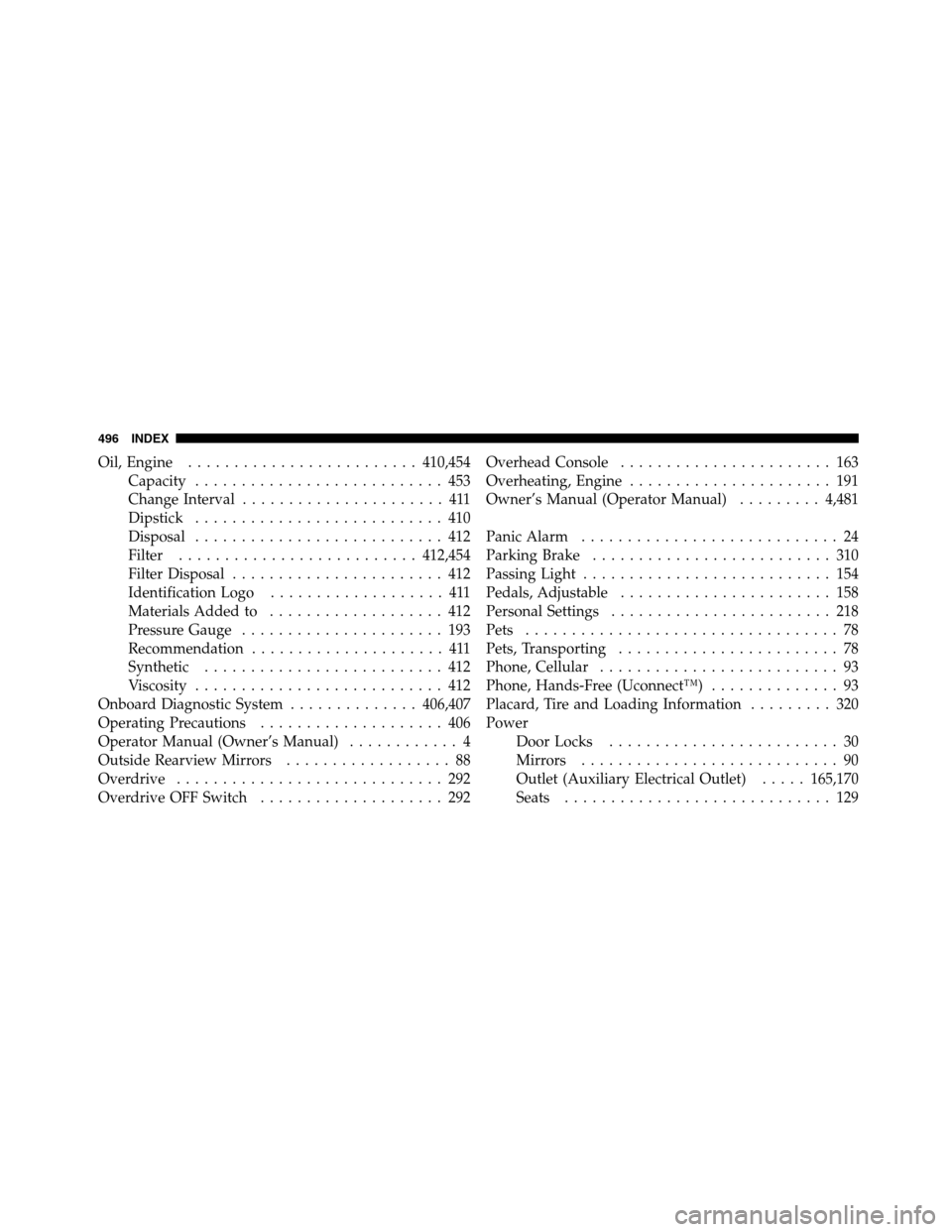
Oil, Engine.........................410,454
Capacity........................... 453
Change Interval...................... 411
Dipstick........................... 410
Disposal........................... 412
Filter ..........................412,454
Filter Disposal....................... 412
Identification Logo................... 411
Materials Added to................... 412
Pressure Gauge...................... 193
Recommendation..................... 411
Synthetic.......................... 412
Viscosity........................... 412
Onboard Diagnostic System..............406,407
Operating Precautions.................... 406
Operator Manual (Owner’s Manual)............ 4
Outside Rearview Mirrors.................. 88
Overdrive............................. 292
Overdrive OFF Switch.................... 292Overhead Console....................... 163
Overheating, Engine...................... 191
Owner’s Manual (Operator Manual)......... 4,481
Panic Alarm............................ 24
Parking Brake.......................... 310
Passing Light........................... 154
Pedals, Adjustable....................... 158
Personal Settings........................ 218
Pets.................................. 78
Pets, Transporting........................ 78
Phone, Cellular.......................... 93
Phone, Hands-Free (Uconnect™).............. 93
Placard, Tire and Loading Information......... 320
Power
Door Locks......................... 30
Mirrors ............................ 90
Outlet (Auxiliary Electrical Outlet).....165,170
Seats............................. 129
496 INDEX