brake light Ram 5500 Chassis Cab 2012 Owner's Guide
[x] Cancel search | Manufacturer: RAM, Model Year: 2012, Model line: 5500 Chassis Cab, Model: Ram 5500 Chassis Cab 2012Pages: 508, PDF Size: 7.01 MB
Page 364 of 508
WARNING!
The ITBM module has been designed and verified
for electric trailer brakes. Connecting a trailer that is
not compatible with the ITBM system may result in
reduced or complete loss of trailer braking. There
may be a increase in stopping distance or trailer
instability which could result in personal injury.
NOTE:
•An aftermarket controller may be available for use
with trailers with air or electric-over-hydraulic trailer
brake systems. To determine the type of brakes on
your trailer and the availability of controllers, check
with your trailer manufacturer or dealer.
•Removal of the ITBM will cause errors and it may
cause damage to the electrical system and electronic
modules of the vehicle. See your authorized dealer if
an aftermarket module is to be installed.
Towing Requirements – Trailer Lights And Wiring
Whenever you pull a trailer, regardless of the trailer size,
stop lights and turn signals on the trailer are required for
motoring safety.
NOTE:Do not cut or splice wiring into the vehicle’s
wiring harness.
WARNING!
Any work done to the vehicle’s electrical system or
wiring should be performed by a qualified automo-
tive technician. If done improperly it may cause
damage to the electrical system wiring and could
result in serious or fatal injury.
Towing Tips
Before setting out on a trip, practice turning, stopping
and backing the trailer up in an area away from heavy
traffic.
362 STARTING AND OPERATING
Page 376 of 508

CAUTION!
It is necessary to follow these steps to be certain that
the transfer case is fully in NEUTRAL before recre-
ational towing to prevent damage to internal parts.
1. Bring the vehicle to a complete stop. Shift automatic
transmission into PARK.
2. Turn OFF the engine.
3. Turn the ignition switch to the ON/RUN position, but
do not start the engine.
4. Press and hold the brake pedal.
5. Shift the automatic transmission into NEUTRAL or
press the clutch pedal on a manual transmission.
6. Press and hold the transfer case NEUTRAL button
(located by the selector switch). The NEUTRAL indicatorlight will blink while the shift is in progress. The light
will stop blinking (stay on solid) when the shift to
NEUTRAL is complete.
7. After the shift is completed and the NEUTRAL light
stays on, release the NEUTRAL button.
8. Start the engine.
9. Shift the transmission into REVERSE.
10. Release the brake pedal (and clutch pedal on manual
transmissions) for five seconds and ensure that there is
no vehicle movement.
11. Repeat steps 9 and 10 with automatic transmission in
DRIVE or manual transmission in first gear.
12. Turn OFF the engine.
13. Firmly apply the parking brake.
374 STARTING AND OPERATING
Page 377 of 508

14. Shift the transmission into PARK or place manual
transmission in gear (not in Neutral).
CAUTION!
Damage to the transmission may occur if the trans-
mission is shifted into PARK with the transfer case in
NEUTRAL and the engine running. With the transfer
case in NEUTRAL, ensure that the engine is OFF
prior to shifting the transmission into PARK.
15. Remove the key fob from the ignition switch.
16. Attach the vehicle to the tow vehicle using a suitable
tow bar.
17. Release the parking brake.
NOTE:
•The transfer case cannot be shifted into NEUTRAL
from the 4WD AUTO (if equipped) position.
•Steps 1 through 5 are requirements that must be met
prior to pressing the NEUTRAL button, and must
continue to be met until the shift has been completed.
If any of these requirements are not met prior to
pressing the NEUTRAL button or are no longer met
during the shift, the NEUTRAL indicator light will
flash continuously until all requirements are met or
until the NEUTRAL button is released.
•The ignition switch must be in the ON/RUN position
for a shift to take place and for the position indicator
lights to be operable. If the ignition switch is not in the
ON/RUN position, the shift will not take place and no
position indicator lights will be on or flashing.
•A flashing NEUTRAL indicator light indicates that
shift requirements have not been met.
5
STARTING AND OPERATING 375
Page 378 of 508

Shifting Out Of NEUTRAL – Electronic Shift
Transfer Case (If Equipped)
Use the following procedure to prepare your vehicle for
normal usage:
1. Bring the vehicle to a complete stop, leaving it con-
nected to the tow vehicle.
2. Firmly apply the parking brake.
3. Turn the ignition switch to the ON/RUN position, but
do not start the engine.
4. Press and hold the brake pedal.
5. Shift the transmission into NEUTRAL.
6. Press and hold the transfer case NEUTRAL button
(located by the selector switch) until the NEUTRAL
indicator light turns off.
7. After the NEUTRAL indicator light turns off, release
the NEUTRAL button.8. After the NEUTRAL button has been released, the
transfer case will shift to the position indicated by the
selector switch.
NOTE:When shifting out of transfer case NEUTRAL,
turning the engine OFF may be required to avoid gear
clash.
9. Shift the automatic transmission into PARK, or place
manual transmission in NEUTRAL.
10. Release the brake pedal.
11. Disconnect vehicle from the tow vehicle.
12. Start the engine.
13. Press and hold the brake pedal.
14. Release the parking brake.
376 STARTING AND OPERATING
Page 379 of 508
15. Shift the transmission into gear, release the brake
pedal (and clutch pedal on manual transmissions), and
check that the vehicle operates normally.
NOTE:
•Steps 1 through 5 are requirements that must be met
prior to pressing the transfer case NEUTRAL button
and must continue to be met until the shift has been
completed. If any of these requirements are not met
prior to pressing the NEUTRAL button, or are no
longer met during the shift, the NEUTRAL indicator
light will flash continuously until all requirements are
met or until the NEUTRAL button is released.
•The ignition switch must be in the ON/RUN position
for a transfer case shift to take place and for the
position indicator lights to be operable. If the ignition
switch is not in the ON/RUN position, the shift will
not take place and no position indicator lights will be
on or flashing.
•A flashing NEUTRAL position indicator light indicates
that shift requirements have not been met.
5
STARTING AND OPERATING 377
Page 395 of 508
Preparations For Jump-Start
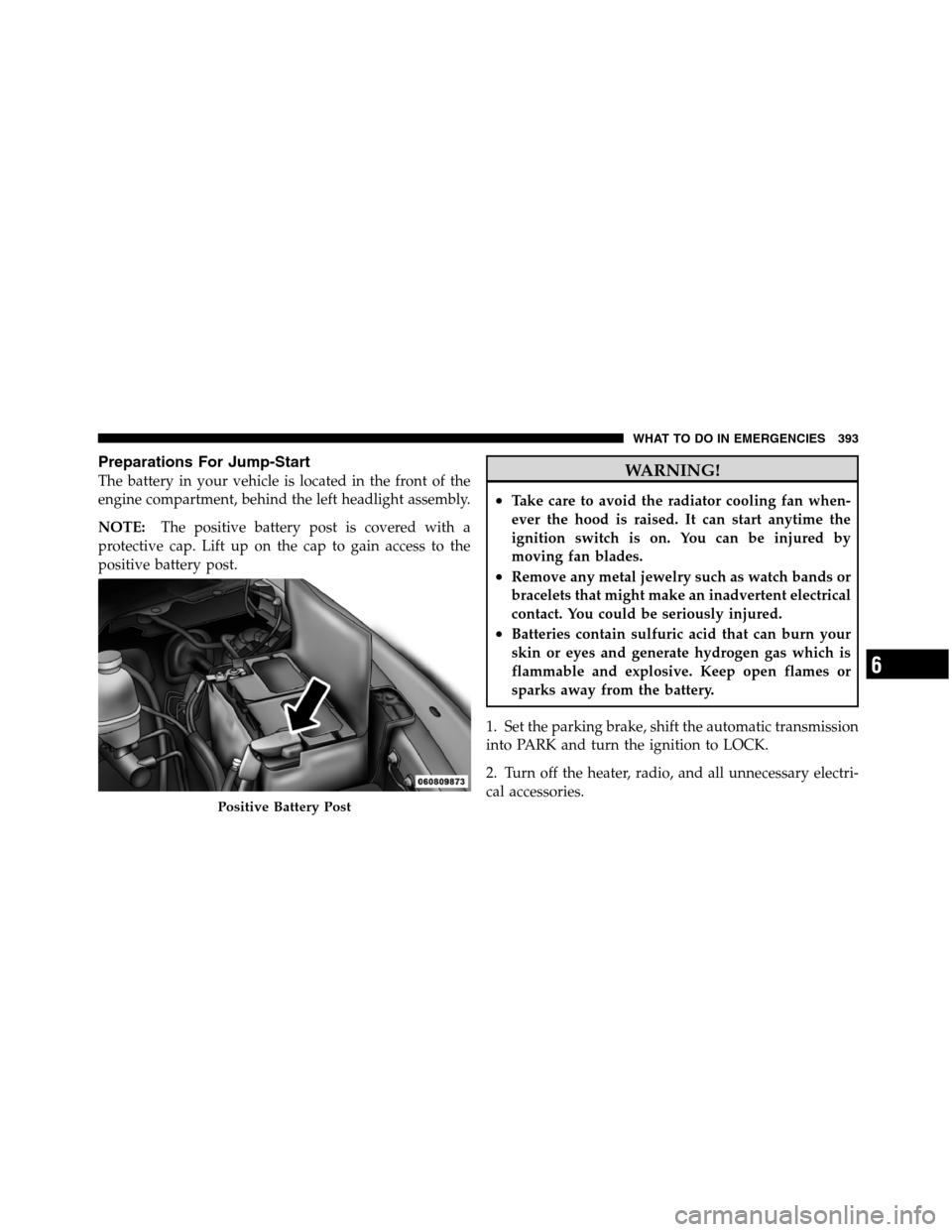
The battery in your vehicle is located in the front of the
engine compartment, behind the left headlight assembly.
NOTE:The positive battery post is covered with a
protective cap. Lift up on the cap to gain access to the
positive battery post.WARNING!
•Take care to avoid the radiator cooling fan when-
ever the hood is raised. It can start anytime the
ignition switch is on. You can be injured by
moving fan blades.
•Remove any metal jewelry such as watch bands or
bracelets that might make an inadvertent electrical
contact. You could be seriously injured.
•Batteries contain sulfuric acid that can burn your
skin or eyes and generate hydrogen gas which is
flammable and explosive. Keep open flames or
sparks away from the battery.
1. Set the parking brake, shift the automatic transmission
into PARK and turn the ignition to LOCK.
2. Turn off the heater, radio, and all unnecessary electri-
cal accessories.
Positive Battery Post
6
WHAT TO DO IN EMERGENCIES 393
Page 436 of 508
NOTE:If it is necessary to check the transmissionbelow
the operating temperature, the fluid level should be
between the two “COLD” (lower) holes on the dipstick
with the fluid at approximately 70°F (21°C) (room tem-
perature). If the fluid level is correctly established at
room temperature, it should be between the “HOT”
(upper) reference holes when the transmission reaches
180°F (82°C). Remember it is best to check the level at the
normal operating temperature.
CAUTION!
Be aware that if the fluid temperature is below 50°F
(10°C) it may not register on the dipstick. Do not add
fluid until the temperature is elevated enough to
produce an accurate reading.
7. Check for leaks. Release parking brake.To prevent dirt and water from entering the transmission
after checking or replenishing fluid, make certain that the
dipstick cap is properly reseated. It is normal for the
dipstick cap to spring back slightly from its fully seated
position, as long as its seal remains engaged in the
dipstick tube.
Automatic Transmission Fluid And Filter Change
Refer to the “Maintenance Schedule” for the proper
maintenance intervals.
NOTE:If the transmission is disassembled for any
reason, the fluid and filter(s) should be changed.
It is important that proper lubricant is used in the
transmission. Refer to “Fluids, Lubricants, and Genuine
Parts” in “Maintaining Your Vehicle” for further
information.
434 MAINTAINING YOUR VEHICLE
Page 462 of 508
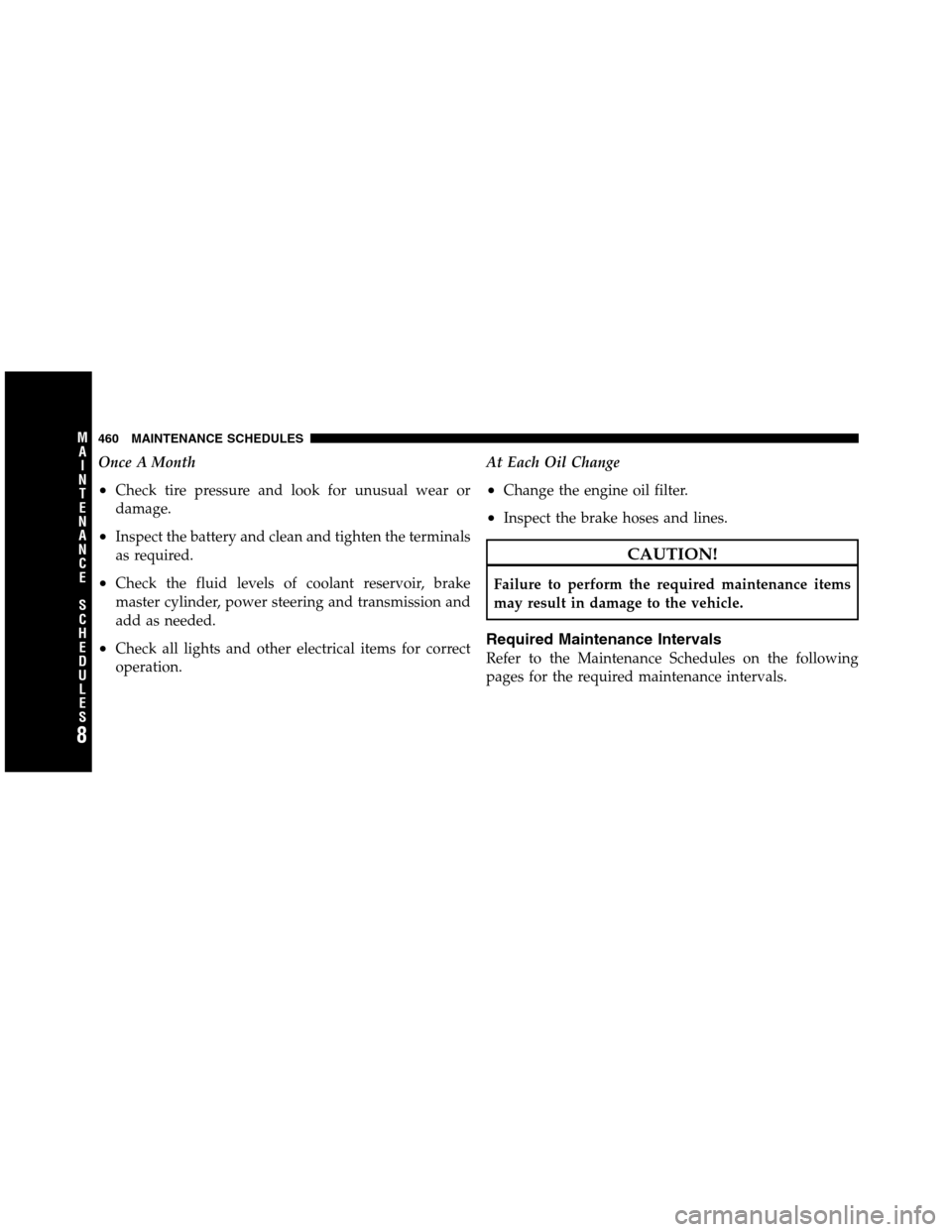
Once A Month
•Check tire pressure and look for unusual wear or
damage.
•Inspect the battery and clean and tighten the terminals
as required.
•Check the fluid levels of coolant reservoir, brake
master cylinder, power steering and transmission and
add as needed.
•Check all lights and other electrical items for correct
operation.At Each Oil Change
•Change the engine oil filter.
•Inspect the brake hoses and lines.
CAUTION!
Failure to perform the required maintenance items
may result in damage to the vehicle.
Required Maintenance Intervals
Refer to the Maintenance Schedules on the following
pages for the required maintenance intervals.
8
M
A
I
N
T
E
N
A
N
C
E
S
C
H
E
D
U
L
E
S460 MAINTENANCE SCHEDULES
Page 489 of 508
Automatic Transmission
Adding Fluid....................... 433
Fluid and Filter Changes............... 434
Fluid Level Check.................432,433
FluidType ......................432,455
Shifting ........................... 284
Special Additives..................... 432
AxleFluid .......................430,431,455
Axle Lubrication (Axle Fluid)............430,431
B-Pillar Location........................ 320
Battery............................... 414
Keyless Transmitter Replacement (RKE)..... 25
Saving Feature (Protection).............. 152
Belts, Seat............................ 40,80
Body Builders Guide....................... 6
Body Mechanism Lubrication............... 417
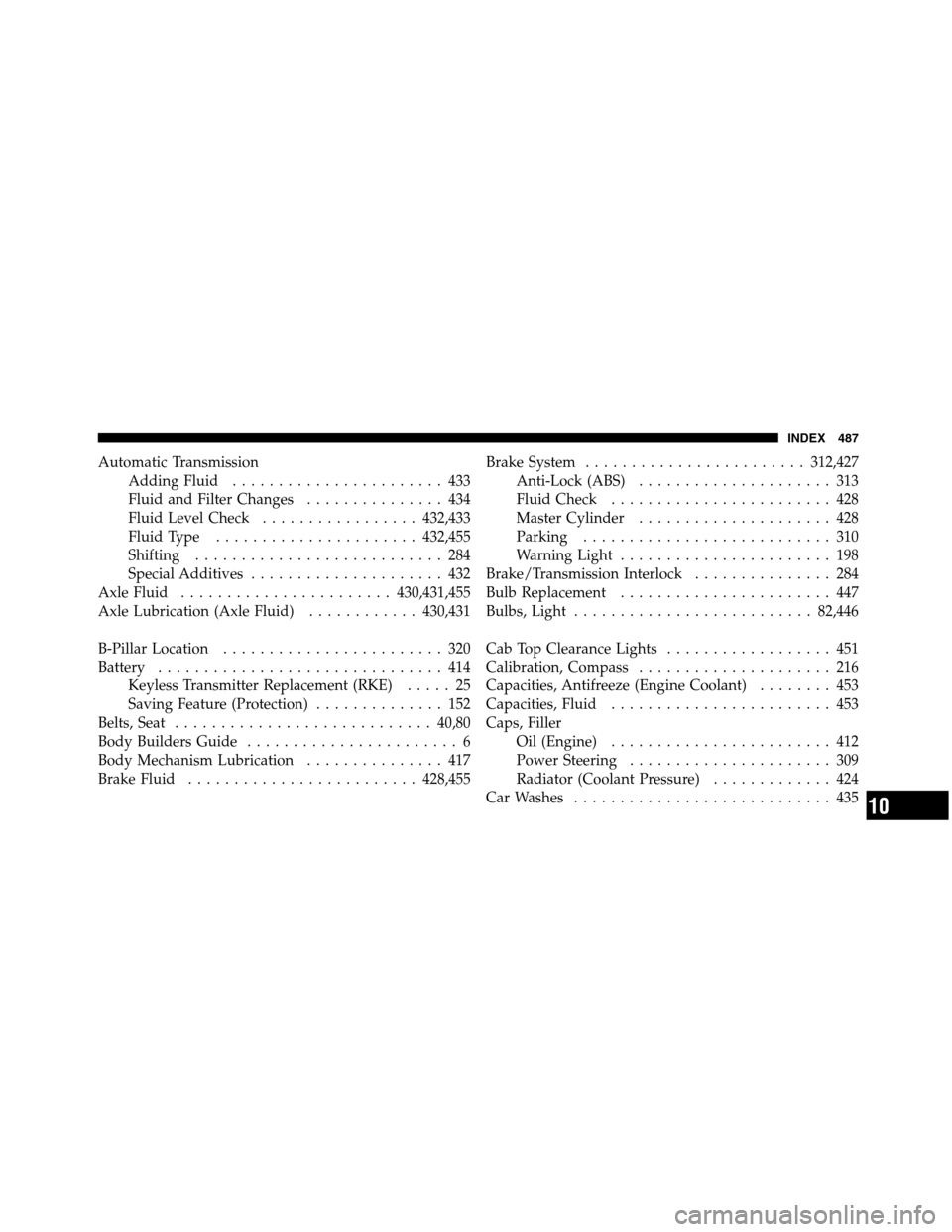
Brake Fluid.........................428,455Brake System........................312,427
Anti-Lock (ABS)..................... 313
Fluid Check........................ 428
Master Cylinder..................... 428
Parking........................... 310
Warning Light....................... 198
Brake/Transmission Interlock............... 284
Bulb Replacement....................... 447
Bulbs,Light .......................... 82,446
Cab Top Clearance Lights.................. 451
Calibration, Compass..................... 216
Capacities, Antifreeze (Engine Coolant)........ 453
Capacities, Fluid........................ 453
Caps, Filler
Oil (Engine)........................ 412
Power Steering...................... 309
Radiator (Coolant Pressure)............. 424
Car Washes............................ 435
10
INDEX 487
Page 491 of 508
Drain, Flush, and Refill................ 422
Inspection.......................... 425
Points to Remember.................. 426
Pressure Cap........................ 424
Radiator Cap....................... 424
Selection of Coolant (Antifreeze).......422,454
Cupholders............................ 172
Customer Assistance..................... 477
Data Recorder, Event...................... 64
Daytime Running Lights................... 153
Dealer Service.......................... 409
Defroster, Rear Window................... 180
Defroster, Windshield................ 80,265,271
Delay (Intermittent) Wipers................. 155
Differential, Limited-Slip.................. 304
Dipsticks
Automatic Transmission................ 433
Power Steering...................... 309Disabled Vehicle Towing................... 399
Disposal
Antifreeze (Engine Coolant)............. 425
Door Locks............................. 29
Door Locks, Automatic.................... 31
Driving
Through Flowing, Rising, or Shallow
Standing Water...................... 306
Dual Rear Wheels.....................340,388
Electric Rear Window Defrost............... 180
Electrical Power Outlets................... 165
Electronic Range Select (ERS)............... 290
Electronic Speed Control (Cruise Control)...... 160
Electronic Vehicle Information Center (EVIC).... 204
Electronically Shifted Transfer Case........... 298
Emergency Brake........................ 310
10
INDEX 489