tires Ram 5500 Chassis Cab 2012 Owner's Guide
[x] Cancel search | Manufacturer: RAM, Model Year: 2012, Model line: 5500 Chassis Cab, Model: Ram 5500 Chassis Cab 2012Pages: 508, PDF Size: 7.01 MB
Page 383 of 508

WARNING! (Continued)
•The jack is designed to use as a tool for changing
tires only. The jack should not be used to lift the
vehicle for service purposes. The vehicle should
be jacked on a firm level surface only. Avoid ice or
slippery areas.
3500 Models — If Equipped
The jack and jack tools are stored under the front
passenger seat. Lift the flap on the side of the seat for
access.
Remove the jack and tools by removing the wing bolt and
sliding the assembly from under the seat.
Jack Location6
WHAT TO DO IN EMERGENCIES 381
Page 386 of 508
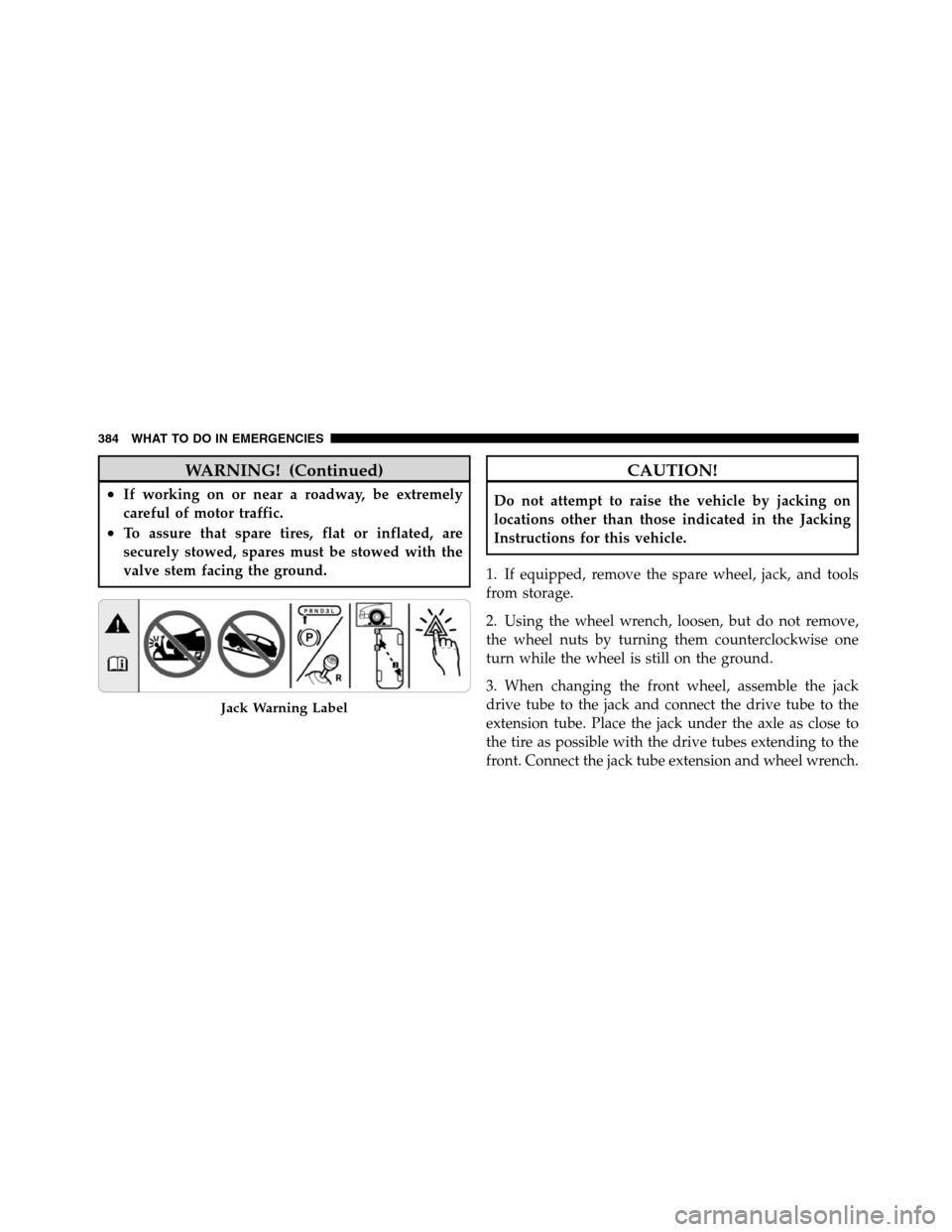
WARNING! (Continued)
•If working on or near a roadway, be extremely
careful of motor traffic.
•To assure that spare tires, flat or inflated, are
securely stowed, spares must be stowed with the
valve stem facing the ground.
CAUTION!
Do not attempt to raise the vehicle by jacking on
locations other than those indicated in the Jacking
Instructions for this vehicle.
1. If equipped, remove the spare wheel, jack, and tools
from storage.
2. Using the wheel wrench, loosen, but do not remove,
the wheel nuts by turning them counterclockwise one
turn while the wheel is still on the ground.
3. When changing the front wheel, assemble the jack
drive tube to the jack and connect the drive tube to the
extension tube. Place the jack under the axle as close to
the tire as possible with the drive tubes extending to the
front. Connect the jack tube extension and wheel wrench.
Jack Warning Label
384 WHAT TO DO IN EMERGENCIES
Page 387 of 508
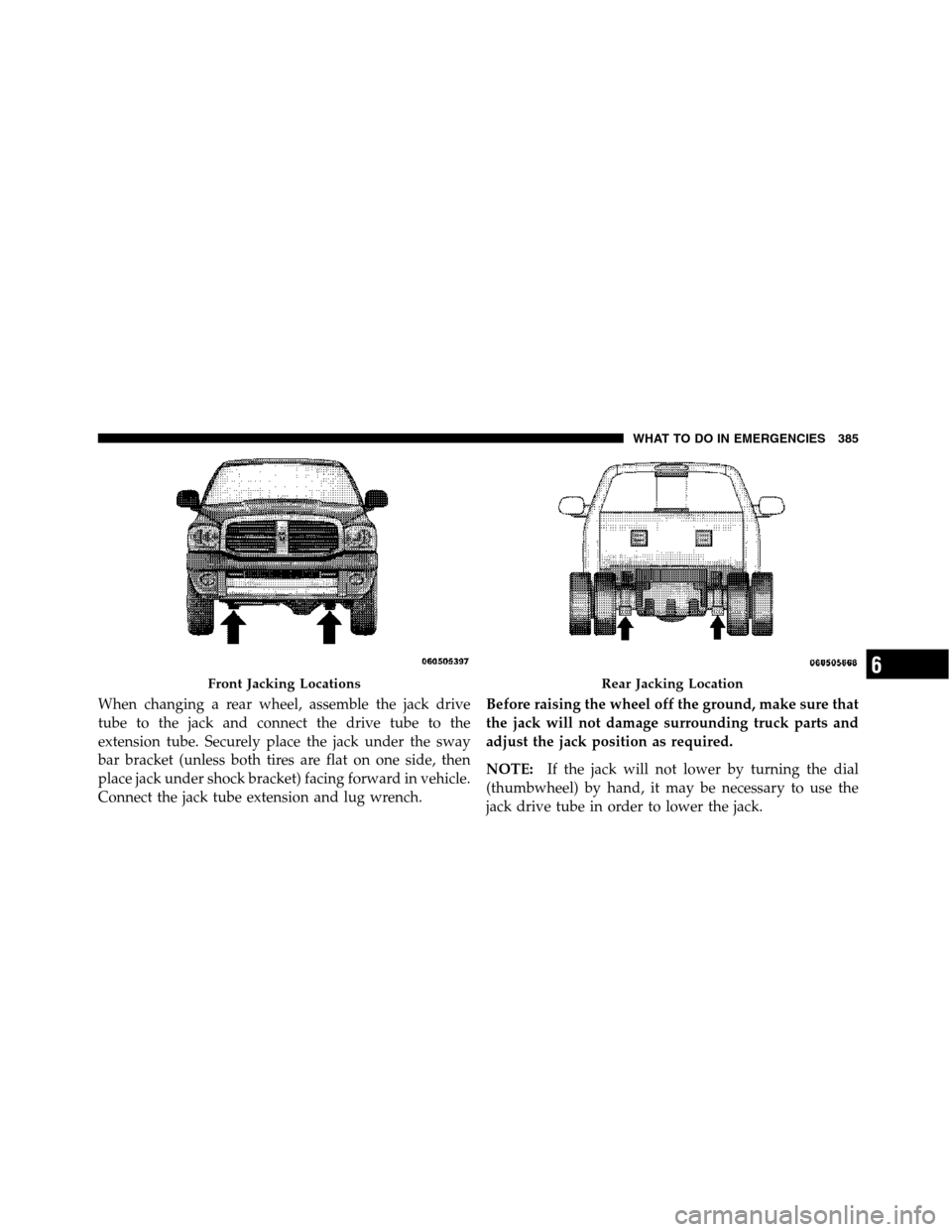
When changing a rear wheel, assemble the jack drive
tube to the jack and connect the drive tube to the
extension tube. Securely place the jack under the sway
bar bracket (unless both tires are flat on one side, then
place jack under shock bracket) facing forward in vehicle.
Connect the jack tube extension and lug wrench.Before raising the wheel off the ground, make sure that
the jack will not damage surrounding truck parts and
adjust the jack position as required.
NOTE:If the jack will not lower by turning the dial
(thumbwheel) by hand, it may be necessary to use the
jack drive tube in order to lower the jack.
Front Jacking LocationsRear Jacking Location6
WHAT TO DO IN EMERGENCIES 385
Page 390 of 508

models use the blade on the end of the lug wrench to pry
the caps off. The wheel skin can now be removed.
CAUTION!
•Use a back and forth motion to remove the hub
cap. Do not use a twisting motion when removing
the hub cap, damage to the hub cap; finish may
occur.
•The rear hub caps on the dual rear wheel has two
pry off notches. Make sure that the hook of the
jack handle driver is located squarely in the cap
notch before attempting to pull off.
You must use the flat end of the lug wrench to pry off the
wheel skins. Insert the flat tip completely and using a
back and forth motion, loosen the wheel skin. Repeat this
procedure around the tire until the skin pops off.Replace the wheel skins first using a rubber mallet. When
replacing the hub caps, tilt the cap retainer over the lug
nut bolt circle and strike the high side down with a
rubber mallet. Be sure that the hub caps and wheel skins
are firmly seated around the wheel.
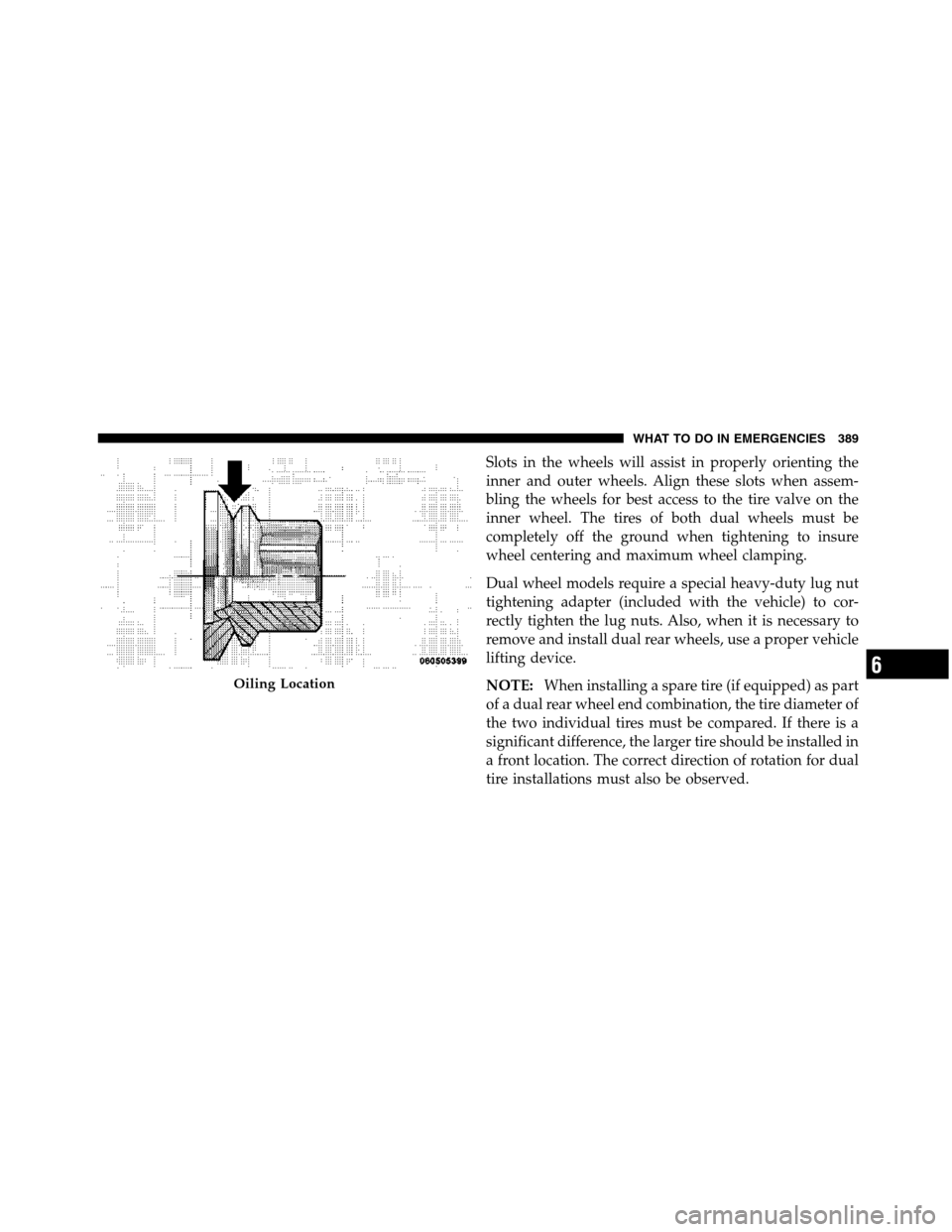
Dual Rear Wheels
Dual wheels are flat mounted, center piloted. The lug
nuts are a two-piece assembly. When the tires are being
rotated or replaced, clean these lug nuts and add two
drops of oil at the interface between the hex and the
washer.
388 WHAT TO DO IN EMERGENCIES
Page 391 of 508
Slots in the wheels will assist in properly orienting the
inner and outer wheels. Align these slots when assem-
bling the wheels for best access to the tire valve on the
inner wheel. The tires of both dual wheels must be
completely off the ground when tightening to insure
wheel centering and maximum wheel clamping.
Dual wheel models require a special heavy-duty lug nut
tightening adapter (included with the vehicle) to cor-
rectly tighten the lug nuts. Also, when it is necessary to
remove and install dual rear wheels, use a proper vehicle
lifting device.
NOTE:When installing a spare tire (if equipped) as part
of a dual rear wheel end combination, the tire diameter of
the two individual tires must be compared. If there is a
significant difference, the larger tire should be installed in
a front location. The correct direction of rotation for dual
tire installations must also be observed.
Oiling Location6
WHAT TO DO IN EMERGENCIES 389
Page 398 of 508

FREEING A STUCK VEHICLE
If the vehicle becomes stuck in snow, sand, or mud, it can
often be moved by a rocking motion. Move the shift lever
rhythmically between DRIVE/1st and REVERSE while
applying slight pressure to the accelerator.
CAUTION!
•Racing the engine or spinning the wheels may
lead to transmission overheating and failure. Al-
low the engine to idle with the shift lever in
NEUTRAL for at least one minute after every five
rocking-motion cycles. This will minimize over-
heating and reduce the risk of transmission failure
during prolonged efforts to free a stuck vehicle.
(Continued)
CAUTION! (Continued)
•When “rocking” a stuck vehicle by moving be-
tween DRIVE/1st and REVERSE, do not spin the
wheels faster than 15 mph (24 km/h), or drivetrain
damage may result.
•Revving the engine or spinning the wheels too fast
may lead to transmission overheating and failure.
It can also damage the tires. Do not spin the
wheels above 30 mph (48 km/h) while in gear (no
transmission shifting occurring).
396 WHAT TO DO IN EMERGENCIES
Page 399 of 508
WARNING!
Fast spinning tires can be dangerous. Forces gener-
ated by excessive wheel speeds may cause damage, or
even failure, of the axle and tires. A tire could
explode and injure someone. Do not spin your vehi-
cle’s wheels faster than 30 mph (48 km/h) or for
longer than 30 seconds continuously without stop-
ping when you are stuck and do not let anyone near
a spinning wheel, no matter what the speed.
EMERGENCY TOW HOOKS — IF EQUIPPED
Your vehicle may be equipped with emergency tow
hooks.
NOTE:For off-road recovery, it is recommended to use
both of the front tow hooks to minimize the risk of
damage to the vehicle.
WARNING!
•Chains are not recommended for freeing a stuck
vehicle. Chains may break, causing serious injury
or death.
•Stand clear of vehicles when pulling with tow
hooks. Tow straps may become disengaged, caus-
ing serious injury.
CAUTION!
Tow hooks are for emergency use only to rescue a
vehicle stranded off-road. Do not use tow hooks for
tow truck hookup or highway towing. You could
damage your vehicle.6
WHAT TO DO IN EMERGENCIES 397
Page 463 of 508
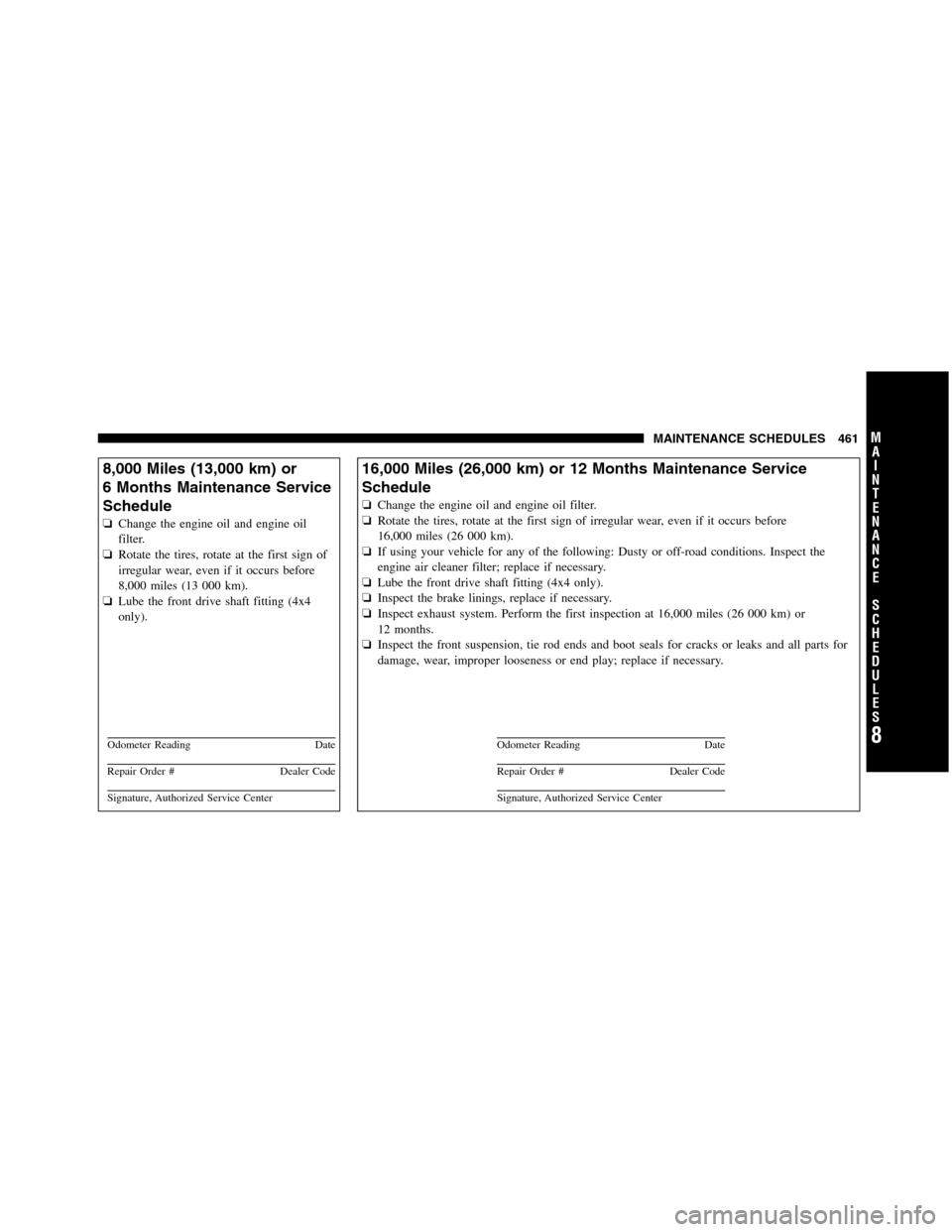
8,000 Miles (13,000 km) or
6 Months Maintenance Service
Schedule
❏Change the engine oil and engine oil
filter.
❏Rotate the tires, rotate at the first sign of
irregular wear, even if it occurs before
8,000 miles (13 000 km).
❏Lube the front drive shaft fitting (4x4
only).
Odometer Reading Date
Repair Order # Dealer Code
Signature, Authorized Service Center
16,000 Miles (26,000 km) or 12 Months Maintenance Service
Schedule
❏Change the engine oil and engine oil filter.
❏Rotate the tires, rotate at the first sign of irregular wear, even if it occurs before
16,000 miles (26 000 km).
❏If using your vehicle for any of the following: Dusty or off-road conditions. Inspect the
engine air cleaner filter; replace if necessary.
❏Lube the front drive shaft fitting (4x4 only).
❏Inspect the brake linings, replace if necessary.
❏Inspect exhaust system. Perform the first inspection at 16,000 miles (26 000 km) or
12 months.
❏Inspect the front suspension, tie rod ends and boot seals for cracks or leaks and all parts for
damage, wear, improper looseness or end play; replace if necessary.
Odometer Reading Date
Repair Order # Dealer Code
Signature, Authorized Service Center
8
M
A
I
N
T
E
N
A
N
C
E
S
C
H
E
D
U
L
E
SMAINTENANCE SCHEDULES 461
Page 464 of 508
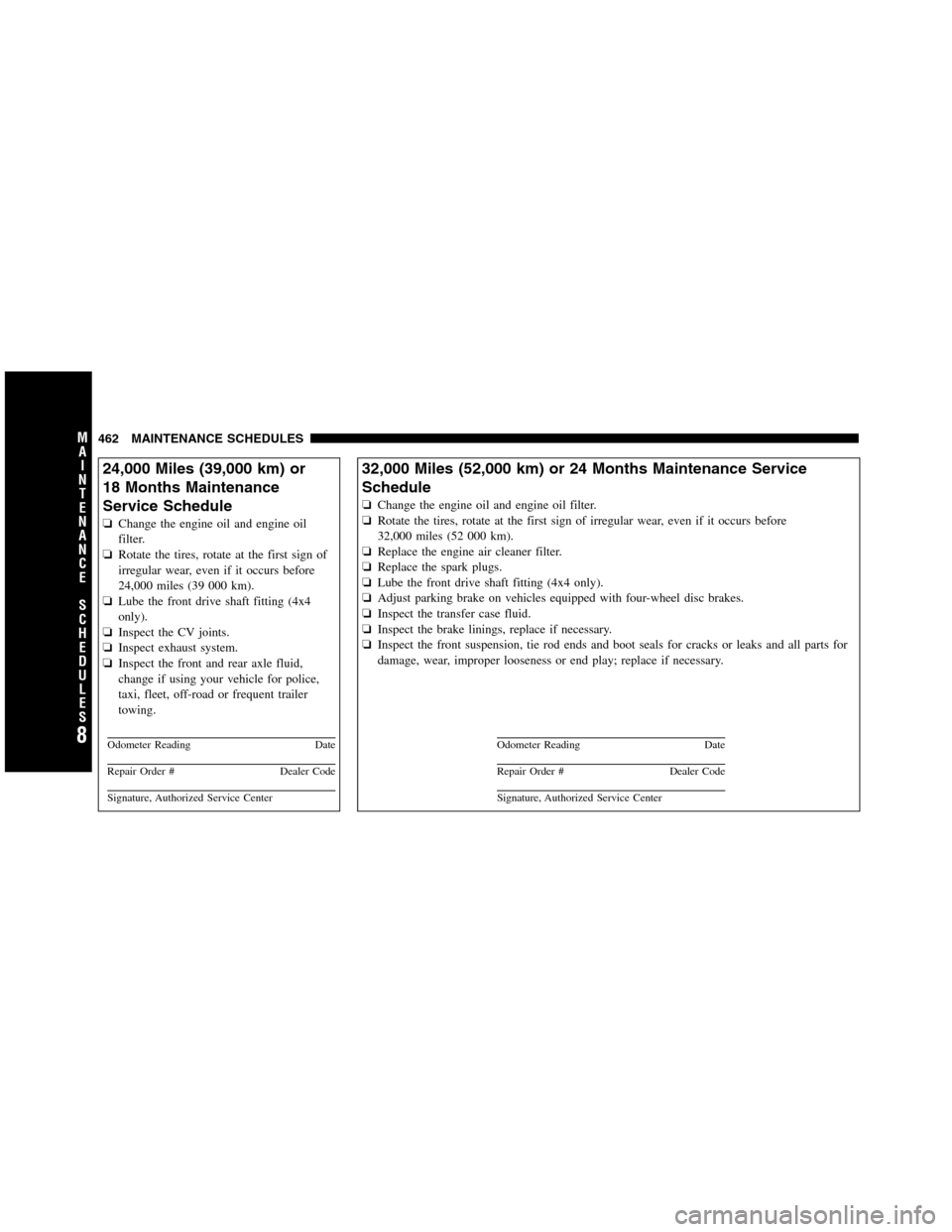
24,000 Miles (39,000 km) or
18 Months Maintenance
Service Schedule
❏Change the engine oil and engine oil
filter.
❏Rotate the tires, rotate at the first sign of
irregular wear, even if it occurs before
24,000 miles (39 000 km).
❏Lube the front drive shaft fitting (4x4
only).
❏Inspect the CV joints.
❏Inspect exhaust system.
❏Inspect the front and rear axle fluid,
change if using your vehicle for police,
taxi, fleet, off-road or frequent trailer
towing.
Odometer Reading Date
Repair Order # Dealer Code
Signature, Authorized Service Center
32,000 Miles (52,000 km) or 24 Months Maintenance Service
Schedule
❏Change the engine oil and engine oil filter.
❏Rotate the tires, rotate at the first sign of irregular wear, even if it occurs before
32,000 miles (52 000 km).
❏Replace the engine air cleaner filter.
❏Replace the spark plugs.
❏Lube the front drive shaft fitting (4x4 only).
❏Adjust parking brake on vehicles equipped with four-wheel disc brakes.
❏Inspect the transfer case fluid.
❏Inspect the brake linings, replace if necessary.
❏Inspect the front suspension, tie rod ends and boot seals for cracks or leaks and all parts for
damage, wear, improper looseness or end play; replace if necessary.
Odometer Reading Date
Repair Order # Dealer Code
Signature, Authorized Service Center
8
M
A
I
N
T
E
N
A
N
C
E
S
C
H
E
D
U
L
E
S462 MAINTENANCE SCHEDULES
Page 465 of 508
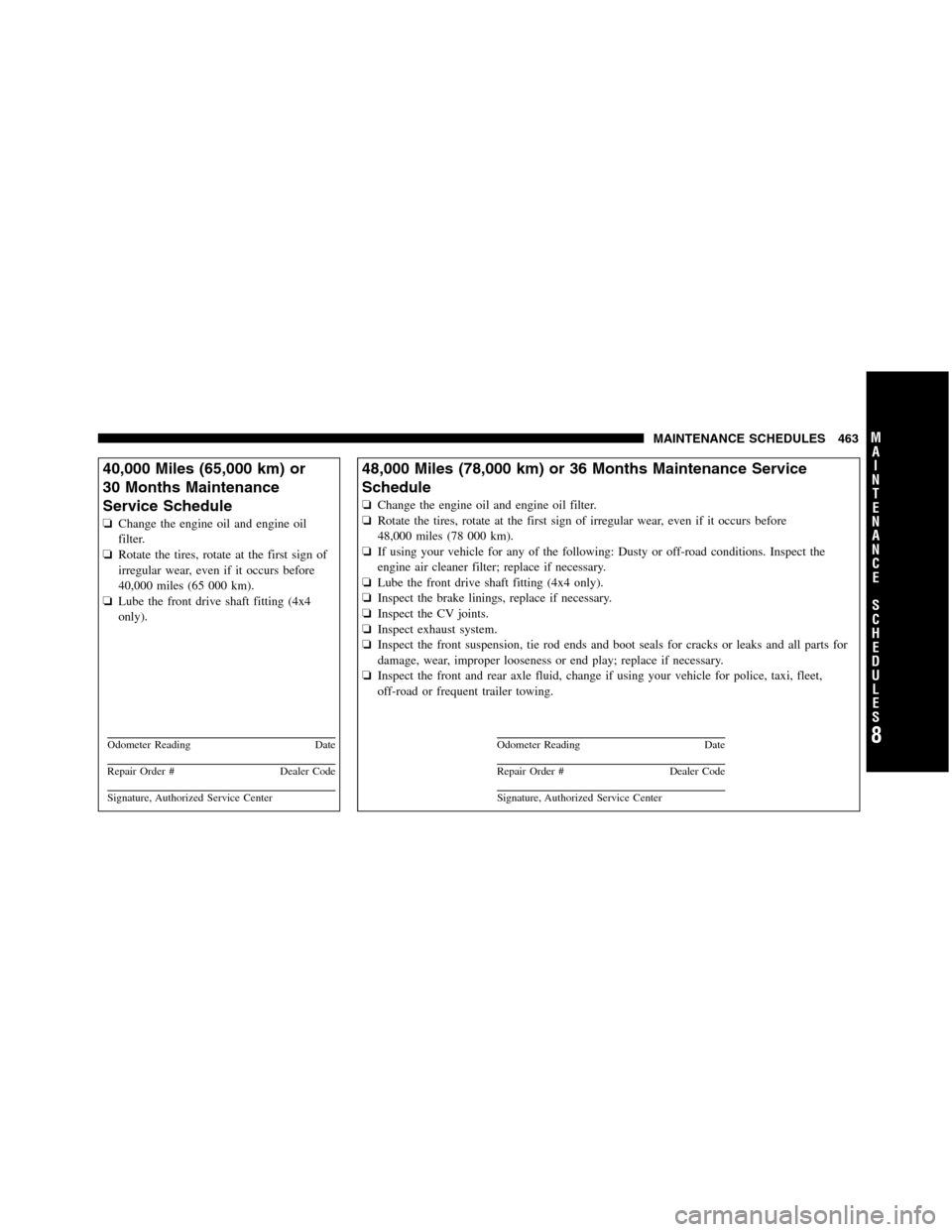
40,000 Miles (65,000 km) or
30 Months Maintenance
Service Schedule
❏Change the engine oil and engine oil
filter.
❏Rotate the tires, rotate at the first sign of
irregular wear, even if it occurs before
40,000 miles (65 000 km).
❏Lube the front drive shaft fitting (4x4
only).
Odometer Reading Date
Repair Order # Dealer Code
Signature, Authorized Service Center
48,000 Miles (78,000 km) or 36 Months Maintenance Service
Schedule
❏Change the engine oil and engine oil filter.
❏Rotate the tires, rotate at the first sign of irregular wear, even if it occurs before
48,000 miles (78 000 km).
❏If using your vehicle for any of the following: Dusty or off-road conditions. Inspect the
engine air cleaner filter; replace if necessary.
❏Lube the front drive shaft fitting (4x4 only).
❏Inspect the brake linings, replace if necessary.
❏Inspect the CV joints.
❏Inspect exhaust system.
❏Inspect the front suspension, tie rod ends and boot seals for cracks or leaks and all parts for
damage, wear, improper looseness or end play; replace if necessary.
❏Inspect the front and rear axle fluid, change if using your vehicle for police, taxi, fleet,
off-road or frequent trailer towing.
Odometer Reading Date
Repair Order # Dealer Code
Signature, Authorized Service Center
8
M
A
I
N
T
E
N
A
N
C
E
S
C
H
E
D
U
L
E
SMAINTENANCE SCHEDULES 463