transmission Ram 5500 Chassis Cab 2012 Workshop Manual
[x] Cancel search | Manufacturer: RAM, Model Year: 2012, Model line: 5500 Chassis Cab, Model: Ram 5500 Chassis Cab 2012Pages: 508, PDF Size: 7.01 MB
Page 378 of 508

Shifting Out Of NEUTRAL – Electronic Shift
Transfer Case (If Equipped)
Use the following procedure to prepare your vehicle for
normal usage:
1. Bring the vehicle to a complete stop, leaving it con-
nected to the tow vehicle.
2. Firmly apply the parking brake.
3. Turn the ignition switch to the ON/RUN position, but
do not start the engine.
4. Press and hold the brake pedal.
5. Shift the transmission into NEUTRAL.
6. Press and hold the transfer case NEUTRAL button
(located by the selector switch) until the NEUTRAL
indicator light turns off.
7. After the NEUTRAL indicator light turns off, release
the NEUTRAL button.8. After the NEUTRAL button has been released, the
transfer case will shift to the position indicated by the
selector switch.
NOTE:When shifting out of transfer case NEUTRAL,
turning the engine OFF may be required to avoid gear
clash.
9. Shift the automatic transmission into PARK, or place
manual transmission in NEUTRAL.
10. Release the brake pedal.
11. Disconnect vehicle from the tow vehicle.
12. Start the engine.
13. Press and hold the brake pedal.
14. Release the parking brake.
376 STARTING AND OPERATING
Page 379 of 508
15. Shift the transmission into gear, release the brake
pedal (and clutch pedal on manual transmissions), and
check that the vehicle operates normally.
NOTE:
•Steps 1 through 5 are requirements that must be met
prior to pressing the transfer case NEUTRAL button
and must continue to be met until the shift has been
completed. If any of these requirements are not met
prior to pressing the NEUTRAL button, or are no
longer met during the shift, the NEUTRAL indicator
light will flash continuously until all requirements are
met or until the NEUTRAL button is released.
•The ignition switch must be in the ON/RUN position
for a transfer case shift to take place and for the
position indicator lights to be operable. If the ignition
switch is not in the ON/RUN position, the shift will
not take place and no position indicator lights will be
on or flashing.
•A flashing NEUTRAL position indicator light indicates
that shift requirements have not been met.
5
STARTING AND OPERATING 377
Page 384 of 508
WARNING!
After using the jack and tools, always reinstall them
in the original carrier and location. While driving
you may experience abrupt stopping, rapid accelera-
tion, or sharp turns. A loose jack, tools, bracket or
other objects in the vehicle may move around with
force, resulting in serious injury.
4500/5500 Models
These vehicles do not come equipped with a jack.
NOTE:Jacking and tire changing on 4500/5500 models
should be performed by an authorized dealer, or knowl-
edgeable service personnel with the appropriate heavy
duty equipment, like a tire service company.
Preparations For Jacking
1. Park the vehicle on a firm, level surface. Avoid ice or
slippery areas.
WARNING!
Do not attempt to change a tire on the side of the
vehicle close to moving traffic, pull far enough off
the road to avoid the danger of being hit when
operating the jack or changing the wheel.
2. Turn on the Hazard Warning flasher.
3. Set the parking brake.
4. Place the shift lever into PARK (automatic transmis-
sion) or REVERSE (manual transmission). On 4-Wheel
drive vehicles, shift the transfer case to the “4L” position.
5. Turn OFF the ignition.
382 WHAT TO DO IN EMERGENCIES
Page 385 of 508
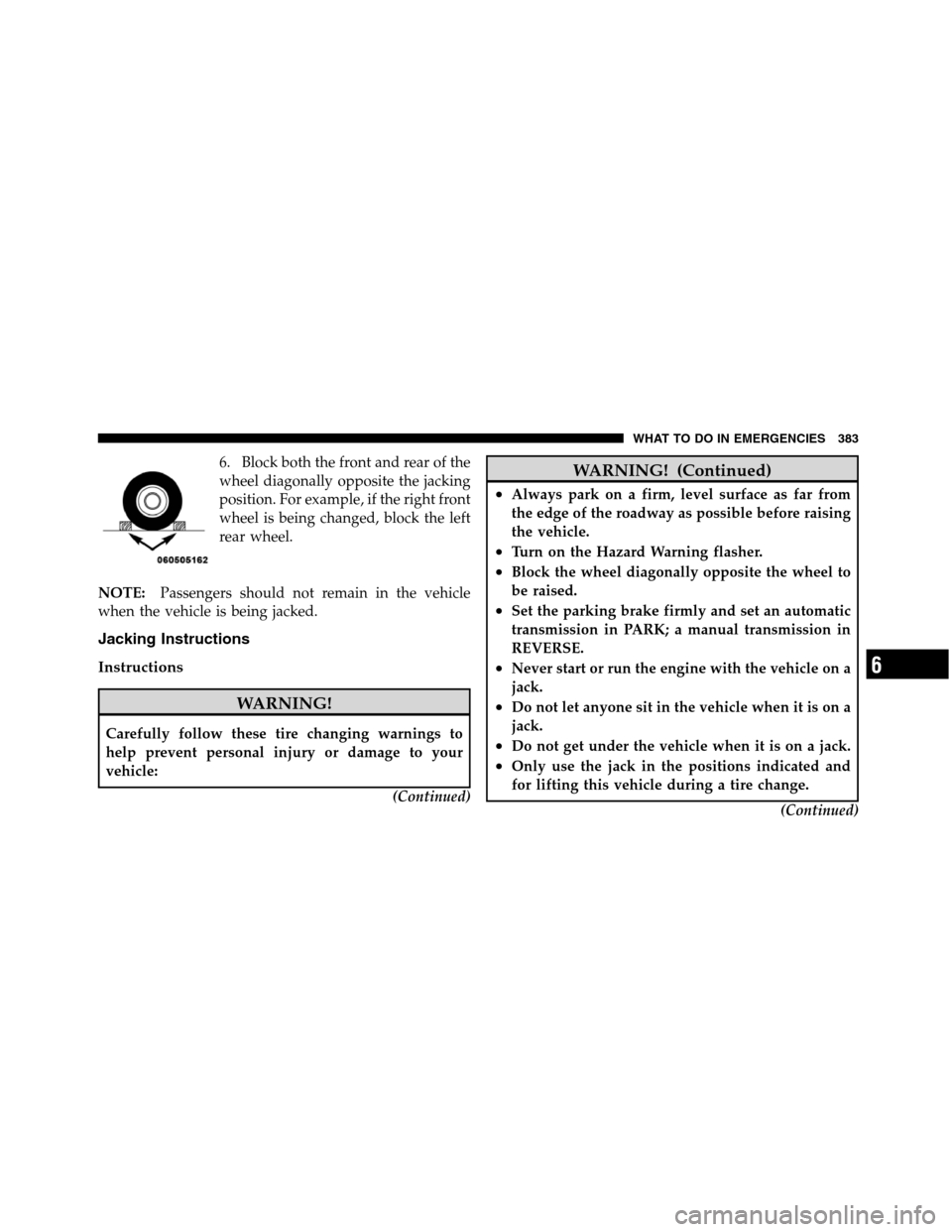
6. Block both the front and rear of the
wheel diagonally opposite the jacking
position. For example, if the right front
wheel is being changed, block the left
rear wheel.
NOTE:Passengers should not remain in the vehicle
when the vehicle is being jacked.
Jacking Instructions
Instructions
WARNING!
Carefully follow these tire changing warnings to
help prevent personal injury or damage to your
vehicle:
(Continued)
WARNING! (Continued)
•Always park on a firm, level surface as far from
the edge of the roadway as possible before raising
the vehicle.
•Turn on the Hazard Warning flasher.
•Block the wheel diagonally opposite the wheel to
be raised.
•Set the parking brake firmly and set an automatic
transmission in PARK; a manual transmission in
REVERSE.
•Never start or run the engine with the vehicle on a
jack.
•Do not let anyone sit in the vehicle when it is on a
jack.
•Do not get under the vehicle when it is on a jack.
•Only use the jack in the positions indicated and
for lifting this vehicle during a tire change.
(Continued)
6
WHAT TO DO IN EMERGENCIES 383
Page 395 of 508
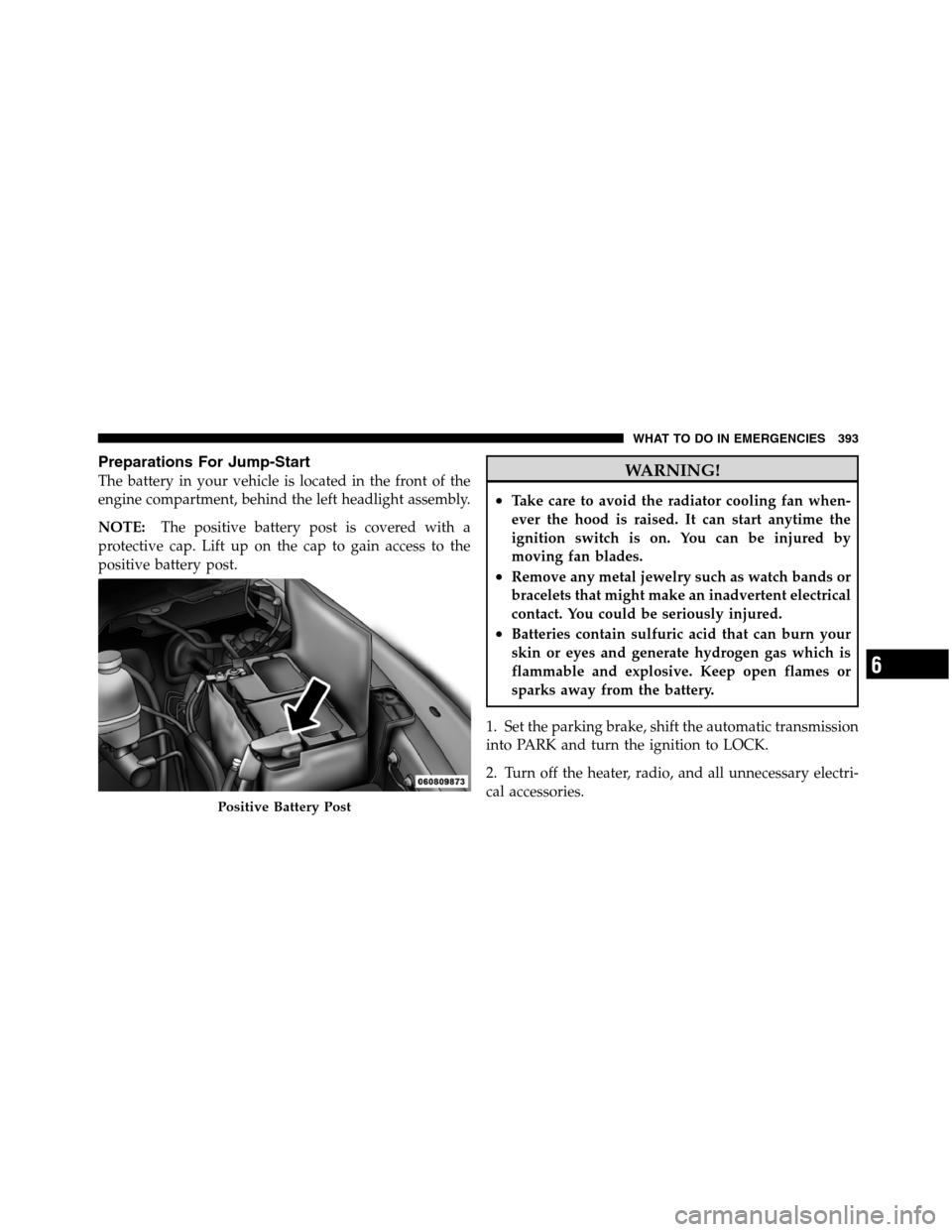
Preparations For Jump-Start
The battery in your vehicle is located in the front of the
engine compartment, behind the left headlight assembly.
NOTE:The positive battery post is covered with a
protective cap. Lift up on the cap to gain access to the
positive battery post.WARNING!
•Take care to avoid the radiator cooling fan when-
ever the hood is raised. It can start anytime the
ignition switch is on. You can be injured by
moving fan blades.
•Remove any metal jewelry such as watch bands or
bracelets that might make an inadvertent electrical
contact. You could be seriously injured.
•Batteries contain sulfuric acid that can burn your
skin or eyes and generate hydrogen gas which is
flammable and explosive. Keep open flames or
sparks away from the battery.
1. Set the parking brake, shift the automatic transmission
into PARK and turn the ignition to LOCK.
2. Turn off the heater, radio, and all unnecessary electri-
cal accessories.
Positive Battery Post
6
WHAT TO DO IN EMERGENCIES 393
Page 398 of 508

FREEING A STUCK VEHICLE
If the vehicle becomes stuck in snow, sand, or mud, it can
often be moved by a rocking motion. Move the shift lever
rhythmically between DRIVE/1st and REVERSE while
applying slight pressure to the accelerator.
CAUTION!
•Racing the engine or spinning the wheels may
lead to transmission overheating and failure. Al-
low the engine to idle with the shift lever in
NEUTRAL for at least one minute after every five
rocking-motion cycles. This will minimize over-
heating and reduce the risk of transmission failure
during prolonged efforts to free a stuck vehicle.
(Continued)
CAUTION! (Continued)
•When “rocking” a stuck vehicle by moving be-
tween DRIVE/1st and REVERSE, do not spin the
wheels faster than 15 mph (24 km/h), or drivetrain
damage may result.
•Revving the engine or spinning the wheels too fast
may lead to transmission overheating and failure.
It can also damage the tires. Do not spin the
wheels above 30 mph (48 km/h) while in gear (no
transmission shifting occurring).
396 WHAT TO DO IN EMERGENCIES
Page 401 of 508

TOWING A DISABLED VEHICLE
This section describes procedures for towing a disabled vehicle using a commercial wrecker service. If the
transmission and drivetrain are operable, disabled vehicles may also be towed as described under “Recreational
Towing” in the “Starting and Operating” section.
Towing ConditionWheels OFF
the Ground2WD Models 4WD Models
Flat Tow NONEIf transmission is operable:
•Transmission inNEUTRAL
•30 mphmax(48 km/h)
•15 miles (24 km)maxdistanceSee instructions in “Recreational Tow-
ing” under “Starting and Operating”
•Auto Transmission inPARK
•Manual Transmission in gear (NOT
Neutral)
•Transfer Case inNEUTRAL
•To w i nforwarddirection
Wheel Lift or Dolly
To wFrontNOT ALLOWED
Rear OKNOT ALLOWED
FlatbedALL BEST METHOD BEST METHOD
6
WHAT TO DO IN EMERGENCIES 399
Page 402 of 508
Proper towing or lifting equipment is required to prevent
damage to your vehicle. Use only tow bars and other
equipment designed for the purpose, following equip-
ment manufacturer ’s instructions. Use of safety chains is
mandatory. Attach a tow bar or other towing device to
main structural members of the vehicle, not to bumpers
or associated brackets. State and local laws applying to
vehicles under tow must be observed.
If you must use the accessories (wipers, defrosters, etc.)
while being towed, the ignition must be in the ON/RUN
position, not the ACC position.
If the vehicle’s battery is discharged, see “Shift Lever
Override” in “What To Do In Emergencies” for instruc-
tions on shifting the automatic transmission out of the
PARK position for towing.CAUTION!
Do not attempt to use sling type equipment when
towing. When securing the vehicle to a flat bed truck,
do not attach to front or rear suspension components.
Damage to your vehicle may result from improper
towing.
Towing Without The Ignition Key Fob
Special care must be taken when the vehicle is towed
with the ignition in the LOCK/OFF position. The only
approved method of towing without the ignition key is
with a flatbed truck. Proper towing equipment is neces-
sary to prevent damage to the vehicle.
400 WHAT TO DO IN EMERGENCIES
Page 403 of 508

Two-Wheel Drive Models
The manufacturer recommends towing your vehicle with
all four wheelsOFFthe ground using a flatbed.
If flatbed equipment is not available, and the transmis-
sion is operable, the vehicle may be towed (with rear
wheels on the ground) with the transmission inNEU-
TRAL. Speed must not exceed 30 mph (48 km/h) and the
distance must not exceed 15 miles (24 km).
CAUTION!
Towing faster than 30 mph (48 km/h) or farther than
15 miles (24 km) with rear wheels on the ground can
cause severe damage to the transmission. Such dam-
age is not covered by the New Vehicle Limited
Warranty.If the transmission is not operable, or the vehicle must be
towed faster than 30 mph (48 km/h) or farther than
15 miles (24 km), tow with the rear wheelsOFFthe
ground. Acceptable methods are to tow the vehicle on a
flatbed, or with the front wheels raised and the rear
wheels on a towing dolly, or (when using a suitable
steering wheel stabilizer to hold the front wheels in the
straight position) with the rear wheels raised and the
front wheels on the ground.6
WHAT TO DO IN EMERGENCIES 401
Page 404 of 508

Four-Wheel Drive Vehicles
The manufacturer recommends towing with all wheels
OFFthe ground. Acceptable methods are to tow the
vehicle on a flatbed or with one end of vehicle raised and
the opposite end on a towing dolly.
If flatbed equipment is not available, and the transfer
case is operable, the vehicle may be towed (in the
forward direction, withALLwheels on the ground),IF
the transfer case is in NEUTRAL and the transmission is
inPARK(for automatic transmissions) or in gear (NOT
in Neutral, for manual transmissions). Refer to “Recre-
ational Towing” in “Starting And Operating” for further
information.CAUTION!
•Front or rear wheel lifts should not be used.
Internal damage to the transmission or transfer
case will occur if a front or rear wheel lift is used
when towing.
•Failure to follow these towing methods can cause
severe damage to the transmission and/or transfer
case. Such damage is not covered by the New
Vehicle Limited Warranty.
402 WHAT TO DO IN EMERGENCIES