fuel pressure Ram 5500 Chassis Cab 2016 Diesel Supplement
[x] Cancel search | Manufacturer: RAM, Model Year: 2016, Model line: 5500 Chassis Cab, Model: Ram 5500 Chassis Cab 2016Pages: 338, PDF Size: 1.63 MB
Page 218 of 338
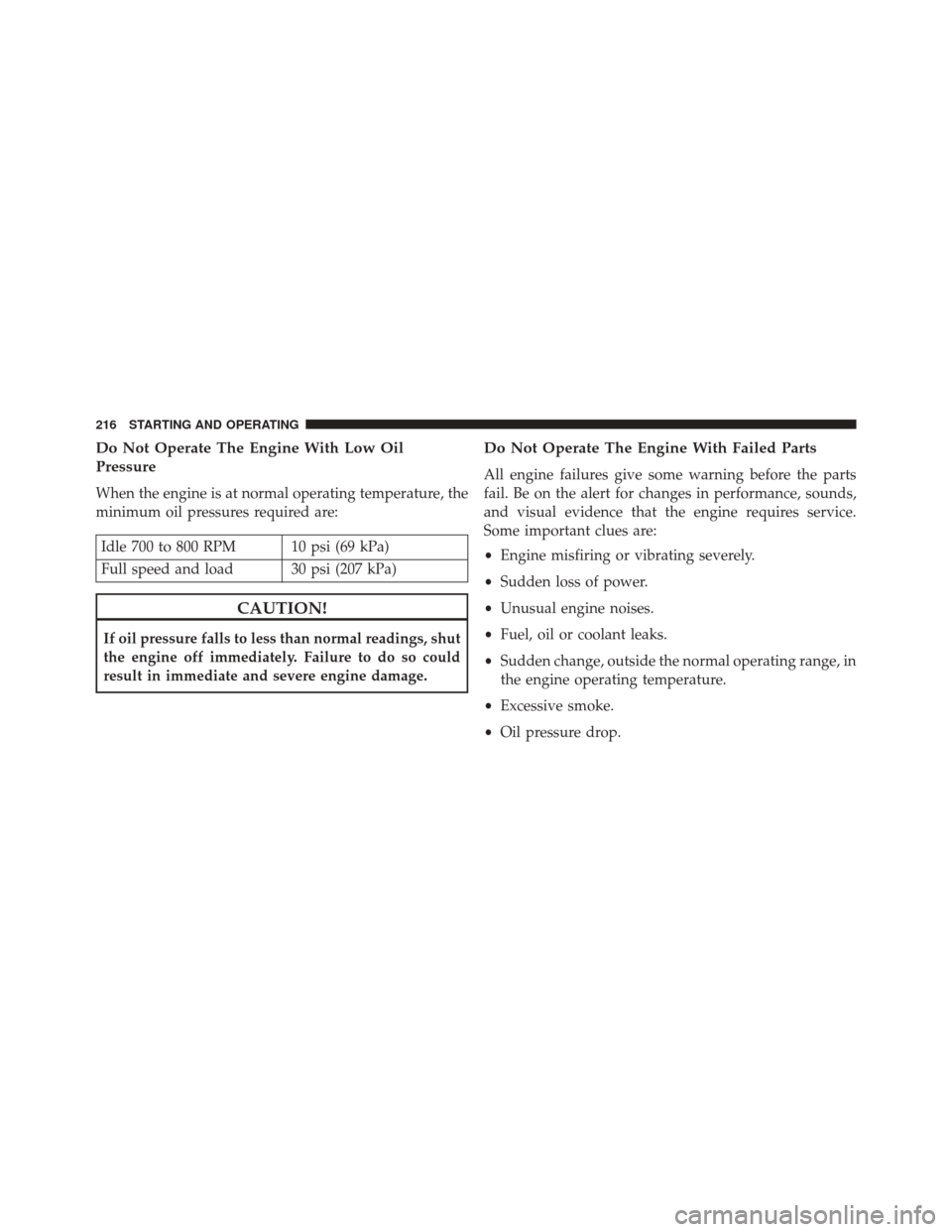
Do Not Operate The Engine With Low Oil
Pressure
When the engine is at normal operating temperature, the
minimum oil pressures required are:
Idle 700 to 800 RPM 10 psi (69 kPa)
Full speed and load 30 psi (207 kPa)
CAUTION!
If oil pressure falls to less than normal readings, shut
the engine off immediately. Failure to do so could
result in immediate and severe engine damage.
Do Not Operate The Engine With Failed Parts
All engine failures give some warning before the parts
fail. Be on the alert for changes in performance, sounds,
and visual evidence that the engine requires service.
Some important clues are:
•Engine misfiring or vibrating severely.
• Sudden loss of power.
• Unusual engine noises.
• Fuel, oil or coolant leaks.
• Sudden change, outside the normal operating range, in
the engine operating temperature.
• Excessive smoke.
• Oil pressure drop.
216 STARTING AND OPERATING
Page 255 of 338
microbes form “slime” that will clog the fuel filtration
system and lines. Drain condensation from the supply
tank and change the line filter on a regular basis.
NOTE:When a diesel engine is allowed to run out of
fuel, air is pulled into the fuel system.
If the vehicle will not start, refer to “Maintenance
Procedures/Priming If The Engine Has Run Out Of Fuel”
in “Maintaining Your Vehicle” for further information.
WARNING!
Do not open the high pressure fuel system with the
engine running. Engine operation causes high fuel
pressure. High pressure fuel spray can cause serious
injury or death.
Diesel Exhaust Fluid Storage
Diesel Exhaust Fluid (DEF) is considered a very stable
product with a long shelf life. If DEF is kept in tempera-
tures between 10° and 90°F (-12° and 32°C), it will last a
minimum of one year.
DEF is subject to freezing at the lowest temperatures. For
example, DEF may freeze at temperatures at or below
12° F (-11° C). The system has been designed to operate in
this environment.
NOTE: When working with DEF, it is important to know
that:
•
Any containers or parts that come into contact with DEF
must be DEF compatible (plastic or stainless steel). Cop-
per, brass, aluminum, iron or non-stainless steel should be
avoided as they are subject to corrosion by DEF.
• If DEF is spilled, it should be wiped up completely.
5
STARTING AND OPERATING 253
Page 288 of 338
5. Remove lid using a socket or strap wrench. Rotatecounterclockwise for removal. Remove used o-ring
and discard it.
6. Remove the used filter cartridge from the housing and dispose of according to your local regulations.
7. Wipe clean the sealing surfaces of the lid and housing.
8. Install new o-ring back into ring groove on the filter housing and lubricate with clean engine oil.
NOTE: WIF sensor is re-usable. Service kit comes with
new o-ring for filter canister and WIF sensor.Priming If The Engine Has Run Out Of Fuel
WARNING!
Do not open the high pressure fuel system with the
engine running. Engine operation causes high fuel
pressure. High pressure fuel spray can cause serious
injury or death.
1. Add a substantial amount of fuel to the tank, approxi- mately 2 to 5 gal (8L to 19L).
2. Turn ignition switch to the start position to engage starter for one second, return ignition switch to run
position. This will activate in tank fuel pump for
approximately 15 seconds. Repeat this process twice.
3. Start the engine using the “Normal Starting” proce- dure. Refer to “Starting Procedures” in “Starting and
Operating” for further information.
286 MAINTAINING YOUR VEHICLE
Page 290 of 338
•Use of biodiesel mixture in excess of 20% can nega-
tively impact the fuel filter’s ability to separate water
from the fuel, resulting in high pressure fuel system
corrosion or damage.
• Ethanol blends are not recommended or approved for
use with your Cummins diesel engine.
• In addition, commercially available fuel additives are
not necessary for the proper operation of your Cum-
mins diesel engine.
Intervention Regeneration Strategy — Message
Process Flow
The Cummins diesel engine meets all EPA Heavy Duty
Diesel Engine Emissions Standards, resulting in one of
the lowest emitting diesel engines ever produced.
To achieve these emissions standards, your vehicle is
equipped with a state-of-the-art engine and exhaust
system. The engine and exhaust after-treatment system work together to achieve the EPA Heavy Duty Diesel
Engine Emissions Standards. These systems are seam-
lessly integrated into your vehicle and managed by the
Cummins Powertrain Control Module (PCM). The PCM
manages engine combustion to allow the exhaust sys-
tem’s catalyst to trap and burn Particulate Matter (PM)
pollutants, with no input or interaction on your part.
Additionally, your vehicle has the ability to alert you to
additional maintenance required on your truck or engine.
Refer to “Electronic Vehicle Information Center (EVIC)”
or “Driver Information Display (DID)” in “Understand-
ing Your Instrument Panel” for further information.
WARNING!
A hot exhaust system can start a fire if you park over
materials that can burn. Such materials might be
(Continued)
288 MAINTAINING YOUR VEHICLE
Page 298 of 338
•Do not change the thermostat for Summer or Winter
operation. If replacement is ever necessary, install
ONLY the correct type thermostat. Other designs may
result in unsatisfactory engine coolant (antifreeze)
performance, poor gas mileage, and increased emis-
sions.
Charge Air Cooler — Inter-Cooler
The charge air cooler is positioned below the radiator and
the air conditioner condenser. Air enters the engine
through the air cleaner and passes through the turbo-
charger, where it is pressurized. This pressurized air
rapidly reaches high temperature. The air is then directed
through a hose to the charge air cooler and through
another hose to the intake manifold of the engine. The air
entering the engine has been cooled by about 50° to 100°F
(10° to 38°C). This cooling process enables more efficient
burning of fuel resulting in fewer emissions. To guarantee optimum performance of the system, keep
the surfaces of the charge air cooler, condenser and
radiator clean and free of debris. Periodically check the
hoses leading to and from the charge air cooler for cracks
or loose clamps resulting in loss of pressure and reduced
engine performance.
Brake System
Brake Master Cylinder — Brake Fluid Level Check
The fluid level of the master cylinder should be checked
when performing under the hood service, or immedi-
ately if the “Brake System Warning Light” indicates
system failure.
The brake master cylinder has a translucent plastic
reservoir. On the outboard side of the reservoir, there is a
“MAX” mark and a “MIN” mark. The fluid level must be
kept within these two marks. Do not add fluid above the
full mark because leakage may occur at the cap.
296 MAINTAINING YOUR VEHICLE
Page 328 of 338
Adding Engine Coolant (Antifreeze)............106
Adding Fuel ..............................80
Air Cleaner, Engine (Engine Air Cleaner Filter) .....94
Antifreeze (Engine Coolant) ..................105
Capacities .............................113
Disposal ............................. .108
Automatic Transmission Fluid Type ............................118
Axle Fluid ..............................118
Battery ................................ .103
Brake Fluid ..............................118
Brake System ............................110
Fluid Check ...........................110
Master Cylinder ........................110
Capacities, Antifreeze (Engine Coolant) ..........113
Capacities, Fluid ..........................113 Caps, Filler
Oil (Engine) ............................93
Radiator (Coolant Pressure) ................108
Charge Air Cooler .........................110
Coolant Pressure Cap (Radiator Cap) ...........108
Cooling System .......................... .104
Adding Coolant (Antifreeze) ...............106
Coolant Capacity .......................113
Coolant Level ......................... .104
Disposal Of Used Coolant .................108
Drain, Flush, And Refill ...................105
Points To Remember .....................109
Pressure Cap ......................... .108
Radiator Cap ......................... .108
Selection Of Coolant (Antifreeze) ........105 , 114
Diesel Fuel ...............................73
Diesel Fuel Requirements ....................73
Bulk Storage Of .........................83
326 INDEX - RAM 1500
Page 332 of 338
Adding Engine Coolant (Antifreeze)............292
Adding Fuel ............................ .248
Air Cleaner, Engine (Engine Air Cleaner Filter) . . . .276
Air Filter .............................. .276
Antifreeze (Engine Coolant) ..................291
Capacities ........................... .308
Disposal ............................. .294
Automatic Transmission Adding Fluid ......................... .301
Fluid Level Check ...................... .300
Fluid Type ............................311
Shifting ............................. .222
Axle Fluid ..............................311
Battery ................................ .289
Blanket ...........................211,290
Emergency Starting ..................... .262
Brake System ........................... .296Fluid Check
.......................... .296
Master Cylinder ....................... .296
Brake/Transmission Interlock .................222
Capacities, Antifreeze (Engine Coolant) ..........308
Capacities, Fluid ......................... .308
Caps, Filler Oil (Engine) .......................... .274
Radiator (Coolant Pressure) ................294
Charge Air Cooler ........................ .296
Coolant Pressure Cap (Radiator Cap) ...........294
Cooling System .......................... .290
Adding Coolant (Antifreeze) ...............292
Coolant Capacity ...................... .308
Coolant Level ......................... .290
Disposal Of Used Coolant .................294
Drain, Flush, And Refill ...................291
Points To Remember .....................295
Pressure Cap ......................... .294
330 INDEX - RAM 2500 / 3500 / 4500 / 5500