alarm Ram 5500 Chassis Cab 2017 User Guide
[x] Cancel search | Manufacturer: RAM, Model Year: 2017, Model line: 5500 Chassis Cab, Model: Ram 5500 Chassis Cab 2017Pages: 534, PDF Size: 4.74 MB
Page 36 of 534
NOTE:
•After setting the Child-Protection Door Lock system,
always test the door from the inside to make certain it is
in the desired position.
• For emergency exit with the system engaged, move the
door lock switch to the UNLOCK position, roll down the
window and open the door with the outside door
handle.
KEYLESS ENTER-N-GO — PASSIVE ENTRY
The Passive Entry system is an enhancement to the vehi-
cle’s Remote Keyless Entry system and a feature of Keyless
Enter-N-Go. Refer to “Keyless Enter-N-Go” in “Starting
And Operating” for further information. This feature al-
lows you to lock and unlock the vehicle’s door(s) without
having to push the key fob lock or unlock buttons.
NOTE:
• Passive Entry may be programmed ON/OFF. Refer to
“Uconnect Settings” in “Understanding Your Instrument
Panel” for further information.
• If wearing gloves on your hands, or if it has been raining
on the Passive Entry door handle, the unlock sensitivity
can be affected, resulting in a slower response time. •
If the vehicle is unlocked by Passive Entry and no door
is opened within 60 seconds, the vehicle will re-lock and
if equipped will arm the security alarm.
• The vehicles security alarm can be armed/disarmed by
pushing the passive entry key fob lock/unlock buttons
(if equipped).
To Unlock From The Driver’s Side:
With a valid Passive Entry key fob within 5 ft (1.5 m) of the
driver door handle, grab the front driver door handle to
unlock the driver’s door automatically. The interior door
panel lock knob will raise when the door is unlocked.
Grab The Door Handle To Unlock
34 THINGS TO KNOW BEFORE STARTING YOUR VEHICLE
Page 60 of 534
Front Air Bag Operation
Front Air Bags are designed to provide additional protec-
tion by supplementing the seat belts. Front air bags are not
expected to reduce the risk of injury in rear, side, or
rollover collisions. The front air bags will not deploy in all
frontal collisions, including some that may produce sub-
stantial vehicle damage — for example, some pole colli-
sions, truck underrides, and angle offset collisions.
On the other hand, depending on the type and location of
impact, front air bags may deploy in crashes with little
vehicle front-end damage but that produce a severe initial
deceleration.
Because air bag sensors measure vehicle deceleration over
time, vehicle speed and damage by themselves are not
good indicators of whether or not an air bag should have
deployed.
Seat belts are necessary for your protection in all collisions,
and also are needed to help keep you in position, away
from an inflating air bag.
When the ORC detects a collision requiring the front air
bags, it signals the inflator units. A large quantity of
non-toxic gas is generated to inflate the front air bags.The steering wheel hub trim cover and the upper right side
of the instrument panel separate and fold out of the way as
the air bags inflate to their full size. The front air bags fully
inflate in less time than it takes to blink your eyes. The
front air bags then quickly deflate while helping to restrain
the driver and front passenger.
Knee Impact Bolsters
The Knee Impact Bolsters help protect the knees of the
driver and front passenger, and position the front occu-
pants for improved interaction with the front air bags.
WARNING!
•
Do not drill, cut, or tamper with the knee impact
bolsters in any way.
• Do not mount any accessories to the knee impact
bolsters such as alarm lights, stereos, citizen band
radios, etc.
Supplemental Side Air Bags
Your vehicle is equipped with two types of side air bags:
1. Supplemental Seat-Mounted Side Air Bags (SABs):
Located in the outboard side of the front seats. The
58 THINGS TO KNOW BEFORE STARTING YOUR VEHICLE
Page 167 of 534

NOTE:The courtesy/reading lights will remain on until
the switch is pushed a second time, so be sure they have
been turned off before leaving the vehicle. If the interior
lights are left on after the ignition is turned OFF, they will
automatically turn off after 15 minutes.
GARAGE DOOR OPENER — IF EQUIPPED
HomeLink replaces up to three hand-held transmitters that
operate devices such as garage door openers, motorized
gates, lighting or home security systems. The HomeLink
unit is powered by your vehicles 12 Volt battery. The HomeLink buttons that are located in the overhead
console designate the three different HomeLink channels.
NOTE:
HomeLink is disabled when the Vehicle Security
Alarm is active.
WARNING!
• Your motorized door or gate will open and close
while you are training the universal transceiver. Do
not train the transceiver if people, pets or other
objects are in the path of the door or gate. Only use
(Continued)
Rear Passenger Courtesy/Reading Light
HomeLink Buttons
3
UNDERSTANDING THE FEATURES OF YOUR VEHICLE 165
Page 173 of 534

CHANNELS.” Release the buttons when the Instrument
Cluster Display shows “CHANNELS CLEARED.”
The HomeLink Universal Transceiver is disabled when the
Vehicle Security Alarm is active.
Troubleshooting Tips
If you are having trouble programming HomeLink, here
are some of the most common solutions:
•Replace the battery in the Garage Door Opener hand-
held transmitter.
• Push the LEARN button on the Garage Door Opener to
complete the training for a Rolling Code.
• Did you unplug the device for programming and re-
member to plug it back in?
If you have any problems, or require assistance, please call
toll-free 1-800-355-3515 or, on the Internet at
HomeLink.com for information or assistance.
WARNING!
• Vehicle exhaust contains carbon monoxide, a danger-
ous gas. Do not run your vehicle in the garage while
(Continued)
WARNING! (Continued)
programming the transceiver. Exhaust gas can cause
serious injury or death.
• Your motorized door or gate will open and close
while you are programming the universal trans-
ceiver. Do not program the transceiver if people, pets
or other objects are in the path of the door or gate.
Only use this transceiver with a garage door opener
that has a “stop and reverse” feature as required by
Federal safety standards. This includes most garage
door opener models manufactured after 1982. Do not
use a garage door opener without these safety fea-
tures. Call toll-free 1-800-355-3515 or, on the Internet
at HomeLink.com for safety information or assis-
tance.
General Information
This device complies with FCC rules Part 15 and Industry
Canada RSS-210. Operation is subject to the following two
conditions:
1. This device may not cause harmful interference, and
3
UNDERSTANDING THE FEATURES OF YOUR VEHICLE 171
Page 205 of 534
WARNING!
Driving a vehicle with the red brake light on is
dangerous. Part of the brake system may have failed. It
will take longer to stop the vehicle. You could have a
collision. Have the vehicle checked immediately.
Vehicles equipped with the Anti-Lock Brake System (ABS)
are also equipped with Electronic Brake Force Distribution
(EBD). In the event of an EBD failure, the Brake Warning
Light will turn on along with the ABS Light. Immediate
repair to the ABS system is required. Operation of the Brake Warning Light can be checked by
placing the ignition in the ON/RUN position. The light
should illuminate for approximately two seconds. The light
should then turn off unless the parking brake is applied or
a brake fault is detected. If the light does not illuminate,
have the light inspected by an authorized dealer.
The light also will turn on when the parking brake is
applied with the ignition placed in the ON/RUN position.
NOTE:
This light shows only that the parking brake is
applied. It does not show the degree of brake application.
Vehicle Security Warning Light — If Equipped
Red Telltale Light What It Means
Vehicle Security Warning Light — If Equipped
This light will flash at a fast rate for approximately 15 seconds when the vehicle security alarm is
arming, and then will flash slowly until the vehicle is disarmed.
4
UNDERSTANDING YOUR INSTRUMENT PANEL 203
Page 239 of 534

Loss of the battery charge may indicate one or more of the
following conditions:
•The charging system cannot deliver enough electrical
power to the vehicle system because the electrical loads
are larger than the capability of charging system. The
charging system is still functioning properly.
• Turning on all possible vehicle electrical loads (e.g.
HVAC to max settings, exterior and interior lights,
overloaded power outlets +12V, 115V AC, USB ports)
during certain driving conditions (city driving, towing,
frequent stopping).
• Installing options like additional lights, upfitter electri-
cal accessories, audio systems, alarms and similar de-
vices.
• Unusual driving cycles (short trips separated by long
parking periods).
• The vehicle was parked for an extended period of time
(weeks, months).
• The battery was recently replaced and was not charged
completely.
• The battery was discharged by an electrical load left on
when the vehicle was parked. •
The battery was used for an extended period with the
engine not running to supply radio, lights, chargers,
+12V portable appliances like vacuum cleaners, game
consoles and similar devices.
What to do when an electrical load reduction action
message is present (“Battery Saver On” or “Battery Saver
Mode”)
During a trip:
• Reduce power to unnecessary loads if possible:
– Turn off redundant lights (interior or exterior)
– Check what may be plugged in to power outlets +12V, 115V AC, USB ports
– Check HVAC settings (blower, temperature)
– Check the audio settings (volume)
After a trip:
• Check if any aftermarket equipment was installed (ad-
ditional lights, upfitter electrical accessories, audio sys-
tems, alarms) and review specifications if any (load and
Ignition Off Draw currents).
• Evaluate the latest driving cycles (distance, driving time
and parking time).
4
UNDERSTANDING YOUR INSTRUMENT PANEL 237
Page 309 of 534

NOTE:Your vehicle may be transmitting data as autho-
rized by the subscriber.
An included trial and/or subscription is required to take
advantage of the Uconnect Access services in the next
section of this guide. To register with Uconnect Access,
press the Apps button on the 8.4-inch touchscreen to get
started. Detailed registration instructions can be found on
the next page.
NOTE: Uconnect Access is available only on equipped
vehicles purchased within the continental United States,
Alaska and Hawaii. Services can only be used where
coverage is available; see coverage map for details.
9-1-1 Call
Security Alarm Notification
Remote Door Lock/Unlock
Stolen Vehicle Assistance
Remote Vehicle Start**
Remote Horn and Lights
Yelp Search
Voice Texting
Roadside Assistance Call
3G Wi-Fi Hotspot***
**If vehicle is equipped.
***Extra charges apply.
Vehicle Health Alert
Your vehicle will send you an email alert if it senses a
problem under the hood with one of your vehicles key
systems. For further information go to the Mopar Owner
Connect website moparownerconnect.com.
4
UNDERSTANDING YOUR INSTRUMENT PANEL 307
Page 518 of 534
Adding Engine Coolant (Antifreeze).............473
Adding Fuel ............................. .400
Additives, Fuel ........................... .398
Adjust Down .............................115,116
Forward ............................115,116
Rearward ...........................115,116
Up................................115,116
Adjustable Pedals ......................... .142
Air Bag Air Bag Operation .........................58
Air Bag Warning Light .....................55
Enhanced Accident Response ..............68, 444
Event Data Recorder (EDR) .................444
If A Deployment Occurs ....................67
Knee Impact Bolsters .......................58
Maintaining Your Air Bag System ..............69
Side Air Bags ......................... .58, 62
Transporting Pets .........................93
Air Bag Light ....................... .55, 96, 201
Air Bag Maintenance .........................69
Air Cleaner, Engine (Engine Air Cleaner Filter) ......454
Air Conditioner Maintenance ..................458
Air Conditioning .......................... .277
Air Conditioning Controls ....................277 Air Conditioning Filter
...................292, 459
Air Conditioning, Operating Tips ...............291
Air Conditioning Refrigerant ...............458, 459
Air Conditioning System ...............277, 291, 458
Air Pressure, Tires ......................... .377
Alarm, Panic ...............................24
Alarm (Security Alarm) ....................19, 203
Alarm System (Security Alarm) .................19
Alterations/Modifications, Vehicle ................7
Antifreeze (Engine Coolant) ...................472
Capacities ............................. .499
Disposal .............................. .474
Anti-Lock Brake System (ABS) .................353
Appearance Care .......................... .481
Ashtray ................................ .177
Assist, Hill Start .......................... .355
Auto
Down Power Windows ...................38
Automatic Door Locks ........................32
Automatic Headlights ...................... .130
Automatic High Beams ..................... .132
Automatic Temperature Control (ATC) ...........291
Automatic Transmission ..................... .478
Adding Fluid .......................... .480
Fluid And Filter Changes ...................481
Fluid Level Check ....................... .479
516 INDEX
Page 525 of 534

Low Fuel............................. .214
Malfunction Indicator (Check Engine) ..........208
Park ................................. .219
Passing ............................... .138
Seat Belt Reminder ...................... .201
Security Alarm ......................... .203
Service ............................ .493, 494
Tire Pressure Monitoring (TPMS) ..........212, 389
Traction Control ........................ .360
Transfer Case .......................... .341
Turn Signal ....................98, 137, 220, 494
Warning (Instrument Cluster Description) . . . .204, 220
Limited-Slip Differential ..................346, 478
Loading Vehicle ........................... .401
Tires................................. .371
Load Shed Battery Saver Mode ...................... .236
Battery Saver On ........................ .236
Electrical Load Reduction ...................236
Intelligent Battery Sensor ...................236
Locks ....................................30
Automatic Door ..........................32
Child Protection ..........................33
Door ..................................30
Power Door .............................32 Low Tire Pressure System
.....................389
Lubrication, Body ......................... .465
Lug Nuts ......................... .427, 433, 434
Maintenance Free Battery .....................457
Maintenance Procedures ..................... .451
Maintenance Schedule ...................... .504
Malfunction Indicator Light (Check Engine) . . . .208, 449
Manual, Service ........................... .514
Manual Transmission Fluid Level Check ....................... .478
Memory Seat ............................. .124
Methanol ............................... .397
Mirrors ................................. .103
Electric
Powered .........................111
Heated ................................112
Memory .............................. .124
Outside ...............................110
Rearview ....................... .103, 104, 109
Trailer Towing ...........................113
Modifications/Alterations, Vehicle ................7
Monitor, Tire Pressure System ..................389
MOPAR Parts ......................... .450, 513
MTBE/ETBE ............................. .397
10
INDEX 523
Page 526 of 534
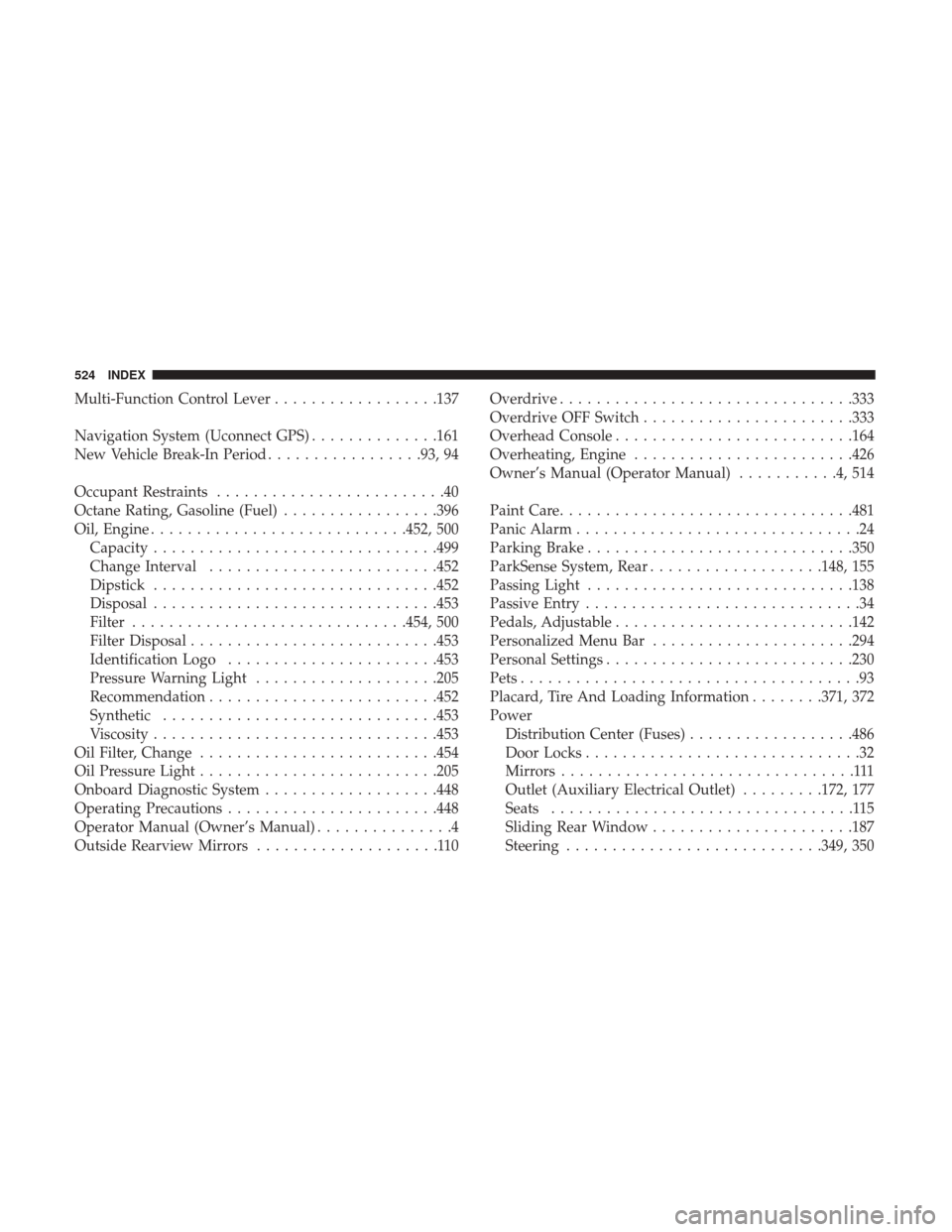
Multi-Function Control Lever..................137
Navigation System (Uconnect GPS) ..............161
New Vehicle Break-In Period .................93, 94
Occupant Restraints .........................40
Octane Rating, Gasoline (Fuel) .................396
Oil, Engine ........................... .452, 500
Capacity .............................. .499
Change Interval ........................ .452
Dipstick .............................. .452
Disposal .............................. .453
Filter ............................. .454, 500
Filter Disposal .......................... .453
Identification Logo ...................... .453
Pressure Warning Light ....................205
Recommendation ........................ .452
Synthetic ............................. .453
Viscosity .............................. .453
Oil Filter, Change ......................... .454
Oil Pressure Light ......................... .205
Onboard Diagnostic System ...................448
Operating Precautions ...................... .448
Operator Manual (Owner’s Manual) ...............4
Outside Rearview Mirrors ....................110 Overdrive
............................... .333
Overdrive OFF Switch ...................... .333
Overhead Console ......................... .164
Overheating, Engine ....................... .426
Owner’s Manual (Operator Manual) ...........4,514
Paint Care ............................... .481
Panic Alarm ...............................24
Parking Brake ............................ .350
ParkSense System, Rear ...................148, 155
Passing Light ............................ .138
Passive Entry ..............................34
Pedals, Adjustable ......................... .142
Personalized Menu Bar ..................... .294
Personal
Settings .......................... .230
Pets .....................................93
Placard, Tire And Loading Information ........371, 372
Power Distribution Center (Fuses) ..................486
Door Locks ..............................32
Mirrors ................................111
Outlet (Auxiliary Electrical Outlet) .........172, 177
Seats .................................115
Sliding Rear Window ..................... .187
Steering ........................... .349, 350
524 INDEX