mirror Ram Cargo Van 2015 Owner's Guide
[x] Cancel search | Manufacturer: RAM, Model Year: 2015, Model line: Cargo Van, Model: Ram Cargo Van 2015Pages: 671, PDF Size: 5.05 MB
Page 416 of 671
4. Rear Temperature Control — If Equipped
Provides temperature control for the rear cabin. Turn left
for cooler or right for warmer temperature settings in the
rear cabin.
5. Right Front Temperature Control
Provides right front seat occupant with independent
temperature control. Turn left for cooler or right for
warmer temperature settings.
6. Mix ModeAir is directed through the floor, defrost and side
window demist outlets. This setting works best in
cold or snowy conditions that require extra heat at the
windshield. This setting is good for maintaining comfort,
while reducing moisture on the windshield. 7. Front Defrost Mode
Air is directed through the windshield and side
window demist outlets. Use Defrost mode with
maximum blower and temperature settings for best
windshield and side window defrosting.
NOTE: The air conditioning compressor may operate in
Mix and Defrost, even if the A/C button is not pushed.
This dehumidifies the air to help dry the windshield.
To improve fuel economy, use these modes only when
necessary.
8. Electronic Rear Window Defrost
Push this button to turn on the rear window
defroster and the heated outside mirrors (if
equipped). An indicator in the button will illuminate
when the rear window defroster is on. The rear window
defroster automatically turns off after approximately
10 minutes.
414 UNDERSTANDING YOUR INSTRUMENT PANEL
Page 417 of 671
NOTE:•You can turn off the heated mirror feature at anytime
by pushing the rear window defroster switch a
second time.
•
To prevent excessive battery drain, use the rear win-
dow defroster only when the engine is operating.
CAUTION!
Failure to follow these cautions can cause damage to
the heating elements:
• Use care when washing the inside of the rear
window. Do not use abrasive window cleaners on
the interior surface of the window. Use a soft cloth
and a mild washing solution, wiping parallel to the
heating elements. Labels can be peeled off after
soaking with warm water.
(Continued)
CAUTION!
(Continued)
•Do not use scrapers, sharp instruments, or abrasive
window cleaners on the interior surface of the
window.
• Keep all objects a safe distance from the window.
9. Recirculation Control Button Push this button to choose between outside air
intake or recirculation of the air inside the
vehicle. An indicator light will illuminate when
you are in Recirculation mode. Only use the
Recirculation mode to temporarily block out any outside
odors, smoke, or dust, and to cool the interior rapidly
upon initial start-up in very hot or humid weather.
4
UNDERSTANDING YOUR INSTRUMENT PANEL 415
Page 424 of 671
10. Passenger Temperature Control Up/Down Button
Provides the passenger with independent temperature
control. Push the top button for warmer temperatures or
the lower button for cooler temperature settings.
11. Rear Control Button
Provides toggle operation between front control screen
and rear control screen. Push the button to activate the
rear climate control screen and allow the front seat
occupants control over the rear climate settings.
12. Rear Window Defrost
Push this button to turn on the rear window defroster
and the heated outside mirrors (if equipped). An indica-
tor in the button will illuminate when the rear window
defroster is on. The rear window defroster automatically
turns off after approximately 10 minutes.13. Rear Lock
Push and release the Rear Lock button on the front ATC
panel to lock and unlock the rear climate controls.
14. Auto Temperature Control Button
Controls airflow temperature, distribution, volume, and
the amount of air recirculation automatically. Push and
release to select. Refer to “Automatic Operation” for
more information. Performing this function will cause
the ATC to switch between manual mode and automatic
modes.
15. Climate Control OFF Button
Push and release to turn the Climate Control OFF. If the
control is OFF, push any button to turn the control ON.
422 UNDERSTANDING YOUR INSTRUMENT PANEL
Page 441 of 671
STARTING PROCEDURES
Before starting your vehicle, adjust your seat, adjust the
inside and outside mirrors, fasten your seat belt, and if
present, instruct all other occupants to buckle their seat
belts.
WARNING!
•When leaving the vehicle, always remove the key
fob from the ignition and lock your vehicle.
• Never leave children alone in a vehicle, or with
access to an unlocked vehicle.
• Allowing children to be in a vehicle unattended is
dangerous for a number of reasons. A child or
others could be seriously or fatally injured. Chil-
dren should be warned not to touch the parking
brake, brake pedal or the shift lever.
(Continued)
WARNING! (Continued)
•Do not leave the key fob in or near the vehicle, or
in a location accessible to children and do not leave
the ignition of a vehicle equipped with Keyless
Enter-N-Go™ in the ACC or ON/RUN Mode. A
child could operate power windows, other controls,
or move the vehicle.
Automatic Transmission
The shift lever must be in the NEUTRAL or PARK
position before you can start the engine. Press the brake
pedal before shifting into any driving gear.
Normal Starting
1. Do not press the accelerator.
2. Use the Fob with Integrated Key to briefly turn the ignition switch to the START position and release it as
5
STARTING AND OPERATING 439
Page 609 of 671

CAUTION!
•Do not use volatile solvents for cleaning purposes.
Many are potentially flammable, and if used in
closed areas they may cause respiratory harm.
• Do not use power washers to clean the inside of the
vehicle, plastic parts can be permanently damaged
and the amount of water can cause problems with
the electrical components of your vehicle.
Cleaning Headlights
Your vehicle is equipped with plastic headlights and fog
lights that are lighter and less susceptible to stone break-
age than glass headlights.
Plastic is not as scratch resistant as glass and therefore
different lens cleaning procedures must be followed. To minimize the possibility of scratching the lenses and
reducing light output, avoid wiping with a dry cloth. To
remove road dirt, wash with a mild soap solution fol-
lowed by rinsing.
Do not use abrasive cleaning components, solvents, steel
wool or other aggressive material to clean the lenses.
Glass Surfaces
All glass surfaces should be cleaned on a regular basis
with MOPAR® Glass Cleaner, or any commercial
household-type glass cleaner. Never use an abrasive type
cleaner. Use caution when cleaning the inside rear win-
dow equipped with electric defrosters or windows
equipped with radio antennas. Do not use scrapers or
other sharp instrument that may scratch the elements.
When cleaning the rear view mirror, spray cleaner on the
towel or rag that you are using. Do not spray cleaner
directly on the mirror.
7
MAINTAINING YOUR VEHICLE 607
Page 617 of 671
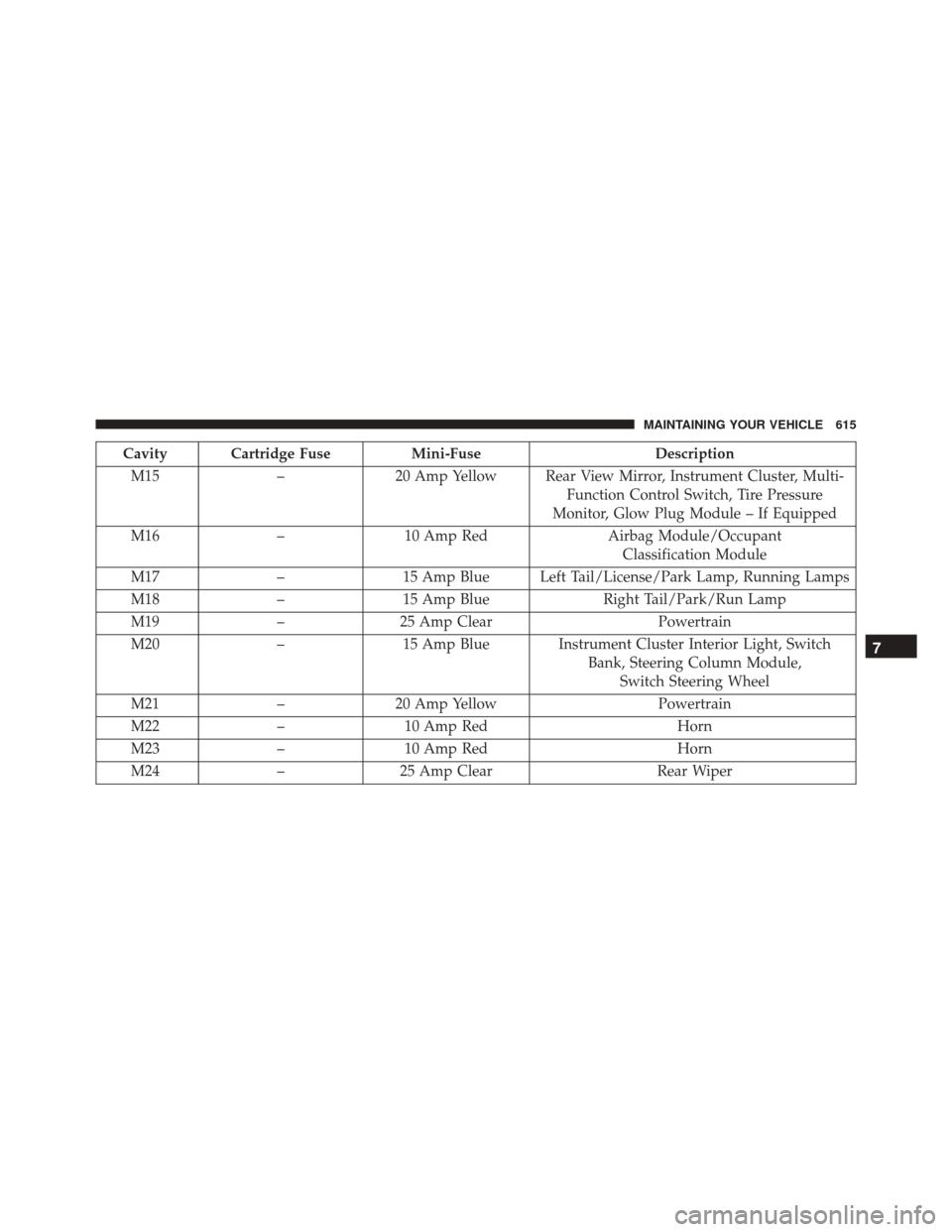
Cavity Cartridge FuseMini-FuseDescription
M15 –20 Amp Yellow Rear View Mirror, Instrument Cluster, Multi-
Function Control Switch, Tire Pressure
Monitor, Glow Plug Module – If Equipped
M16 –10 Amp Red Airbag Module/Occupant
Classification Module
M17 –15 Amp Blue Left Tail/License/Park Lamp, Running Lamps
M18 –15 Amp Blue Right Tail/Park/Run Lamp
M19 –25 Amp Clear Powertrain
M20 –15 Amp Blue Instrument Cluster Interior Light, Switch
Bank, Steering Column Module,Switch Steering Wheel
M21 –20 Amp Yellow Powertrain
M22 –10 Amp Red Horn
M23 –10 Amp Red Horn
M24 –25 Amp Clear Rear Wiper
7
MAINTAINING YOUR VEHICLE 615
Page 618 of 671
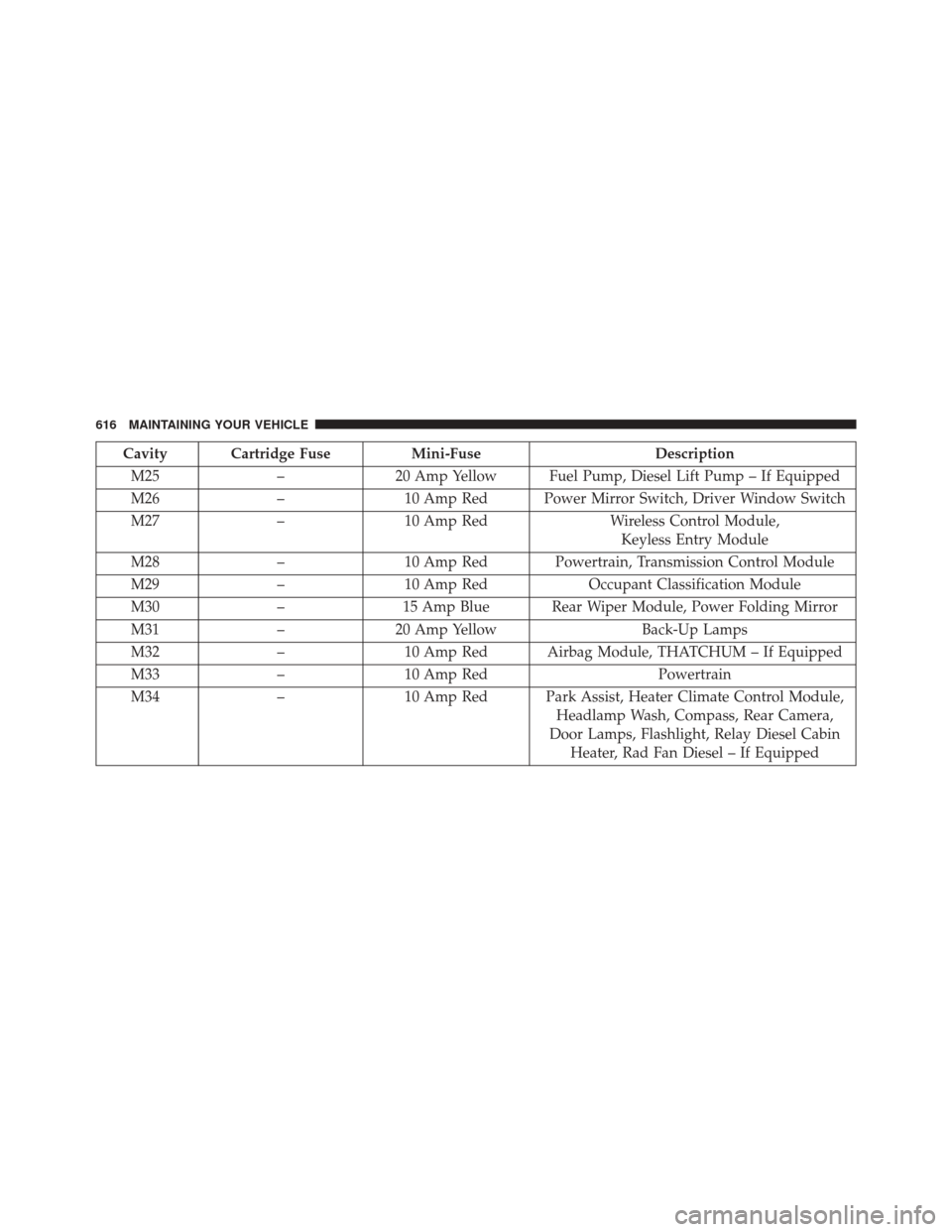
Cavity Cartridge FuseMini-FuseDescription
M25 –20 Amp Yellow Fuel Pump, Diesel Lift Pump – If Equipped
M26 –10 Amp Red Power Mirror Switch, Driver Window Switch
M27 –10 Amp Red Wireless Control Module,
Keyless Entry Module
M28 –10 Amp Red Powertrain, Transmission Control Module
M29 –10 Amp Red Occupant Classification Module
M30 –15 Amp Blue Rear Wiper Module, Power Folding Mirror
M31 –20 Amp Yellow Back-Up Lamps
M32 –10 Amp Red Airbag Module, THATCHUM – If Equipped
M33 –10 Amp Red Powertrain
M34 –10 Amp Red Park Assist, Heater Climate Control Module,
Headlamp Wash, Compass, Rear Camera,
Door Lamps, Flashlight, Relay Diesel Cabin Heater, Rad Fan Diesel – If Equipped
616 MAINTAINING YOUR VEHICLE
Page 619 of 671
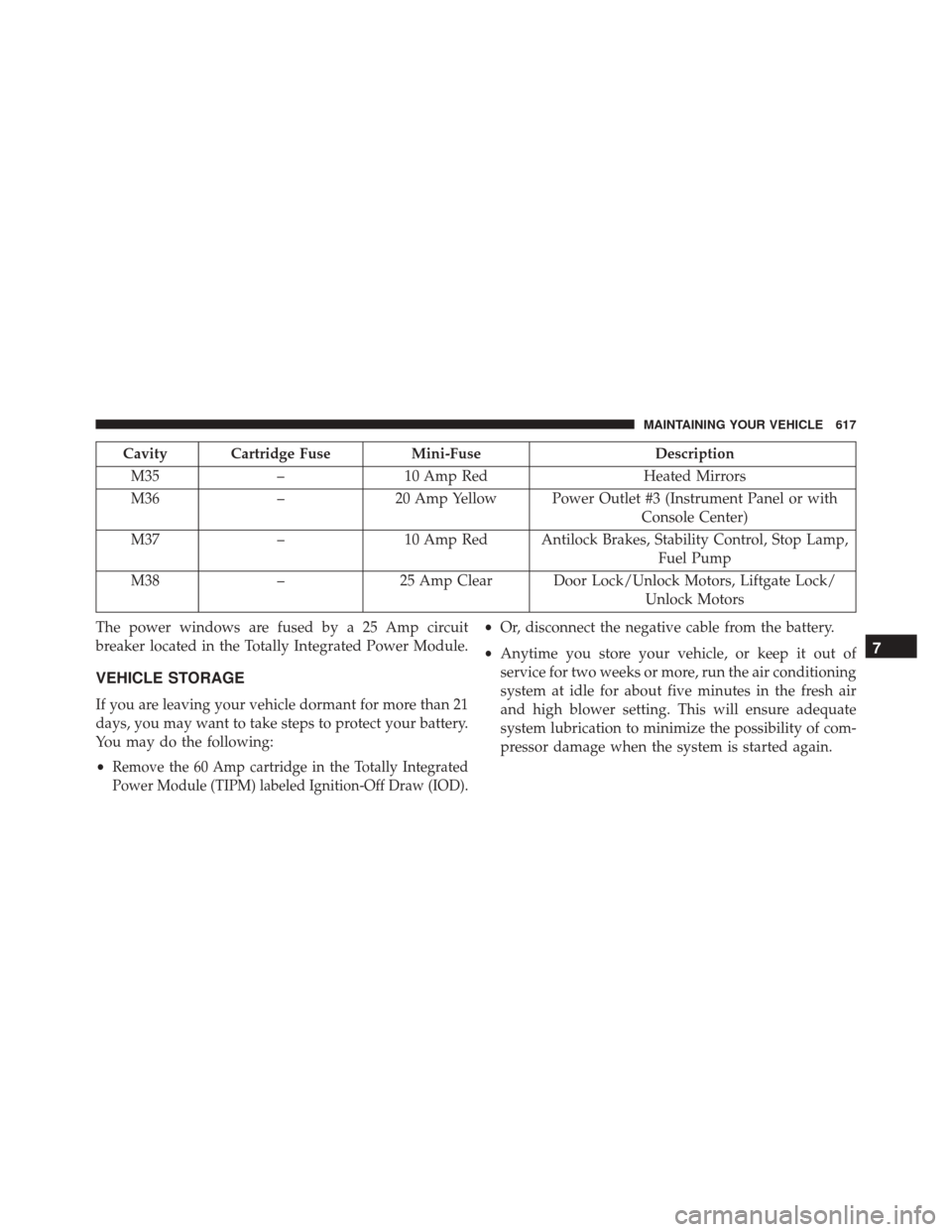
Cavity Cartridge FuseMini-FuseDescription
M35 –10 Amp Red Heated Mirrors
M36 –20 Amp Yellow Power Outlet #3 (Instrument Panel or with
Console Center)
M37 –10 Amp Red Antilock Brakes, Stability Control, Stop Lamp,
Fuel Pump
M38 –25 Amp Clear Door Lock/Unlock Motors, Liftgate Lock/
Unlock Motors
The power windows are fused by a 25 Amp circuit
breaker located in the Totally Integrated Power Module.
VEHICLE STORAGE
If you are leaving your vehicle dormant for more than 21
days, you may want to take steps to protect your battery.
You may do the following:
•
Remove the 60 Amp cartridge in the Totally Integrated
Power Module (TIPM) labeled Ignition-Off Draw (IOD).
• Or, disconnect the negative cable from the battery.
• Anytime you store your vehicle, or keep it out of
service for two weeks or more, run the air conditioning
system at idle for about five minutes in the fresh air
and high blower setting. This will ensure adequate
system lubrication to minimize the possibility of com-
pressor damage when the system is started again.
7
MAINTAINING YOUR VEHICLE 617
Page 651 of 671
Disposal............................. .596
Anti-Lock Warning Light ....................289
Appearance Care ........................ .602
Ashtray ............................... .253
Assistance Towing ........................ .138
Assist, Hill Start ......................... .472
Auto Down Power Windows ..................47
Automatic Dimming Mirror ..................118
Automatic Door Locks ......................38
Automatic Headlights ..................... .200
Automatic Temperature Control (ATC) ..........420
Automatic Transmission ....................442
Adding Fluid ......................... .601
Fluid and Filter Changes ..................602
Fluid Change ......................... .602
Fluid Level Check ...................... .601
Fluid Type ........................... .600
Gear Ranges .......................... .447
Special Additives ...................... .601Torque Converter
...................... .454
Auto Up Power Windows ....................47
Battery ................................ .586
Jump Starting ......................... .562
Keyless Transmitter Replacement (RKE) ........28
Saving Feature (Protection) ................204
Belts, Seat .............................. .107
Body Builders Guide ........................6
Body Mechanism Lubrication .................590
B-Pillar Location ......................... .482
Brake Assist System ...................... .466
Brake Control System, Electronic ..............463
Brake Fluid ............................ .627
Brake System ........................... .462
Anti-Lock (ABS) ....................... .462
Fluid Check .......................... .599
Parking ............................. .460
Brake/T
ransmission Interlock .................444
10
INDEX 649
Page 654 of 671
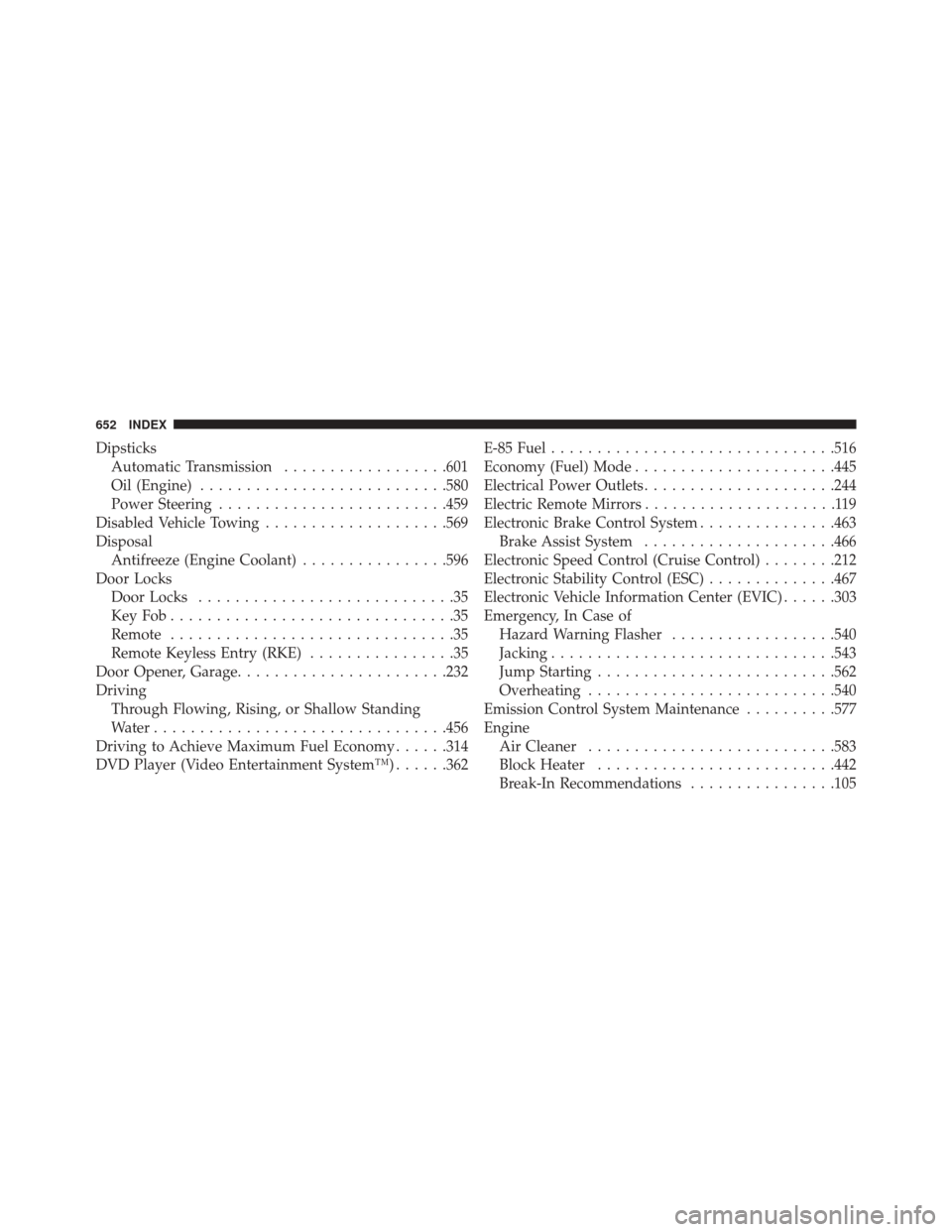
DipsticksAutomatic Transmission ..................601
Oil (Engine) .......................... .580
Power Steering ........................ .459
Disabled Vehicle Towing ....................569
Disposal Antifreeze (Engine Coolant) ................596
Door Locks Door Locks ............................35
KeyFob...............................35
Remote ...............................35
Remote Keyless Entry (RKE) ................35
Door Opener, Garage ...................... .232
Driving Through Flowing, Rising, or Shallow Standing
Water ............................... .456
Driving to Achieve Maximum Fuel Economy ......314
DVD Player (Video Entertainment System™) ......362E-85 Fuel
.............................. .516
Economy (Fuel) Mode ..................... .445
Electrical Power Outlets .....................244
Electric Remote Mirrors .....................119
Electronic Brake Control System ...............463
Brake Assist System .....................466
Electronic Speed Control (Cruise Control) ........212
Electronic Stability Control (ESC) ..............467
Electronic Vehicle Information Center (EVIC) ......303
Emergency, In Case of Hazard Warning Flasher ..................540
Jacking .............................. .543
Jump Starting ......................... .562
Overheating .......................... .540
Emission Control System Maintenance ..........577
Engine Air Cleaner .......................... .583
Block Heater ......................... .442
Break-In Recommendations ................105
652 INDEX