automatic transmission RAM CHASSIS CAB 2009 Owner's Manual
[x] Cancel search | Manufacturer: RAM, Model Year: 2009, Model line: CHASSIS CAB, Model: RAM CHASSIS CAB 2009Pages: 429, PDF Size: 3.51 MB
Page 319 of 429

6. Block both the front and rear of the
wheel diagonally opposite the jacking
position. For example, if the right front
wheel is being changed, block the left
rear wheel.
NOTE: Passengers should not remain in the vehicle
when the vehicle is being jacked.
Jacking Instructions
Instructions
WARNING!
Carefully follow these tire changing warnings to
help prevent personal injury or damage to your
vehicle:
(Continued)
WARNING! (Continued)
•Always park on a firm, level surface as far from
the edge of the roadway as possible before raising
the vehicle.
•Block the wheel diagonally opposite the wheel to
be raised.
•Set the parking brake firmly and set an automatic
transmission in PARK; a manual transmission in
REVERSE.
•Never start or run the engine with the vehicle on a
jack.
•Do not let anyone sit in the vehicle when it is on a
jack.
•Do not get under the vehicle when it is on a jack.
•Only use the jack in the positions indicated and
for lifting this vehicle during a tire change.(Continued)
WHAT TO DO IN EMERGENCIES 317
6
Page 334 of 429

NOTE:The transfer case must be in the neutral position,
and the transmission must be in PARK (automatic trans-
mission), or in gear (manual transmission) to tow a
4-Wheel Drive vehicle with one end of the vehicle raised.
The manufacturer recommends towing with all wheels
OFF the ground. Acceptable methods are to tow the
vehicle on a flatbed or with one end of vehicle raised and
the opposite end on a towing dolly.
2–Wheel Drive Vehicles
Provided that the transmission is operable, tow with the
transmission in NEUTRAL and the ignition key in the
OFF position along with the front wheels raised and the
rear wheels on the ground. Speed must not exceed
30 mph (50 km/h) and distance must not exceed 15 miles
(25 km).
CAUTION!
Towing faster than 30 mph (50 km/h) or for more than
15 miles (25 km) can cause severe damage to the
transmission.
If the vehicle is to be towed faster than 30 mph (50 km/h)
or more than 15 miles (25 km) the vehicle must be towed
with the rear wheels raised and the front wheels on the
ground. It may also be towed on a flatbed or with the
front wheels raised and the rear wheels on a dolly.
332 WHAT TO DO IN EMERGENCIES
Page 336 of 429

\4Transfer Case — If Equipped ............ 356
\4 Automatic Transmission ............... 356
\4 Appearance Care And Protection From
Corrosion .......................... 359
\2 Fuses .............................. 364
\4 Integrated Power Module .............. 364
\2 Vehicle Storage ....................... 369
\2 Replacement Light Bulbs ................ 370 \2
Bulb Replacement ..................... 370
\4 Headlight (Halogen)/Front Park And Turn
Lights ............................ 370
\4 Fog Lights ......................... 374
\4 Cab Top Clearance Lights — If Equipped . . . 375
\2 Fluid And Capacities ................... 377
\2 Fluids, Lubricants And Genuine Parts ....... 378
\4 Engine ............................ 378
\4 Chassis ........................... 379
334 MAINTAINING YOUR VEHICLE
Page 337 of 429
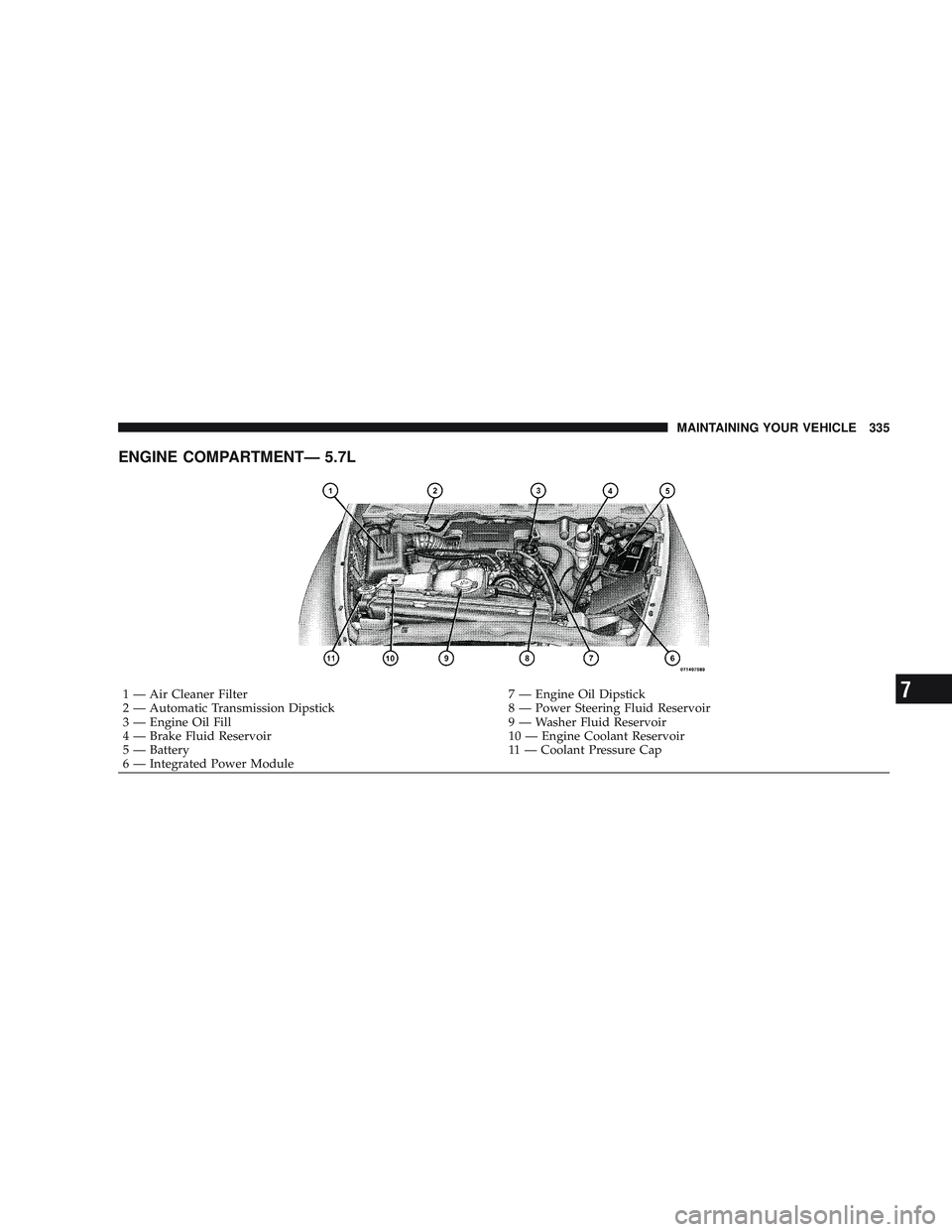
ENGINE COMPARTMENT— 5.7L
1 — Air Cleaner Filter7 — Engine Oil Dipstick
2 — Automatic Transmission Dipstick 8 — Power Steering Fluid Reservoir
3 — Engine Oil Fill 9 — Washer Fluid Reservoir
4 — Brake Fluid Reservoir 10 — Engine Coolant Reservoir
5 — Battery 11 — Coolant Pressure Cap
6 — Integrated Power Module MAINTAINING YOUR VEHICLE 3357
Page 338 of 429

ONBOARD DIAGNOSTIC SYSTEM (OBD II)
Vehicles with 5.7L engines are equipped with a sophisti-
cated onboard diagnostic system called OBD II. This
system monitors the performance of the emissions, en-
gine, and automatic transmission control systems. When
these systems are operating properly, your vehicle will
provide excellent performance and fuel economy, as well
as engine emissions well within current government
regulations.
If any of these systems require service, the OBD II system
will turn on the Malfunction Indicator Light (MIL). It will
also store diagnostic codes and other information to
assist your service technician in making repairs. Al-
though your vehicle will usually be driveable and not
need towing, see your authorized dealer for service as
soon as possible.CAUTION!
Prolonged driving with the MIL on could cause
further damage to the emission control system. It
could also affect fuel economy and driveability. The
vehicle must be serviced before any emissions tests
can be performed.
If the MIL is flashing, severe catalytic converter
damage and power loss will soon occur. Immediate
service is required.
Loose Fuel Filler Cap Message
If the vehicle’s diagnostic system determines that the fuel
filler cap is loose, improperly installed, or damaged, a
gASCAP message will be displayed in the instrument
cluster. Tighten the gas cap until a “clicking” sound is
heard. This is an indication that the gas cap is properly
tightened. Press the odometer reset button to turn the
message off. If the problem persists, the message will
336 MAINTAINING YOUR VEHICLE
Page 358 of 429
Lubricant Selection
Refer to “Fluids, Lubricants, and Genuine Parts” in this
section for the correct fluid type.
NOTE:The presence of water in the gear lubricant will
result in corrosion and possible failure of differential
components. Operation of the vehicle in water, as may be
encountered in some off-highway types of service, will
require draining and refilling the axle to avoid damage.
Limited-Slip Differentials DO NOT REQUIRE any
limited slip oil additive (friction modifiers).
NOTE: Slight noise and mild shuddering may be evi-
dent while turning a vehicle with limited slip differential
on concrete or dry pavement. These conditions should be
considered normal operation of the limited slip
differential.
Transfer Case — If Equipped
Drain And Refill
Refer to the “Maintenance Schedule” in Section 8 of this
manual for the proper maintenance intervals.
Lubricant Selection
Refer to “Fluids, Lubricants, and Genuine Parts” in this
section for the correct fluid type.
Fluid Level Check
This fluid level can be checked by removing the filler
plug. The fluid level should be to the bottom edge of the
filler plug hole with the vehicle in a level position.
Automatic Transmission
Selection Of Lubricant
It is important that the proper lubricant is used in the
transmission to assure optimum transmission perfor-
mance. Use only manufacturer ’s recommended transmis-
sion fluid. Refer to “Fluids, Lubricants, and Genuine
356 MAINTAINING YOUR VEHICLE
Page 359 of 429
Parts” in this section for the correct fluid type. It is
important that the transmission fluid be maintained at
the prescribed level using the recommended fluid.
CAUTION!
Using a transmission fluid other than the manufac-
turer’s recommended fluid may cause deterioration
in transmission shift quality and/or torque converter
shudder. Using a transmission fluid other than the
manufacturer’s recommended fluid will result in
more frequent fluid and filter changes. Refer to
“Fluids, Lubricants, and Genuine Parts” in this sec-
tion for the correct fluid type.
Fluid Level Check – 545RFE Transmission
Check the fluid level while the transmission is at normal
operating temperature 180°F (82°C). This occurs after at
least 15 miles (25 km) of driving. At normal operatingtemperature, the fluid on the end of the dipstick cannot
be held comfortably between the fingertips.
Procedure For Checking Fluid Level
To properly check the automatic transmission fluid level,
the following procedure must be used:
1. Operate the engine at idle speed and normal operating
temperature.
2. The vehicle must be on level ground.
3. Fully apply parking brake.
4. Place the shift lever momentarily in each gear position
ending with the lever in PARK.
5. Remove the dipstick, wipe it clean and reinsert it until
seated.
MAINTAINING YOUR VEHICLE 357
7
Page 360 of 429
6. Remove the dipstick again and note the fluid level on
both sides. The fluid level should be between the HOT
(upper) reference holes on the dipstick at normal operat-
ing temperature. Verify that a solid coating of oil is seen
on both sides of the dipstick. If the fluid is low, add as
required into the dipstick tube.Do not overfill.After
adding any quantity of oil through the dipstick tube, wait
a minimum of two minutes for the oil to fully drain into
the transmission before rechecking the fluid level.
NOTE: If it is necessary to check the transmission below
the operating temperature, the fluid level should be
between the two cold (lower) holes on the dipstick with
the fluid at approximately 70°F (21°C) (room tempera-
ture). If the fluid level is correctly established at room
temperature, it should be between the HOT (upper)
reference holes when the transmission reaches 180°F
(21°C). Remember it is best to check the level at the
normal operating temperature.CAUTION!
Be aware that if the fluid temperature is below 50°F
(10°C), it may not register on the dipstick. Do not add
fluid until the temperature is elevated enough to
produce an accurate reading.
7. Check for leaks. Release the parking brake.
NOTE: To prevent dirt and water from entering the
transmission after checking or replenishing fluid, make
certain that the dipstick cap is properly reseated. It is
normal for the dipstick cap to spring back slightly from
its fully seated positions, as long as its seal remains
engaged in the dipstick tube.
Automatic Transmission Fluid and Filter Change
Refer to the “Maintenance Schedule” in Section 8 of this
manual for the proper maintenance intervals.
358 MAINTAINING YOUR VEHICLE
Page 361 of 429

NOTE:If the transmission is disassembled for any
reason, the fluid and filter should be changed.
It is important that proper lubricant is used in the
transmission. Refer to “Fluids, Lubricants, and Genuine
Parts” in this section for the correct fluid type.
Special Additives
Automatic Transmission Fluid (ATF) is an engineered
product and its performance may be impaired by supple-
mental additives. Therefore, do not add any fluid addi-
tives to the transmission. The only exception to this
policy is the use of special dyes to aid in detecting fluid
leaks. In addition, avoid using transmission sealers as
they may adversely affect seals.
Appearance Care and Protection from Corrosion
Protection of Body and Paint from Corrosion
Vehicle body care requirements vary according to geo-
graphic locations and usage. Chemicals that make roads passable in snow and ice, and those that are sprayed on
trees and road surfaces during other seasons, are highly
corrosive to the metal in your vehicle. Outside parking,
which exposes your vehicle to airborne contaminants,
road surfaces on which the vehicle is operated, extreme
hot or cold weather and other extreme conditions will
have an adverse affect on paint, metal trim, and under-
body protection.
The following maintenance recommendations will enable
you to obtain maximum benefit from the corrosion
resistance built into your vehicle.
What Causes Corrosion?
Corrosion is the result of deterioration or removal of
paint and protective coatings from your vehicle.
The most common causes are:
•Road salt, dirt and moisture accumulation.
•Stone and gravel impact.
MAINTAINING YOUR VEHICLE 359
7
Page 381 of 429
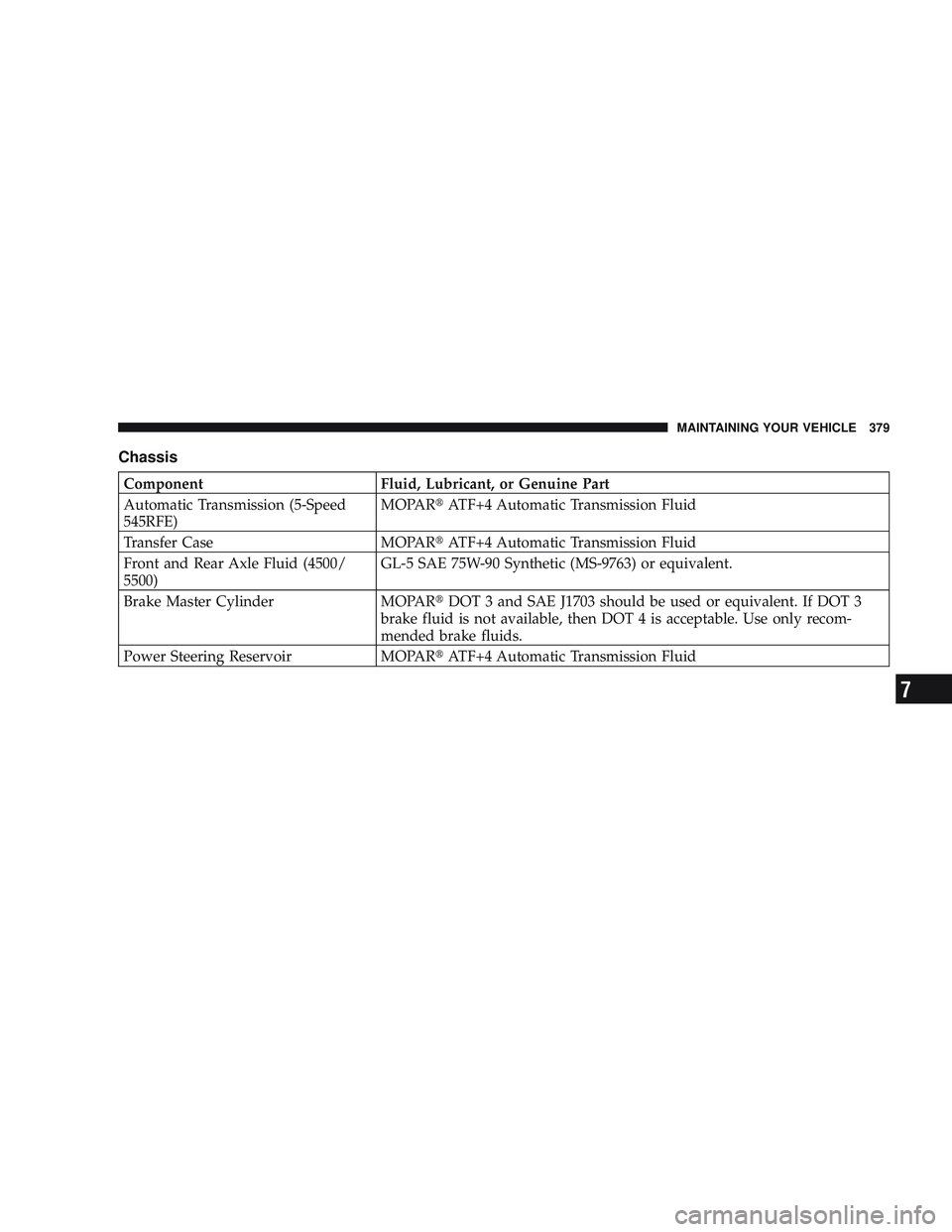
Chassis
ComponentFluid, Lubricant, or Genuine Part
Automatic Transmission (5-Speed
545RFE) MOPAR\3
ATF+4 Automatic Transmission Fluid
Transfer Case MOPAR\3ATF+4 Automatic Transmission Fluid
Front and Rear Axle Fluid (4500/
5500) GL-5 SAE 75W-90 Synthetic (MS-9763) or equivalent.
Brake Master Cylinder MOPAR\3DOT 3 and SAE J1703 should be used or equivalent. If DOT 3
brake fluid is not available, then DOT 4 is acceptable. Use only recom-
mended brake fluids.
Power Steering Reservoir MOPAR\3ATF+4 Automatic Transmission Fluid
MAINTAINING YOUR VEHICLE 379
7