window RAM CHASSIS CAB 2009 Owner's Manual
[x] Cancel search | Manufacturer: RAM, Model Year: 2009, Model line: CHASSIS CAB, Model: RAM CHASSIS CAB 2009Pages: 429, PDF Size: 3.51 MB
Page 215 of 429
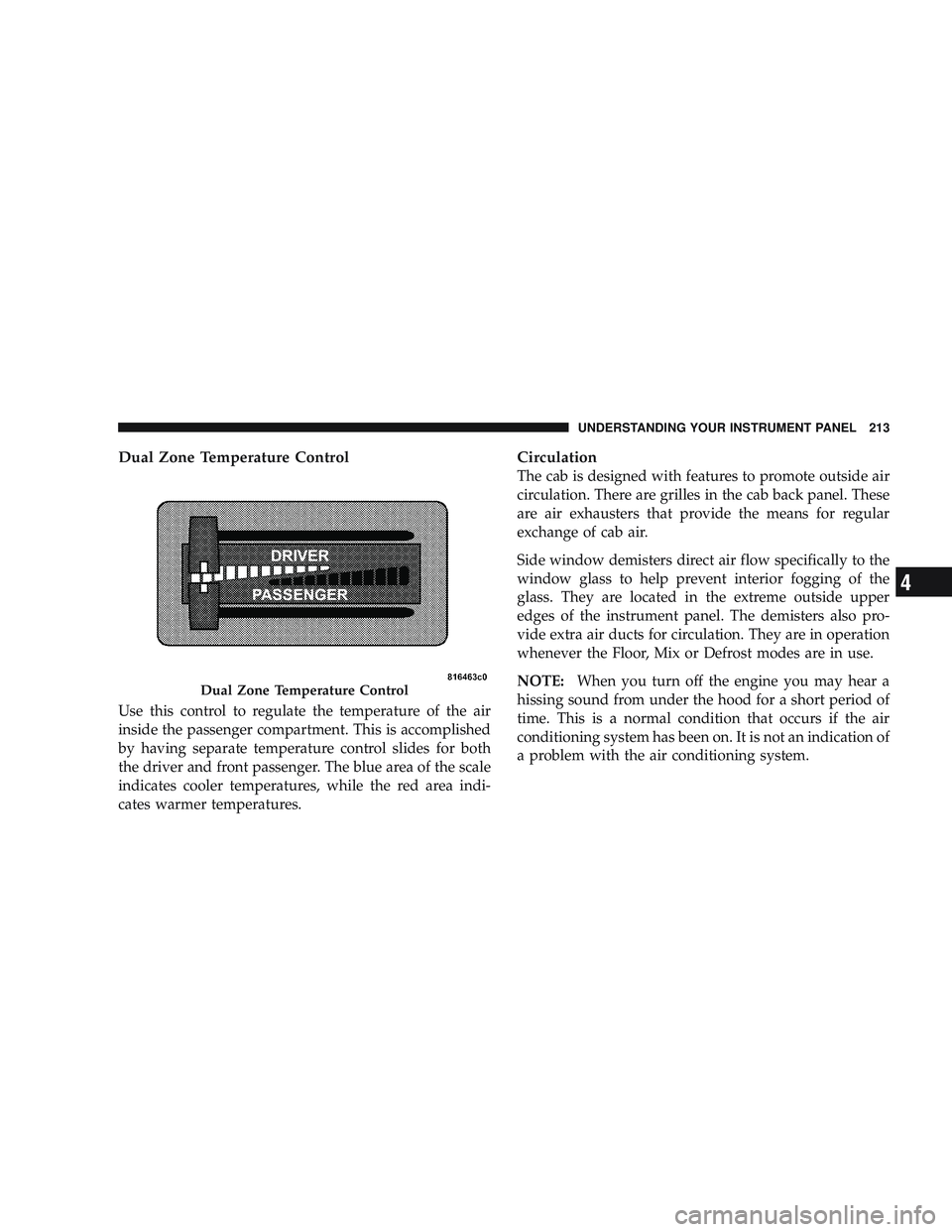
Dual Zone Temperature Control
Use this control to regulate the temperature of the air
inside the passenger compartment. This is accomplished
by having separate temperature control slides for both
the driver and front passenger. The blue area of the scale
indicates cooler temperatures, while the red area indi-
cates warmer temperatures.
Circulation
The cab is designed with features to promote outside air
circulation. There are grilles in the cab back panel. These
are air exhausters that provide the means for regular
exchange of cab air.
Side window demisters direct air flow specifically to the
window glass to help prevent interior fogging of the
glass. They are located in the extreme outside upper
edges of the instrument panel. The demisters also pro-
vide extra air ducts for circulation. They are in operation
whenever the Floor, Mix or Defrost modes are in use.
NOTE:When you turn off the engine you may hear a
hissing sound from under the hood for a short period of
time. This is a normal condition that occurs if the air
conditioning system has been on. It is not an indication of
a problem with the air conditioning system.
Dual Zone Temperature Control
UNDERSTANDING YOUR INSTRUMENT PANEL 213
4
Page 216 of 429
Operating Tips
Fast Cooldown
For a fast cooldown, turn the blower fan rotary knob to
the extreme right position, turn the mode control to the
panel fresh position, press the snowflake button to turn
on the air conditioning, and drive with the windows
open for the first few minutes. Once the hot air has been
expelled, close the windows and press the recirculation
pushbutton on dual zone control, or switch the mode
from panel/fresh to panel/recirculate on single zone
control. When a comfortable condition has been reached,
choose a mode position and adjust the temperature
control slide and blower speed as necessary to maintain
comfort. For high humidity conditions it may be neces-
sary to remain in the Recirculation mode to maintain
comfort.
Window Fogging
Windows will fog on the inside when the humidity inside
the vehicle is high. This often occurs in mild or cool
temperatures when it’s rainy or humid. In most cases
turning on the air conditioning (pressing the snowflake
button) will clear the fog. Adjust the temperature control,
air direction and blower speed to maintain comfort.
As the temperature gets colder it may be necessary to
direct air onto the windshield by using the Mix mode
position on the control. Adjust the temperature control
and blower speed to maintain comfort. Higher blower
speeds will reduce fogging. Interior fogging on the
windshield can be quickly removed by selecting the
defrost mode.
Regular cleaning of the inside of the windows with a
non-filming cleaning solution (vinegar and water works
very well) will help prevent contaminates (cigarette
214 UNDERSTANDING YOUR INSTRUMENT PANEL
Page 217 of 429

smoke, perfumes, etc.) from sticking to the windows.
Contaminates increase the rate of window fogging.
Summer Operation
Air conditioned vehicles must be protected with a high
quality antifreeze coolant during summer to provide
proper corrosion protection and to raise the boiling point
of the coolant for protection against overheating. A 50 %
concentration is recommended. Refer to ”Engine Cool-
ant” under “ Fluids, Lubricants and Genuine Parts” in
section 7.
When using the air conditioner in extremely heavy traffic
in hot weather, especially when towing a trailer, addi-
tional engine cooling may be required. If this situation is
encountered, operate the transmission in a lower gear to
increase engine RPM, coolant flow and fan speed. When
stopped in heavy traffic, it may be necessary to shift into
NEUTRAL and depress the accelerator slightly for fast
idle operation to increase coolant flow and fan speed.Your air conditioning system is also equipped with an
automatic recirculation system. When the system senses
a heavy load or high heat conditions, it may use partial
Recirculation A/C mode to provide additional comfort.
Winter Operation
When operating the system during the winter months,
make sure the air intake, located directly in front of the
windshield, is free of ice, slush, snow, or other
obstructions.
UNDERSTANDING YOUR INSTRUMENT PANEL 215
4
Page 287 of 429
WARNING! (Continued)
•Guard against carbon monoxide with proper
maintenance. Have the exhaust system inspected
every time the vehicle is raised. Have any abnor-
mal conditions repaired promptly. Until repaired,
drive with all side windows fully open.
ADDING FUEL
The fuel tank filler tube has a restricting door about 2 in
(50 mm) inside the opening. If using a portable fuel
container, it should have a flexible nozzle long enough to
force open the restricting door.
CAUTION!
•Damage to the fuel system or emissions control
system could result from using an improper fuel
tank filler tube cap (gas cap). A poorly fitting cap
could let impurities into the fuel system. Also, a
poorly-fitted aftermarket cap can cause the MIL
(Malfunction Indicator Light) to illuminate due to
fuel vapors escaping from the system.
•A poorly fitting gas cap may cause the MIL to turn
on.
•To avoid fuel spillage and overfilling, do not “top
off” the fuel tank after filling.
NOTE: When the fuel nozzle “clicks” or shuts off the
fuel tank is full.
STARTING AND OPERATING 285
5
Page 365 of 429

Cleaning Headlights
Your vehicle has plastic headlights that are lighter and
less susceptible to stone breakage than glass headlights.
Plastic is not as scratch resistant as glass and therefore
different lens cleaning procedures must be followed.
To minimize the possibility of scratching the lenses and
reducing light output, avoid wiping with a dry cloth. To
remove road dirt, wash with a mild soap solution fol-
lowed by rinsing.
Do not use abrasive cleaning components, solvents, steel
wool or other aggressive material to clean the lenses.
Glass Surfaces
All glass surfaces should be cleaned on a regular basis
with MOPAR\3Glass Cleaner or any commercial
household-type glass cleaner. Never use an abrasive type
cleaner. Use caution when cleaning the inside rear win-
dow equipped with electric defrosters or the right rear quarter window equipped with the radio antenna. Do
not use scrapers or other sharp instruments which may
scratch the elements. When cleaning the rearview mirror,
spray cleaner on the towel or rag that you are using. Do
not spray cleaner directly on the mirror.
Cleaning Plastic Instrument Cluster Lenses
The lenses in front of the instruments in this vehicle are
molded in clear plastic. When cleaning the lenses, care
must be taken to avoid scratching the plastic.
1. Clean with a wet soft rag. A mild soap solution may be
used, but do not use high alcohol content or abrasive
cleaners. If soap is used, wipe clean with a clean damp
rag.
2. Dry with a soft tissue.
MAINTAINING YOUR VEHICLE 363
7
Page 371 of 429
VEHICLE STORAGE
If you are storing your vehicle for more than 21 days, we
recommend that you take the following steps to mini-
mize the drain on your vehicle’s battery:
•Disconnect the Ignition-Off Draw (IOD) fuse located in
the Integrated Power Module, located in the engine
compartment. The IOD cavity includes a snap-in re-
tainer that allows the fuse to be disconnected without
removing it from the fuse block.
•The electronic shift transfer case should be placed in
the 4HI mode and kept in this position to minimize the
battery drain.
•As an alternative to the above steps you may discon-
nect the negative cables from both batteries.
•Any time you store your vehicle or keep it out of
service (i.e., vacation) for two weeks or more, run the
air conditioning system at idle for about five minutesin the fresh air and high blower setting. This will
ensure adequate system lubrication to minimize the
possibility of compressor damage when the system is
started again.
NOTE:
•When reinstalling the IOD fuse push firmly until fully
seated; the gauges in the instrument cluster will do a
full sweep when the ignition key is cycled to RUN.
This is a normal condition.
•When the vehicle is shipped from the factory, the IOD
fuse is in the up or extracted position. If the radio,
interior lamps, keyless entry or other features do not
work with the key OFF, check the position of the fuse
(or check to see if the fuse is blown) to ensure that it is
fully seated. When the IOD fuse is extracted, the
instrument cluster in the odometer window will dis-
play \6NO FUSE.”
MAINTAINING YOUR VEHICLE 369
7
Page 414 of 429

CleaningWheels ............................. 361
Climate Control ......................... 204
Clock ........................ 172,175,189,195
Compact Disc (CD) Maintenance ............. 203
Compass ........................... 140,141
Compass Calibration ..................... 141
Compass Variance ....................... 143
Computer, Trip/Travel .................... 136
Contract, Service ........................ 403
Coolant Pressure Cap (Radiator Cap) .......... 351
Cooling System ......................... 348
Adding Coolant (Antifreeze) .............. 350
Coolant Capacity ...................... 377
Coolant Level ...................... 348,352
Disposal of Used Coolant ................ 352
Drain, Flush, and Refill .................. 349
Inspection ........................... 352
Points to Remember .................... 352 Pressure Cap
......................... 351
Radiator Cap ......................... 351
Selection of Coolant (Antifreeze) .........349,378
Cruise Control (Speed Control) .............. 133
Cupholders ............................ 146
Customer Assistance ..................... 401
Data Recorder, Event ...................... 57
Daytime Running Lights ................... 126
Dealer Service .......................... 337
Defroster, Rear Window ................... 153
Defroster, Windshield ................74,205,208
Delay (Intermittent) Wipers ................. 129
Differential, Limited-Slip .................. 249
Dipsticks .............................. 338
Power Steering ........................ 253
Disposal .............................. 340
Antifreeze (Engine Coolant) ............... 352
Engine Oil ........................... 340
412 INDEX
Page 415 of 429

Door Locks............................. 27
Driving Through Flowing, Rising, or Shallow
Standing Water ........................ 250
Dual Rear Wheels ..................... 280,322
DVD Player (Video Entertainment System™) .... 201
Electric Rear Window Defrost ............... 153
Electrical Power Outlets ................... 144
Electronic Speed Control (Cruise Control) ...... 133
Electronically Shifted Transfer Case ........234,242
Emergency Brake ........................ 254
Emergency, In Case of Freeing Vehicle When Stuck ............... 330
Hazard Warning Flasher ................. 314
Jump Starting ......................... 326
Tow Hooks .......................... 330
Towing ............................. 331
Emission Control System Maintenance ......... 382Engine
............................... 335
Air Cleaner .......................... 340
Block Heater ......................... 223
Break-In Recommendations ................ 72
Compartment Identification ............... 335
Coolant (Antifreeze) .................... 378
Exhaust Gas Caution .................. 73,284
Flooded, Starting ...................... 222
Jump Starting ......................... 326
Oil .............................. 338,378
Oil Filler Cap ......................... 339
Oil Selection .......................... 339
Oil Synthetic ......................... 340
Temperature Gauge .................... 164
Event Data Recorder ...................... 57
Exhaust Gas Caution ................73,284,345
Exhaust System ....................... 73,345
Exterior Lighting ........................ 125
INDEX 413
10
Page 421 of 429

Change Interval....................... 339
Dipstick ............................. 338
Disposal ............................ 340
Filter ......................... 338,340,378
Identification Logo ..................... 339
Materials Added to ..................... 340
Pressure Gauge ....................... 164
Recommendation ...................... 339
Synthetic ............................ 340
Viscosity ............................ 339
Onboard Diagnostic System ................ 336
Operating Precautions .................... 336
Operator Manual (Owner’s Manual) ............ 4
Outside Rearview Mirrors .................. 82
Overdrive ............................. 227
Overdrive OFF Switch .................... 227
Overhead Console ....................... 136
Overhead Travel Information Center .......... 136
Overheating, Engine ...................... 165 Owner’s Manual (Operator Manual)
.........4,405
Parking Brake .......................... 254
Passenger Airbag On/Off Switch ............. 53
Passing Light ........................... 128
Pedals, Adjustable ....................... 131
Pets .................................. 72
Pets, Transporting ........................ 72
Phone, Cellular .......................... 86
Phone, Hands-Free (UConnect\3) .............. 86
Placard, Tire and Loading Information ......... 262
Power Door Locks ........................... 28
Mirrors .............................. 83
Outlet (Auxiliary Electrical Outlet) .......... 144
Seats ............................... 118
Sliding Rear Window ................. 34,154
Steering .......................... 252,253
Windows ............................. 32
INDEX 419
10
Page 422 of 429

Power Steering Fluid..................... 379
Pregnant Women and Seat Belts .............. 47
Programming Transmitters
(Remote Keyless Entry) .................... 24
Radial Ply Tires ......................... 272
Radiator Cap (Coolant Pressure Cap) .......348,351
Radio, Navigation ....................... 194
Radio Operation ...................... 173,187
Radio Remote Controls .................... 201
Radio, Satellite ....................... 195,197
Radio (Sound Systems) .................173,187
Rear Axle (Differential) .................355,356
Rear Window Features .................... 153
Rear Window, Sliding ................... 34,154
Reclining Front Seats ..................... 116
Recorder, Event Data ...................... 57
Recreational Towing ...................... 304
Shifting into Transfer Case Neutral (N) ....305,307 Shifting out of Transfer Case
Neutral (N)
....................... 306,309
Reformulated Gasoline .................... 281
Refrigerant ............................ 343
Reminder, Seat Belt ....................... 46
Remote Keyless Entry (RKE) ................. 21
Remote Sound System (Radio) Controls ........ 201
Remote Starting System .................... 26
Replacement Keys ........................ 16
Replacement Parts ....................... 337
Replacement Tires ....................... 274
Reporting Safety Defects ................... 404
Resetting Oil Change Indicator .............. 167
Restraint, Head ......................... 117
Restraints, Child ....................... 60,66
Restraints, Occupant ...................... 35
Rotation, Tires .......................... 279
Safety Checks Inside Vehicle ................. 74
420 INDEX