child seat RAM CHASSIS CAB 2009 Owners Manual
[x] Cancel search | Manufacturer: RAM, Model Year: 2009, Model line: CHASSIS CAB, Model: RAM CHASSIS CAB 2009Pages: 429, PDF Size: 3.51 MB
Page 12 of 429

\4To Lock The Doors .................... 22
\4 Using The Panic Alarm ................. 23
\4 Programming Additional RKE Transmitters . . . 24
\4 General Information ................... 24
\4 RKE Transmitter Battery Service ........... 25
\2 Remote Starting System — If Equipped ....... 26
\2 Door Locks ........................... 27
\4 Manual Door Locks ................... 27
\4 Power Door Locks — If Equipped ......... 28
\4 Child Protection Door Lock .............. 30
\2 Windows ............................ 32
\4 Power Windows – If Equipped ............ 32
\4 Power Sliding Rear Window – If Equipped . . . 34 \4
Sliding Rear Window – If Equipped ........ 34
\4 Wind Buffeting ....................... 34
\2 Occupant Restraints ..................... 35
\4 Lap/Shoulder Belts .................... 36
\4 Adjustable Upper Shoulder Belt Anchorage . . . 44
\4 Automatic Locking Restraint (ALR) Mode –
If Equipped ......................... 44
\4 Center Lap Belts ...................... 45
\4 Enhanced Driver Seat Belt Reminder System
(BeltAlert\3) ......................... 46
\4 Seat Belts And Pregnant Women .......... 47
\4 Seat Belt Extender ..................... 47
10 THINGS TO KNOW BEFORE STARTING YOUR VEHICLE
Page 32 of 429

5. Within 30 seconds, press the driver’s door LOCK
switch in the UNLOCK direction.
6. A single chime will sound to indicate the feature has
been changed.
7. Repeat the above steps to alternate the availability of
this feature.
8. If a chime is not heard, the program mode was
canceled before the feature could be changed. If neces-
sary, repeat the above procedure.
Child Protection Door Lock
To provide a safer environment for children riding in the
rear seat, the rear doors of your vehicle have the Child
Protection Door Lock system.Child Protection Door Lock Location
30 THINGS TO KNOW BEFORE STARTING YOUR VEHICLE
Page 37 of 429
OCCUPANT RESTRAINTS
Some of the most important safety features in your
vehicle are the restraint systems. These include the front
and rear seat belts for the driver and all passengers, and
front airbags for both the driver and front passenger. If
you will be carrying children too small for adult-size
belts, your seat belts also can be used to hold infant and
child restraint systems.
Please pay close attention to the information in this
section. It tells you how to use your restraint system
properly to keep you and your passengers as safe as
possible.WARNING!
In a collision, you and your passengers can suffer
much greater injuries if you are not properly buckled
up. You can strike the interior of your vehicle or other
passengers, or you can be thrown out of the vehicle.
Always be sure you and others in your vehicle are
buckled up properly.
Buckle up even though you are an excellent driver, even
on short trips. Someone on the road may be a poor driver
and cause a collision that includes you. This can happen
far away from home or on your own street.
Research has shown that seat belts save lives, and that
they can reduce the seriousness of injuries in a collision.
Some of the worst injuries happen when people are
thrown from the vehicle. Seat belts reduce the possibility
THINGS TO KNOW BEFORE STARTING YOUR VEHICLE 35
2
Page 46 of 429
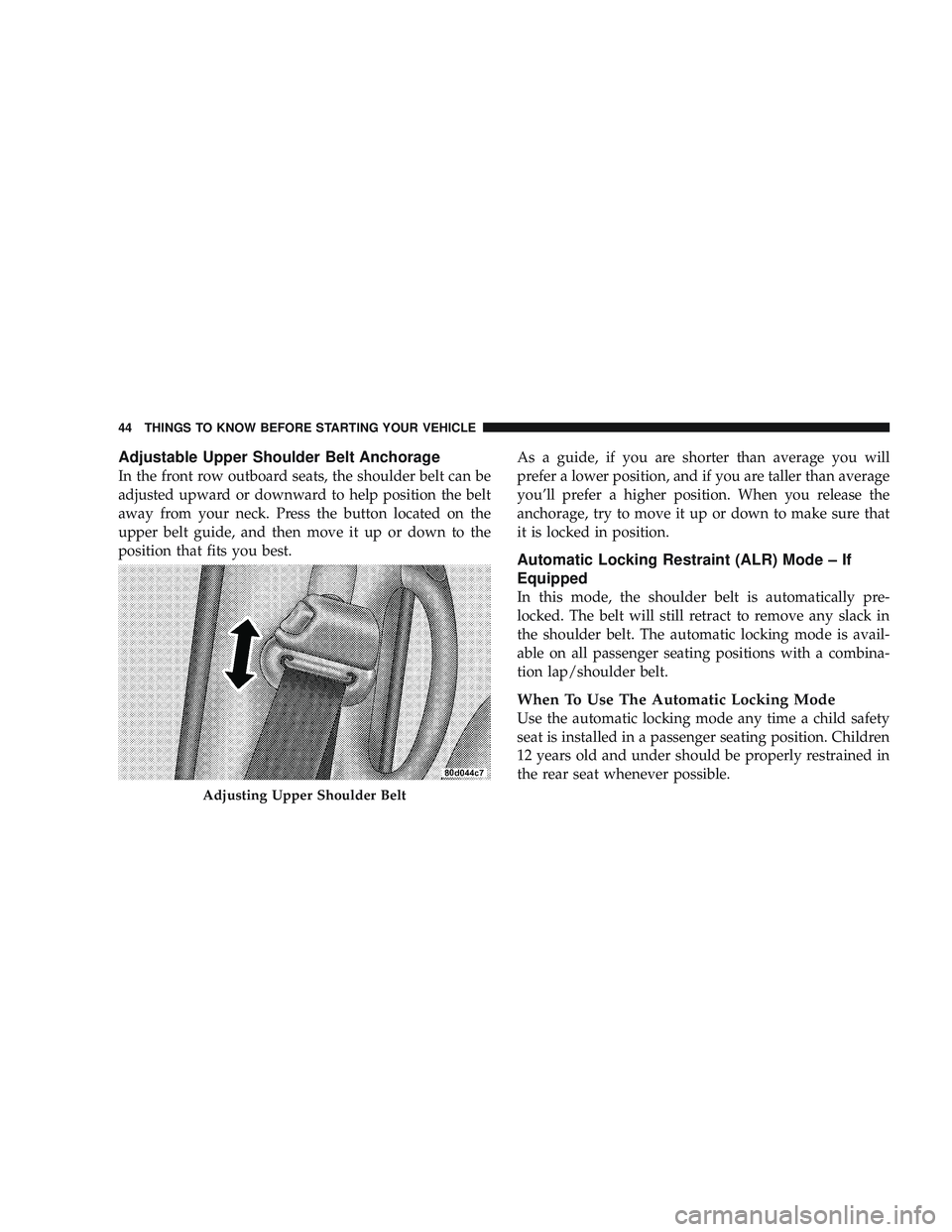
Adjustable Upper Shoulder Belt Anchorage
In the front row outboard seats, the shoulder belt can be
adjusted upward or downward to help position the belt
away from your neck. Press the button located on the
upper belt guide, and then move it up or down to the
position that fits you best.As a guide, if you are shorter than average you will
prefer a lower position, and if you are taller than average
you’ll prefer a higher position. When you release the
anchorage, try to move it up or down to make sure that
it is locked in position.
Automatic Locking Restraint (ALR) Mode – If
Equipped
In this mode, the shoulder belt is automatically pre-
locked. The belt will still retract to remove any slack in
the shoulder belt. The automatic locking mode is avail-
able on all passenger seating positions with a combina-
tion lap/shoulder belt.
When To Use The Automatic Locking Mode
Use the automatic locking mode any time a child safety
seat is installed in a passenger seating position. Children
12 years old and under should be properly restrained in
the rear seat whenever possible.
Adjusting Upper Shoulder Belt
44 THINGS TO KNOW BEFORE STARTING YOUR VEHICLE
Page 51 of 429

WARNING!
•Do not put anything on or around the airbag
covers or attempt to manually open them. You may
damage the airbags and you could be injured
because the airbags are not there to protect you.
These protective covers for the airbag cushions are
designed to open only when the airbags are inflat-
ing.
•Do not mount any aftermarket equipment such as
trailer brake controllers, snowplow controllers,
auxiliary light switches, radios, etc. on or behind
the knee bolster. Knee bolsters are designed to
work with the airbag and seat belt to protect you.
Mounting any additional equipment on or behind
the knee bolster can cause injury during a crash.Airbags inflate in moderate to high speed impacts. Along
with the seat belts, front airbags work with the instru-
ment panel knee bolsters to provide improved protection
for the driver and front passenger.
The seat belts are designed to protect you in many types
of collisions. The front airbags deploy in moderate to
severe frontal collisions. In certain types of collisions, the
front airbags may be triggered. But even in collisions
where the airbags work, you need the seat belts to keep
you in the right position for the airbags to protect you
properly.
Here are some simple steps you can follow to minimize
the risk of harm from a deploying airbag.
•Children 12 years and under should ride buckled up in
a rear seat, if available.
THINGS TO KNOW BEFORE STARTING YOUR VEHICLE 49
2
Page 52 of 429
•Infants in rear-facing child restraints mustNEVER
ride in the front seat of a vehicle with a passenger front
airbag unless the airbag is turned off (Regular Cab
Vehicles Only). An airbag deployment can cause se-
vere injury or death to infants in that position. Refer to
the “Passenger Airbag On/Off Switch (if equipped)”
in this section.
•If your vehicle does not have a rear seat, refer to the
“Passenger Airbag On/Off Switch (if equipped)” in
this section
•Children that are not big enough to properly wear the
vehicle seat belt (refer to “Child Restraints” in this
section) should be secured in the rear seat in child
restraints or belt-positioning booster seats. Older chil-
dren who do not use child restraints or belt-
positioning booster seats should ride properly buckled
up in the rear seat. Never allow children to slide the
shoulder belt behind them or under their arms.
•All occupants should use their seat belts properly.
•The driver and front passenger seats should be moved
back as far as practical to allow the airbag room to
inflate.
WARNING!
•Relying on the airbags alone could lead to more
severe injuries in a collision. The airbags work
with your seat belt to restrain you properly. In
some collisions the airbags won’t deploy at all.
Always wear your seat belts even though you have
airbags.
•Being too close to the steering wheel or instrument
panel during airbag deployment could cause seri-
ous injury. Airbags need room to inflate. Sit back,
comfortably extending your arms to reach the
steering wheel or instrument panel.
50 THINGS TO KNOW BEFORE STARTING YOUR VEHICLE
Page 55 of 429

Passenger Airbag On/Off Switch (Regular Cab
Vehicles Only) – If EquippedThe passenger front airbag is to be turned off only if the
passenger:
•is an infant (less than one year old) who must ride in
the front seat because there is no rear seat, because the
rear seat is too small for a rear-facing infant restraint or
because the infant has a medical condition which
makes it necessary for the driver to be able to see the
infant,
•is a child, age one to 12 who must ride in the front seat
because there is no rear seat, because there is no rear
seat position available, or because the child has a
medical condition which makes it necessary for the
driver to be able to see the child,
•has a medical condition which makes passenger airbag
(if equipped) inflation (deployment) a greater risk for
the passenger than the risk of hitting the dashboard
(instrument panel) or windshield in a crash.Passenger Airbag On/Off Switch
THINGS TO KNOW BEFORE STARTING YOUR VEHICLE 53
2
Page 62 of 429
Child Restraint
Everyone in your vehicle needs to be buckled up all the
time — babies and children, too. Every state in the United
States and all Canadian provinces require that small
children ride in proper restraint systems. This is the law,
and you can be prosecuted for ignoring it.
Children 12 years and under should ride properly buck-
led up in a rear seat, if available. According to crash
statistics, children are safer when properly restrained in
the rear seats rather than in the front.WARNING!
In a collision, an unrestrained child, even a tiny baby,
can become a missile inside the vehicle. The force
required to hold even an infant on your lap can
become so great that you could not hold the child, no
matter how strong you are. The child and others
could be badly injured. Any child riding in your
vehicle should be in a proper restraint for the child’s
size.
Infants and Small Children
There are different sizes and types of restraints for
children from newborn size to the child almost large
enough for an adult safety belt. Use the restraint that is
correct for your child:
•Safety experts recommend that children ride
rearward-facing in the vehicle until they are at least
one year old and weigh at least 20 lbs (9 kg). Two types
60 THINGS TO KNOW BEFORE STARTING YOUR VEHICLE
Page 63 of 429
of child restraints can be used rearward-facing: infant
carriers and\6convertible\6 child seats. Both types of
child restraints are held in the vehicle by the lap/
shoulder belt.
•The infant carrier is only used rearward-facing in the
vehicle. It is recommended for children who weigh up
to about 20 lbs (9 kg). \6Convertible\6child seats can be
used either rearward-facing or forward-facing in the
vehicle. Convertible child seats often have a higher
weight limit in the rearward-facing direction than
infant carriers do, so they can be used rearward-facing
by children who weigh more than 20 lbs (9 kg) but are
less than one year old.
•Rearward-facing child seats must NEVERbe used in
the front seat of a vehicle with a front passenger airbag
(if equipped) unless the airbag is turned off. An airbag
deployment could cause severe injury or death to
infants in this position.
•Children who weigh more than 20 lbs (9 kg) and who
are older than one year can ride forward-facing in the
vehicle. Forward-facing child seats and convertible
child seats used in the forward-facing direction are for
children who weigh 20 to 40 lbs (9 to 18 kg) and who
are older than one year. These child seats are also held
in the vehicle by the lap/shoulder belt.
•The belt-positioning booster seat is for children weigh-
ing more than 40 lbs (18 kg), but who are still too small
to fit the vehicle’s seat belts properly. If the child
cannot sit with knees bent over the vehicle’s seat
cushion while the child’s back is against the seat back,
they should use a belt-positioning booster seat. The
child and booster seat are held in the vehicle by the
lap/shoulder belt. (Some booster seats are equipped
with a front shield and are held in the vehicle by the
lap portion.) For further information, refer to
www.seatcheck.org.
THINGS TO KNOW BEFORE STARTING YOUR VEHICLE 61
2
Page 64 of 429
WARNING!
•Improper installation can lead to failure of an
infant or child restraint. It could come loose in a
collision. The child could be badly injured or
killed. Follow the manufacturer’s directions ex-
actly when installing an infant or child restraint.
•A rearward-facing child restraint should only be
used in a rear seat, or in the front seat if the
passenger’s front airbag is Off (if equipped). If the
airbag is left On, a rearward-facing child restraint
in the front seat may be struck by a deploying
passenger airbag (if equipped) which may cause
severe or fatal injury to the infant.
Here are some tips for getting the most out of your child
restraint:
•Before buying any restraint system, make sure that it
has a label certifying that it meets all applicable Safety Standards. We also recommend that you make sure
that you can install the child restraint in the vehicle
where you will use it before you buy it.
•The restraint must be appropriate for your child’s
weight and height. Check the label on the restraint for
weight and height limits.
•Carefully follow the instructions that come with the
restraint. If you install the restraint improperly, it may
not work when you need it.
•The passenger seat belts are equipped with Automatic
Locking Retractors (ALR), which are designed to keep
the lap portion tight around the child restraint so that
it is not necessary to use a locking clip.
Pull the belt from the retractor until there is enough to
allow you to pass through the child restraint and slide
the latch plate into the buckle. Then pull on the belt
until it is completely extended from the retractor.
62 THINGS TO KNOW BEFORE STARTING YOUR VEHICLE