key fob RAM CHASSIS CAB 2011 User Guide
[x] Cancel search | Manufacturer: RAM, Model Year: 2011, Model line: CHASSIS CAB, Model: RAM CHASSIS CAB 2011Pages: 472, PDF Size: 7.38 MB
Page 32 of 472

• For vehicles not equipped with the EVIC, perform the
following procedure:
1. Enter your vehicle and close all doors.
2. Fasten your seat belt. (Fastening the seat belt will
cancel any chiming that may confuse you during this
programming procedure.)
3. Place the Key Fob into the ignition.
4. Within 15 seconds cycle the Key Fob from the OFF
position to the ON/RUN position a minimum of four
times, ending in the OFF position. (Do not start the
engine) .
5. Within 30 seconds, press the driver’s door LOCK
switch.
6. A single chime will be heard to indicate the feature has
been disabled.
7. To reactivate this feature, repeat the above steps. 8. If a chime is not heard, program mode was canceled
before the feature could be disabled. If necessary, repeat
the above procedure.
Auto Unlock Doors — If Equipped
This feature unlocks all of the doors of the vehicle when
either front door is opened. This will occur only after the
vehicle has been shifted into the PARK position after the
vehicle has been driven (shifted out of PARK and all
doors closed).
Auto Unlock Doors Programming — If Equipped
The Auto Unlock Doors feature can be enabled or dis-
abled as follows:
• For vehicles equipped with the EVIC, refer to “Elec-
tronic Vehicle Information Center (EVIC)/Personal
Settings (System Setup)” in “Understanding Your In-
strument Panel” for further information. 2 THINGS TO KNOW BEFORE STARTING YOUR VEHICLE 31
Page 33 of 472

• For vehicles not equipped with the EVIC, perform the
following procedure:
1. Enter your vehicle and close all doors.
2. Fasten your seat belt. (Fastening the seat belt will
cancel any chimes that may be confusing during this
programming procedure.)
3. Insert the Key Fob into the ignition.
4. Within 15 seconds, cycle the Key Fob from the OFF
position to the ON/RUN position a minimum of four
times, ending in the OFF position. (Do not start the
engine) .
5. Within 30 seconds, press the driver’s door UNLOCK
switch.
6. A single chime will sound to indicate the feature has
been changed.
7. Repeat the above steps to alternate the availability of
this feature. 8. If a chime is not heard, the program mode was
canceled before the feature could be changed. If neces-
sary, repeat the above procedure.
Child-Protection Door Lock
To provide a safer environment for children riding in the
rear seat, the rear doors (if equipped) of your vehicle
have the Child-Protection Door Lock system.
Child-Protection Door Lock Location32 THINGS TO KNOW BEFORE STARTING YOUR VEHICLE
Page 135 of 472
Vehicles Equipped with Remote Start
On models equipped with remote start, the drivers
ventilated seat can be programmed to come on during a
remote start. Refer to “Remote Starting System — If
Equipped” in “Things to Know Before Starting Your
Vehicle” for further information.
40-20-40 Front Bench Seat — If Equipped
The seat is divided into three segments. The outboard
seat portions are each 40% of the total width of the seat.
The back of the center portion (20%) easily folds down to
provide an armrest/center storage compartment (if
equipped).
DRIVER MEMORY SEAT — IF EQUIPPED
Driver memory seats allow the driver to recall settings
for the adjustable pedals, mirrors, seats and the radio
presets using the key fob.
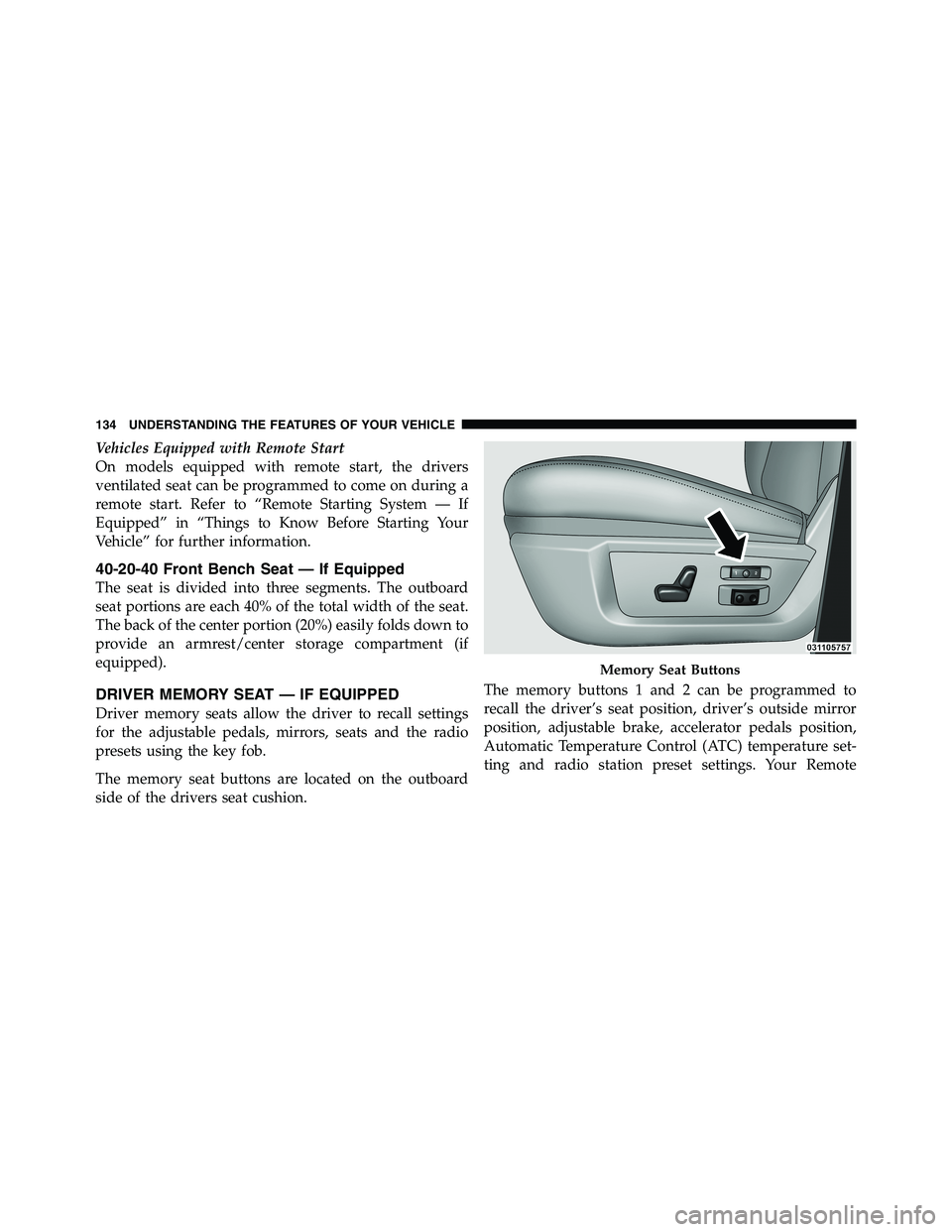
The memory seat buttons are located on the outboard
side of the drivers seat cushion. The memory buttons 1 and 2 can be programmed to
recall the driver’s seat position, driver’s outside mirror
position, adjustable brake, accelerator pedals position,
Automatic Temperature Control (ATC) temperature set-
ting and radio station preset settings. Your Remote Memory Seat Buttons134 UNDERSTANDING THE FEATURES OF YOUR VEHICLE
Page 196 of 472

Electronic Vehicle Information Center (EVIC)
Displays
When the appropriate conditions exist, the EVIC displays
the following messages:
• Left front turn signal lamp out
• Right front turn signal lamp out
• Left rear turn signal lamp out
• Right rear turn signal lamp out
• Service air filter
• Check Tire Pressure
• Perform service
• ESP Off
• Service Tire Pressure System
• Coolant Low • Check Trailer Brake Wiring
• Service Trailer Brake System
• Trailer Brake Connected
• Trailer Brake Disconnected
• Lights On
• Keyfob Battery Low
• ECO (Fuel Saver Indicator) — If Equipped
• Door(s) Ajar (with a single chime, if vehicle is in
motion)
• Wrong Key
• Damaged Key
• Key not programmed
• Key In Ignition 4 UNDERSTANDING YOUR INSTRUMENT PANEL 195
Page 264 of 472

STARTING PROCEDURES
Before starting your vehicle, adjust your seat, adjust both
inside and outside mirrors, and fasten your seat belt.
The starter should not be operated for more than 15-
second intervals. Waiting a few seconds between such
intervals will protect the starter from overheating.
WARNING!Never leave children alone in a vehicle. Leaving
unattended children in a vehicle is dangerous for a
number of reasons. A child or others could be seri-
ously or fatally injured. Do not leave the key fob in
the ignition. A child could operate power windows,
other controls, or move the vehicle.
Normal Starting
Normal starting of either a warm or cold engine is
obtained without pumping or pressing the accelerator pedal. Turn the key fob to the START position and release
when the engine starts. If the engine fails to start within
10 seconds, turn the key fob to the OFF position, wait five
seconds, then repeat the “Normal Starting” procedure.
Automatic Transmission
Start the engine with the shift lever in the NEUTRAL or
PARK position. Apply the brake before shifting into any
driving range.
NOTE: This vehicle is equipped with a transmission
shift interlocking system. The brake pedal must be
pressed to shift out of PARK.
Tip Start Feature
Do not press the accelerator. Turn the ignition switch
briefly to the START position and release it. The starter
motor will continue to run but will automatically disen-
gage when the engine is running.
5 STARTING AND OPERATING 263
Page 266 of 472

If the engine has been flooded, it may start to run, but not
have enough power to continue running when the key
fob is released. If this occurs, continue cranking with the
accelerator pedal pushed all the way to the floor. Release
the accelerator pedal and the key fob once the engine is
running smoothly.
If the engine shows no sign of starting after two 15-
second periods of cranking with the accelerator pedal
held to the floor, the “Normal Starting” procedure should
be repeated.
After Starting
The idle speed is automatically controlled and will de-
crease as the engine warms up.
ENGINE BLOCK HEATER — IF EQUIPPED
The engine block heater warms the engine, and permits
quicker starts in cold weather. Connect the cord to a
standard 110-115 Volt AC electrical outlet with a
grounded, three-wire extension cord. 3500 Models — 5.7L Engine Only
The engine block heater cord is routed through the grille
by the right front tow hook.
It includes a removable cap that is secured by a tethered
strap. It also has a c-clip that is used for storage when not
in use for the winter months. During winter months,
remove the heater cord wiring assembly from itself on
the c-clip.
The engine block heater must be plugged in at least one
hour to have an adequate warming effect on the engine.
WARNING!Remember to disconnect the engine block heater
cord before driving. Damage to the 110-115 Volt
electrical cord could cause electrocution.
5 STARTING AND OPERATING 265
Page 268 of 472

WARNING! (Continued)• Unintended movement of a vehicle could injure
those in and near the vehicle. As with all vehicles,
you should never exit a vehicle while the engine is
running. Before exiting a vehicle, you should
always shift the transmission into PARK, remove
the key fob from the ignition, and apply the
parking brake. Once the key fob is removed from
the ignition, the shift lever is locked in the PARK
position, securing the vehicle against unwanted
movement. Furthermore, you should never leave
unattended children inside a vehicle.
Key Ignition Park Interlock
This vehicle is equipped with a Key Ignition Park Inter-
lock which requires the shift lever to be placed in PARK
prior to rotating the ignition switch to the LOCK posi-
tion. The key fob can only be removed from the ignition switch when the ignition switch is in the LOCK position
and once removed the shift lever is locked in PARK.
Brake/Transmission Shift Interlock System
This vehicle is equipped with a Brake Transmission Shift
Interlock System (BTSI) that holds the shift lever in the
PARK position when the ignition switch is in the LOCK
position. To move the shift lever out of the PARK
position, the ignition switch must be turned to any other
ignition switch position (ACC, ON, or START) (engine
running or not) and the brake pedal must be pressed.
Brake/Transmission Interlock Manual Override
There is an override for the BTSI that allows you to move
the shift lever out of the PARK position if an electrical
system malfunction occurs (i.e., dead battery).
1. Turn the ignition switch to the ACC or ON position
without starting the engine.
2. Tilt the steering wheel to the full up position
5 STARTING AND OPERATING 267
Page 290 of 472
Power Steering Fluid Check
Checking the power steering fluid level at a defined
service interval is not required. The fluid should only be
checked if a leak is suspected, abnormal noises are
apparent, and/or the system is not functioning as antici-
pated. Coordinate inspection efforts through an autho-
rized dealer.
CAUTION!Do not use chemical flushes in your power steering
system as the chemicals can damage your power
steering components. Such damage is not covered by
the New Vehicle Limited Warranty. WARNING!Fluid level should be checked on a level surface and
with the engine off to prevent injury from moving
parts and to ensure accurate fluid level reading. Do
not overfill. Use only manufacturer’s recommended
power steering fluid.
If necessary, add fluid to restore to the proper indicated
level. With a clean cloth, wipe any spilled fluid from all
surfaces. Refer to “Fluids, Lubricants, and Genuine Parts”
in “Maintaining Your Vehicle” for further information.
PARKING BRAKE
Before leaving the vehicle, make sure that the parking
brake is fully applied, the engine is off and the key fob is
removed from the ignition switch. Also, be certain to
leave an automatic transmission in PARK, or manual
transmission in REVERSE or first gear.
5 STARTING AND OPERATING 289
Page 292 of 472
The parking brake should always be applied whenever
the driver is not in the vehicle.
WARNING!• Never leave children alone in a vehicle. Leaving
unattended children in a vehicle is dangerous for a
number of reasons. A child or others could be
seriously or fatally injured.
• Do not leave the key fob in the ignition switch. A
child could operate power windows, other con-
trols, or move the vehicle.
• Be sure the parking brake is fully disengaged
before driving; failure to do so can lead to brake
failure and an accident.
(Continued) WARNING! (Continued)• Always fully apply the parking brake when leav-
ing your vehicle or it may roll and cause damage or
injury. Also, be certain to leave an automatic
transmission in PARK, a manual transmission in
REVERSE or first gear. Failure to do so may cause
the vehicle to roll and cause damage or injury.
CAUTION!If the “Brake Warning Light” remains on with the
parking brake released, a brake system malfunction
is indicated. Have the brake system serviced by an
authorized dealer immediately.
5 STARTING AND OPERATING 291
Page 346 of 472
Recreational Towing – Two-Wheel Drive Models
DO NOT flat tow this vehicle. Damage to the drivetrain
will result.
Recreational towing (for two-wheel drive models) is
allowed ONLY if the rear wheels are OFF the ground.
This may be accomplished using a tow dolly or vehicle
trailer. If using a tow dolly, follow this procedure:
1. Properly secure the dolly to the tow vehicle, following
the dolly manufacturer’s instructions.
2. Drive the rear wheels onto the tow dolly.
3. Firmly set the parking brake. Place automatic transmis-
sion in PARK, manual transmission in gear (not in Neutral).
4. Properly secure the rear wheels to the dolly, following
the dolly manufacturer’s instructions.
5. Remove the key fob from the ignition switch.
6. Install a suitable clamping device, designed for tow-
ing, to secure the front wheels in the straight position. CAUTION!• Towing with the rear wheels on the ground will
cause severe transmission damage. Damage from
improper towing is not covered under the New
Vehicle Limited Warranty.
• Do not disconnect the driveshaft because fluid
will leak from the transmission, causing damage
to internal parts.
Recreational Towing – Four-Wheel Drive Models
NOTE: Both the manual shift and electronic shift trans-
fer cases must be shifted into NEUTRAL for recreational
towing. Automatic transmissions must be shifted into
PARK for recreational towing. Manual transmissions
must be placed in gear (NOT in NEUTRAL) for recre-
ational towing. Refer to the following for the proper
transfer case NEUTRAL shifting procedure for your
vehicle. 5 STARTING AND OPERATING 345