flat tire RAM CHASSIS CAB 2019 Owner's Manual
[x] Cancel search | Manufacturer: RAM, Model Year: 2019, Model line: CHASSIS CAB, Model: RAM CHASSIS CAB 2019Pages: 607, PDF Size: 12.68 MB
Page 395 of 607

IN CASE OF EMERGENCY 393
Jack Warning Label 1. If equipped, remove the spare wheel, jack, and tools from
storage.
2. Using the lug wrench, loosen, but do not remove, the lug
nuts by turning them counterclockwise one turn while
the wheel is still on the ground.• To assure that spare tires, flat or inflated, are securely
stowed, spares must be stowed with the valve stem
facing the ground. WARNING! (Continued) CAUTION!
Do not attempt to raise the vehicle by jacking on
locations other than those indicated in the Jacking
Instructions for this vehicle.
6
Page 396 of 607

394 IN CASE OF EMERGENCY
3. When changing the front wheel, assemble the jack driver
to the jack and connect the jack driver to the extension
tube. Place the jack under the axle as close to the tire as
possible with the jack driver extending to the front.
Connect the extension tubes and lug wrench.
Front Jacking Locations
When changing a rear wheel, assemble the jack driver to
the jack and connect the jack driver to the extension tubes.
Securely place the jack under the sway bar bracket (unless
both tires are flat on one side, then place jack under shock
bracket) facing forward in vehicle. Connect the extension
tubes and lug wrench. Rear Jacking Location
Before raising the wheel off the ground, make sure that
the jack will not damage surrounding truck parts and
adjust the jack position as required.
NOTE:
If the jack will not lower by turning the dial (thumbwheel) by
hand, it may be necessary to use the jack driver in order to
lower the jack.
4. By rotating the lug wrench clockwise, raise the vehicle
until the wheel just clears the surface.
Page 397 of 607

IN CASE OF EMERGENCY 395
5. Remove the lug nuts and pull the wheel off. Install the
spare wheel and lug nuts with the cone shaped end of the
nuts toward the wheel on single rear wheel (SRW)
models. On dual rear wheel models (DRW) the lug nuts
are a two-piece assembly with a flat face. Lightly tighten
the nuts. To avoid risk of forcing the vehicle off the jack,
do not fully tighten the nuts until the vehicle has been
lowered.
6. Using the lug wrench, finish tightening the nuts using a
crisscross pattern. For the proper lug nut torque specifica -
tions refer to “Wheel And Tire Torque Specifications” in
“Technical Specifications.” If in doubt about the correct
tightness, have them checked with a torque wrench by an
authorized dealer or at a service station. 7. Install wheel center cap (if equipped) and remove wheel
blocks. Do not install chrome or aluminum wheel center
caps on the spare wheel. This may result in cap damage.
8. Lower the jack to its fully closed position. If the jack will
not lower by turning the dial (thumbwheel) by hand, it
may be necessary to use the jack driver in order to lower
the jack. Stow the replaced tire, jack, and tools as previ -
ously described.
9. Adjust the tire pressure when possible.WARNING!
Raising the vehicle higher than necessary can make the
vehicle less stable. It could slip off the jack and hurt
someone near it. Raise the vehicle only enough to
remove the tire. WARNING!
A loose tire or jack thrown forward in a collision or hard
stop, could endanger the occupants of the vehicle.
Always stow the jack parts and the spare tire in the
places provided.
6
Page 398 of 607

396 IN CASE OF EMERGENCY
Dual Rear Wheels
Slots in the wheels will assist in properly orienting the inner
and outer wheels. Align these slots when assembling the
wheels for best access to the tire valve on the inner wheel.
The tires of both dual wheels must be completely off the
ground when tightening to insure wheel centering and
maximum wheel clamping.
Dual wheel models require a special heavy-duty lug nut
tightening adapter (included with the vehicle) to correctly
tighten the lug nuts. Also, when it is necessary to remove and
install dual rear wheels, use a proper vehicle lifting device.
NOTE:
When installing a spare tire (if equipped) as part of a dual
rear wheel end combination, the tire diameter of the two
individual tires must be compared. If there is a significant
difference, the larger tire should be installed in a front loca -
tion. The correct direction of rotation for dual tire installa -
tions must also be observed
It is recommended that wheel stud nuts be kept torqued to
specifications at all times. Torque wheel stud nuts to specifi -
cations at each lubrication interval.
Refer to “Wheel And Tire Torque Specifications” in “Tech -
nical Specifications” for further information. Wheel Nuts
All wheel nuts should be tightened occasionally to eliminate
the possibility of wheel studs being sheared or the bolt holes
in the wheels becoming elongated. This is especially
important during the first few hundred miles/kilometers of
operation to allow the wheel nuts to become properly set. All
wheel nuts should first be firmly seated against the wheel.
The wheel nuts should then be tightened to recommended
torque. Tighten the wheel nuts to final torque in increments.
Progress around the bolt circle, tightening the wheel nut
opposite to the wheel nut just previously tightened until
final torque is achieved.
Refer to “Wheel And Tire Torque Specifications” in “Tech -
nical Specifications” for further information.
To Stow The Flat Or Spare — If Equipped
Refer to Upfitters Body Builder’s Guide for information on
stowing your spare tire (if equipped).
Page 408 of 607

406 IN CASE OF EMERGENCY
TOWING A DISABLED VEHICLE
This section describes procedures for towing a disabled
vehicle using a commercial towing service. If the transmis -
sion and drivetrain are operable, disabled vehicles may also
be towed as described under “Recreational Towing” in the
“Starting And Operating” section.• Revving the engine or spinning the wheels too fast may lead
to transmission overheating and failure. It can also damage
the tires. Do not spin the wheels above 30 mph (48 km/h)
while in gear (no transmission shifting occurring). CAUTION! (Continued)
Towing
Condition Wheels OFF
The Ground 2WD Models 4WD Models
Flat Tow NONE If transmission is operable:
• Transmission in NEUTRAL
• 30 mph (48 km/h) max speed
• 15 miles (24 km) max distance (6–speed
transmission)
• 30 miles (48 km) max distance (8–speed
transmission) See instructions in “Recreational Towing”
under “Starting And Operating”
• Auto Transmission in PARK
• Transfer Case in NEUTRAL
• Tow in forward direction
Wheel Lift Or
Dolly Tow Front NOT ALLOWED
Rear OK NOT ALLOWED
Flatbed ALL BEST METHOD BEST METHOD
Page 413 of 607

SERVICING AND MAINTENANCE 411
Once A Month Or Before A Long Trip:
• Check engine oil level.
• Check windshield washer fluid level.
• Check the tire inflation pressures and look for unusual
wear or damage. Rotate at the first sign of irregular wear.
• Check the fluid levels of the coolant reservoir, brake
master cylinder, power steering and automatic transmis -
sion (six-speed only), and fill as needed.
• Check function of all interior and exterior lights. Maintenance Plan
Required Maintenance
Refer to the maintenance plan on the following pages for
required maintenance.
At Every Oil Change Interval As Indicated By Oil Change Indicator System:
• Change oil and filter.
• Rotate the tires. Rotate at the first sign of irregular wear, even if it occurs before the oil indicator system turns on.
• Inspect engine cooling system protection and hoses.
• Inspect exhaust system.
• Inspect engine air cleaner if using in dusty or off-road conditions.
• Inspect battery and clean and tighten terminals as required.
• Inspect automatic transmission fluid if equipped with dipstick.
• Inspect brake pads, shoes, rotors, drums, hoses and park brake.
• Inspect front end, and lubricate — If equipped with serviceable fittings. 7
Page 449 of 607

SERVICING AND MAINTENANCE 447
H = Speed Symbol
• A symbol indicating the range of speeds at which a tire can carry a load corresponding to its load index under certain oper -
ating conditions
• The maximum speed corresponding to the speed symbol should only be achieved under specified operating conditions
(i.e., tire pressure, vehicle loading, road conditions, and posted speed limits)
Load Identification:
Absence of the following load identification symbols on the sidewall of the tire indicates a Standard Load (SL) tire:
• XL = Extra load (or reinforced) tire, or
• LL = Light load tire or
• C, D, E, F, G = Load range associated with the maximum load a tire can carry at a specified pressure
Maximum Load – Maximum load indicates the maximum load this tire is designed to carry
Maximum Pressure – Maximum pressure indicates the maximum permissible cold tire inflation pressure for this tire EXAMPLE:
7
Page 451 of 607

SERVICING AND MAINTENANCE 449
Tire Terminology And Definitions
Term Definition
B-Pillar The vehicle B-Pillar is the structural member of the body located behind
the front door.
Cold Tire Inflation Pressure Cold tire inflation pressure is defined as the tire pressure after the vehicle
has not been driven for at least three hours, or driven less than 1 mile
(1.6 km) after sitting for a minimum of three hours. Inflation pressure is
measured in units of PSI (pounds per square inch) or kPa (kilopascals).
Maximum Inflation Pressure The maximum inflation pressure is the maximum permissible cold tire
inflation pressure for this tire. The maximum inflation pressure is
molded into the sidewall.
Recommended Cold Tire Inflation Pressure Vehicle manufacturer's recommended cold tire inflation pressure as
shown on the tire placard.
Tire Placard A label permanently attached to the vehicle describing the vehicle’s
loading capacity, the original equipment tire sizes and the recommended
cold tire inflation pressures.
7
Page 452 of 607
450 SERVICING AND MAINTENANCE
Tire Loading And Tire Pressure
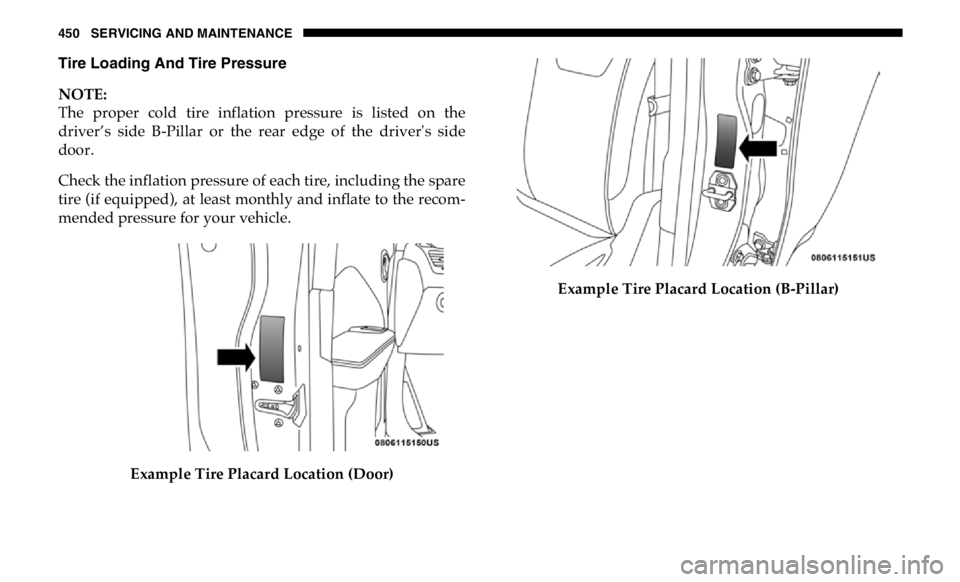
NOTE:
The proper cold tire inflation pressure is listed on the
driver’s side B-Pillar or the rear edge of the driver's side
door.
Check the inflation pressure of each tire, including the spare
tire (if equipped), at least monthly and inflate to the recom -
mended pressure for your vehicle.
Example Tire Placard Location (Door) Example Tire Placard Location (B-Pillar)
Page 453 of 607
SERVICING AND MAINTENANCE 451
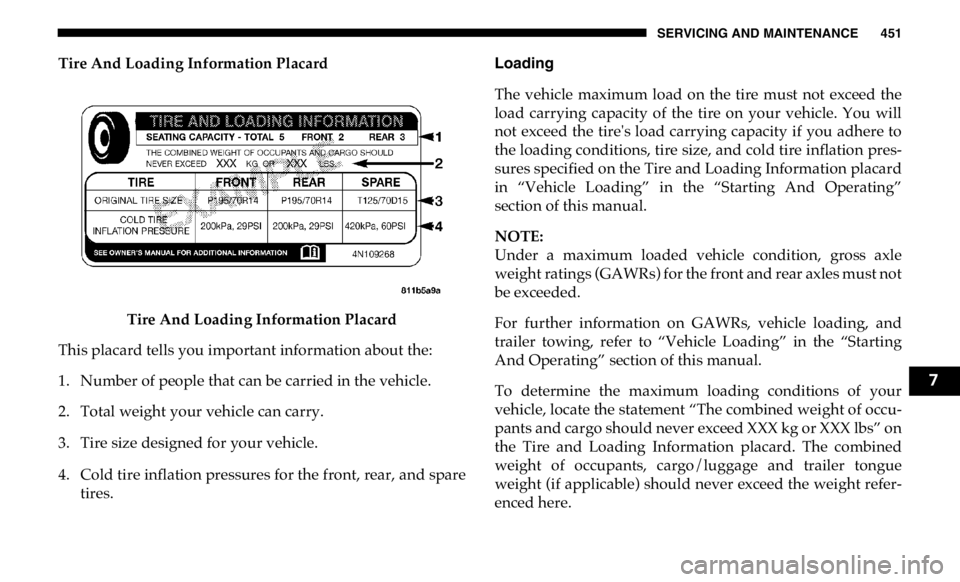
Tire And Loading Information Placard
Tire And Loading Information Placard
This placard tells you important information about the:
1. Number of people that can be carried in the vehicle.
2. Total weight your vehicle can carry.
3. Tire size designed for your vehicle.
4. Cold tire inflation pressures for the front, rear, and spare
tires. Loading
The vehicle maximum load on the tire must not exceed the
load carrying capacity of the tire on your vehicle. You will
not exceed the tire's load carrying capacity if you adhere to
the loading conditions, tire size, and cold tire inflation pres -
sures specified on the Tire and Loading Information placard
in “Vehicle Loading” in the “Starting And Operating”
section of this manual.
NOTE:
Under a maximum loaded vehicle condition, gross axle
weight ratings (GAWRs) for the front and rear axles must not
be exceeded.
For further information on GAWRs, vehicle loading, and
trailer towing, refer to “Vehicle Loading” in the “Starting
And Operating” section of this manual.
To determine the maximum loading conditions of your
vehicle, locate the statement “The combined weight of occu -
pants and cargo should never exceed XXX kg or XXX lbs” on
the Tire and Loading Information placard. The combined
weight of occupants, cargo/luggage and trailer tongue
weight (if applicable) should never exceed the weight refer -
enced here. 7