oil temperature RAM CHASSIS CAB 2020 Owner's Manual
[x] Cancel search | Manufacturer: RAM, Model Year: 2020, Model line: CHASSIS CAB, Model: RAM CHASSIS CAB 2020Pages: 516, PDF Size: 16.57 MB
Page 331 of 516
329
SERVICING AND MAINTENANCE
SCHEDULED SERVICING — GAS ENGINE
Your vehicle is equipped with an automatic oil
change indicator system. The oil change indi-
cator system will remind you that it is time to
take your vehicle in for scheduled maintenance.
Based on engine operation conditions, the oil
change indicator message will illuminate. This
means that service is required for your vehicle.
Operating conditions such as frequent
short-trips, trailer tow, extremely hot or cold
ambient temperatures, and E85 fuel usage will
influence when the “Oil Change Required”
message is displayed. Severe Operating Condi-
tions can cause the change oil message to illu -
minate as early as 3,500 miles (5,600 km)
since last reset. Have your vehicle serviced as
soon as possible, within the next 500 miles
(805 km). An authorized dealer will reset the oil change
indicator message after completing the sched
-
uled oil change. If a scheduled oil change is
performed by someone other than an autho -
rized dealer, the message can be reset by refer -
ring to the steps described under “Instrument
Cluster Display” in “Getting To Know Your
Instrument Panel” for further information.
Gas Engines:
Under no circumstances should oil change
intervals exceed 8,000 miles (13,000 km),
12 months or 350 hours of engine run time,
whichever comes first. The 350 hours of engine
run or idle time is generally only a concern for
fleet customers.
Severe Duty:
Change Engine Oil at 4,000 miles (6,500 km) or
350 hours of engine run time if the vehicle is
operated in a dusty and off road environment or
is operated predominately at idle or very low
engine RPM. This type of vehicle use is consid -
ered Severe Duty. Once A Month Or Before A Long Trip:Check engine oil level.
Check windshield washer fluid level.
Check the tire inflation pressures and look
for unusual wear or damage. Rotate at the
first sign of irregular wear.
Check the fluid levels of the coolant reservoir,
brake master cylinder, power steering and
automatic transmission (six-speed only), and
fill as needed.
Check function of all interior and exterior
lights.
7
2020_RAM_CHASSIS_CAB_OM_USA=GUID-6C67832B-7839-4CCF-BEFC-CDF988F949EA=1=en=.book Page 329
Page 347 of 516

SERVICING AND MAINTENANCE345
Checking Oil Level — Gas Engine
To ensure proper lubrication of your vehicle's
engine, the engine oil must be maintained at
the correct level. Check the oil level at regular
intervals, such as every fuel stop. The best time
to check the engine oil level is about five
minutes after a fully warmed up engine is shut
off.
Checking the oil while the vehicle is on level
ground will improve the accuracy of the oil level
readings. Always maintain the oil level within
the SAFE zone on the dipstick. Adding one quart
of oil when the reading is at the bottom of the
SAFE zone will result in a reading at the top of
the safe zone on these engines.
Checking Oil Level — Diesel Engine
To ensure proper lubrication of your vehicle's
engine, the engine oil must be maintained at
the correct level. Check the oil level at regular
intervals. The best time to check the oil level is
before starting the engine after it has been parked overnight. When checking oil after oper
-
ating the engine, first ensure the engine is at full
operating temperature, then wait for
30 minutes after engine shutdown to check the
oil.
Engine Oil Dipstick
Checking the oil while the vehicle is on level
ground will improve the accuracy of the oil level
readings. Add oil only when the level on the
dipstick is below the “ADD” mark. The total
capacity from the ADD mark to the Full mark is
2 Quarts (1.9Liters). Never operate the engine with oil level below
the “ADD” mark or above the upper “SAFE”
mark.
Adding Washer Fluid
The fluid reservoir is located under the hood
and should be checked for fluid level at regular
intervals. Fill the reservoir with windshield
washer solvent only (not radiator antifreeze).
When refilling the washer fluid reservoir, take
some washer fluid and apply it to a cloth or
towel and wipe the wiper blades clean. This will
help blade performance.
To prevent freeze-up of your windshield washer
system in cold weather, select a solution or
mixture that meets or exceeds the temperature
range of your climate. This rating information
can be found on most washer fluid containers.
CAUTION!
Overfilling or underfilling will cause oil
aeration or loss of oil pressure. This could
damage your engine.
1 — ADD Range
2 — Full Mark
3 — SAFE Range
CAUTION!
Overfilling or underfilling the crankcase will
cause oil aeration or loss of oil pressure. This
could damage your engine.
7
2020_RAM_CHASSIS_CAB_OM_USA=GUID-6C67832B-7839-4CCF-BEFC-CDF988F949EA=1=en=.book Page 345
Page 350 of 516
348SERVICING AND MAINTENANCE
American Petroleum Institute (API) Engine Oil
Identification Symbol — Diesel Engine
This symbol means that the oil has
been certified by the American Petro -
leum Institute (API). The manufac -
turer only recommends API Certified
engine oils.
Oils with a high ash content may produce
damaging deposits on cylinder head valves
and/or aftertreatment system damage. A
maximum sulfated ash content of 1.00 mass %
is recommended for all oil used in the engine.
The same oil change interval is to be followed
for synthetic oil as for petroleum based oil. Also,
synthetic oil must meet the same performance
specifications as petroleum oil.
Engine Oil Viscosity — Gas Engine
Use Mopar SAE 0W-40 engine oil approved to
FCA Material Standard MS-12633 such as
Pennzoil Ultra equivalent is recommended for
all operating temperatures.
The engine oil filler cap also shows the recom -
mended engine oil viscosity for your engine. For
information on engine oil filler cap location,
refer to the “Engine Compartment” illustration
in this section.
Lubricants which do not have both the engine
oil certification mark and the correct SAE
viscosity grade number should not be used.
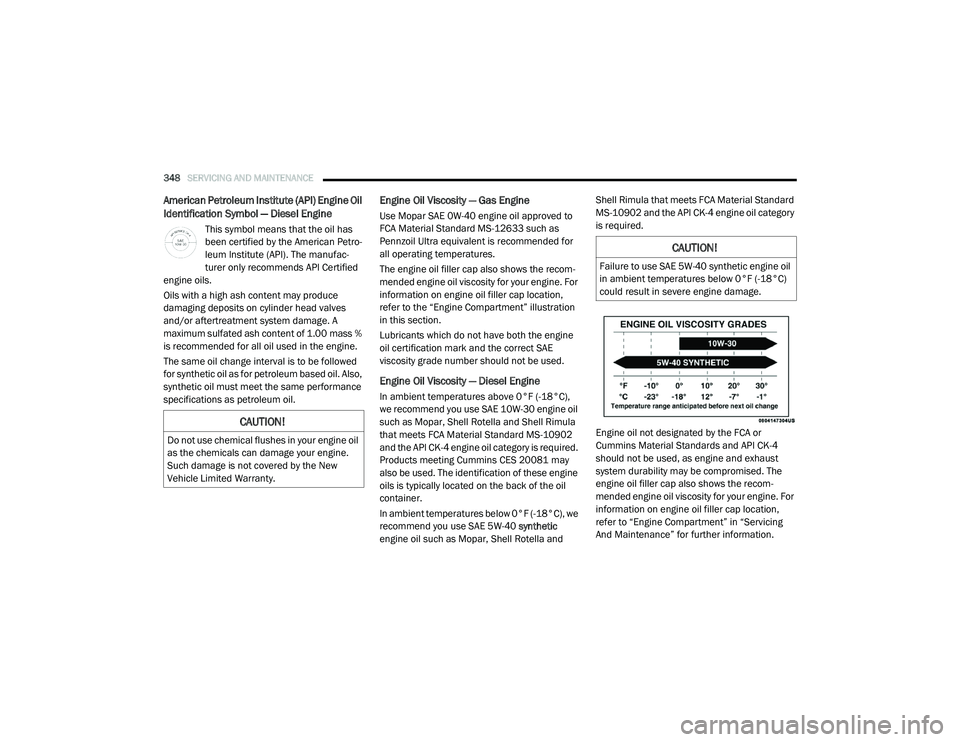
Engine Oil Viscosity — Diesel Engine
In ambient temperatures above 0°F (-18°C),
we recommend you use SAE 10W-30 engine oil
such as Mopar, Shell Rotella and Shell Rimula
that meets FCA Material Standard MS-10902
and the API CK-4 engine oil category is required.
Products meeting Cummins CES 20081 may
also be used. The identification of these engine
oils is typically located on the back of the oil
container.
In ambient temperatures below 0°F (-18°C), we
recommend you use SAE 5W-40 synthetic
engine oil such as Mopar, Shell Rotella and Shell Rimula that meets FCA Material Standard
MS-10902 and the API CK-4 engine oil category
is required.
Engine oil not designated by the FCA or
Cummins Material Standards and API CK-4
should not be used, as engine and exhaust
system durability may be compromised. The
engine oil filler cap also shows the recom
-
mended engine oil viscosity for your engine. For
information on engine oil filler cap location,
refer to “Engine Compartment” in “Servicing
And Maintenance” for further information.
CAUTION!
Do not use chemical flushes in your engine oil
as the chemicals can damage your engine.
Such damage is not covered by the New
Vehicle Limited Warranty.
CAUTION!
Failure to use SAE 5W-40 synthetic engine oil
in ambient temperatures below 0°F (-18°C)
could result in severe engine damage.
2020_RAM_CHASSIS_CAB_OM_USA=GUID-6C67832B-7839-4CCF-BEFC-CDF988F949EA=1=en=.book Page 348
Page 369 of 516

SERVICING AND MAINTENANCE367
(Continued)
Brake System
In order to ensure brake system performance,
all brake system components should be
inspected periodically. Refer to the “Mainte -
nance Plan” in this section for the proper main -
tenance intervals.
Fluid Level Check — Brake Master Cylinder
The fluid level of the master cylinder should be
checked when performing under the hood
service or immediately if the brake system
warning lamp indicates system failure.
If necessary, add fluid to bring level within the
designated marks on the side of the reservoir of
the brake master cylinder. Be sure to clean the
top of the master cylinder area before removing
cap. With disc brakes the fluid level can be expected
to fall as the brake linings wear. However, an
unexpected drop in fluid level may be caused by
a leak and a system check should be
conducted.
Refer to “Fluids And Lubricants” in “Technical
Specifications” for further information.
WARNING!
Riding the brakes can lead to brake failure
and possibly a collision. Driving with your foot
resting or riding on the brake pedal can result
in abnormally high brake temperatures,
excessive lining wear, and possible brake
damage. You would not have your full braking
capacity in an emergency.WARNING!
Use only manufacturer's recommended
brake fluid. Refer to “Fluids And Lubri
-
cants” in “Technical Specifications” for
further information. Using the wrong type of
brake fluid can severely damage your brake
system and/or impair its performance. The
proper type of brake fluid for your vehicle is
also identified on the original factory
installed hydraulic master cylinder reser -
voir.
To avoid contamination from foreign matter
or moisture, use only new brake fluid or
fluid that has been in a tightly closed
container. Keep the master cylinder reser -
voir cap secured at all times. Brake fluid in
a open container absorbs moisture from
the air resulting in a lower boiling point. This
may cause it to boil unexpectedly during
hard or prolonged braking, resulting in
sudden brake failure. This could result in a
collision.
Overfilling the brake fluid reservoir can
result in spilling brake fluid on hot engine
parts, causing the brake fluid to catch fire.
Brake fluid can also damage painted and
vinyl surfaces, care should be taken to
avoid its contact with these surfaces.
Do not allow petroleum based fluid to
contaminate the brake fluid. Brake seal
components could be damaged, causing
partial or complete brake failure. This could
result in a collision.
WARNING! (Continued)
7
2020_RAM_CHASSIS_CAB_OM_USA=GUID-6C67832B-7839-4CCF-BEFC-CDF988F949EA=1=en=.book Page 367
Page 371 of 516

SERVICING AND MAINTENANCE369
Use the following procedure to check the trans -
mission fluid level properly:
1. Monitor the transmission temperature using the instrument cluster display, and
operate the vehicle as required to reach
the normal operating temperature. If the
transmission is not functioning properly, or
the vehicle cannot be driven, see the NOTE
and CAUTION below about checking the
fluid level at colder temperatures.
2. Park the vehicle on level ground.
3. Run the engine at normal idle speed for at least 60 seconds, and leave the engine
running for the rest of this procedure.
4. Fully apply the parking brake, and press the brake pedal.
5. Place the gear selector momentarily into each gear position (allowing time for the
transmission to fully engage in each posi -
tion), ending with the transmission in PARK.
6. Remove the dipstick, wipe it clean and rein -
sert it until seated. 7. Remove the dipstick again and note the
fluid level on both sides. The fluid level
reading is only valid if there is a solid
coating of oil on both sides of the dipstick.
Note that the holes in the dipstick will be full
of fluid if the actual level is at or above the
hole. The fluid level should be between the
“HOT” (upper) reference holes on the
dipstick at normal operating temperature. If
the fluid level is low, add fluid through the
dipstick tube to bring it to the proper level.
Do not overfill. Use ONLY the specified fluid
(refer to "Fluids And Lubricants" in “Tech -
nical Specifications” for fluid specifica -
tions). After adding any quantity of oil
through the dipstick tube, wait a minimum
of two minutes for the oil to fully drain into
the transmission before rechecking the
fluid level.
NOTE:
If it is necessary to check the transmission
below the operating temperature, the fluid level
should be between the two “COLD” (lower)
holes on the dipstick with the fluid at 60-70°F /
16-21°C. Only use the COLD region of the
dipstick as a rough reference when setting the
fluid level after a transmission service or fluid change. Re-check the fluid level, and adjust as
required, once the transmission reaches
normal operating temperature.
8. Reinsert the dipstick. Check for leaks.
Release the parking brake.
NOTE:
If it is necessary to check the transmission
below the operating temperature, the fluid level
should be between the two COLD (lower) holes
on the dipstick with the fluid at 68-86°F /
20-30°C. Only use the COLD region of the
dipstick as a rough reference when setting the
fluid level after a transmission service or fluid
change. Re-check the fluid level, and adjust as
required, once the transmission reaches
normal operating temperature.
CAUTION!
If the fluid temperature is below 50 °F (10
°C) it may not register on the dipstick. Do not
add fluid until the temperature is elevated
enough to produce an accurate reading. Run
the engine at idle, in PARK, to warm the fluid.
7
2020_RAM_CHASSIS_CAB_OM_USA=GUID-6C67832B-7839-4CCF-BEFC-CDF988F949EA=1=en=.book Page 369
Page 405 of 516
TECHNICAL SPECIFICATIONS403
Biodiesel Fuel Requirements
Chassis Cab Models
A maximum blend of 5% biodiesel meeting
ASTM specification D975 may be used with
your Cummins diesel engine. If operation with
biodiesel blends greater than 5% but not
greater than 20% (B6-B20) is desired, the truck
must first be reconfigured by an authorized
Ram dealer and the provisions in the following
section must be adhered to.
Pickup Models And Chassis Cab Models
Ordered With B20 Option
Your vehicle has been validated and approved
for the use of biodiesel in blends up to 20%
(B20) provided that you comply with the require -
ments outlined below. It is important that you
understand and comply with these require -
ments. Failure to comply with Oil Change
requirements for vehicles operating on
biodiesel blends up to B20 will result in prema -
ture engine wear. Such wear is not covered by
the New Vehicle Limited Warranty. Biodiesel is a fuel produced from renewable
resources typically derived from animal fat,
rapeseed oil (Rapeseed Methyl Ester (RME)
base), or soybean oil (Soy Methyl Ester (SME or
SOME) base). Biodiesel fuel has inherent limita-
tions which require that you understand and
adhere to the following requirements if you use
blends of biodiesel greater then 5% but not
greater than 20% (B6-B20). There are no
unique restrictions for the use of B5. Use of
blends greater than 20% is not approved. Use of
blends greater than 20% can result in engine
damage. Such damage is not covered by the
New Vehicle Limited Warranty.Fuel Quality — Must Comply With ASTM
Standards
The quality of biodiesel fuel may vary widely.
Only fuel produced by a BQ9000 supplier to the
following specifications may be blended to
meet biodiesel blend (B6–B20) fuel meeting
ASTM specification D-7467:
Pretrodiesel fuel meeting ASTM specification
D-975 and biodiesel fuel (B100) meeting
ASTM specification D-6751.
Fuel Oxidation Stability — Must Use Fuel
Within Six Months Of Manufacture
Biodiesel fuel has poor oxidation stability which
can result in long term storage problems. Fuel
produced to approved ASTM standards, if
stored properly, provides for protection against
fuel oxidation for up to six months.
Fuel Water Separation — Must Use Mopar/
Cummins Approved Fuel Filter Elements
You must use Mopar/Cummins approved fuel
filter elements in both your engine mounted
filter and frame mounted filter.
Biodiesel fuel has a natural affinity to water and
water accelerates microbial growth. Your
Mopar/Cummins filtration system is designed
to provide adequate fuel water separation capa-
bilities.
Bio-Diesel Fuel Properties — Low Ambient
Temperatures
Biodiesel fuel may gel or solidify at low ambient
temperatures, which may pose problems for
both storage and operation. Precautions can be
necessary at low ambient temperatures, such
as storing the fuel in a heated building or a
heated storage tank, or using cold temperature
additives.
8
2020_RAM_CHASSIS_CAB_OM_USA=GUID-6C67832B-7839-4CCF-BEFC-CDF988F949EA=1=en=.book Page 403
Page 409 of 516

TECHNICAL SPECIFICATIONS407
FLUIDS AND LUBRICANTS — GAS ENGINE
Engine
Component Fluid, Lubricant, or Genuine Part
Engine Coolant We recommend you use Mopar Antifreeze/Coolant 10–Year/150,000
Mile Formula OAT (Organic Additive Technology).
Engine Oil – 6.4L Engine For best performance and maximum protection under all types of
operating conditions, the manufacturer only recommends full synthetic
engine oils that meet the American Petroleum Institute (API) categories of
SN. The manufacturer recommends the use of Pennzoil Ultra 0W-40 or
equivalent Mopar engine oil meeting the requirements of FCA Material
Standard MS-12633 for use in all operating temperatures.
Engine Oil Filter – 6.4L Engine We recommend you use Mopar Engine Oil Filters.
Spark Plugs – 6.4L Engine We recommend you use Mopar Spark Plugs.
Fuel Selection – 6.4L Engine 89 Octane Recommended - 87 Octane Acceptable (R+M)/2 Method,
0-15% Ethanol (Do not use E-85).
8
2020_RAM_CHASSIS_CAB_OM_USA=GUID-6C67832B-7839-4CCF-BEFC-CDF988F949EA=1=en=.book Page 407
Page 412 of 516

410TECHNICAL SPECIFICATIONS
FLUIDS AND LUBRICANTS — DIESEL ENGINE
Engine
Component Fluid, Lubricant, or Genuine Part
Engine CoolantWe recommend you use Mopar Antifreeze/Coolant 10 Year/150,000 Mile Formula OAT (Organic Additive Technology).
Engine Oil In ambient temperatures above 0°F (-18°C), we recommend you use 10W-30 engine oil such as Mopar, Shell Rotella
and Shell Rimula that meets FCA Material Standard MS-10902 and the API CK-4 engine oil category is required.
Products meeting Cummins CES 20081 may also be used. The identification of these engine oils is typically located on
the back of the oil container.
In ambient temperatures below 0°F (-18°C), we recommend you use 5W-40
synthetic engine oil such as Mopar, Shell
Rotella and Shell Rimula that meets FCA Material Standard MS-10902 and the API CK-4 engine oil category is
required.
Engine Oil Filter We recommend you use Mopar Engine Oil Filters.
Fuel Filters We recommend you use Mopar Fuel Filter. Must meet 3 micron rating (engine mounted filter). Must meet 5 micron
rating (chassis mounted filter).
Using a fuel filter that does not meet the manufacturers filtration and water separating
requirements can severely impact fuel system life and reliability.
Crankcase Ventilation Filter We recommend you use Mopar CCV Filter.
2020_RAM_CHASSIS_CAB_OM_USA=GUID-6C67832B-7839-4CCF-BEFC-CDF988F949EA=1=en=.book Page 410
Page 513 of 516
511
Snow Chains (Tire Chains)
.......................390Snow Plow...........................................286Snow Tires...........................................387Spare Tires...................................387, 388Spark Plugs..........................................407Speed Control Accel/Decel......................................231Cancel.............................................231Resume...........................................231Speed Control (Cruise Control)..........230, 232Starting............................... 183, 184, 187Automatic Transmission............... 183, 187Button...............................................17Cold Weather....................................187Engine Block Heater...........................190Engine Fails To Start...........................186Starting And Operating............................184Starting Procedures........................184, 187Starting Procedures (Diesel Engines)..........187Starting Procedures (Gas Engines).............183SteeringPower..............................................229Tilt Column.........................................38Wheel, Heated.....................................38Wheel, Tilt..........................................38Steering Wheel Audio Controls..................481Steering Wheel Mounted Sound
System Controls....................................481Storage.................................................72Storage Compartment, Center Seat..............73
Storage, Vehicle.............................. 63, 393Storing Your Vehicle............................... 393Sunglasses Storage................................. 81Sway Control, Trailer.............................. 127Synthetic Engine Oil............................... 349
T
Telescoping Steering Column..................... 38Temperature Control, Automatic (ATC).......... 62TiltDown................................................ 31Up.................................................... 31Tilt Steering Column................................. 38Tip Start...................................... 183, 188Tire And Loading Information Placard......... 379Tire Markings....................................... 375Tire Safety Information........................... 374Tires........................... 182, 382, 387, 392Aging (Life Of Tires)............................ 385Air Pressure...................................... 382Chains............................................. 390Changing......................................... 314Compact Spare................................. 387Dual............................... 317, 391, 398General Information................... 382, 387High Speed....................................... 383Inflation Pressure............................... 383Jacking............................................ 314Life Of Tires...................................... 385Load Capacity................................... 379
Pressure Monitoring System(TPMS)................................ 113, 132Quality Grading................................. 392Radial............................................. 384Replacement.................................... 385Rotation.......................................... 391Safety..................................... 374, 382Sizes.............................................. 376Snow Tires....................................... 387Spare Tires.............................. 387, 388Spinning.......................................... 384Trailer Towing................................... 280Tread Wear Indicators......................... 385Wheel Nut Torque.............................. 397To Open Hood........................................ 66Tongue Weight/Trailer Weight.................. 279Torque Converter Clutch......................... 212Towing........................................ 274, 326Disabled Vehicle................................ 326Guide.............................................. 279Recreational..................................... 288Weight............................................ 279Towing Behind A Motorhome................... 288Traction.............................................. 292Traction Control.................................... 124Traction Control Switch........................... 124Trailer Sway Control (TSC)....................... 127Trailer Towing....................................... 274Cooling System Tips........................... 285Hitches........................................... 278
11
2020_RAM_CHASSIS_CAB_OM_USA=GUID-6C67832B-7839-4CCF-BEFC-CDF988F949EA=1=en=.book Page 511