wheel torque RAM CHASSIS CAB 2021 User Guide
[x] Cancel search | Manufacturer: RAM, Model Year: 2021, Model line: CHASSIS CAB, Model: RAM CHASSIS CAB 2021Pages: 463, PDF Size: 21.5 MB
Page 188 of 463
186STARTING AND OPERATING
CHANGING LANESENSE STATUS
The LaneSense system has settings to adjust
the intensity (Low/Medium/High) of the torque
warning and the warning zone sensitivity (Early/
Medium/Late) that you can configure through
the Uconnect system Úpage 228.
NOTE:
When enabled the system operates above
37 mph (60 km/h) and below 112 mph (180 km/h).
Use of the turn signal suppresses the warnings.
The system will not apply torque to the
steering wheel whenever a safety system
engages (Anti-Lock Brakes, Traction Control
System, Electronic Stability Control, Forward
Collision Warning, etc.).
PARKVIEW REAR BACK UP CAMERA
The ParkView Rear Back Up Camera allows
you to see an on-screen image of the rear
surroundings of your vehicle whenever the gear
selector is put into REVERSE. The image will be
displayed on the Navigation/Multimedia radio
display screen along with a caution note to
“Check Entire Surroundings” across the top of
the screen. After five seconds this note will
disappear. The ParkView Camera is located in
the center of the tailgate handle.
NOTE:
For the 3500, 4500, and 5500 Chassis Cab
vehicles, the Rear Backup Camera is shipped
loose and not installed. Please refer to the Ram
Body Builders Guide for more information.
Manual Activation Of The Rear View
Camera:
1. Press the "Controls" button located on the bottom of the Uconnect display.
2. Press the "Back Up Camera" icon to turn the Rear View Camera system on.
When the vehicle is shifted out of REVERSE (with
camera delay turned off), the rear camera mode is exited and the previous screen appears. When
the vehicle is shifted out of REVERSE (with
camera delay turned on), the camera image will
continue to be displayed for up to 10 seconds
unless the following conditions occur: The vehicle
speed exceeds 8 mph (13 km/h), the vehicle is
shifted into PARK, the vehicle’s ignition is placed
in the OFF position, or the user presses image
defeat “X” to exit out of the camera video display.
Whenever the Rear View Camera image is
activated through the "Backup Camera" button
in the Controls menu, and the vehicle speed is
greater than, or equal to, 8 mph (13 km/h), a
display timer for the image is initiated. The
image will continue to be displayed until the
display timer exceeds 10 seconds.
NOTE:
If the vehicle speed remains below 8 mph
(13 km/h), the Rear View Camera image will
be displayed continuously until deactivated
via the touchscreen button "X", the transmis -
sion is shifted into PARK, or the ignition is
placed in the OFF position.
The touchscreen button "X" to disable display
of the camera image is made available ONLY
when the vehicle is not in REVERSE.
21_DPF_OM_EN_USC_t.book Page 186
Page 277 of 463
SAFETY275
Electronic Brake Force Distribution (EBD)
EBD manages the distribution of the braking
torque between the front and rear axles by
limiting braking pressure to the rear axle. This is
done to prevent overslip of the rear wheels to
avoid vehicle instability, and to prevent the rear
axle from entering ABS before the front axle.
Electronic Roll Mitigation (ERM)
ERM anticipates the potential for wheel lift by
monitoring the driver’s steering wheel input and
the speed of the vehicle. When ERM determines
that the rate of change of the steering wheel
angle and vehicle’s speed are sufficient to
potentially cause wheel lift, it then applies the
appropriate brake and may also reduce engine
power to lessen the chance that wheel lift will
occur. ERM can only reduce the chance of
wheel lift occurring during severe or evasive
driving maneuvers; it cannot prevent wheel lift
due to other factors, such as road conditions,
leaving the roadway, or striking objects or other
vehicles.
NOTE:
ERM is disabled any time the ESC is in “Full Off”
mode (if equipped). For a complete explanation
of the available ESC modes, see Ú page 275.
Electronic Stability Control (ESC)
ESC enhances directional control and stability
of the vehicle under various driving conditions.
ESC corrects for oversteering or understeering
of the vehicle by applying the brake of the
appropriate wheel(s) to counteract the above
conditions. Engine power may also be reduced
to help the vehicle maintain the desired path.
Oversteer — when the vehicle is turning more
than appropriate for the steering wheel position.
Understeer — when the vehicle is turning less
than appropriate for the steering wheel position.
ESC uses sensors in the vehicle to determine
the vehicle path intended by the driver and
compares it to the actual path of the vehicle.
When the actual path does not match the
intended path, ESC applies the brake of the
appropriate wheel to assist in counteracting the
oversteer or understeer condition.
The ESC Activation/Malfunction Indicator Light
located in the instrument cluster will start to flash
as soon as the ESC system becomes active.
The ESC Activation/Malfunction Indicator Light
also flashes when the TCS is active. If the ESC
Activation/Malfunction Indicator Light begins to
flash during acceleration, ease up on the
accelerator and apply as little throttle as possible.
Be sure to adapt your speed and driving to the
prevailing road conditions.
WARNING!
Many factors, such as vehicle loading, road
conditions and driving conditions, influence
the chance that wheel lift or rollover may occur.
ERM cannot prevent all wheel lift or roll overs,
especially those that involve leaving the
roadway or striking objects or other vehicles.
The capabilities of an ERM-equipped vehicle
must never be exploited in a reckless or
dangerous manner which could jeopardize
the user's safety or the safety of others.
6
21_DPF_OM_EN_USC_t.book Page 275
Page 344 of 463

342IN CASE OF EMERGENCY
5. Remove the lug nuts and pull the wheel off.
Install the spare wheel and lug nuts with the
cone shaped end of the nuts toward the
wheel on Single Rear-Wheel (SRW) models.
On Dual Rear-Wheel models (DRW) the lug
nuts are a two-piece assembly with a flat
face. Lightly tighten the nuts. To avoid risk
of forcing the vehicle off the jack, do not
fully tighten the nuts until the vehicle has
been lowered.
6. Using the lug wrench, finish tightening the nuts using a crisscross pattern
Úpage 432. If in doubt about the correct
tightness, have them checked with a torque
wrench by an authorized dealer or at a
service station. 7. Install wheel center cap (if equipped) and
remove wheel blocks. Do not install chrome
or aluminum wheel center caps on the
spare wheel. This may result in cap damage.
8. Lower the jack to its fully closed position. If the jack will not lower by turning the dial
(thumbwheel) by hand, it may be necessary
to use the jack driver in order to lower the
jack. Stow the replaced tire, jack, and tools
as previously described.
9. Adjust the tire pressure when possible.
10. After 25 miles (40 km), check the lug nut torque Úpage 432 with a torque wrench to
ensure that all lug nuts are properly seated
against the wheel.
Dual Rear Wheels
Slots in the wheels will assist in properly
orienting the inner and outer wheels. Align
these slots when assembling the wheels
for best access to the tire valve on the inner
wheel. The tires of both dual wheels must be
completely off the ground when tightening to
ensure wheel centering and maximum wheel
clamping.
Dual wheel models require a special heavy-duty
lug nut tightening adapter (included with the
vehicle) to correctly tighten the lug nuts. Also,
when it is necessary to remove and install dual
rear wheels, use a proper vehicle lifting device.
NOTE:
When installing a spare tire (if equipped) as part
of a dual rear wheel end combination, the tire
diameter of the two individual tires must be
compared. If there is a significant difference,
the larger tire should be installed in a front loca-
tion. The correct direction of rotation for dual
tire installations must also be observed.
It is recommended that wheel stud nuts be kept
torqued to specifications at all times. Torque
wheel stud nuts to specifications at each
lubrication interval Ú page 432.WARNING!
Raising the vehicle higher than necessary can
make the vehicle less stable. It could slip off
the jack and hurt someone near it. Raise the
vehicle only enough to remove the tire.
WARNING!
A loose tire or jack thrown forward in a collision
or hard stop, could endanger the occupants of
the vehicle. Always stow the jack parts and the
spare tire in the places provided.
21_DPF_OM_EN_USC_t.book Page 342
Page 345 of 463

IN CASE OF EMERGENCY343
(Continued)
Wheel Nuts
All wheel nuts should be tightened occasionally
to eliminate the possibility of wheel studs being
sheared or the bolt holes in the wheels becoming
elongated. This is especially important during the
first few hundred miles/kilometers of operation
to allow the wheel nuts to become properly set.
All wheel nuts should first be firmly seated
against the wheel. The wheel nuts should then
be tightened to recommended torque. Tighten
the wheel nuts to final torque in increments.
Progress around the bolt circle, tightening the
wheel nut opposite to the wheel nut just
previously tightened until final torque is achieved
Ú
page 432.
TO STOW THE FLAT OR SPARE — IF
E
QUIPPED
Refer to Upfitters Body Builder’s Guide for
information on stowing your spare tire
(if equipped).
HUB CAPS/WHEEL COVERS — IF
E
QUIPPED
The hub caps must be removed before raising
the vehicle off the ground. For 3500 Single Rear-Wheel (SRW) models, use
the flat end of the lug wrench to hook and pull
off the hub cap. Find the opening in the hub cap,
insert the lug wrench, and pull off the cap. If you
need to pry against the wheel, protect the wheel
surface.
Lug Wrench Insertion Location — Hub Cap
On 3500 models with Dual Rear-Wheels (DRW),
you must first remove the hub caps—use the
procedure noted for the single rear wheel. For
the wheel covers (wheel skins), insert the flat
end of the lug wrench between the outer edge
of the wheel cover and the wheel. Pry against
the wheel to remove the wheel cover. Repeat
this procedure around the wheel until the cover
pops off.
Lug Wrench Insertion Location — Wheel Cover
CAUTION!
Use extreme caution when removing the front and
rear wheel covers. Damage can occur to the
center cap and/or the wheel if screwdriver type
tools are used. A pulling motion, not a pry off
motion, is recommended to remove the caps.
CAUTION!
Use a pulling motion to remove the hub
cap. Do not use a twisting motion when
removing the hub cap, damage to the hub
cap; finish may occur.
7
21_DPF_OM_EN_USC_t.book Page 343
Page 434 of 463
432TECHNICAL SPECIFICATIONS
WHEEL AND TIRE TORQUE SPECIFICATIONS
Proper lug nut/bolt torque is very important to
ensure that the wheel is properly mounted to the
vehicle. Any time a wheel has been removed and
reinstalled on the vehicle, the lug nuts/bolts
should be torqued using a properly calibrated
torque wrench using a six sided (hex) deep wall
socket.
TORQUE SPECIFICATIONS
**Use only authorized dealer recommended
lug nuts/bolts and clean or remove any dirt or
oil before tightening. Inspect the wheel mounting surface prior to
mounting the tire and remove any corrosion or
loose particles.
NOTE:
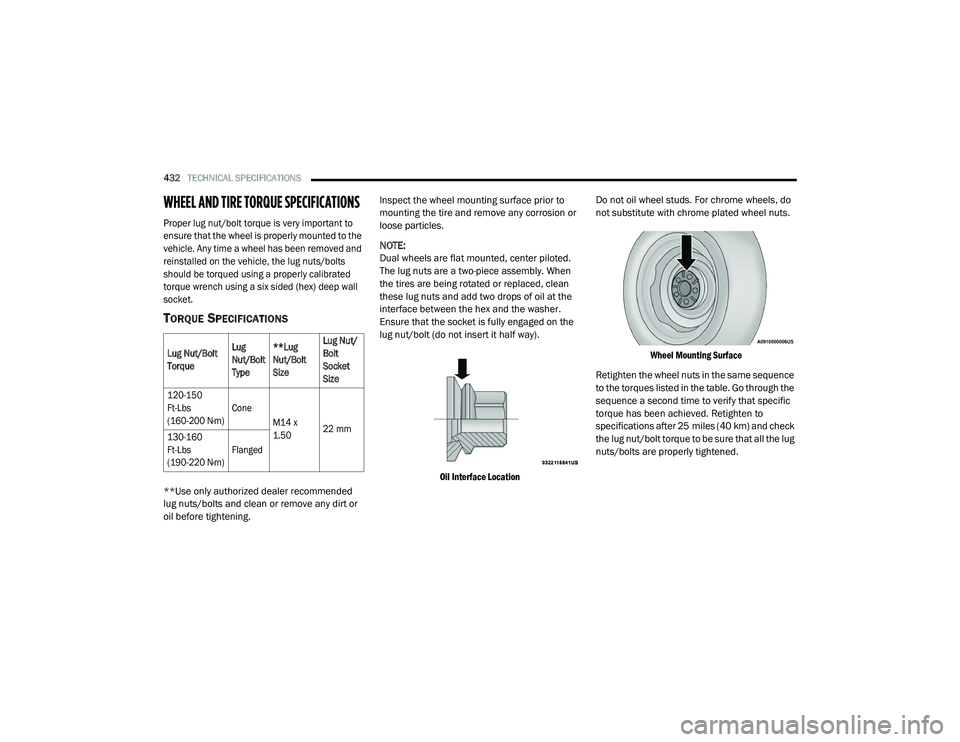
Dual wheels are flat mounted, center piloted.
The lug nuts are a two-piece assembly. When
the tires are being rotated or replaced, clean
these lug nuts and add two drops of oil at the
interface between the hex and the washer.
Ensure that the socket is fully engaged on the
lug nut/bolt (do not insert it half way).
Oil Interface Location
Do not oil wheel studs. For chrome wheels, do
not substitute with chrome plated wheel nuts.
Wheel Mounting Surface
Retighten the wheel nuts in the same sequence
to the torques listed in the table. Go through the
sequence a second time to verify that specific
torque has been achieved. Retighten to
specifications after 25 miles (40 km) and check
the lug nut/bolt torque to be sure that all the lug
nuts/bolts are properly tightened.
Lug Nut/Bolt
Torque
Lug
Nut/Bolt
Type**Lug
Nut/Bolt
Size Lug Nut/
Bolt
Socket
Size
120-150
Ft-Lbs
(160-200 N·m) Cone
M14 x
1.50 22 mm
130-160
Ft-Lbs
(190-220 N·m) Flanged
21_DPF_OM_EN_USC_t.book Page 432
Page 435 of 463

TECHNICAL SPECIFICATIONS433
8/10 Lug Nuts/Bolts Torque Patterns
It is recommended that wheel stud nuts be kept
torqued to specifications at all times. Torque
wheel stud nuts to specifications at each
lubrication interval.
All wheel nuts should be tightened occasionally
to eliminate the possibility of wheel studs being
sheared or the bolt holes in the wheels becoming
elongated. This is especially important during the
first few hundred miles/kilometers of operation
to allow the wheel nuts to become properly set.
All wheel nuts should first be firmly seated
against the wheel. The wheel nuts should then be
tightened to recommended torque. Tighten the wheel nuts to final torque in increments.
Progress around the bolt circle, tightening the
wheel nut opposite to the wheel nut just
previously tightened until final torque is
achieved.
FUEL REQUIREMENTS — GASOLINE ENGINE
While operating on gasoline with the required
octane number, hearing a light knocking sound
from the engine is not a cause for concern.
However, if the engine is heard making a heavy
knocking sound, see a dealer immediately. Use
of gasoline with a lower than recommended
octane number can cause engine failure and
may void or not be covered by the New Vehicle
Limited Warranty.
Poor quality gasoline can cause problems such as
hard starting, stalling, and hesitations. If you
experience these symptoms, try another brand of
gasoline before considering service for the vehicle.
6.4L ENGINE
Do not use E-85 flex fuel or ethanol blends
greater than 15% in this engine.
This engine is designed to meet all
emissions regulations and provide
satisfactory fuel economy and
performance when using high quality
unleaded gasoline having a posted octane number
of 87 as specified by the (R+M)/2 method.
REFORMULATED GASOLINE
Many areas of the country require the use of
cleaner burning gasoline referred to as
“reformulated gasoline”. Reformulated
gasoline contains oxygenates and are
specifically blended to reduce vehicle
emissions and improve air quality.
The use of reformulated gasoline is
recommended. Properly blended reformulated
gasoline will provide improved performance
and durability of engine and fuel system
components.
1 — 10 Bolt Pattern
2 — 8 Bolt Pattern
WARNING!
To avoid the risk of forcing the vehicle off the
jack, do not tighten the lug nuts/bolts fully until
the vehicle has been lowered. Failure to follow
this warning may result in personal injury.
9
21_DPF_OM_EN_USC_t.book Page 433
Page 460 of 463
458 Rotation
.................................................... 424Safety.............................................. 406, 414Sizes.......................................................... 407Snow Tires................................................. 419Spare Tires............................. 419, 420, 421Spinning.................................................... 416Trailer Towing............................................ 206Tread Wear Indicators............................... 417Wheel Nut Torque..................................... 432To Open Hood.................................................. 79Tongue Weight/Trailer Weight....................... 205Torque Converter Clutch................................ 151Towing................................................. 200, 350Disabled Vehicle........................................ 350Guide......................................................... 205Recreational.............................................. 214Weight....................................................... 205Towing Behind A Motorhome......................... 214Traction......................................................... 218Traction Control............................................. 281Trailer Sway Control (TSC)............................. 281Trailer Towing................................................ 200Hitches...................................................... 204Minimum Requirements............................ 205Mirrors......................................................... 46Tips........................................................... 211Trailer And Tongue Weight........................ 205Wiring........................................................ 209Trailer Towing Guide...................................... 205Trailer Weight................................................ 205
Transfer Case............................................... 391Electronically Shifted....................... 153, 156Fluid......................................................... 444Transmission................................................ 141Automatic............................... 141, 146, 387Fluid......................................................... 444Maintenance............................................ 387Shifting..................................................... 140Transporting Pets.......................................... 330Tread Wear Indicators.................................. 417Turn Signals.................................. 54, 115, 402
U
UconnectPhone Call Features
................................. 264Things You Should Know About Your Uconnect Phone................................... 267Uconnect Phone.................................. 259, 260Answer Or Ignore An Incoming Call — Call Currently In Progress..................... 265Answer Or Ignore An Incoming Call — No Call Currently In Progress................ 265Bluetooth Communication Link................ 269Call Continuation...................................... 266Call Controls............................................. 264Call Termination....................................... 266Cancel Command..................................... 260Connecting To A Particular Mobile Phone Or Audio Device After Pairing............... 262
Help Command......................................... 260Join Calls.................................................. 266Making A Phone Or Audio Device A Favorite................................................ 262Making A Second Call While Current Call Is In Progress................................. 266Managing Your Favorites.......................... 263Natural Speech......................................... 259Operation.................................................. 259Overview................................................... 258Pair (Link) Uconnect Phone To A Mobile Phone....................................... 260Phonebook Download............................... 263Place/Retrieve A Call From Hold............... 266Power-Up.................................................. 269Recent Calls.............................................. 264Redial....................................................... 266To Remove A Favorite............................... 263Toggling Between Calls............................. 266Touch-Tone Number Entry........................ 264Transfer Call To And From Mobile Phone.. 266Voice Command....................................... 267Uconnect SettingsCustomer Programmable Features..............26Passive Entry Programming.........................26Uconnect System.......................................... 244Uniform Tire Quality Grades.......................... 425Unleaded Gasoline........................................ 433Untwisting Procedure, Seat Belt.................... 297USB..................................................................72
21_DPF_OM_EN_USC_t.book Page 458